Air India: There is an Air About India
Air India: There is an Air About India

Director
Year
Format
Industry
The people who made it
Director Spotlight
Directors & Producers

Ganesh Pareek
Cannes Gold and Glass Lion winning producer, counted among the world’s top TV commercial producers, and director of the feature film Manu (2023).
His first flight was on his father's shoulders. That is how Air India's film tells his story: a boy who watched a match from up there, saw the world from a little higher for the first time, and has kept looking at the sky ever since.
There is an Air About India is a 102-second AI film for Air India with Vaibhav Sooryavanshi, the teenage batter who became the youngest centurion in IPL history in 2025. It travels from a childhood rooftop to a country of 140 crore people standing behind him, through about 100 shots of India as it actually looks: a match in a lane, a fishing boat dragged up a beach, saris stretched out to dry, a young monk on a mountainside, a well of death. Its images and motion were generated with AI. The whole job was making sure nobody would think so.
Ganesh Pareek directed and produced it for First December Films with the creative agency McCann. It went live on Air India's YouTube channel on 18 September 2026, the day before the Asian Games opened in Aichi-Nagoya, and passed 7.5 million views there within three weeks.
At a glance
- Brand: Air India
- Campaign: There is an Air About India
- Featuring: Vaibhav Sooryavanshi
- Agency: McCann
- Production house: First December Films
- Director and producer: Ganesh Pareek
- Made with: AI-generated images and motion, directed and selected by people
- Released: 18 September 2026, on Air India's YouTube channel
- Running time: 1 min 42 sec
- The cut: about 100 shots in 102 seconds, chosen from 600+ generated and reviewed assets
- Reach: 7.5 million views on Air India's YouTube channel within three weeks of release
The brief
Air India launched There is an Air About India with McCann in May 2025 as its brand platform. This chapter, conceived by Air India with McCann, put the airline beside a teenage cricketer the whole country was watching, just as India went into the Asian Games with him in the cricket squad. The soundtrack's refrain is Together We Fly, and the film signs off on A billion hearts cheer.
The visual brief came from Indian street photography and observational filmmaking. The references were rooted and raw. The film had to carry an Incredible India feeling without turning into a glossy tourism commercial: natural Indian places and everyday behaviour, available light, almost no grade, handheld energy, life happening in front of and behind the subject, frames that look straight out of a camera.
That is the opposite of what image models do on their own. Left alone, they clean, beautify and compose. They light faces like products, empty the background and put everything in the middle. So the brief for the production came down to one sentence: the film could never feel overly generated, overly polished or disconnected from real India.
The idea: a country seen through one cricketer's eyes
There is almost no dialogue. A young voice speaks over the film in Hindi: his first flight was on his father's shoulders, he was the youngest and still reached the top, and now 140 crore people are with him, with many more skies to touch. The pictures do the rest, in three passages.
- The climb, 0:00 to 0:47. A boy on a rooftop, an Air India plane passing low overhead. A fishing boat dragged up a beach. Matches on a maidan, in a lane, in a yard seen through a doorway.
- The cheer, 0:47 to 1:00. Photographs of him as a child taped to a cupboard door. A workshop of painters making his cut-outs. A portrait of him and his father going up on scaffolding beside the Howrah Bridge. Saris stretched out to dry around a cut-out of him.
- The country, 1:00 to 1:42. The film widens from one cricketer to everyone who plays: a young monk on a mountainside, a sprinter, wrestlers, a footballer on sand, dancers on a beach, a high jumper, a badminton player, boys watching a plane pass low over their heads. It ends on him, bat in hand, in a wall of sea spray, and on Air India's sign-off: A billion hearts cheer.

Observed, not designed
The working rule was that every frame should feel as if a street photographer had walked into a real place and happened to catch a moment. Two habits made that possible.
The first was treating references as grammar, not as frames to copy. The director kept sharing photographs for light, camera distance, density, where people stand, time of day, colour temperature and mood. The AI team pulled out what made each one work and rebuilt those ingredients for the film's own world. Replicate the language, not the photograph.
The second was building depth into every frame on purpose. Generated images tend to put one clean subject in the middle of an empty scene. Here each frame was built in three planes: something close to the lens, the moment itself, and a place busy with its own life. People could be half hidden. The horizon did not have to be level. Things were allowed to wander into frame.
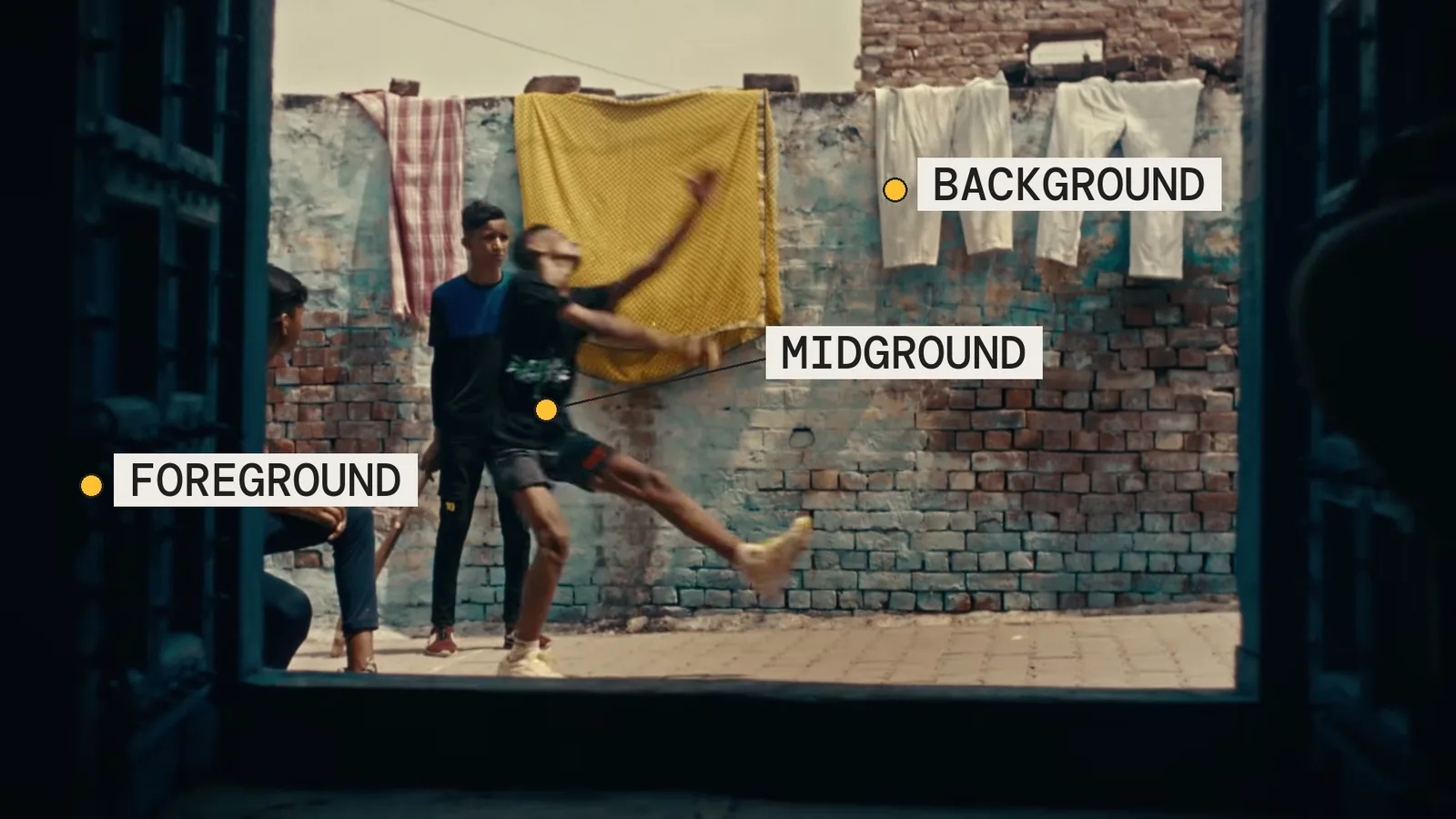
Before a frame was approved, the team asked it six questions. Where is the photographer standing? What is happening a metre in front of the lens? What is happening behind the subject? Would a real camera operator have framed this moment so perfectly? Does the place feel lived in, or like a backdrop? Is it interesting because of the moment, or because of an effect? A slightly imperfect frame usually beat a perfect one.
The still comes first
No shot moved until its still was right. For every important set-up the team made still images first, in several versions, so the director could react to real options instead of descriptions: where the camera sits and what lens it implies, where people stand and what they wear, the direction of the light, what blocks the foreground and what happens behind. Some had the right light and the wrong framing. Some had the right composition and still felt synthetic. The iteration ran until what the director meant and what the AI team made were the same thing.
- Reference. The director shares the visual intention.
- Exploration. Several stills interpret it.
- Director review. Frames are selected, rejected or redirected.
- Refinement. Composition, light, people and depth are corrected.
- Image lock. One frame becomes the approved foundation.
- Motion. Only then does the shot move.
The order matters because video generation rarely rescues a frame that was wrong to begin with. Moving a shot before its frame is approved only multiplies the motion attempts and takes control away from the director.
Directing a camera that isn't there
Once a still was locked, it became the first frame of a moving shot. Shots were generated at different lengths depending on their job in the montage: five-second tests, ten- and fifteen-second takes, and a few that ran to about thirty seconds. Long takes were rarely used whole. They gave the edit several usable moments to choose from, and they showed exactly where the motion started to come apart.
The camera behaves like a documentary operator reacting to something real: handheld, breathing slightly, correcting its framing, walking with the subject, panning to catch what just happened, pushing in only a little. Speeds are natural. There is almost no slow motion, a habit of generated video the film refused.
The prompts were written as instructions to a cinematographer, not as lists of objects. Each one described a photographic situation in the same order:
Character + action + location + camera + lens + depth + light + imperfection + intent.
It says where the camera is, what is happening around it, how the light behaves, what should stay rough and why the moment matters.
If you notice the AI, iterate
Every generated shot went through a realism gate. The question was never whether a shot was beautiful. It was whether it looked generated. If it did, it went back, however impressive it was.
- People: walking, hands and fingers, faces, eye movement, body weight and balance, the people in the background.
- Picture and physics: how clothes move, how hands meet objects, perspective, texture, continuity of light, and any morphing or synthetic motion.

A clean generation could be thrown out for one wrong behaviour that broke the illusion. A slightly messy one could survive because its mess made it feel photographed. A shot made the film only when the behaviour, the camera and the place were believable enough that the technology stopped drawing attention to itself.
600+ generations, about 100 shots
AI filmmaking has its own shooting ratio. A prompt is closer to setting up a take than to pressing render: performance, physics, camera, background and even light can change from one generation to the next. The working pool for this film ran past 600 assets across stills and motion: explorations, motion tests, alternates, failed takes, near-finals and final selects. That volume was not waste. It was the method.

Selection was a creative job, not a clean-up step. The team looked for the few seconds inside hundreds of outputs that belonged in the film. They rejected attractive shots that did not serve the rhythm, chose believable behaviour over spectacle, pulled small moments out of longer takes, tracked repetition so the montage stayed varied, and kept alternates in reserve for late changes to the edit.
Generate for the cut
Because the film is a fast montage, the edit did not wait for generation to finish. Rough cuts were updated as new material arrived, and the cut became the diagnostic tool. It showed which shots joined naturally and which felt forced, where the film needed to speed up or breathe, when two shots in a row repeated the same camera direction or size, whether India felt varied enough, which transitions needed a particular movement, and which beautiful clips the film did not need at all.
So the next prompt was usually written for a gap in the cut, not for a pretty clip. Every new shot was then tested against six words that held the film together:
Rooted. Indian. Observed. Layered. Imperfect. Human.
Anything that drifted towards the generic AI look was cut: heavy HDR, plastic skin, oversaturated colour, dramatic AI light, empty streets, perfect symmetry, slow motion and synthetic camera moves.
A director in the loop
The process worked because every creative decision stayed human. AI was the medium, not the author. Ganesh owned the story, the emotional journey, the references, the rhythm and the key moments. The AI team owned the prompt systems, image development, the translation of camera language into generation, motion, alternates and realism checks. Every shot then came back to the director to be judged on four things: is it authentic, does it carry feeling, does it look generated, and does the edit need it.
The loop ran the same way all through the job: director intent, AI interpretation, generation, review, refinement, approval. It meant the director never had to think like a technician. He directed through photographs, films and instinct, as a director does on a live set, and the team turned that into decisions a model could follow.
Labelled, not hidden
The film is open about how it was made. Air India's end card carries the line: Some content is computer-generated. First December Films delivers every AI job as a labelled master and a clean master, and the client decides in writing where each one runs.
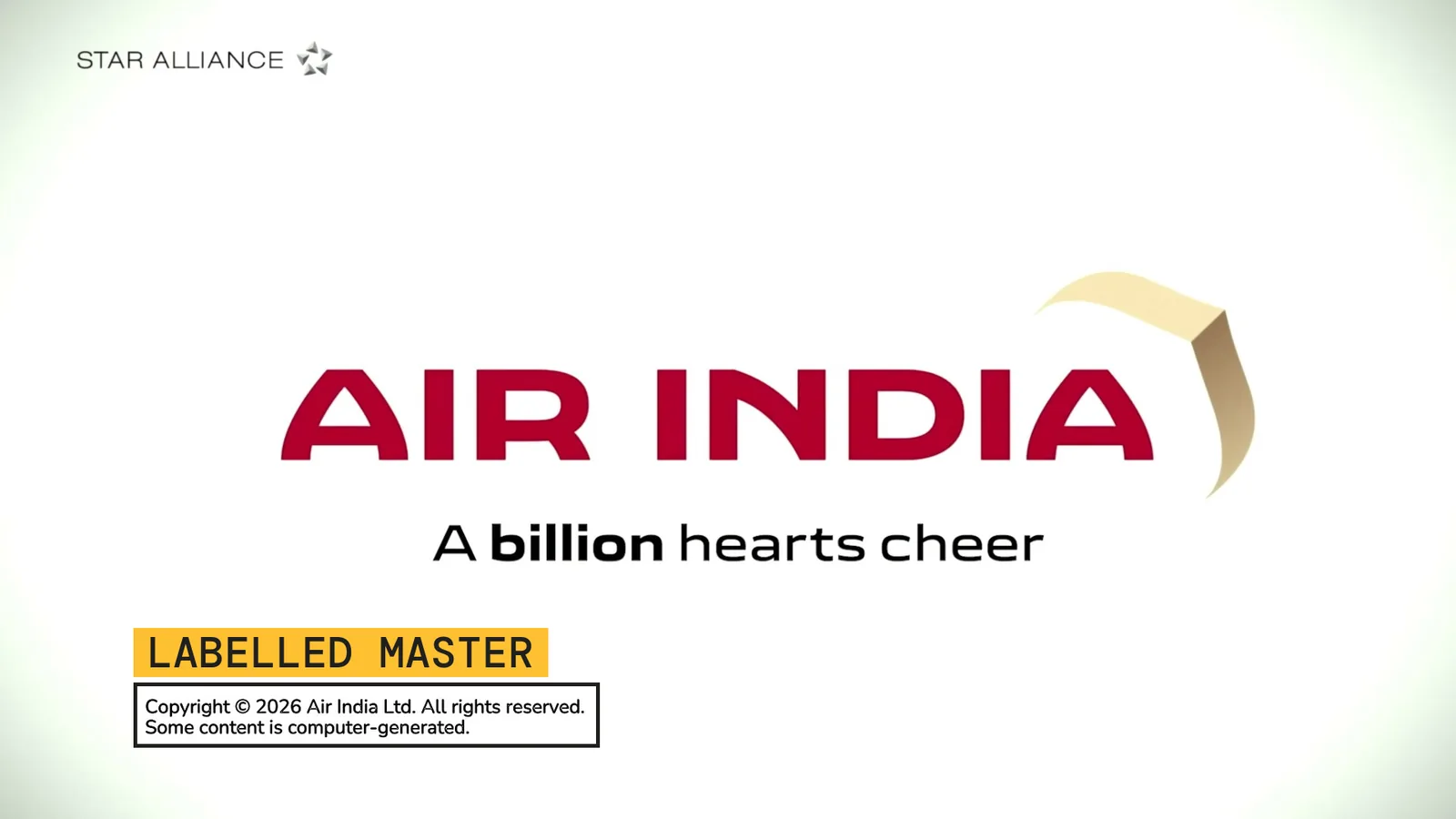
The house rule is to disclose AI by function, not by fashion: say what was generated and what stayed with people. On this film the images and the motion were generated. The direction, the selection, the edit and every approval stayed with people.
What it did
The film went up on Air India's YouTube channel on 18 September 2026 and passed 7.5 million views there within three weeks. Air India announced it on 21 September, and the trade press picked it up, from Storyboard18, Indiantelevision, Adgully and SportzPower to exchange4media's week in ads. BestMediaInfo chose it as one of its Super 7 ads of the week.
The timing did the rest. The Asian Games opened in Aichi-Nagoya the day after release, and on 3 October India beat Pakistan in the men's cricket final to win gold, with Vaibhav in the side. The film's last line had got there first: a billion hearts cheer.
The test the production was built around held up in public too. By 12 October the film had 109 comments on YouTube. Three mention AI, and none of those has more than one like. The most-liked are about the cricketer, the music and the pictures.
What the film proves
This is the reference to reach for when a brief needs any of the following:
- a whole country on screen, dozens of places and people, without a unit travelling to each of them
- AI images that read as photographed rather than generated
- an athlete-led brand film with a real emotional arc in under two minutes
- an airline or travel brand that wants India as it is, not as a brochure
- an AI film with a director answerable for every frame, and a labelled master for compliance
See how we make AI ad films, Ganesh Pareek's credits and more of our work, or bring us the shot everyone says can't be done.
Credits
- Client: Air India
- Campaign: There is an Air About India
- Agency: McCann
- Production house: First December Films
- Director and Producer: Ganesh Pareek
- Featuring: Vaibhav Sooryavanshi
Frequently Asked Questions
Who made Air India's There is an Air About India film with Vaibhav Sooryavanshi?
First December Films, the Mumbai ad film house. Ganesh Pareek directed and produced it with the creative agency McCann, and Air India released it on YouTube on 18 September 2026.
Was Air India's Vaibhav Sooryavanshi film made with AI?
Yes. Its images and motion were generated with AI and directed like a live-action film. Air India's end card says so: Some content is computer-generated.
How many shots are in Air India's AI film?
About 100 shots in 102 seconds, chosen from more than 600 generated and reviewed assets across stills and motion.
How did the team stop the Air India film looking like AI?
Every shot passed a realism gate: walking, hands, faces, eyes, weight, background people, clothing, objects, perspective, texture, light and morphing. If anyone noticed the AI, the shot went back.
How is an AI ad film like this made?
Director brief, reference breakdown, still images explored and locked first, then motion from the locked still, a realism gate, edit tests, new shots generated for gaps in the cut, final selection and post.
How many people have watched There is an Air About India?
The film passed 7.5 million views on Air India's YouTube channel within three weeks of its release on 18 September 2026.