Manu: A Short Film by Ganesh Pareek
Manu: A Short Film by Ganesh Pareek

Director
Year
Format
Industry
The people who made it
Director Spotlight
Directors & Producers
Ganesh Pareek
Cannes Gold and Glass Lion winning producer, counted among the world’s top TV commercial producers, and writer-director of the short film Manu (2026).
More than 150 international awards
The Record
Award
Awarding Body
Year
Manu | Global India International Film Festival 2026 (Best Children’s Film Award)
Global India International Film Festival
2026
Manu | Global INDIE Filmmaker Awards 2026 (Winner)
Global INDIE Filmmaker Awards
2026
Manu | Indo Dubai International Film Festival 2026 (Winner)
Indo Dubai International Film Festival
2026
Manu | Rajasthan International Film Festival (RIFF) 2026 (Winner)
Rajasthan International Film Festival (RIFF)
2026
Manu | 8th Ritu Rangam International Film Festival 2025, Kolkata (Winner)
8th Ritu Rangam International Film Festival
2025
Manu | 15th Dadasaheb Phalke Film Festival 2025 (Official Selection, Honourable Jury Mention)
15th Dadasaheb Phalke Film Festival
2025
Manu | Oxford Film Festival, 24th Annual (Honorable Mention)
Oxford Film Festival (24th Annual)
2026
Manu | Australia Independent Film Festival 2025 (Quarter-Finalist)
Australia Independent Film Festival
2025
On the day of Gangaur, a house in Burrabazar spends everything it has on two small idols. Gauri and Isar are bought, dressed, worshipped and carried to the river with great care. Manu is ten, and he carries everything else.
Manu is a 15-minute Hindi short film written and directed by Ganesh Pareek and produced by 1st December Films and Agápē Films. Drawn from his own 1990s childhood and set in today’s Burrabazar, Kolkata, on the day of the Gangaur festival, it follows a ten-year-old boy who runs every errand in his family's house and is seen by almost no one. It has won five festival awards, from Kolkata and Jaipur to Dubai, including the Best Children’s Film Award at the Global India International Film Festival and Best Movie (Short) at the Global INDIE Filmmaker Awards. Panorama Studios released it worldwide on YouTube on 7 November 2026.
Watch Manu free on Panorama Studios’ YouTube channel. It is in Hindi with English subtitles, and it opens with a card that reads “Inspired by true events”. The events are Ganesh’s own.
At a glance
- Film: Manu (2026), a short film
- Written and directed by: Ganesh Pareek, drawn from his own 1990s childhood in Burrabazar
- Produced by: Ganesh Pareek and Atul Kattukaran
- Production: 1st December Films and Agápē Films
- Released by: Panorama Studios, on YouTube, 7 November 2026
- Running time: 15 minutes
- Language: Hindi, with English subtitles
- Setting: today’s Burrabazar, Kolkata, on the day of the Gangaur festival
- Shot: four days on location in Burrabazar, March 2023, after a two-day recce
- Starring: Shankhadeep Banerjee as Manu
- Festival record: five awards, plus an Official Selection and Honourable Jury Mention, an Honorable Mention and a quarter-final place
- IMDb: Manu on IMDb
What is Manu about?
Manu is in the fifth grade. On Gangaur, the spring festival of the goddess Gauri, his family’s house runs on him. He reads his lessons aloud for his mother before he is properly awake. He hangs the laundry on the roof, stands beside his older brother while the brother rehearses for an interview, fetches the salt, carries the tiffin, follows the grown-ups to the shop and keeps the family’s secrets. It is also his birthday. No one notices.
The family dresses the Gangaur idols, worships them and carries them to the river with great care. Nobody carries Manu that way. As the day goes on, the errands get heavier, until the grown-ups decide he can be sent on one because, as one of them puts it, “he won’t even realise the situation”.
Under the day runs a second story, told in voice-over and playing in Manu’s head: Iravan from the Mahabharata, the son Arjuna left behind as a child, who was called back to his father’s war and gave everything for his family. For Manu himself it is a quiet, nearly wordless day, told through texture, breath, light and silence.

Why did Ganesh Pareek make Manu?
Because Manu is him. Ganesh Pareek is a Cannes Lions-winning producer and a partner at First December Films, and Manu is his first film as writer and director. He grew up in Burrabazar in the 1990s, in a Marwari family: temple bells, street calls, women singing on the ghats of the Hooghly, and every spring, Gangaur. The memories are from that 1990s childhood, but he set the film in today’s Burrabazar on purpose, “to keep a little distance from myself”.
Manu began not as a script, but as a memory. I didn’t want to tell a story. I wanted to re-enter one.
I was the useful child. Get the salt. Bring the tiffin. Carry this. Hold that. Everyone needed me. Nobody saw me.
What stayed with him was a gap in the record. “From my whole childhood, right up to almost twenty, I have three or four photographs. That’s it,” he says. “My siblings are ten, twelve years older than me. They have so many more. More photographs. More visibility. So what happened in those years? Where was I? That question is where Manu really began.”
There was one Gangaur when it went the other way. An old neighbour grandmother called the children over for her puja, dressed him up, put a tilak on his forehead, offered him flowers and worshipped him as Lord Ganesh. “She fed me first. For one afternoon, I was the one being looked after.”
And there was the song. “My whole life, I’ve sung the Gangaur song. Ask me what it meant? No idea. It just lived in me.” That is how he works: “I’m very audio and kinesthetic. I hear it first. I feel it in my body. Then I see it.” Manu was his attempt to make a film the way his mind works. “I see the world in pieces. Disjointed. The question was simple: can I hold all those pieces together in one film?”

How was Manu made?
A report, not a story
In 2022 Ganesh took a few scripts to the filmmaker Rajula Shah, whom he had known for years, for consulting. What he really brought her was the question of the photographs. He narrated a few of his stories, processed the whole thing with her, and while he was talking, realised what he wanted to make. Her first exercise was a character sketch of a child called Manu, a story map and five scenes, with one instruction that changed everything:
Don’t decide what’s important. Just report what happened. Everything is equally important.
“So I didn’t write a story,” he says. “I wrote a report. One day in Manu’s life, from memory.”
Spoken, talked through, drawn
He built the film on how he takes in the world, through sound and feeling:
- He spoke before he wrote. He recorded his memories into his phone, in Hindi, in the third person, as “Manu”.
- He talked the script through, scene by scene. During his Sundance Collab directing course he recorded himself going through every scene: what Manu wants, what stops him, what he sees. One line from that night became the whole film: on Gangaur, the pot gets everything, and the child carrying it gets none.
- He drew it with crayons. The team went to a farmhouse in Karjat, built an image bank of more than a hundred pictures, and he sketched what he saw in his head.
- He let sound carry the inside. The camera stays outside the boy, on the errands, the stairs and the sky. The sound tells you what he feels.
The six-page script he registered went through ten drafts. The method never changed: feel it first, then shoot it. Read the finished film with his three questions and the method is easy to find:
| Scene | What Manu wants | What stops him | What he sees |
|---|---|---|---|
| 01:00, lessons at dawn | A little more sleep | His mother: “Your words should reach my ears.” | A poem about walking gently past a sleeping snake, because to the snake “each step must sound like thunder” |
| 03:00, the roof | To know how his brother learns so much | His brother, still memorising: “Hold on, I’ll tell you.” | An interview answer about Six Sigma, rehearsed at the sky |
| 07:15, the shop | To be part of the grown-ups’ talk | They ask his school, his class and whether Manu is his real name, then wave him off | A deal going on over his head |
| 10:30, the afternoon | A sip of his sister’s cold drink | She is on the phone, planning a life away from home | A secret worth trading, and a bribe to keep it |
Our reading of four scenes in the finished film, using the three questions Ganesh wrote with.
Two stories, told at once
Manu has two soundtracks. One is the house: orders from every room, phone calls, the street. The other is a voice telling the Mahabharata. It opens with the questions the Yaksha put to Yudhishthira. Who is higher than the sky? The father. What is heavier than the earth? The mother carrying her child. Then it follows Iravan, the son of Arjuna and the Naga princess Ulupi, from the day his father leaves him to the day he is called to the war.
The film follows the retelling, best known from Tamil tradition, in which Iravan offers himself to the goddess Kali so that the Pandavas can win. Each time the voice returns, it lands on a moment in Manu’s day.

| Time | The myth, in voice-over | Manu’s day |
|---|---|---|
| 00:21 | The Yaksha asks Yudhishthira who is higher than the sky and heavier than the earth | Manu, in his school uniform, alone at the river’s edge |
| 04:22 | Arjuna marries Ulupi, and Iravan is born | Manu is sent out into Burrabazar on Gangaur morning |
| 05:04 | Arjuna leaves Iravan and his mother behind | “Manu, where is the salt?” |
| 05:34 | Arjuna is losing the war; at his father’s insistence, Iravan joins it | Manu carries the tiffin, and his father dresses him for the afternoon |
| 12:07 | A prophecy: the Pandavas will win only if a prince is offered to Kali | The family takes Gauri to the river |
| 13:35 | Iravan steps forward | Manu goes back to the river |
Four days in Burrabazar
Manu was cast in Kolkata, with actors whose own lives matched their characters. There were no workshops: one Zoom call, then everyone met on set. The team tried call sheets and threw them away. “What felt right was right.” The actors didn’t know what came next until the shot was ready, so what is on screen is close to real, and most scenes didn’t need a second take.
The shoot ran four days in Burrabazar in March 2023, after a two-day recce: a real home, the terrace, the ghat and the lanes. Howrah Bridge stands in the frame from the ghat, from the roof and from the street, so the city watches the whole day. The palette is the colour of a Kolkata sky before rain: greys, concrete and faded walls. The strong colours belong to the festival, its reds, golds and pinks, and to the loud red shirt Manu is put in for the afternoon.
The night before the recce
The shoot began under a loss. In Ganesh’s words:
I landed in Kolkata the night before the recce. My mother was in hospital. I was going to see her in the morning. At four a.m., my phone lit up. My niece: “Nani no more.”
I told the crew: go on the recce without me. We brought her home from the hospital. That night, we held her funeral at her favourite place. The next day, I did the recce. The day after that, we started shooting Manu.
A hero who barely speaks
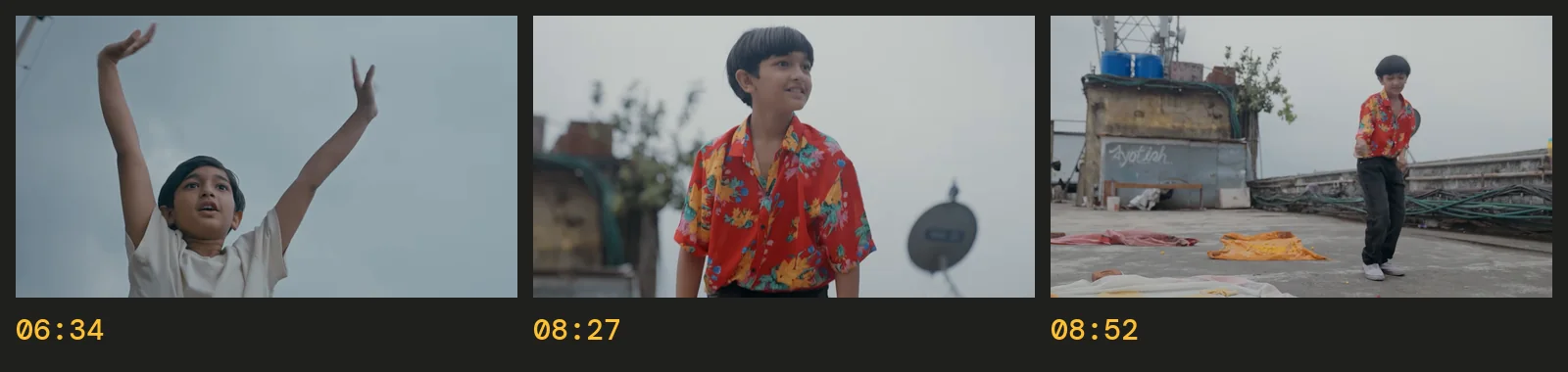
Almost none of the dialogue is Manu’s. He has a handful of short lines in fifteen minutes; the rest is other people talking past him, about him or through him. The story lives in his face, in his errands and in what he overhears. The one time he raises his voice, he is alone on the roof, waving both arms at the sky: “I’m here. Look up.”
An edit built like a diary
When the first cut was done, a senior jury member gave Ganesh mixed feedback, and he doubted the film for five days. “Then I decided I liked it. And I trusted that.”
He took that cut to his editor, Manendra Lodhi, and they talked for hours while Manendra kept listening: who Ganesh is, who he was, again and again. They rebuilt the edit from that listening, on the way Ganesh remembers: “Not in a straight line. Like a diary. Pieces of memory, joined together until they make sense.”
The music came from the same place. The idea Ganesh gave the music supervisor, Alick Sethi, was simple: this boy’s life has no rhythm, so the music can’t keep a regular rhythm; it has to break it. Christian Meyer composed the score. Sound design is by Ashish Thomas and Joseph George, mixed by Ashish Thomas at Shoralag Audio Post in Mumbai, with Foley recorded at Audible Tones Recording Studios in Chennai.
One child at the centre
Shankhadeep Banerjee plays Manu, cast in Kolkata by Ayan Bhattacharjee, Dipanjana Mukherjee and Aritra Sengupta, and the film rests on his face. Pritesh Patel shot it, Raj Shah designed it and Ivan Narozhnyi graded it, with Abhilash Sunkesula and Vivek Muralidharan as associate directors.
What is Gangaur, and why does it matter in Manu?
Gangaur is the spring festival of Gauri, the goddess Parvati, and her husband Isar, Shiva. It is kept mostly by women in Rajasthani and Marwari families. Idols of the couple are bought, dressed and worshipped, and on the last day they are carried in procession and immersed in water. Rajasthani families who settled in Kolkata have kept the festival for generations, and the film keeps it where Ganesh grew up with it, in Burrabazar.
Manu follows the festival from the market to the river: Gangaur idols for sale in Burrabazar, the puja at home, the immersion at the ghat under Howrah Bridge and a lit procession at night.

The festival is also the film’s argument. All day the house cares for Gauri and Shiva. Late in the film a stranger wishes Manu a happy birthday, the only one who does, and asks whether he is Gauri Shankar. He says yes. It is his real name, the one almost nobody uses: the boy no one looks at carries both their names.
The festival ends by sending Gauri into the water, “somewhere where everything is good, and she’ll come back next year”, as Ganesh puts it. He reads Manu’s ending the same way: “The boy doesn’t die, the useful child does.” The stranger who remembers his birthday calls herself Kali, and in the Iravan myth the sacrifice goes to Kali. But the film shows Manu alive after her: awake in the dark, then at the ghat at dawn. What sinks is his school bag, not the boy: the same bag that sinks in the opening shot, so the film loops back to its start, like a festival that comes back next year. His name is Gauri Shankar, so he does his own visarjan. What goes into the river is the burden of the always-useful child.
What awards has Manu won?
Manu travelled to festivals in 2025 and 2026, before its release, and won at five of them, starting in Kolkata, the city it was shot in. Its record so far:
| Festival | Result | Year |
|---|---|---|
| Global India International Film Festival | Best Children’s Film Award | 2026 |
| Global INDIE Filmmaker Awards | Award Winner, Best Movie (Short) | 2026 |
| Indo Dubai International Film Festival | Award Winner, Best International Short Film | 2026 |
| Rajasthan International Film Festival (RIFF) | Award Winner, Non-Feature Film Competition | 2026 |
| 8th Ritu Rangam International Film Festival, Kolkata | Award Winner | 2025 |
| 15th Dadasaheb Phalke Film Festival | Official Selection and Honourable Jury Mention | 2025 |
| Oxford Film Festival (24th Annual) | Honorable Mention, Narrative Short | 2026 |
| Australia Independent Film Festival | Quarter-Finalist | 2025 |
On 7 November 2026, Panorama Studios released Manu worldwide on its YouTube channel, free to watch with English subtitles. Watch Manu on YouTube.
What did Manu start?
Manu did something Ganesh didn’t expect. “It became therapeutic. A part of me feels complete now.” All his films, he says, are like a diary: memory, shot and cut in pieces, then joined together, so he can understand what drives him.
The film’s last words, “to make the ultimate sacrifice for his family”, named his next film. SACRIFICE ends on Manu’s own footage: the boy on the roof, calling to the sky, “I’m here. Look up.” He has made two more films this way, SACRIFICE and THE FLUID MASS, and both are now travelling to festivals.
As a child, even when I had nothing, I gave everything. That’s who I am. So I decided: whatever the pain, I’ll keep doing good work for others. I’ll be a giver.
What does Manu mean for brands?
Ganesh Pareek is the director of Manu, from the house behind Nike and Air India films. Manu is the eye he brings to brand films: Indian families, festivals and childhood, told with restraint and real feeling. Diwali, Raksha Bandhan, homecoming and family stories, made to be felt rather than explained.
What carries over from Manu to a brand film:
- A child’s point of view. The story told from where he stands, with the grown-ups’ world going on over his head.
- The festival from inside the house. Real homes, real rituals and the small chores that make a festival happen, not a postcard of it.
- Performances close to real. Actors cast for lives that match their characters, and scenes shot as they come.
- Sound that does the emotional work. A voice, a street and a score where other films would use words.
Directing enquiries: to make a family or festival film with Ganesh, write to us or email mail@1stdecember.com. See more of his work on his director page, and the house’s films for Nike and Pantaloons’ Durga Puja.
Credits
- Written and directed by: Ganesh Pareek
- Producers: Ganesh Pareek, Atul Kattukaran
- Executive producers: Imran Patel, Ankit Singh
- Cast: Shankhadeep Banerjee (Manu), Srishty Tiwari, Rana Mukherjee, Swati Sharma, Enakshi Ganguly, Sreyashi Mazumdar, Udayraj Soni, Imran Patel
- Associate directors: Abhilash Sunkesula, Vivek Muralidharan
- Director of photography: Pritesh Patel
- Editor: Manendra Lodhi
- Production designer: Raj Shah
- Line producer: Sandip Roy
- Casting: Ayan Bhattacharjee, Dipanjana Mukherjee, Aritra Sengupta
- Costume stylist: Adrija Biswas
- Music: Christian Meyer; music supervisor Alick Sethi
- Sound design: Ashish Thomas, Joseph George
- Audio post: Shoralag Audio Post, Mumbai
- Colourist: Ivan Narozhnyi
- CG: Ventana Studios
- Production: 1st December Films, Agápē Films
- Released by: Panorama Studios
Frequently Asked Questions
Who directed the short film Manu?
Ganesh Pareek wrote and directed Manu (2026), his first film as writer and director, drawn from his own childhood in Burrabazar, Kolkata. It is a 15-minute Hindi short film produced by 1st December Films and Agápē Films. Panorama Studios released it on YouTube on 7 November 2026.
What is the short film Manu about?
Manu follows a ten-year-old boy in Burrabazar, Kolkata, who runs every errand in his family’s house on the day of the Gangaur festival, which is also his birthday, and is seen by almost no one, while the story of Iravan from the Mahabharata plays in voice-over. Shankhadeep Banerjee plays Manu.
Where can I watch Manu?
Manu is free to watch on Panorama Studios’ YouTube channel, in Hindi with English subtitles. It runs 15 minutes and was released worldwide on 7 November 2026.
What awards has Manu won?
Manu has won five festival awards: the Best Children’s Film Award at the Global India International Film Festival 2026, Best Movie (Short) at the Global INDIE Filmmaker Awards 2026, Best International Short Film at the Indo Dubai International Film Festival 2026, Award Winner in the Non-Feature Film Competition at the Rajasthan International Film Festival (RIFF) 2026, and Award Winner at the 8th Ritu Rangam International Film Festival 2025 in Kolkata. It was also an Official Selection with an Honourable Jury Mention at the 15th Dadasaheb Phalke Film Festival 2025, received an Honorable Mention (Narrative Short) at the Oxford Film Festival (24th Annual) and was a Quarter-Finalist at the Australia Independent Film Festival 2025.
Does Manu die at the end of the film?
No. As Ganesh Pareek reads it, the boy doesn’t die; the useful child does. After Kali, the only one who remembers his birthday, the film shows Manu alive: awake in the dark, then at the ghat at dawn. What sinks is his school bag, not the boy: the same bag that sinks in the opening shot. His real name is Gauri Shankar, so, like the Gauri idol, he does his own visarjan: what goes into the river is the burden of the always-useful child.
Is Manu based on a true story?
Yes. Manu is drawn from Ganesh Pareek’s own 1990s childhood in a Marwari family in Burrabazar, Kolkata, as the child everyone needed and nobody saw. He set the film in today’s Burrabazar on purpose, to keep a little distance from himself. It opens with the card “Inspired by true events” and was shot on location in Burrabazar in March 2023.