Nike Make Every Yard Count
Nike Make Every Yard Count
Director
Year
Format
Industry
The people who made it
Director Spotlight
Directors & Producers
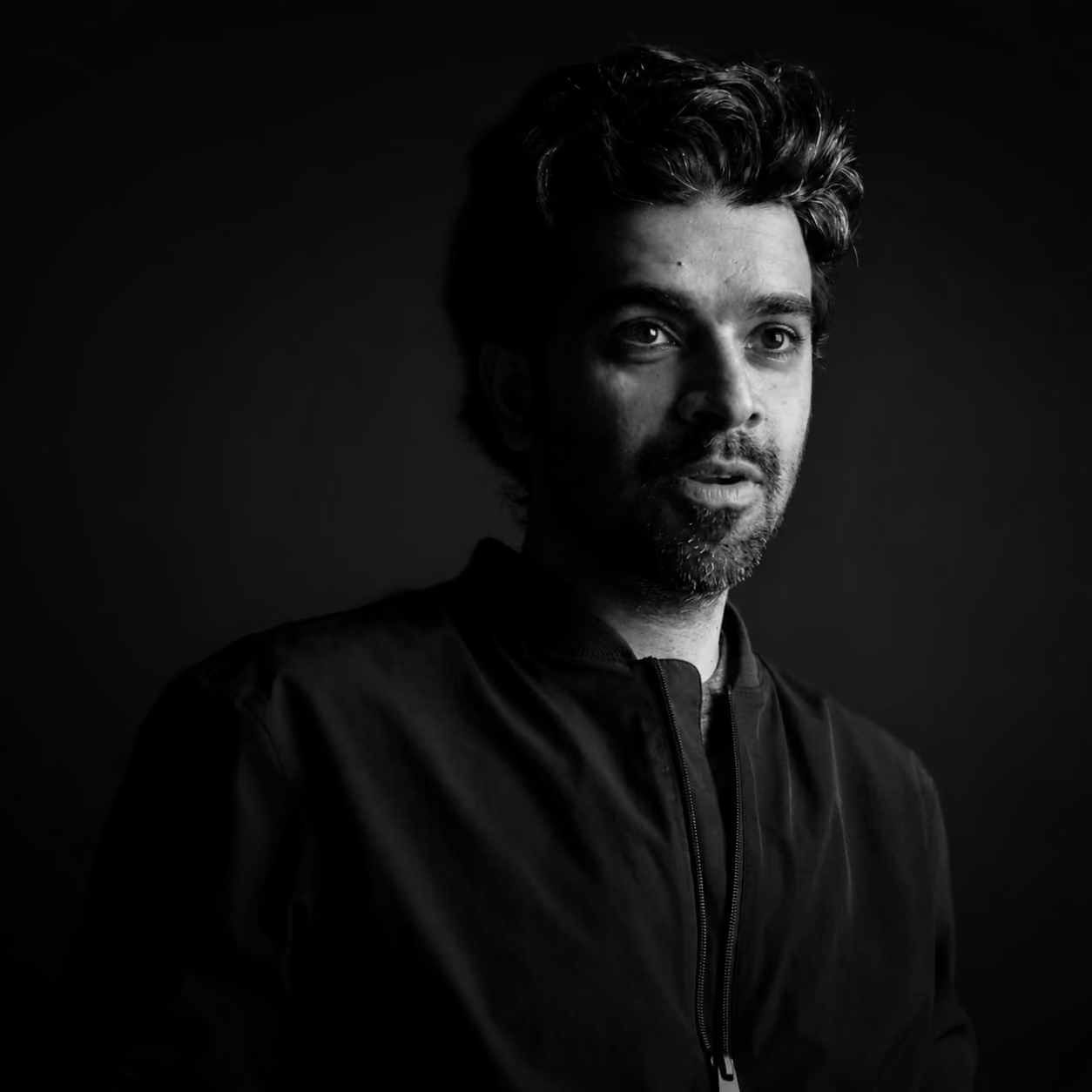
Atul Kattukaran
Cannes Lions winning director (2014, 2016, 2017) and the only Indian ever named in the world’s Top 10 TVC directors by the Cannes Lions Global Creativity Report.
More than 150 international awards
The Record
Award
Awarding Body
Year
Nike Cricket: Make Every Yard Count | Goafest National Awards 2014-15
Goafest National Awards
2014
Nike Cricket: Make Every Yard Count | Adfest Asia Pacific 2014-15 (Lotus)
Adfest Asia Pacific
2014
Nike Cricket: Make Every Yard Count | Clio Awards 2014-15 (Clio)
Clio Awards
2014
Nike Cricket: Make Every Yard Count | Spikes Asia 2014-15 (Silver)
Spikes Asia
2014
Nike Cricket: Make Every Yard Count | Spikes Asia 2014-15 (Gold)
Spikes Asia
2014
Nike Cricket: Make Every Yard Count | D&AD 2014-15 (Graphite Pencil)
D&AD
2014
Nike Cricket: Make Every Yard Count | The One Show 2014-15 (Silver Pencil)
The One Show
2014
Nike Cricket: Make Every Yard Count | The One Show 2014-15 (Gold Pencil)
The One Show
2014
Nike Cricket: Make Every Yard Count | Cannes Lions 2014-15 (Lion)
Cannes Lions
2014
A cricket pitch is 22 yards long. In 2014 Nike India asked what would happen if every one of those yards belonged to somebody different. Finding out took four months.
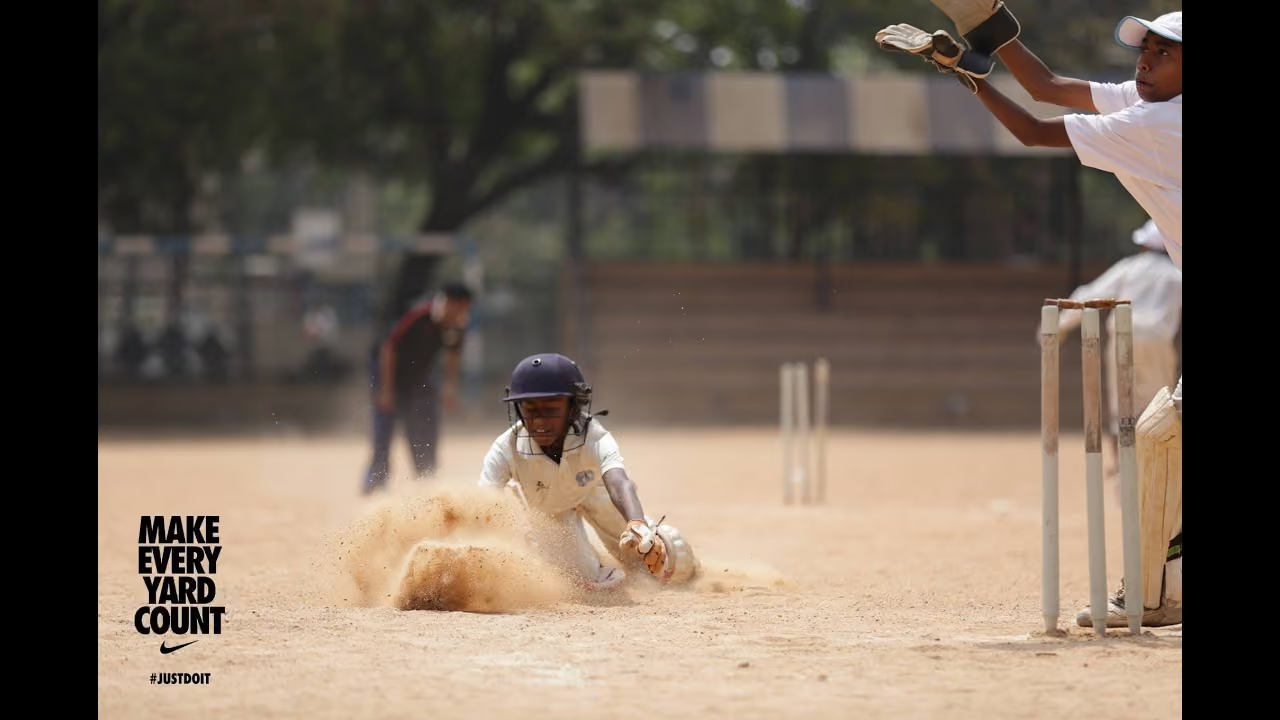
Make Every Yard Count is a single delivery: run-up, leap, arm over, ball away. It was built frame by frame from 2,25,000 photographs of 1,440 young cricketers across India. Nobody in particular bowls the ball. The country does.
At a glance
- Brand: Nike India
- Agency: JWT Bangalore + Ogilvy Bangalore
- Production house: 1st December Films
- Year: 2014
- Running time: 1 min 24 sec
- Technique: Stop-motion assembled from still photography
- Scale: 1,440 young cricketers, 2,25,000 photographs
- Recognition: 50+ international awards, including a record 7 Cannes Lions
The brief
Nike wanted to talk to India's young cricketers. Not the eleven who play for the country, but the millions who play in gullies, on maidans, on terraces and on any strip of road flat enough to bowl down.
That brief defeats a normal commercial. Cast four kids, shoot them beautifully, and you have made a film about four kids. Here the scale was the message, and scale is the one thing a conventional shoot cannot show you. The film had to contain the size of the country rather than describe it.
The idea: one ball, bowled by 1,440 people
A single delivery was broken into individual frames of movement: the grip, the run-up, the jump, the arm coming over, the release, the shot, the field scrambling after it. Young cricketers across India were then asked to photograph themselves in those exact positions.
Each person became one frame. Run in sequence, 1,440 bodies standing in 1,440 different places turn into a single continuous action.
The idea and the production method are the same thing. The film does not talk about participation. It is made out of it.
Pre-production: a grammar strangers could shoot to
Everything difficult about this film happened before a single frame was taken. If you are going to accept images from 1,440 people using 1,440 cameras in 1,440 places, you have to decide in advance what makes a frame usable, and you only get one chance to decide it.
So the delivery was built on paper first. The whole action was keyframed position by position, and the capture brief that came out of it had to be simple enough for a fifteen-year-old with a phone to follow, and precise enough that his frame would cut against the next one.
| What had to be solved | How it was solved |
|---|---|
| Different people, different cameras | Keyframe the action first, then brief each pose so the photographs connect |
| Participation across a whole country | One repeatable capture brief, written to work for amateurs and professionals alike |
| Continuity | Treat the delivery as one movement broken into frames, not as a set of portraits |
| Authenticity | Real players in real places. No actors standing in for the community |
| Legibility | Keep the action readable at speed inside an enormous bank of images |
The shoot
Submissions came in from everywhere. Professional photography filled what the crowd could not: the frames where the arm angle had to be exact, the resolution had to hold, or the action had to land cleanly on a beat.
That mix is the film's texture. The amateur frames bring grain, odd backgrounds and the real light of a Tuesday evening on a maidan. The professional frames hold the action together. Neither works alone. Take out the raw material and you have a slick sports ad. Take out the control and you have a slideshow.
Anup Kattukaran's work on the film won India's first Clio for Cinematography. For a film without a single continuous camera move in it.
The edit is where the film was actually made
On a stop-motion film assembled from stills, the edit is not a stage of production. It is the production.
Every frame had to hold body position, arm direction, ball trajectory, eyeline and framing steady while the background changed completely underneath it. Miss by a little and the eye reads a slideshow. Hold it and the eye reads a bowler.
| Editorial decision | What the audience feels |
|---|---|
| Action keyframed before capture | Separate photographs read as one movement |
| Cut on the rhythm of the game | It moves like sport, not like a gallery |
| Amateur and professional frames intercut | Raw and polished sit together without a seam |
| The scale revealed, not explained upfront | The making-of lands as a payoff instead of a disclaimer |
Sound: making the effort audible
The sound world came out of the game itself: field chants, the calls between fielders, breathing, the noise a group of boys makes when someone is about to get out.
None of it sits under the film as a music bed. It is cut to the action, and that is what convinces you the photographs are moving. You hear the effort a beat before you see it.
What it won
Make Every Yard Count became the most awarded film in advertising history from Asia, with more than 50 international wins.
| Festival | Result | Detail |
|---|---|---|
| Cannes Lions | 7 Lions | A record for a single film |
| The One Show | 3 Gold Pencils | Film, Film Craft, Film Innovation |
| The One Show | 4 Silver Pencils | Across categories |
| D&AD | 6 Pencils | Including a Graphite Pencil |
| Clio Awards | 5 Clios | Including India's first Clio for Cinematography |
| Spikes Asia | 2 Gold, 5 Silver | Across categories |
| Adfest Asia Pacific | 6 Lotus | Film, Film Craft, Lotus Roots |
| Goafest | 10 National Awards | Including 5 Gold, across Film, Film Craft, Digital and Content Creation |
| Adweek | Featured | World's Best Commercials |
What the film proves
This is the reference to reach for when a brief needs any of the following:
- a campaign where the audience has to be inside the film, not watching it
- user-generated and crowd-sourced material held to a broadcast standard
- photography-led storytelling across many cities and many contributors
- a production system designed before the first frame, and held for months
- an edit that carries the idea rather than assembling it
- sound built out of a real place instead of a library
See more of our work, the director's reel and credits, or send us a script and a date.
Credits
- Client: Nike India
- Agency: JWT Bangalore + Ogilvy Bangalore
- Production house: 1st December Films
- Director: Atul Kattukaran and Senthil K
- Director of Photography: Anup Kattukaran
- Executive Producer: Ganesh Pareek
- Year: 2014
Frequently Asked Questions
How was Nike Make Every Yard Count made?
It is a stop-motion film. One cricket delivery was broken into individual frames, and 1,440 young cricketers across India photographed themselves in those positions. The 2,25,000 photographs were then edited into one continuous bowling action.
Is there any CGI or AI in the film?
No. There is no CGI, no motion capture and no generative AI. Every frame is a real photograph of a real person. The continuous movement comes from keyframe planning before the shoot and frame-by-frame editing after it.
Who directed Nike Make Every Yard Count?
Atul Kattukaran and Senthil K directed it for 1st December Films, with Anup Kattukaran as Director of Photography and Ganesh Pareek as Executive Producer. Made for Nike India with JWT Bangalore and Ogilvy Bangalore.
How many awards did the film win?
More than 50 international awards, including a record seven Cannes Lions for a single film, three One Show Gold Pencils, six D&AD Pencils and five Clios. It is the most awarded film in advertising history from Asia.
How many people appear in the film?
1,440 young cricketers, photographed across India across 2,25,000 frames. Nobody in particular bowls the ball. The whole country does.
What kind of brief is this film a reference for?
Briefs whose scale can only be proved by doing them at scale: crowd-sourced and participation-led campaigns, sports and youth culture, multi-city photography, and ideas that live or die on the edit.