

The short answer. Sometimes, and it depends on where the ad runs and what the AI does in it. China labels almost all AI content. The EU requires a label on realistic AI people, products and places. New York, Pennsylvania and California require one in specific cases. The UK and India ask for one only where leaving it out would mislead. A label never makes a fake testimonial legal.
Do you have to label AI ads? Most answers to that question cover one market, usually the US, and most stop at the law. We make AI, hybrid and live-action films for brands in India and abroad, and a film we deliver in Mumbai can run on a phone in Milan, a billboard in Shanghai and a connected TV in Los Angeles in the same week. So we read the rules the way a producer has to: shot by shot, for every market the film will reach.
This guide sets out what each of the five rulebooks asks as it will stand on 1 January 2027, when California joins the others, and adds three things we could not find anywhere else: a decision table for 15 common AI shots across all five markets, an audit of what 12 ad platforms require of advertisers, and a count of the UK advertising regulator’s rulings on AI ads.
A producer’s reading of the rules, checked against the primary documents on 14 November 2026. It is not legal advice; for a celebrity likeness, a voice clone or a regulated category, have a lawyer read the script.
Key takeaways
- From 1 January 2027, AI labels are a legal duty on ad makers in three of the five markets: the EU (Article 50 of the AI Act, since 2 August 2026), China (since 1 September 2025) and three US states (New York, Pennsylvania and California).
- The UK and India have no blanket rule. Both require a disclosure only where leaving it out would mislead the viewer; India’s ad self-regulator, ASCI, starts applying its AI guidelines in the second half of December 2026.
- China is the only market that specifies the label: "AI" plus "generated" on the opening frame, at least 5% of the frame’s shortest side, for at least 2 seconds.
- The EU duty falls on whoever controls the AI use, usually the agency or production house, and it reaches companies outside Europe whose ads are seen there.
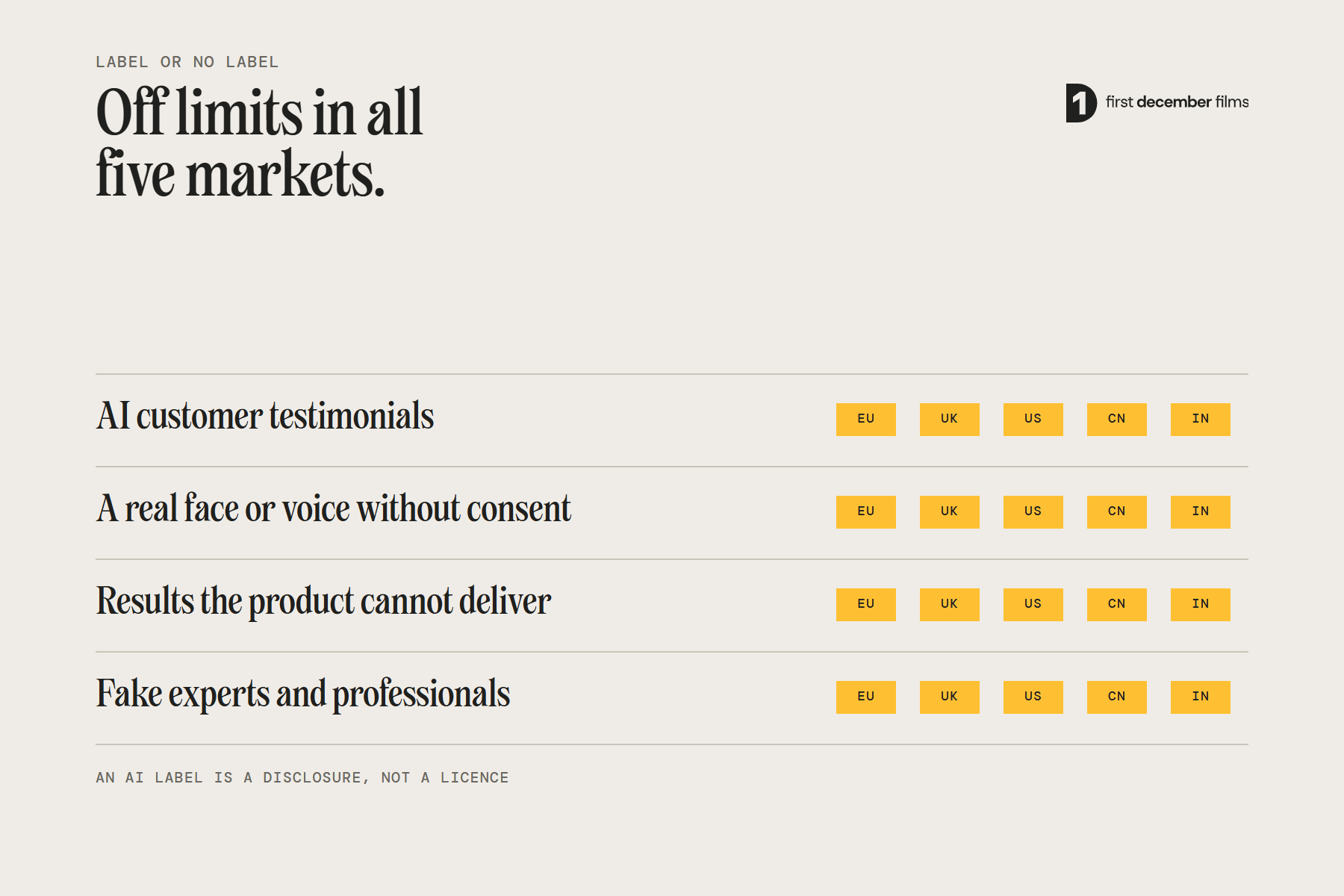
- A label is not a licence. Fake testimonials, unconsented faces and voices, and AI product shots that overstate results are unlawful or banned by regulators in all five markets with or without one. The UK’s advertising regulator has upheld at least 20 rulings on ads containing AI since 2024, and none for a missing label.
- Platform labels do not discharge the advertiser’s duty. Of 12 ad platforms we checked, only TikTok makes advertisers disclose AI in ordinary commercial ads.
- The safest single specification for a film that travels is a corner label in the local language from the first frame, for at least 2 seconds, sized to China’s 5% rule, plus a clean master for markets that do not need it.
Do you have to label an AI ad? The answer by market
An AI ad needs a label in the EU when it contains a realistic AI person, product, place or event; in China when it contains AI-generated audio, images or video of almost any kind; in New York, Pennsylvania and California in the cases their laws define; and in the UK and India only when the AI would otherwise mislead.
| Market | Is an AI label required? | Who carries the duty | In force |
|---|---|---|---|
| European Union | Yes, for deep fakes: realistic AI people, objects, places or events | The deployer: whoever controls the AI use, usually the agency or studio | 2 August 2026 |
| United Kingdom | No blanket rule; disclose where leaving it out would mislead | The advertiser | Ongoing (CAP Code) |
| United States, federal | No label law; deception banned, including AI fake reviews | The advertiser and anyone who creates the ad | 21 October 2024 (reviews rule) |
| New York | Yes, for synthetic performers (AI humans who resemble no real person) | Whoever produces or creates the ad | 9 June 2026 |
| Pennsylvania | Yes, where AI content creates a false impression of the product | The advertiser | 21 December 2026 |
| California | Yes, for prominent AI performers and AI voices | Whoever creates the ad and has it published | 1 January 2027 |
| China | Yes, visible and metadata labels on most AI audio, images and video | AI tools and platforms; whoever posts must declare | 1 September 2025 |
| India | Platforms and AI tools label realistic AI content; ASCI requires a label in the ad where AI could mislead a buyer | Platforms and tools (IT Rules); the advertiser (ASCI) | 20 February 2026; ASCI from 17 or 29 December 2026 |
EU AI Act Art. 50 and Commission guidelines C(2026) 7702; CAP Code and CAP guidance of 29 May 2025; 16 CFR Part 465; NY GBL s.396-b; PA Act 99 of 2026; Cal. Bus. & Prof. Code s.17610; China’s Labelling Measures and GB 45438-2025; India’s IT Rules 2026 and ASCI guidelines of 29 September 2026.

What counts as an "AI ad" for a label?
No market labels AI because a tool was used. Each labels a particular effect on the viewer, and the definitions differ in ways that change the answer for the same shot:
- Deep fake (EU). AI-generated or manipulated image, audio or video that "resembles existing persons, objects, places, entities or events and would falsely appear to a person to be authentic or truthful" (AI Act, Article 3(60)). Plausibly real counts, so an invented photoreal person is in.
- Synthetic performer (New York, California). An AI-generated human performer "not recognizable as any identifiable natural performer" (New York) or "person" (California). A real person’s replica is outside it; California adds voices.
- Synthetic content that misleads (Pennsylvania). AI-generated or significantly modified image, video or audio that creates "a false consumer perception about the nature, origin or authenticity" of what is sold.
- AI-generated synthetic content (China). Text, images, audio, video and virtual scenes made by AI generation services of the kind that "may cause public confusion".
- Synthetically generated content (India, ASCI). Audio or video "materially altered using a computer resource, to appear real, authentic or true" that shows a person or event as real.
In practice the tiers are the same everywhere. Assistive AI (colour, clean-up, upscaling, copy) needs no label anywhere. Realistic AI people, voices and products need a label in most markets. Deceptive AI (fake customers, overstated results, faces without consent) is banned in all of them.
EU: what does Article 50 ask of an ad?
Since 2 August 2026, whoever controls the AI in an ad shown in the EU must tell viewers when it contains a deep fake: realistic AI-generated or AI-altered image, audio or video of people, objects, places or events that could pass as real. The duty sits in Article 50(4) of the AI Act, and it reaches companies outside the EU when the output is used in the Union.
The AI Act defines a deep fake as AI-generated or manipulated content that "resembles existing persons, objects, places, entities or events" and would falsely appear authentic. The European Commission’s guidelines on Article 50, published on 20 July 2026 and formally adopted on 5 November 2026 as C(2026) 7702, read that widely. A simulated person only has to resemble someone who "can plausibly exist", so an invented photoreal model counts. No intention to deceive is needed (paragraph 114). The guidelines list "fully AI-generated actors, digital replicas of real or deceased actors, de-aging" as likely deep fakes.
Their advertising examples are the clearest any regulator has published:
- A deep fake: "an AI-generated depiction of a celebrity influencer in an advertising or promotional context", and an AI product image "that can affect the audience’s perception and mislead as to the actual product appearance".
- Not a deep fake: AI mice "arguing in human language over the best type of cheese" in an ad, and a real car shown against an AI background, as long as the background does not mislead.
- Minor, so usually no label: colour correction, background extension and "re-scaling of images applied in product advertisements" (paragraph 116).
Who is the deployer when a brand, an agency and a production house all touch the film?
The deployer is whoever decides whether and how AI is used, and that is usually the agency or studio running the generation, not the brand. The guidelines say a company that "merely commissions an advertising agency to produce an advertisement, without taking decisions and exercising control over whether and how the advertising agency uses AI", is not a deployer. Staff and freelancers working under the agency are not separate deployers (paragraph 14).
Distance from Europe is no shield. The guidelines’ own example is "a company established in a third country that uses an AI system to generate a deep fake of a celebrity featured in an advertisement displayed in the Union". Posting on the open internet can be enough (paragraph 13). Bird & Bird’s lawyers concluded on 22 July that without geo-blocking it is "challenging to shield online content" from the rule. For a production house in Mumbai, that means a film made for an Indian brand and posted on YouTube can carry an EU duty.
Does the creative exception cover a commercial?
Rarely. Article 50(4) lets "evidently artistic, creative, satirical, fictional" works disclose lightly, "in an appropriate manner that does not hamper the display or enjoyment of the work", for example in the credits. The guidelines say ads qualify only "in certain, specific situations, but not in others", and where creative and informative content mix, "the informative character should always prevail" (paragraph 122). Every ad example the guidelines give is outside the carve-out, including "a realistic synthetic influencer testing out a sponsored real product". Bird & Bird’s reading: the scope for lighter labelling in advertising "appears to be very narrow". The French self-regulator ARPP, in its practical guide of 3 August 2026, is blunter: "no exception is provided for advertising."
What does an EU label have to look like?
It has to be visible or audible to a person "in a clear and distinguishable manner at the latest at the time of the first interaction or exposure" (Article 50(5)). The tool’s watermark or C2PA metadata does not count (paragraph 117), and a line in the terms or a menu is not clear (paragraph 142).
The EU’s Code of Practice, final since 10 June 2026 and found adequate by the Commission on 8 July, is the predictable way to comply. Its label is an icon or equivalent built around the capitalised acronym "AI". For video, it goes "at the beginning of the video as well as, where possible, at regular intervals", and at minimum after ad breaks; for audio-only content, "a short audible disclaimer" at the start. The Commission’s own EU icon is optional: "The use of these EU icons is optional, but the labelling requirements under Article 50 AI Act are not." About 190 organisations had signed the code by 31 July 2026, Bulgari, Getty Images and Lufthansa among them on the labelling side.
What changes in the EU in 2027?
Nothing new switches on in Article 50 in 2027, despite what several guides say. The Digital Omnibus, adopted as Regulation (EU) 2026/1744 on 8 July 2026, gave one narrow grace period: AI tools already on the market before 2 August 2026 must add machine-readable marking by 2 December 2026. The deployer’s duty to label deep fakes got no grace period at all. Deep fakes generated before 2 August 2026 need no label after the fact (paragraph 154).
What 2027 brings is enforcement and national law on top:
- France already requires commercial influencers to mark AI-produced faces or bodies "Images virtuelles" or an equivalent (Law 2023-451, Article 5, as amended in November 2024), on pain of a year in prison and a €4,500 (about $5,000) fine, and has required "Photographie retouchée" on slimmed model photos since 1 October 2017.
- Spain’s AI bill, published in Congress’s gazette on 12 June 2026, would make a missing deep fake label a "grave" breach, with fines up to €7.5 million (about $8.3 million) or 1% of turnover, not the €35 million figure quoted on several pages, which is the top tier for banned AI practices.
- Italy’s AI law of October 2025 adds no ad label but makes harmful, non-consensual spreading of AI-faked images, video or voice a crime carrying one to five years.
- The Digital Fairness Act, proposed on 11 November 2026, would require influencer ads to carry the words "advertisement" or "commercial collaboration". It has no AI label and would apply 12 months after it enters into force.
Fines under the AI Act reach €15 million or 3% of worldwide turnover, whichever is higher; for small and medium firms, whichever is lower.
United Kingdom: no AI label law, so when must you disclose?
The UK has no law or code that requires a label because an ad used AI, and the government’s March 2026 report on AI proposed voluntary best practice rather than a law. What the UK does require is that an ad must not mislead, and leaving out information a buyer needs counts as misleading. So the question in Britain is always what the viewer would believe without a label.
The Committee of Advertising Practice (CAP), which writes the UK’s advertising codes, set out its test on 29 May 2025: "Is the audience likely to be misled if the use of AI is not disclosed?" and "is the disclosure clarifying the ad’s message or contradicting it?" It said plainly that "There is no blanket legal requirement in the UK to disclose the use of AI in ads", and that "disclosure alone is very unlikely to mitigate the harm caused by a fundamentally misleading message." Where a label can help, CAP gives two examples: "making clear that deepfake content featuring in an ad is only being used for comedic effect or that an influencer is AI-generated".
The government’s Report on Copyright and Artificial Intelligence of 18 March 2026 says "There are no obligations in the UK for AI-generated content to be labelled" and proposes only "to work with industry to explore best practice on labelling". It also confirms that "UK law does not provide a general personal image right", which leaves a famous face to the law of passing off.
What has the ASA ruled on AI ads?
We searched the Advertising Standards Authority’s rulings database on 14 November 2026 and found 21 rulings from 2024 to 2026 that involve AI-generated or AI-altered content in the ad itself. Twenty were upheld. Not one was upheld because an ad lacked an AI label. In every case the problem was the impression the ad created:
- Fake experts with a disclaimer. ShroomIQ’s ads used AI-generated "experts" with a footer saying people shown were "AI-generated representations used for illustrative and branding purposes only". The ASA upheld the complaint on 22 April 2026: the label did not cure a health-professional endorsement.
- Products shown better than they are. WiggyDog showed "real and/or AI-generated puppies" for a robot dog toy (25 March 2026), and Aquoxis used product images "at least partially generated by artificial intelligence" (1 July 2026). Both broke the rules on exaggerating performance.
- A tagged parody that still counted. A Midnite gambling video of Trent Alexander-Arnold carried the tag "ai-generated parody". The ASA said it was still a depiction "which consumers would clearly recognise as being him" (17 September 2025).
- An AI character judged on how old he looks. In a second Midnite ruling on 16 September 2026, the ASA found a fully AI-generated gambler "seemed to be under 25", and noted that "the prompt used to generate the ad did not refer to the character’s age".
The ASA’s chief executive, Guy Parker, told a Lewis Silkin panel in September 2026 that an AI label is not a "get out of jail free card", as the firm reported it. The firm reported the Competition and Markets Authority’s Hayley Fletcher making the same point about claims: whether a human or AI generated them is largely irrelevant.
What about TV ads and Clearcast?
Clearcast, which clears British TV and video-on-demand ads before broadcast, sets no AI-specific rule, label or declaration in its public guidance. The UK research for this guide went through all 163 articles in Clearcast’s public help desk, including its 37 Notes of Guidance, and none sets one. Clearcast applies the general broadcast code instead: living people "must not be featured, caricatured or referred to in advertisements without their permission" (BCAP rule 6.1), and impersonations and sound-alikes are allowed "only if those devices are instantly recognisable" as parody. Clearcast helped clear Channel 4’s first fully generative TV ad in July 2025 with no labelling requirement mentioned. One post-production firm says AI content "must be declared to viewers in the commercial’s supers"; we found no Clearcast source for that, and Clearcast’s submission forms sit behind a login, so ask your clearance contact directly.
Where does UK law bite hardest?
Fake reviews. Since 6 April 2025, the Digital Markets, Competition and Consumers Act 2024 has banned fake consumer reviews outright, and the CMA’s guidance names reviews "generated by software applications (such as bots)" as an example. The CMA can fine up to 10% of global turnover. The ASA itself cannot fine; it publishes rulings, removes ads and refers persistent offenders.
2027 adds duties for platforms, not advertisers. Ofcom plans to publish its statement on fraudulent advertising codes under the Online Safety Act "by mid-2027 at the latest"; the codes, which then go to Parliament, apply to paid ads on the largest platforms with fines up to £18 million (about $24 million) or 10% of global revenue. No UK bill or consultation on an AI label for ads had been announced by 14 November 2026.
United States: which AI ads need a label in 2027?
The United States has no federal law that requires an AI label on a commercial ad. The labelling duties come from three states: New York since 9 June 2026, Pennsylvania from 21 December 2026 and California from 1 January 2027. Over all of them sits the Federal Trade Commission’s ban on deception, which a label does not cure.
The three state laws ask different questions, which is why a single "AI-generated" super does not settle all three:
| New York | Pennsylvania | California | |
|---|---|---|---|
| Law | General Business Law s.396-b | Act 99 of 2026 (SB 806) | Business and Professions Code s.17610 (SB 1050) |
| In force | 9 June 2026 | 21 December 2026 | 1 January 2027 |
| What triggers a label | An AI-generated human performer who is not any real, recognisable person appears in the ad | AI-generated or significantly AI-modified image, video or audio that creates "a false consumer perception" about the product | An AI performer or AI voice, not a real person, is "prominently" in the ad: demonstrating the product, giving the narration, or reacting to it |
| Audio-only ads | Exempt | Covered | Covered |
| What the label says | Not set; must be "conspicuous" | That the ad "contains content that was modified or generated using artificial intelligence", shown the first time it appears | Substantially similar to "this performance features a synthetic performer" or "no human performer is depicted" |
| Exempt | Translation of a human performer; ads for films and games consistent with the work | Evidently fictional content, parody and satire, text only | Translation and accessibility features; ads for expressive works |
| Penalty | $1,000, then $5,000 per violation | Civil fine up to $3,000, brought by the attorney general or a district attorney | Treated as false advertising: up to six months in jail or a $2,500 fine, and civil penalties up to $2,500 per violation |
New York S.8420-A (Chapter 617 of 2025); Pennsylvania SB 806, printer’s number 1808, approved 22 October 2026; California SB 1050 (Chapter 246, Statutes of 2026), approved 16 September 2026. California’s bill sets no start date, so it takes effect on 1 January 2027 under the state’s default rule.
New York’s law is the broadest on its face. Brian Murphy of Frankfurt Kurnit Klein & Selz noted on 29 October 2026 that its wording draws "no distinction between a synthetic ‘star’ delivering the sales pitch and a synthetic extra lurking in the background". California narrowed the trigger to performers who are prominent, but added voices. Pennsylvania took a different route entirely: any AI content, but only where it misleads about the product. Loeb & Loeb’s Libby O’Neill called it "a short window to implement a vague law with multiple interpretations". The final Pennsylvania text has no knowledge standard: the words "knowingly, recklessly or willfully" are struck through in the official version, though some copies online still show them.
None of the three covers a digital replica of a real person, because a recognisable person is not a "synthetic performer". Replicas fall under consent law instead: New York’s right of publicity, extended in December 2025 to dead performers’ digital replicas, and California’s Civil Code s.3344, which requires prior consent to use anyone’s likeness in advertising. Hawaii’s Act 247 of July 2026 dropped a New York-style label from its final text and instead allows damages of up to $25,000 per ad for a realistic AI imitation of an identifiable person used without consent.
What does federal law require?
No label, but no deception either. The FTC’s rule on consumer reviews and testimonials, in force since 21 October 2024, bans reviews and testimonials that misrepresent "That the reviewer or testimonialist exists", and the FTC’s announcement named "AI-generated fake reviews". Knowing violations carry civil penalties of up to $53,088 each, a level the FTC kept unchanged for 2026. Since 2023, the FTC’s Endorsement Guides have treated an endorser as anyone who "could be or appear to be an individual", which takes in virtual influencers. "Disclosures cannot make otherwise false statements true," wrote Laura Protzmann of the National Advertising Division, the industry’s self-regulator, in June 2026.
Washington’s direction is away from new rules. An executive order of 11 December 2025 set up a Justice Department task force "to challenge State AI laws", and the White House asked Congress in March 2026 to pre-empt state AI laws that "impose undue burdens". By 14 November 2026 no pre-emption law had passed, the task force had moved only against Colorado, and no federal challenge to the New York, Pennsylvania or California ad laws had been filed. Two federal bills are often misread as ad rules: the AI Labeling Act of 2026 (S.4915) would put labels on AI providers and platforms, not advertisers, and the AI Advertising Disclosure Act (H.R.10146) is about paid placements inside AI chatbots. Neither has left committee.
The industry’s own framework is lighter than the states’. The Interactive Advertising Bureau’s AI Transparency and Disclosure Framework, updated on 18 August 2026, offers a sparkle icon or a text label and says generic synthetic voices need none, which California’s law contradicts from January. Caroline Giegerich, the IAB’s vice president for AI, warned that "labeling everything teaches consumers to ignore labels". Kelley Drye’s Gonzalo Mon expects more state laws: "we’re likely to see more of these laws" (28 October 2026).
China: what must a visible AI label look like?
China is the only one of the five markets that specifies the label itself: the words, the position, the minimum size and how long it stays on screen. Since 1 September 2025, the Measures for Labeling AI-Generated Synthetic Content and the mandatory national standard GB 45438-2025 require a visible ("explicit") label and a hidden ("implicit") metadata label on AI audio, images and video of the kind that "may cause public confusion".
For a video ad, the standard sets out the visible label precisely (GB 45438-2025, clause 5.4):
- Words: text containing "人工智能" or "AI" plus "生成" (generated) or "合成" (synthesised), such as "AI生成".
- Where: an edge or corner of the opening frame; the end and middle are optional.
- Size: text height of at least 5% of the frame’s shortest side. On a vertical 9:16 ad for Douyin, that is 5% of the width, not the height.
- How long: at least 2 seconds.
- Audio-only: a spoken label, or a rhythm cue of "short-long short-short", which is "AI" in Morse code.
- Metadata: a field whose name contains "AIGC", which nobody may delete or tamper with.
The duties fall on three parties, none of them called "the advertiser". The AI tool adds the label and metadata. The platform checks metadata and marks content as AI, possibly AI, or "suspected" AI. The person who posts, which for a brand account is the brand or its agency, must declare AI content and use the platform’s labelling tool. If an agency asks a tool for unlabelled output, the provider can supply it only after the user agreement puts the labelling duty on the user.
Advertising rules sit on top. The Advertising Law makes the advertiser responsible for the truth of an ad, bans "fabricating the effect of using the product", and requires written consent before anyone’s name or image appears in an ad (Articles 4, 28 and 33). Since 1 February 2026, the live-commerce measures issued by the market regulator (SAMR) and the Cyberspace Administration of China (CAC) require livestreams that use AI-generated people to "continuously" tell viewers so, with fines of 10,000 to 100,000 yuan (about $1,500 to $15,000) if not corrected. Shanghai’s market regulator went further in guidance dated 31 December 2025, asking for "本广告由AI技术生成" (this ad is generated with AI technology) on AI ads and "本广告使用数字虚拟人" (this ad uses a digital virtual human) on ads with digital humans.
Enforcement is real and frequent. The CAC reported on 12 February 2026 that it had acted against 13,421 accounts and removed more than 543,000 items in a crackdown on unlabelled AI content. Market regulators have fined AI ads under the Advertising Law: 200,000 yuan (about $30,000) in Beijing for an AI imitation of a famous television host selling fish-oil sweets with cure claims, and 1.2 million yuan (about $180,000) in Xiamen for device ads with AI-generated fake "inheritor" personas (SAMR cases via AllBright). A label does not protect a false ad. Zhi Zhenfeng, a researcher at the Chinese Academy of Social Sciences’ Institute of Law, told CCTV News in September 2026 that labelling removes only the liability for not labelling; responsibility for whether the ad is true "cannot be waived" (Beijing Daily, our translation). He also said a wholly fictional AI digital human "cannot act as an endorser".
We found nothing new with a 2027 start date in China by 14 November 2026. The rules that apply in 2027 are the ones above, enforced harder.
India: what changes when ASCI’s guidelines take effect?
India’s ad-specific AI rule starts at the end of December 2026. The Advertising Standards Council of India (ASCI), the industry’s self-regulator, released its Guidelines for Responsible Labelling of Synthetically Generated Content in Advertising on 29 September 2026. They "come into effect on the expiration of 3 months from the date of their publication". ASCI has not said whether that runs from the signing on 17 September or the release on 29 September, so the start is 17 or 29 December 2026; as of 14 November, ASCI had published no FAQ, notice or fixed date.
The test is what the AI does to the buyer, not whether AI was used. ASCI’s rules sort AI uses into three groups:
- Banned, even with a label: fabricated endorsements or testimonials, exaggerated results shown through AI visuals, a place that does not exist shown as real, and anyone’s likeness used without consent.
- Label required: synthetic influencers and brand ambassadors, a real person’s face or voice replicated with consent for personalised messages, fabricated events or settings that could change how a buyer understands the product, a product that does not exist yet, AI sound effects tied to a core feature, and paid product suggestions inside AI answers ("Sponsored by [Brand]").
- No label: routine editing, decorative backgrounds and music, obvious fantasy, AI-written copy, and subtitles and translations.
ASCI suggests wording such as "Audio/Video created using AI" or "Audio/Video enhanced using AI" and accepts a platform’s own label. It sets no size, position or duration of its own. "The responsibility remains with advertisers," ASCI’s chief executive, Manisha Kapoor, said at the release: the final ad must be honest, transparent and within the ASCI Code.
Platforms carry the other half. Since 20 February 2026, the amended IT Rules have required AI tools and large platforms to label realistic "synthetically generated information", with users declaring AI content at upload. The draft label size of 10% of the frame was dropped from the final rules, and a later draft requiring a label for a video’s whole duration had still not been notified by 14 November 2026. Television is outside the IT Rules but inside the ASCI Code.
India’s sharpest risk in 2027 is still faces, not labels. The Delhi High Court granted Amitabh Bachchan a permanent injunction against unauthorised commercial use of his name, image and voice on 5 November 2026, and the cardiologist Devi Prasad Shetty a decree against AI videos that put medicine claims in his mouth in October (Verdictum). "Even a properly labelled AI-generated endorsement can be misleading if the underlying claim is false," Malabika Boruah, a partner at Naik Naik & Co., told exchange4media on 30 September. Our guide to whether AI ads are legal in India covers the IT Rules, ASCI and the personality-rights orders in depth.
One Indian date falls in 2027: the data protection law’s notice and consent duties apply from 13 May 2027, which matters for any AI personalisation built on customer data. MeitY’s AI regulation consultation paper, promised "in a month’s time" on 8 October, was described by the minister in late October as coming "in the coming weeks".
Do platform AI labels count as disclosure?
No. A platform’s label is the platform’s choice, and in most markets it does not discharge the advertiser’s duty. The EU says so directly: a deployer cannot rely on the tool’s machine-readable marking, and a platform’s labelling feature is "without prejudice to the responsibility of the deployers" (guidelines, paragraphs 117 and 126). Google tells advertisers that its own AI label setting "doesn’t guarantee your compliance with specific regulations".
To see what the platforms actually ask of advertisers, we read the current ad policies of 12 ad platforms on 14 November 2026. Only one makes advertisers disclose AI in ordinary commercial ads.
| Platform | Advertiser must disclose AI in commercial ads | AI rule for political ads | Labels AI ads by itself |
|---|---|---|---|
| TikTok | Yes: AIGC label or own disclaimer; undisclosed AI ads "rejected or restricted" | Political ads banned | Not confirmed |
| Google Ads (incl. YouTube ads) | No platform rule; a label setting, with visible overlays in the EU, India, New York, California, South Korea and Vietnam | Yes: "Altered or synthetic content" checkbox | Yes: ads made with Google’s own AI tools |
| Microsoft Advertising | No platform rule; "Made with AI" shown on advertiser-labelled ads in the EU and New York | Political ads banned | No visible label |
| Amazon Ads | Unclear: required on store listings with AI people, not confirmed for ads | Not found | No |
| Meta (Facebook, Instagram) | No | Yes: photorealistic AI image, video or audio | Yes: "AI info" for its own tools and, since 1 June 2026, detected third-party AI |
| No | Political ads banned | Yes: C2PA "CR" icon on uploaded single image or video ads | |
| No | Political ads banned | Yes: from IPTC metadata and classifiers | |
| Snapchat | No | No AI rule; manipulated likenesses banned | No |
| X | No | No AI rule found | No |
| Spotify | No | Yes | No |
| No | Yes: "This ad contains AI-generated content." | No | |
| JioHotstar | No | Not covered | No |
Our audit of 12 ad platforms’ own policy pages, read 14 November 2026. Sources in our research notes.
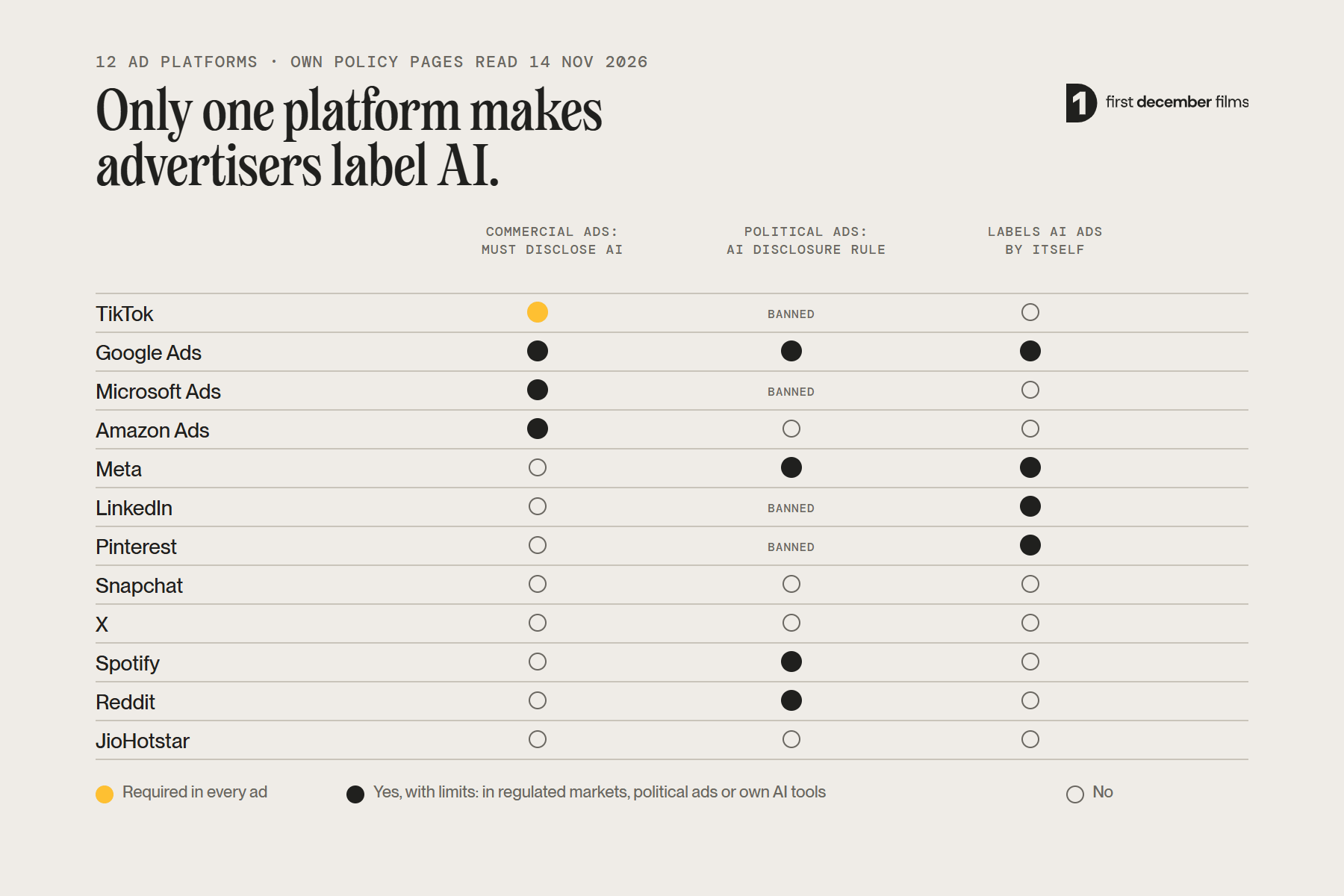
Three things stand out. First, TikTok is alone: its ads policy says "If we identify AI-generated content that has not been disclosed, your ad will be rejected or restricted." Second, Google and Microsoft built label tools but left the legal duty with the advertiser, and show a visible label only where the law requires one. Google’s list of markets for visible overlays (the EU, India, New York, California, South Korea and Vietnam) is a useful map of where regulators already expect a label. Third, the platforms that ban AI fakes ban them even with a label: Google does not allow "Ads that impersonate public figures using AI ... even if they disclose" it, and Microsoft says "A disclosure does not make deceptive content acceptable."
Platform labels also come and go. Four of the 12 label some AI ads automatically, from their own tools or from C2PA and IPTC metadata, which an export can strip. When we checked 177 official YouTube uploads of AI commercials for our State of AI Commercials report in October 2026, only 42 said in the title or description that AI was used, including none of our own seven. A label you control, inside the film, is the only one you can prove.
Which AI shots need a label in which market?
The same AI shot can need a label in one market, nothing in another and be banned in a third. This table applies the five rulebooks, as they stand on 1 January 2027, to the 15 AI uses we see most often in commercial briefs. It is our reading of the texts, not legal advice, and "grey" means the regulator has not said.
| AI use in the film | EU | UK | US (NY, PA, CA) | China | India (ASCI) |
|---|---|---|---|---|---|
| Colour, clean-up, upscaling, retouching that does not change the product | No | No | No | No | No |
| AI-written script or copy, edited by people | No | No | No | No | No |
| AI background or set extension behind a real product and cast | No, unless it misleads | No | No | Label | No |
| Obvious fantasy: talking animals, impossible worlds | No | No | No | Likely label | No |
| AI crowd or extras in the background | Grey | No | Label in NY | Label | No |
| Photoreal AI presenter who resembles no real person | Label | Disclose if shown as real | Label in NY; in CA from 2027 | Label | Label |
| Recurring AI influencer or brand ambassador | Label | Disclose if it could mislead | Label in NY and CA | Label | Label |
| Generic AI voiceover, resembling no real person | Grey | No | Label in CA from 2027 | Label | No |
| AI dubbing or lip-sync of a real actor into another language, with consent | Likely label | No | Exempt | Label | No |
| Digital replica of a real person’s face or voice, with written consent | Label | Permission; disclose if it could mislead | Consent law; label in PA if it misleads | Label and written consent | Label |
| A product that does not exist yet, such as an unbuilt flat, shown as real | Label | Disclose | Label in PA | Label | Label |
| A place that does not exist, shown as real | Label | Disclose | Label in PA | Label | Banned |
| AI product shot or demonstration better than the real product | Banned | Banned | Banned | Banned | Banned |
| AI "customer" testimonial or review | Banned | Banned | Banned | Banned | Banned |
| A real person’s face or voice without consent, or a look-alike | Banned | Banned on TV; passing off online | Banned | Banned | Banned |
Our application of AI Act Art. 50 and Commission guidelines C(2026) 7702 (paras 113 to 124); CAP guidance of 29 May 2025 and ASA rulings 2024 to 2026; NY GBL s.396-b, PA Act 99 of 2026, Cal. Bus. & Prof. Code s.17610, 16 CFR Part 465; China’s Labelling Measures, GB 45438-2025 and Advertising Law; ASCI guidelines of 29 September 2026. Read 14 November 2026.

Four rows explain most of the differences. The AI background is fine in the EU because the Commission’s own example is a real car against an AI background, and fine under ASCI as a "purely decorative" element; China labels it because the footage came from a generation service. The obvious fantasy row is the same split: the EU’s talking mice are not a deep fake, ASCI exempts "obvious, unrealistic effects", and China’s standard lists text-to-video services among the typical cases that may cause confusion, so assume a label there. The AI voice is where the US states disagree with each other: California covers voices from 2027, New York exempts audio-only ads, and the IAB’s voluntary framework says generic synthetic voices need no label at all. And the digital replica with consent needs a label in the EU, China and India, but not under New York’s or California’s performer laws, which cover only people who do not exist.
The bottom three rows are where most real cases end, along with fake experts. Most of the ASA’s misleading-advertising rulings on AI since 2024 turn on the same problem, what the AI made the viewer believe, as do the Chinese fines for AI "experts" and imitated television hosts.
What does a compliant AI label look like on screen?
Only China fixes the words, position, size and duration; Pennsylvania and California fix only the wording. Everywhere else the law sets an outcome, clear to an ordinary viewer at first sight, and leaves the design to you. A label that satisfies the strictest rule you face, placed where the strictest rule wants it, usually satisfies the rest.
| Words | Where and when | Size | Audio-only ads | |
|---|---|---|---|---|
| China (GB 45438) | Must contain "AI" or "人工智能" plus "生成" or "合成" | Edge or corner of the opening frame, at least 2 seconds | Text at least 5% of the frame’s shortest side | Spoken label or the Morse rhythm for "AI" |
| EU (Code of Practice) | An icon or label built on the capitalised "AI"; EU icon optional | At the start, at regular intervals where possible, and after ad breaks | Not fixed; must be clear and distinguishable | Short spoken disclaimer at the start |
| New York | "Conspicuously disclose" that a synthetic performer is in the ad | Not fixed | Not fixed | Audio-only ads exempt |
| Pennsylvania | Must state the ad "contains content that was modified or generated using artificial intelligence" | The first time the content appears, in the same medium | Clear and conspicuous | Covered |
| California (from 2027) | Substantially similar to "this performance features a synthetic performer" | Not fixed | Clear and conspicuous | Covered |
| India (ASCI) | Suggests "Audio/Video created using AI" or "enhanced using AI"; platform labels accepted | Not fixed | Not fixed | Not fixed |
| UK (CAP) | No set wording; must clarify, not contradict | Prominent and timely; not a footer or reply | Not fixed | Not fixed |
Label specifications by market. China: GB 45438-2025, clauses 5.2 to 5.4. EU: Code of Practice on transparency of AI-generated content, Section 2. New York: General Business Law s.396-b. India: ASCI guidelines, 29 September 2026. UK: CAP Code rules 3.3 and 3.9.
Our working default for a film that will travel: a corner super reading "AI-generated" or "Made with AI", in the language of the market, on screen from the first frame for at least two seconds and sized to 5% of the shortest side, repeated after any break, with a spoken line at the start of audio-only versions. That one specification meets China’s standard and the EU code’s placement, and nothing in the other markets forbids it.

Size matters more than most briefs allow for. On a 16:9 master, 5% of the short side is about 54 pixels of text height at 1080p. On a 9:16 vertical cut for Douyin or Reels, the short side is the width, so the label is set against 1,080 pixels, not 1,920.
The industry argues about whether labels hurt. Ganesh Pareek, who wrote this guide, told BestMediaInfo in May 2026: "The moment you put an ‘AI generated’ label on an emotional brand film, you break the suspension of disbelief." Europe’s ad self-regulators agree that more is not always better: "more labels do not automatically mean better information," said Ludovic Basset, director general of the European Advertising Standards Alliance, when it published its guide on 22 October 2026. On the other side, Charles Russell Speechlys’s Willemijn Paul has advised UK clients to treat self-regulatory frameworks as "a floor rather than a ceiling" (30 January 2026). Our position is in between and practical: label by function, where the AI changes what a viewer believes, and design the label into the film from the storyboard, so it is a decision rather than a sticker.
What is banned even with an AI label?
Four uses are unlawful or banned by regulators in all five markets whether or not the ad says AI made them, and the big platforms add a fifth. A label is a disclosure, not a licence.
- Fake testimonials and reviews. An AI "customer" describing an experience nobody had is a fake review under EU consumer law (Unfair Commercial Practices Directive, Annex I), the UK’s DMCC Act 2024, the US Federal Trade Commission’s rule on consumer reviews and testimonials (16 CFR Part 465), China’s Advertising Law and ASCI’s guidelines (clause 1A).
- A real person’s face or voice without consent. China requires written consent (Advertising Law, Article 33); Indian courts grant injunctions; UK broadcast ads need permission (BCAP 6.1) and passing off protects famous faces online; US states such as California and New York require prior consent for advertising use.
- Results the product cannot deliver. An AI "after" shot, a smoother finish, a faster car. CAP’s own example is an AI cosmetic image that "does not accurately reflect real-world results"; the EU guidelines call such product images deep fakes; ASCI bans them (clause 1B).
- Fake experts and professionals. An invented doctor or scientist misleads in every market. The UK bans health-professional endorsements of food supplements outright, so ShroomIQ’s labelled AI experts still broke the code.
- Impersonating public figures, on the platforms. Beyond the law, Google bans AI impersonation of public figures "even if they disclose"; Microsoft bans deepfakes "regardless of whether it is disclosed".
We keep our own list, published on our AI ad films page: no fake testimonials or experts, no real face or voice without written consent, no celebrity look-alikes, no political content, no generated proof for health, medical or financial-return claims, and no fake footage of real news events.
Who carries the label duty: the tool, the platform or the advertiser?
In the EU, the US states and under ASCI, the duty sits with the people who make the ad; in China and under India’s IT Rules, it starts with the AI tool and the platform, with the poster declaring. That difference decides who has to act in your production chain.
- EU: the deployer, meaning whoever controls whether and how AI is used. A brand that only commissions is not the deployer; the agency or studio running the generation usually is. The AI tool’s provider separately watermarks outputs.
- United States: "any person" who produces or creates the ad (New York, California) or the advertiser (Pennsylvania). Media that only run the ad are excluded in New York; in California they must take an ad down once served with a court order.
- United Kingdom: the advertiser, even when an affiliate or an automated tool made the ad, as the ASA held in its second Midnite ruling and its Stripe & Stare ruling.
- China: the AI tool adds the label and metadata, the platform checks and adds its own, and the poster must declare and must not remove labels. The advertiser answers for the truth of the ad.
- India: AI tools and large platforms label under the IT Rules; ASCI holds the advertiser responsible for what the ad communicates.
So the contract matters. The EU guidelines tell deployers in complex chains to secure the label "via contractual conditions with distributing partners". Write down who places the label, who keeps the metadata intact and who declares AI at upload, before the first frame is generated.

What happens if you get it wrong?
Penalties for a missing label are modest outside Europe; penalties for a misleading AI ad are not.
| Market | For a missing AI label | For a misleading AI ad |
|---|---|---|
| European Union | Up to €15 million or 3% of worldwide turnover (about $16.6 million), the lower of the two for small firms | National consumer-law fines; in coordinated cross-border actions, maximum fines of at least 4% of turnover |
| United Kingdom | No label duty | ASA: ad withdrawn, ruling published, referral; CMA: up to 10% of global turnover for fake reviews |
| United States | NY $1,000, then $5,000; PA up to $3,000; CA up to $2,500 per violation, or a misdemeanour | FTC: up to $53,088 per knowing violation of the reviews rule |
| China | Account action and takedowns; livestream digital humans 10,000 to 100,000 yuan (about $1,500 to $15,000) | 3 to 5 times the ad spend, or 200,000 to 1 million yuan (about $30,000 to $150,000) |
| India | ASCI cannot fine; it escalates to regulators | ASCI rulings; High Court injunctions for likeness misuse |
AI Act Art. 99(4) and (6); UCPD Art. 13(3); DMCC Act 2024 and CMA guidance; NY GBL s.396-b(3); PA Act 99 of 2026; Cal. Bus. & Prof. Code ss.17500 and 17536; 16 CFR Part 465 and the FTC’s 2026 penalty notice; China’s Advertising Law Art. 55 and live-commerce measures Art. 59. Conversions at European Central Bank rates of 13 November 2026.
The bigger cost is the withdrawn film. An upheld complaint in the UK, a takedown in China or an injunction in India pulls the ad mid-flight, and the re-edit or re-shoot usually costs more than the fine.
How did we get here, and what changes in 2027?
The past. China moved first, with its deep synthesis rules of January 2023. The FTC’s reviews rule, naming AI-generated fake reviews, followed in October 2024, and the UK banned fake reviews by statute in April 2025. CAP published its AI disclosure test in May 2025, and China’s labelling measures and standard took effect on 1 September 2025.
The present. 2026 brought most of the rest: India’s IT Rules in February, New York’s synthetic performer law in June, the EU’s Article 50 in August, ASCI’s guidelines in September, and Pennsylvania’s and California’s laws signed in October and September.
What changes in 2027, as scheduled in the texts themselves:
- 2 December 2026: AI tools on the EU market before August must carry machine-readable marking.
- 17 or 29 December 2026: ASCI’s AI guidelines take effect in India.
- 21 December 2026: Pennsylvania’s AI ad disclosure law takes effect.
- 1 January 2027: California’s synthetic performer law takes effect, and large online platforms in California must surface provenance data.
- 13 May 2027: India’s data protection consent duties apply.
- By mid-2027: Ofcom’s fraudulent advertising codes for the largest UK platforms, by its own timetable.
These are forecasts, and whose they are matters. Kelley Drye’s Gonzalo Mon expects more US state laws; Frankfurt Kurnit’s Brian Murphy expects the three to "influence the approaches taken by other states". India’s IT minister has promised an AI regulation consultation paper "in the coming weeks". The EU’s Digital Fairness Act, proposed on 11 November 2026, would tighten influencer disclosure but adds no AI label.
Our own forecast is narrower. By the end of 2027 the label will be a delivery spec, like a loudness standard, and the disputes will be about the bottom three rows of the shot table: whose face, whose voice and whose result.

When does this guide not apply?
Skip this if the ad is political. Election and issue ads have their own rules in every market: the EU’s political advertising regulation, US state election deepfake laws, India’s Election Commission directions and platform rules that often ban political ads altogether. We do not make political work.
Skip it if the film is pure animation or obvious fantasy from start to finish. Talking mice, cartoon worlds and dragons are not deep fakes in the EU, need no label under ASCI or CAP, and fall outside New York’s definition. China is the exception: AI-generated video from a generation service still carries its label.
Skip it if the only AI in the film is assistive: colour, clean-up, upscaling, rotoscoping, AI-written copy that people edited. No market requires a label for those, unless EU copy makes health, safety or sustainability claims.
And skip it if someone is running a deepfake ad of your brand or your chief executive. That is fraud. The route is a platform takedown and a police or regulator complaint, not a labelling review.
What should the brief and the delivery include?
A brief for an AI or hybrid film should settle the label before anyone generates a frame, because the label decision follows from what each shot does. Ganesh wrote in MediaBrief in March 2026 that we lock "AI boundaries plus rights clarity" in writing before treatments: "If it’s not written, it doesn’t exist." He has since put the compliance point plainly: every key element is locked and documented before motion generation begins, and "that locked approval is now your compliance paper trail" (BestMediaInfo, May 2026).
- List the markets and the platforms. The label follows the strictest market the film will reach, and posting on the open internet can reach the EU.
- Mark every AI shot by function. Use the shot table above: setting, performer, voice, product, proof. Each one gets a decision: no label, label, or rethink.
- Name the deployer in the contract. In the EU it is whoever controls the AI use. Write down who that is, who places the label and who declares AI at upload.
- Clear every real face and voice in writing. AI use, media, territory, term, fee and approval of outputs.
- Order two masters and a record. A labelled master and a clean master, with a delivery note saying which runs where; the C2PA or metadata kept intact through the online edit; and a generation log of which tools made which shots, on which dates.
That last step is what we deliver on every AI job: a labelled and a clean master and a generation log, as our AI ad films page sets out. Our Air India film for the "There is an Air About India" campaign runs with the line "Some content is computer-generated." on its labelled master. Where our own practice has fallen short is the upload: none of the seven official YouTube uploads of our AI and hybrid films that we checked in October 2026 said AI in its title or description. Those uploads sit on the brands’ channels, but the delivery note is ours, and we count that against ourselves.
Making an AI film for more than one market?
The label is cheapest to get right before anything is generated, because it follows from what each shot does. Paste your script into our free script analyser for a producer’s read of its complexity, or see how we label, clear and log AI work on our AI ad films page. For India in depth, read our guide to whether AI ads are legal in India; for faces and voices, our guide to AI actors in ads; for what the rest of the industry is doing, our State of AI Commercials report. Or send us the brief and a producer will mark which shots need a label, in which market, before the treatment.
Sources
- European Union: Regulation (EU) 2024/1689, the AI Act, Arts. 2, 3(60), 50 and 99; Regulation (EU) 2026/1744, the Digital Omnibus on AI; Commission guidelines on Article 50, C(2026) 7702 of 5 November 2026; Code of Practice on transparency of AI-generated content, 10 June 2026; EU icons for AI-generated content; ARPP practical guide, 3 August 2026; EASA guide, 22 October 2026; Spain’s AI bill, BOCG, 12 June 2026.
- United Kingdom: CAP, Disclosure of AI in advertising, 29 May 2025; CAP Code section 3; BCAP Code section 6; Report on Copyright and AI, 18 March 2026; CMA fake reviews guidance; Ofcom fraudulent advertising consultation, 10 July 2026; ASA rulings on ShroomIQ, Midnite 2025, Midnite 2026, WiggyDog and Aquoxis; Clearcast Notes of Guidance 6.
- United States: New York S.8420-A; Pennsylvania SB 806; California SB 1050 and AB 853; FTC rule on consumer reviews and testimonials; FTC civil penalty notice, 15 September 2026; Executive Order 14365; Hawaii HB 2137, Act 247; IAB framework update, 18 August 2026.
- China: Measures for Labeling AI-Generated Synthetic Content, 14 March 2025; GB 45438-2025; Advertising Law; Live-streaming e-commerce measures; Shanghai AMR guidance, 31 December 2025; CAC enforcement report, 12 February 2026.
- India: ASCI guidelines and press release, 29 September 2026; MeitY acts and policies; MediaNama on the consultation paper, 26 October 2026.
- Platforms: TikTok ads policy; Google Ads AI labels and policy change log, 9 July 2026; Google Ads AI impersonation policy; Microsoft Advertising; Meta SIEP ad standards; LinkedIn content credentials; Pinterest gen AI labels; Snap ad policies; Reddit political ads; Spotify ad policies.
First December Films is an advertising film production company in Mumbai. Our work has won more than 150 international creative awards, including Cannes Lions, D&AD and One Show Gold Pencils.
Frequently asked questions
Do you have to label AI-generated ads?
It depends on the market and on what the AI does. China requires a visible label on almost all AI audio, images and video; the EU requires one on realistic AI people, products and places; New York, Pennsylvania and California require one in defined cases. The UK and India ask for one only where leaving it out would mislead.
Is there a US federal law that requires AI labels on ads?
No. As of November 2026 no federal law requires an AI label on a commercial ad. The duties come from state laws in New York, Pennsylvania and California, and the Federal Trade Commission bans deception, including AI-generated fake reviews and testimonials, with penalties up to 53,088 US dollars per knowing violation.
Does an AI label make a misleading ad legal?
No. Every market treats a label as a disclosure, not a licence. Fake testimonials, a real person’s face or voice used without consent, and AI product shots that overstate results are unlawful or banned by regulators in the EU, UK, US, China and India whether or not the ad says AI made them.
Do you need to label AI-written ad copy?
No market requires a label for AI-written ad copy that people have reviewed, with one exception: in the EU, ad text making health, consumer safety or sustainability claims falls back under the rule on AI text. Pennsylvania exempts text, and ASCI lists AI-written copy among uses that need no label.
Who is responsible for the AI label: the brand, the agency or the production house?
In the EU it is whoever controls the AI use, usually the agency or studio, and a brand that only commissions the ad is not the deployer. In New York and California it is whoever creates the ad. In the UK and under ASCI the advertiser answers for the ad. Put it in the contract.
What should an AI label on an ad say?
Only China fixes the words, position, size and duration: AI or 人工智能 plus generated or synthesised, such as AI生成, on the opening frame for at least 2 seconds. Pennsylvania requires a statement that the ad contains AI-generated or AI-modified content, and California suggests this performance features a synthetic performer. ASCI suggests Audio/Video created using AI.
Does an Indian ad on YouTube need an EU AI label?
It can. The EU AI Act reaches companies outside Europe when the output is used in the Union, and the Commission says posting on the open internet can be enough. If an Indian film with a realistic AI person can be seen in the EU, label it or restrict where it runs.