

The short answer. You can put an AI actor in a commercial almost anywhere, but none is free of obligations. A digital replica of a real person needs that person’s written consent for a named use, and US union scale pays them at least 1.5 session fees for every ad it appears in. A fully synthetic actor needs no one’s consent, but New York, the EU and South Korea now require it to be disclosed, and India’s ad regulator will from December.
"AI actor" became a search term in September 2025, when a London studio introduced Tilly Norwood, a synthetic "actress", at the Zurich Film Festival. Most of what you will find about AI actors since is about her and the union outrage that followed. Very little of it helps a brand that wants to know what it can actually put in a 30-second spot, whose permission it needs, what it should pay and what changes from one market to the next. We make AI films and live-action films for brands in India and abroad, so we checked the primary sources: the union contracts and rate sheets, the statutes and court orders in 12 markets, and the terms of 15 platforms that sell "AI actors" to advertisers. This page is what we found.
Published 19 October 2026. Laws, bills and rates were checked against their official sources on 19 October 2026. This is a production company’s guide, not legal advice; your lawyer reads the contract.
Key takeaways
- An AI actor in an ad is one of three things: a digital replica of a real person, a stock avatar licensed from a real person you never meet, or a synthetic performer who resembles no one. Each carries different consent, pay and label duties.
- A replica needs written consent that names the use. SAG-AFTRA’s 2025 Commercials Contracts and the laws of New York, California and Illinois already void or bar vague likeness clauses that allow any use, in any media, forever, and the NO FAKES bill before the US Senate would do the same nationally.
- A replica does not cut the talent fee. Under the 2025 SAG-AFTRA Commercials Contracts the performer gets at least 1.5 session fees ($1,282.80 at 2026 rates) for every ad their replica appears in, plus use fees as if they had turned up.
- Synthetic performers are not rule-free. New York has required a disclosure in ads since 9 June 2026, South Korea a "virtual person" tag since 1 June 2026, and the EU treats fully AI-generated actors as likely deep fakes under Article 50 of the AI Act.
- We read the terms of 15 platforms that sell AI actors for ads. Nine say their stock avatars are real people, five say those people consented, two say they are paid, none gives a figure, and only one covers the brand if a likeness claim arrives.
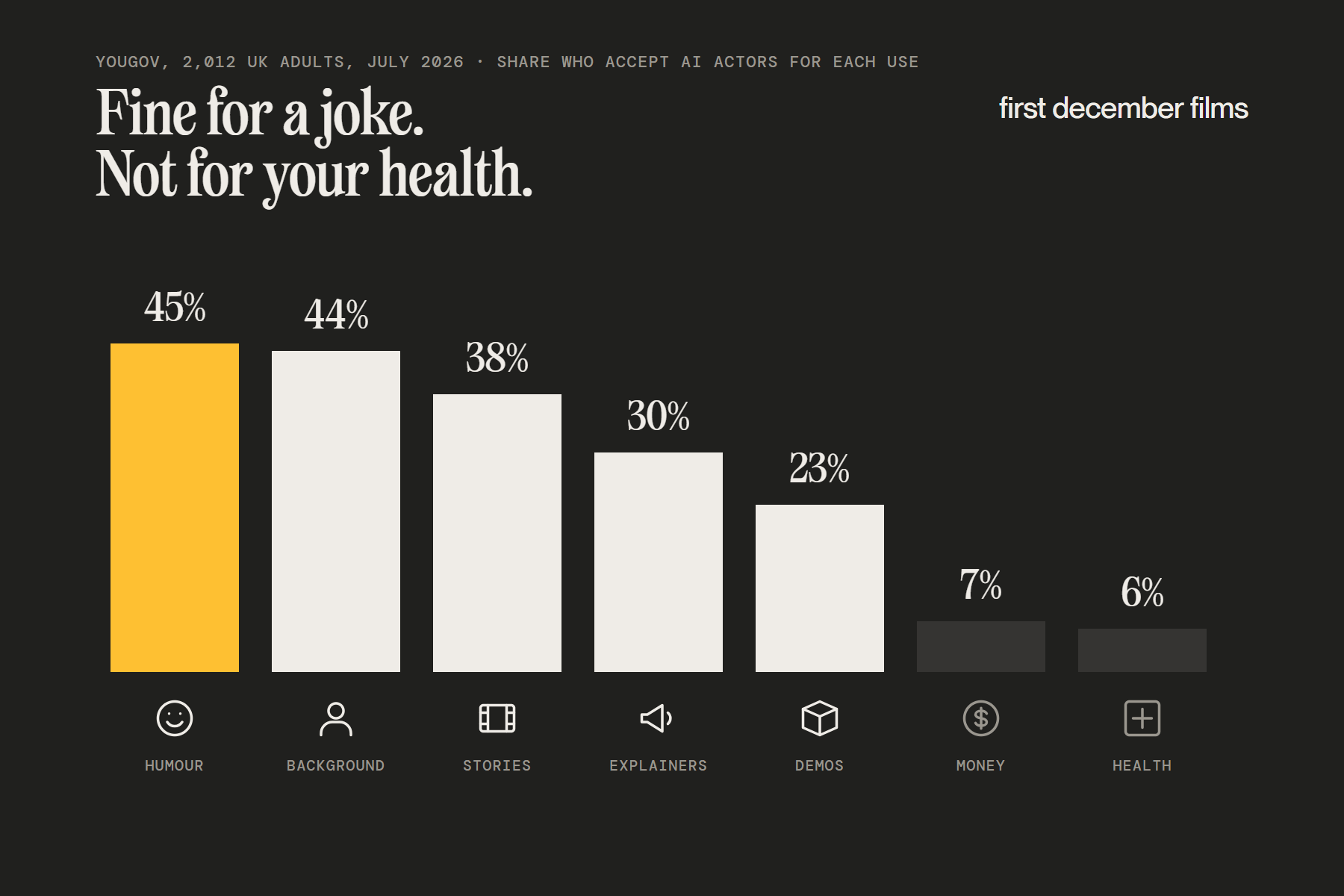
- Audiences draw a clear line. In a YouGov poll of 2,012 UK adults in July 2026, 45% accepted AI actors for humour but 6% for health claims; Gallup found 62% of Americans call AI-created people or voices in ads unacceptable even when disclosed.
What is an AI actor?
An AI actor is a person on screen or a voice in an ad whose performance was generated by an AI model rather than recorded from a human on the day. In ads, AI actors come in three kinds, and the difference decides almost everything that follows.
| Kind | What it is | Who is behind it | Consent you need | Who gets paid | Example |
|---|---|---|---|---|---|
| Digital replica | A model of a real, identifiable person’s face, body or voice that can generate new performances | The real person | Theirs, in writing, for a named use (their estate’s if they have died) | The person, per use | H&M’s digital twins of 30 models, 2025 |
| Stock avatar | A licensed presenter from an AI video platform’s library | Usually a real actor the platform recorded, whom you never meet | The platform’s licence; the actor’s consent is the platform’s job, and often invisible to you | The platform; the actor only if the platform pays them | The "AI actors" sold for UGC-style ads |
| Synthetic performer | An AI-generated person who resembles no real individual | No one, unless the model copied someone | No individual consent, but label and union rules can apply | No one, though US union contracts require a contribution | Tilly Norwood (Particle6, 2025) |
The three kinds of AI actor a brand can put in an ad. Definitions follow SAG-AFTRA’s 2025 Commercials Contracts and New York’s General Business Law s.396-b.
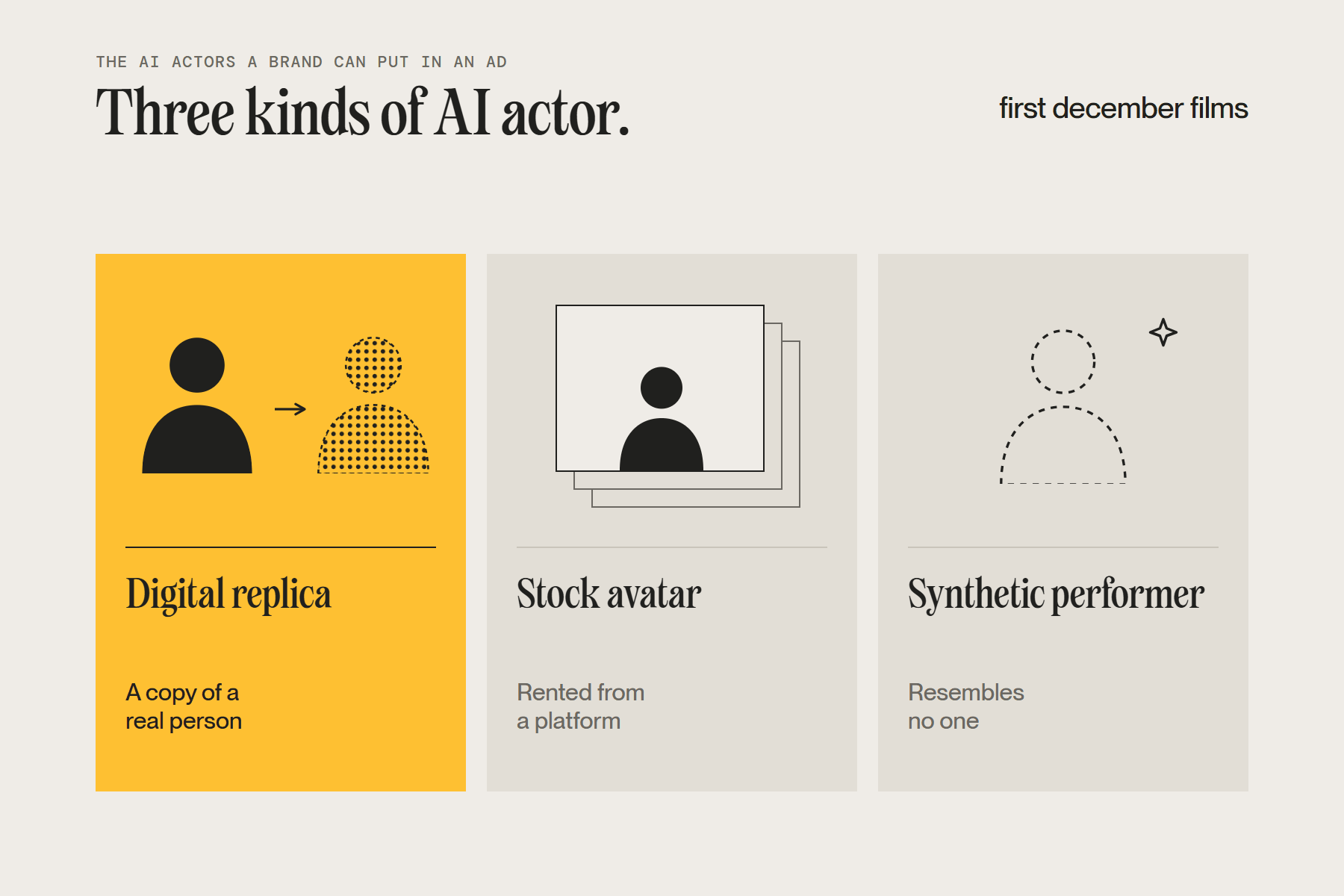
SAG-AFTRA’s commercials contract defines a digital replica as "a computer program made in whole or in part using the voice, image and/or performance of a performer that can independently generate new performances" (SAG-AFTRA, 2025). New York’s law defines a synthetic performer as an AI asset that gives the impression of a human performer "who is not recognizable as any identifiable natural performer" (New York Assembly, A8887-B).
Two things the table hides. First, voice counts. A cloned voice in a radio spot is a digital replica, and the voice cases are the ones most likely to reach court today. "You don’t need many recordings to create a digital replica of a voice," Liam Budd of the UK actors’ union Equity told The Guardian in October 2025. Second, a "synthetic" face that looks like a real person is treated as a replica in more and more markets. We come back to look-alikes below.
Can you put an AI actor in a commercial?
Yes, in every market we checked, if you get three things right: the consent behind the face or voice, the payment for its use, and the label where one is required. The order of questions is the same whatever the market.
- Does the AI actor look or sound like a real person? If yes, it is a replica, even if you never scanned anyone. You need that person’s written consent, or their estate’s.
- Is it a stock avatar from a platform? Then check the platform’s terms allow paid ads in your media, ask what consent its actor gave, and ask who pays if a claim arrives. Our audit below shows why.
- Is it fully synthetic? Then no individual consent is needed, but check the label rules in each market the ad runs in, and in the US check your union obligations.
- What does the AI actor say? Keep synthetic people away from testimonials, expert advice, health claims and financial claims in every market. Those are where regulators act first.
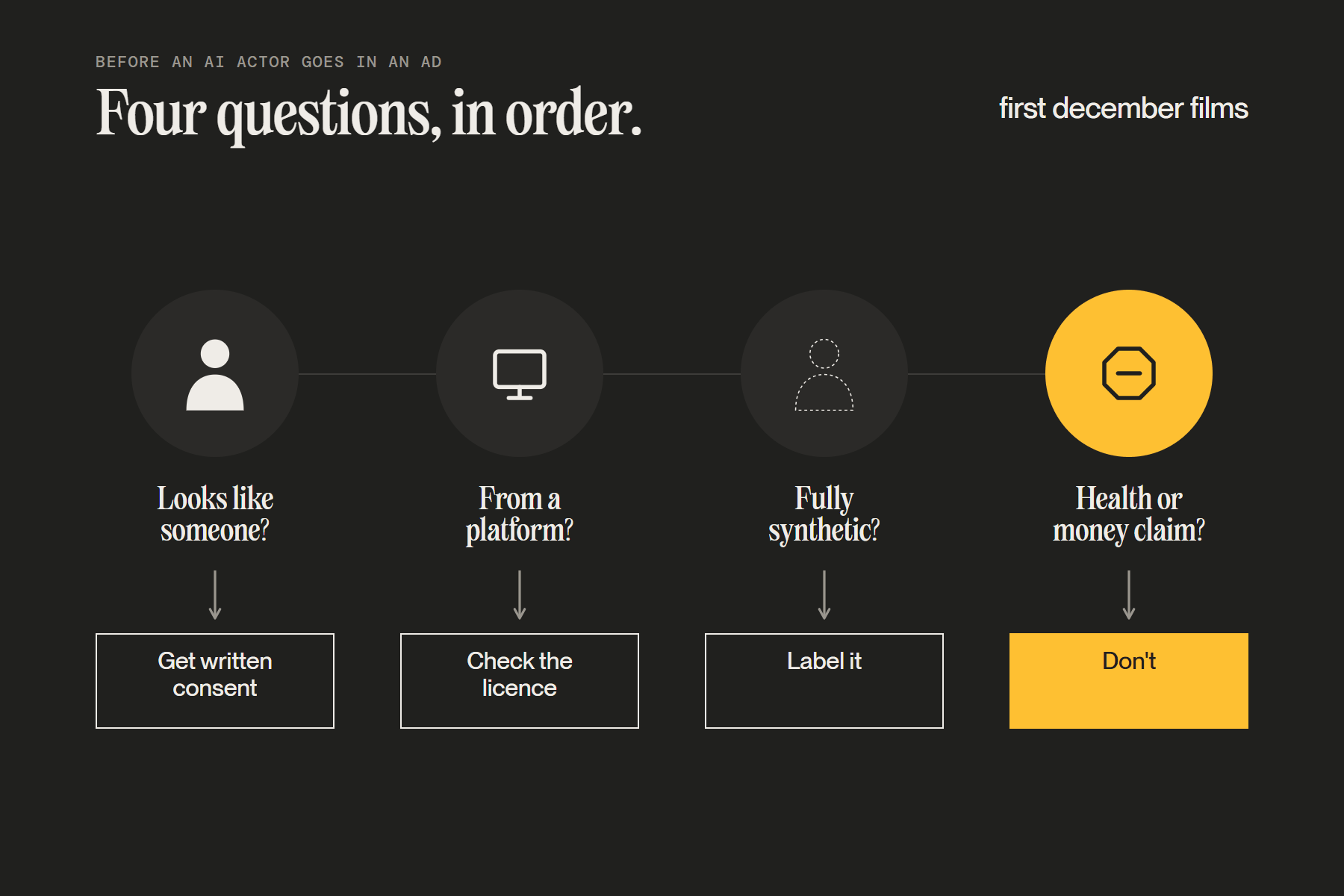
The fourth question matters more than the technology. The US Federal Trade Commission’s rule on fake reviews, in force since 21 October 2024, bans testimonials that misrepresent "that the reviewer or testimonialist exists" and covers AI-generated ones, with penalties of up to $53,088 per violation (16 CFR Part 465). The UK’s Advertising Standards Authority upheld complaints in April 2026 against a supplement website that showed health professional endorsements while a note at the foot of the page said the "people shown, are AI-generated representations"; the note did not save it (ASA ruling on Birling Shore Ltd).
What consent does a digital replica need?
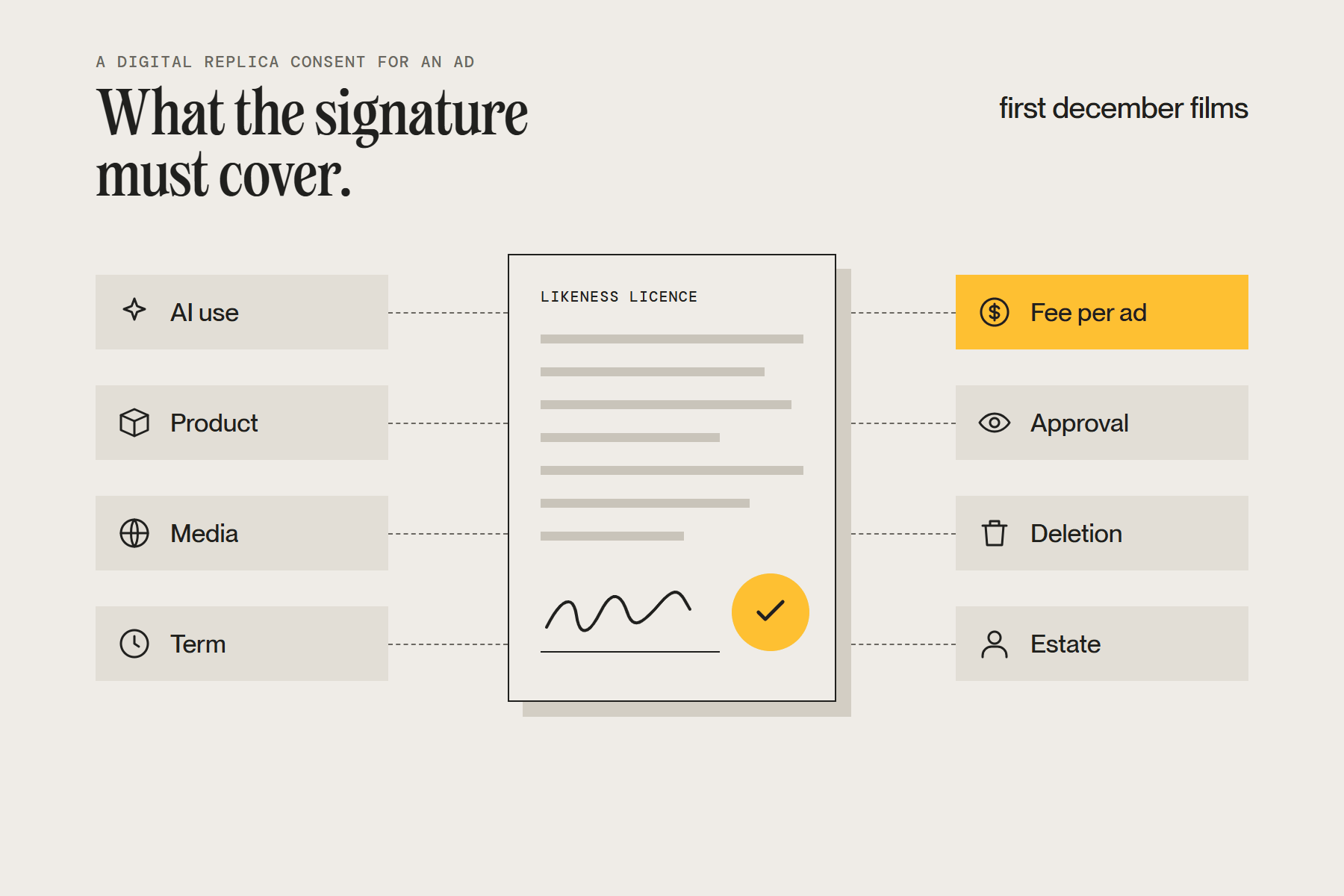
Written, specific and limited. Every rule we read on replicas, from union contracts to statutes on three continents, lands on the same elements: a signed document, a reasonably specific description of how the replica will be used, a limit on time and scope, a fee, and what happens to the files afterwards.
The details differ, but not by much:
- SAG-AFTRA, 2025 Commercials Contracts. Consent sought at least 48 hours ahead, "clear and conspicuous", through the union’s Digital Replica Rider or "a separate, signed writing", with "a reasonably specific description of intended use". Later ads only for "the same advertiser and product line"; the replica deleted within 90 days once the right to keep it ends (SAG-AFTRA summary of new provisions).
- New York. Since 1 January 2025 a replica clause is "void and unenforceable" without "a reasonably specific description of the intended use", unless the performer had a lawyer or a union contract covering replicas (General Obligations Law s.5-302). Since 19 June 2025 the Fashion Workers Act makes clients, including "an advertising agency, a photographer", get a model’s "clear and conspicuous prior written consent" for any digital replica, "detailing the scope, purpose, rate of pay, and duration of such use" (Labor Law s.1037).
- California and Illinois. Both void replica clauses that lack "a reasonably specific description of the intended uses" when the person had no lawyer or union (California AB 2602, 2024; Illinois Public Act 103-0830). California’s Civil Code s.3344 already required "prior consent" to use anyone’s "voice, signature, photograph, or likeness" in advertising; SB 1111, signed on 30 September 2026, writes digital replicas into that section from 1 January 2027 (California Legislature).
- US federal, pending. The NO FAKES Act of 2026 (S.4591) would make a replica licence valid only if it "is in writing and signed" and "includes a reasonably specific description of the intended uses", and would cap licences for living adults at 10 years. It cleared the Senate Judiciary Committee on 18 June 2026 and sits on the Senate calendar; the House version has not left committee (reported bill text, govinfo).
- China. An advertiser that uses another person’s name or image in an ad "应当事先取得其书面同意": must obtain their written consent in advance (Advertising Law, Article 33). On 7 September 2026 the Supreme People’s Court said that generating an identifiable virtual likeness or cloning an identifiable voice without consent infringes personality rights (China News, 7 September 2026).
- India. No statute, but ASCI’s guidelines on synthetically generated content, published on 29 September 2026, prohibit "deepfakes or a person’s likeness without consent" in ads, even with a label (ASCI guidelines, hosted by Fox Mandal).
- EU. A face or voice used to identify someone is biometric data under GDPR Article 9, which needs explicit consent in most commercial uses (GDPR).
From those sources, a replica consent for an ad should cover these points. We use it as a checklist on our own jobs.
| The consent should name | Why | Where it is already law or contract |
|---|---|---|
| The exact AI use: face, voice, body, de-ageing, translation, personalised versions | Vague clauses are void or unenforceable | SAG-AFTRA; New York; California; Illinois; NO FAKES (pending) |
| The brand, product line and the scripts or a description of them | Stops a replica selling something the person never agreed to | SAG-AFTRA (same advertiser and product line); ASCI |
| Media and territories | Pay and risk change with each | SAG-AFTRA use fees; Equity licensing guidance |
| Term, and a hard end date | Perpetual buyouts are where disputes start | NO FAKES (10-year cap, pending); Fashion Workers Act (duration) |
| The fee for creation and for each new use | The person is paid per use, not once | SAG-AFTRA (1.5 session fees per ad); Fashion Workers Act (rate of pay) |
| Approval of outputs before release | The person’s reputation travels with the replica | Equity’s AI vision statement; Narrativ (SAG-AFTRA) per-ad approval |
| Storage, security and deletion of the model and source files | Leaked models make unauthorised ads | SAG-AFTRA (delete within 90 days) |
| What happens on death, and who consents then | Estates now hold rights in several markets | New York; California; SAG-AFTRA; China; Japan (union guideline) |
What a replica consent for an ad should cover, synthesised from the sources above.
The cautionary case is a voice artist in Scotland. Gayanne Potter recorded audio for the speech company ReadSpeaker in 2021; in 2025 a synthetic voice built from it began making ScotRail’s train announcements. ReadSpeaker said "ReadSpeaker and Ms Potter have a contract regarding the use of her voice." Potter’s answer, quoted by The Scotsman, is the best one-line test of any old contract: "You cannot consent to something that doesn’t exist." ScotRail moved to replace the voice in August 2025. A contract signed before a technology existed is the weakest consent a brand can hold.
Our own rule, published on our AI ad films page, is written consent for every real face and voice covering scope, duration, fee and where it runs, with SAG-AFTRA’s digital-replica terms as our benchmark. Ganesh Pareek, our partner and executive producer, put the production side of it in BestMediaInfo in May 2026: "Every key element, prop, copy, character likeness, setting must be locked and documented before motion generation begins." The reason, he said, is that "that locked approval is now your compliance paper trail."
What about look-alikes and sound-alikes?
Treat them as replicas. Courts and regulators increasingly ask whether a viewer would recognise the person, not whether you started from their photo. China’s Supreme People’s Court framed its September 2026 opinion around "identifiable" likenesses and voices. In India, Probir Roy Chowdhury, a partner at JSA, told Storyboard18: "If an AI generated face, voice, style or persona is substantially evocative of a celebrity such that an average viewer would believe there is endorsement, association or involvement, courts can recognise this as actionable misuse." On 30 September 2026 the Tokyo District Court held that a voice can be protected by publicity rights; "The human voice is symbolic of individual personality, just like one’s portrait," Judge Aya Takahashi wrote, according to AP.
The union contract closes the prompt route too. Under SAG-AFTRA’s 2025 terms, a producer that creates a synthetic performer "by prompting a GAI system with the name, photograph, image or recording of an identified performer" must "obtain that Performer’s consent and pay not less than the minimum session fee". We never make celebrity look-alikes; it is on the "Never" list on our AI page.
What about people who have died?
Ask the estate, and in several markets you must. New York has required prior consent to use "a deceased performer’s digital replica" since 11 December 2025, with damages of at least $2,000 (Civil Rights Law s.50-f, A8882); California’s minimum is $10,000 (AB 1836). The NO FAKES bill would give heirs a right for 10 years after death, renewable up to 70. SAG-AFTRA’s commercials contract requires consent from the performer’s estate, or from the union if no one can be found. In China, the Supreme People’s Court’s 2026 opinion lets close relatives sue over AI avatars of the dead. The Japan Actors Union, in a guideline published on 15 October 2026, requires heirs’ permission before a deceased performer’s voice is used (Japan Actors Union, PR TIMES).
India has no settled answer. In 2023 the Delhi High Court refused to stop a film about the late actor Sushant Singh Rajput at his father’s request, writing that "The law cannot allow itself to be a vehicle to promote celebrity culture" (Krishna Kishore Singh v Sarla A Saraogi). That is a reason for more care, not less: a dead founder or film star shown endorsing a product is a fabricated endorsement under ASCI’s code whatever the courts say about heirs.
How are actors paid when their replica appears in an ad?
Per use, not once. Where a union sets the terms, the replica is paid as if the actor had performed, plus a premium; everywhere else it is negotiated, and the trend in every market we checked is towards licences limited in time and scope.
First, the question people search for most: do actors get paid every time a commercial airs? In the US, only network television ("Class A") pays per airing, on a declining scale. Cable, wild spot, streaming and online use are paid in cycles of 13 or 52 weeks, however often the ad runs, plus a holding fee every 13 weeks to keep the right to air it (SAG-AFTRA). In the UK, featured actors are paid by audience size or licence period. In India, there is no union scale; the fee and the usage term are whatever the contract says.
What a replica costs under US union scale
The 2025 SAG-AFTRA Commercials Contracts, ratified by 96.90% of voting members and running from 1 April 2025, set the first price list for replicas in ads. The performer gets "no less than 1.5 session fees for each commercial that contains a performance generated by their Digital Replica", plus "use and holding fees" as for any commercial; one session fee may be set against the use fees (SAG-AFTRA summary; advertisers’ client alert, Joint Policy Committee). Time spent being scanned is paid work time.
Here is what that means for one actor, at the rates in force from 1 April 2026. The arithmetic is ours; the inputs are from the union and advertiser rate sheets.
| Line | Amount (USD) | Source |
|---|---|---|
| Session fee, on-camera principal (also paid for scan time) | 855.20 | JPC rate sheet, Year 2 |
| Replica fee per new commercial: 1.5 session fees | 1,282.80 | SAG-AFTRA summary; our multiplication |
| Online use, 13 weeks (social and websites, no paid YouTube) | 1,212.12 | JPC rate sheet, Year 2 |
| Less one session fee credited against use | minus 855.20 | SAG-AFTRA memorandum of agreement |
| Talent cost per replica commercial, 13 weeks online | 1,639.72 | Our total |
| Three new commercials from one scan, 13 weeks online | 4,919.16 | Our total |
| Pension and health contributions | on top (23.5% of gross under the contract, with different allocations for digital-only ads) | JPC client alert |
Talent cost of a digital replica in a US union commercial at 2026 rates. Holding fees and broadcast use are extra where they apply; foreign use is a multiple of the session fee (UK 3, Europe 2, Asia-Pacific 2, worldwide 9).

The point of the example is not the dollar figure. It is that the replica costs more per ad in talent fees than the actor turning up would: 1.5 session fees instead of one. What the brand saves is the shoot: crew, location, travel and days. Tuhin Mishra, managing director of the athlete agency Baseline Ventures, said the same thing about Indian stars in Fortune India in July 2026: "Production cost might go down. The association cost will not."
The union has also priced voice replicas for personalised audio ads. Under its AI and Dynamic Audio Commercial Waiver, a recording session pays $600.60 from April 2026, each AI-created commercial pays one session fee, custom elements such as a listener’s town or name add half a session, and a year’s digital use is $1,670.15 (JPC, Year 2 waiver). On the union-approved platform Narrativ, performers "set your own price for the use of your digital voice replica, with SAG-AFTRA minimums in place", approve each ad and can have the replica deleted when they leave (SAG-AFTRA).
What a replica costs elsewhere
| Market | Who sets the rate | What is published | Source |
|---|---|---|---|
| United States | SAG-AFTRA contract | 1.5 session fees per replica ad ($1,282.80 from April 2026), plus use and holding fees | SAG-AFTRA; JPC |
| United Kingdom | Negotiated; no collective agreement for commercials | Equity’s guide: base session fee at least £300, more likely £350 (about $467), plus 12.07% holiday pay; UK online use at least 400% of it for one year on one site. No replica rate | Equity |
| Europe (fashion) | Model agencies | H&M’s 30 digital twins: models own the rights and are paid "similarly to traditional licensing agreements"; no figure | Inside Retail Asia, 31 March 2025 |
| India | Negotiated; no union scale or replica rate | Shah Rukh Khan’s endorsement fee about ₹10 crore (about $1.05 million) a deal, per Kroll’s 2025 report as cited by Outlook Business | Outlook Business, 5 August 2026 |
| China (synthetic, for comparison) | The AI actor’s owner | AI actress Fang Taozi: 168,000 to 258,000 yuan (about $25,100 to $38,600) per video, by length | Sixth Tone, 12 August 2026 |
How replica and AI-actor pay is set by market. Conversions at ECB reference rates of 16 October 2026.
Two warnings from outside the US. In the UK, Equity’s position is that "one-off payments offered to performers who engage in AI work often do not reflect the fact that their image, voice or likeness may be used forever and on thousands of different projects" (Equity AI vision statement). In India, nobody has a price yet. "Nobody knows how to price that right now," Manish Porwal of the talent firm Alchemist told Fortune India, and he added: "Celebrities are not keen to give their AI rights at all." Kirti Balasubramanian, a partner at Trilegal, expects identity to be "licensed separately": voice, appearance and other traits as separate rights. That is his forecast, but it matches how the US union already prices voice and on-camera replicas separately.
An Indian brand should also know a 2018 Madras High Court ruling: when the actor Kajal Aggarwal sued over a hair-oil ad that ran beyond its one-year term, the court held that the producer’s copyright in the film could not be cut down by the agreement (The News Minute). The ruling is old and predates AI, but the lesson holds: if a replica’s use is meant to end, the contract has to say so, and say what happens to the model.
What about fully synthetic AI actors like Tilly Norwood?
A synthetic performer needs no one’s consent, but it is not rule-free, and the rules are multiplying.
- US union contracts. SAG-AFTRA’s 2025 commercials terms say a producer "shall not use a Synthetic Performer primarily or materially for reasons of economy". If a synthetic performer appears alongside at least one human principal, the producer pays 1.5 session fees, plus benefit contributions, into the union’s funds within 30 days; fully synthetic ads are bargained case by case. When Tilly Norwood appeared, the union reminded producers "they may not use synthetic performers without complying with our contractual obligations, which require notice and bargaining whenever a synthetic performer is going to be used" (AV Club, 30 September 2025).
- New York. Since 9 June 2026, anyone who produces an ad "shall conspicuously disclose in such advertisement that a synthetic performer is in such advertisement", where they know it. Penalties are $1,000 for a first violation and $5,000 after. Audio ads and AI used only to translate a human performer are exempt (A8887-B). A bill introduced on 2 September 2026 would require the disclosure for the entire time the performer is on screen.
- European Union. Article 50 of the AI Act has required deployers to disclose deep fakes since 2 August 2026. The European Commission’s guidelines of 20 July 2026 list "fully AI-generated actors, digital replicas of real or deceased actors, de-aging" as likely deep fakes, and give "an AI-generated depiction of a celebrity influencer in an advertising or promotional context" as an example. Talking mice arguing over cheese in an ad are not a deep fake. Fines reach €15 million or 3% of worldwide turnover (about $16.9 million) (Commission guidelines).
- South Korea. The Fair Trade Commission’s revised endorsement guidelines, in force since 1 June 2026, treat AI virtual persons as endorsers: in photo and video ads a "virtual person" (가상인물) tag must sit near the figure while it is on screen, and the tag does not excuse a false claim of experience (Financial News, 31 May 2026).
- China. Since 1 February 2026, AI-generated people selling in live-stream commerce must be labelled continuously (live-streaming e-commerce measures, CAC), on top of the general AI labelling rules in force since 1 September 2025.
- India. ASCI’s guidelines, which take effect three months after their 29 September 2026 publication, require a label for "synthetically generated influencers and ambassadors".
And synthetic is only synthetic if it resembles no one. The Scottish actor Briony Monroe says Tilly Norwood resembles her; "I actually had to sit down, because I had never seen something that looked so strikingly similar to myself in my life," she told STV News. Particle6 denies it, saying Tilly "was developed entirely from scratch using original creative design". Whoopi Goldberg made the wider point on The View: an AI actor is "something that’s been generated with 5000 other actors" (TheWrap). For a brand, the practical step is to check a synthetic face against reverse image search and your casting team’s eye before it goes to final.
Where audiences draw the line
The only survey we found that asks about AI actors in ads specifically is YouGov’s poll of 2,012 UK adults on 6 and 7 July 2026. 78% said they would trust a brand less if it used AI-generated actors and 94% said companies should disclose them. Acceptance depended on the job: 45% accepted AI actors for humour and 44% for background characters, but 7% for financial claims and 6% for health claims (YouGov). In the US, a Bentley University-Gallup survey of 3,270 adults in May 2026 found "Nearly two in three Americans (62%) say that practice is unacceptable, even when businesses clearly disclose that AI was used", the practice being AI-created people or voices in ads; among 18 to 29 year olds it was 73% (Gallup, 19 August 2026).
The one dataset pointing the other way comes from India and the Gulf. In a 17-market YouGov study, 55% of Indians and 51% of people in the UAE said they were likely to engage with AI-generated influencers, against a global 23% (Analytics India Magazine, 6 March 2025). That measures interest in AI influencers, not trust in AI actors in ads, so read it as permission to experiment, not to stop disclosing.
What do AI avatar platforms promise about their actors?
Less than most brands assume. Many brands that search "AI actors" end up buying from platforms that sell AI presenters and UGC-style creators for ads. We read the public terms, acceptable-use policies, product pages and ethics pages of 15 of them on 19 October 2026 and recorded only what each platform says in its own words. The platforms: Arcads, HeyGen, Synthesia, Creatify, Captions, D-ID, Colossyan, Tavus, Argil, MakeUGC, Higgsfield, Vidnoz, Synthesys, VEED and TrueFan AI (India).
| What the platform’s own pages say | Platforms (of 15) |
|---|---|
| Stock avatars are based on real people | 9 |
| Those people consented | 5 |
| Consent was written, explicit or under a signed contract | 3 |
| Those people are paid | 2 |
| A pay figure is given | 0 |
| Commercial or advertising use is allowed | 9 |
| Paid ads or TV with stock avatars need the platform’s written agreement | 2 (Synthesia, Colossyan) |
| Testimonials or endorsements by avatars are restricted in binding terms | 5 |
| The platform marks every output as AI | 1 (D-ID) |
| C2PA content credentials applied to output today | 0 |
| The platform defends the brand against a stock avatar likeness claim | 1 (Synthesia) |
| The brand must indemnify the platform | 14 |
| A stock actor can withdraw their likeness | 2 (Arcads, Synthesia) |
| A union agreement (SAG-AFTRA, Equity or other) | 0 |
First December Films audit of 15 AI-avatar platforms’ public terms and pages, read 19 October 2026. Enterprise contracts may say more; "not stated" means the public pages do not say.
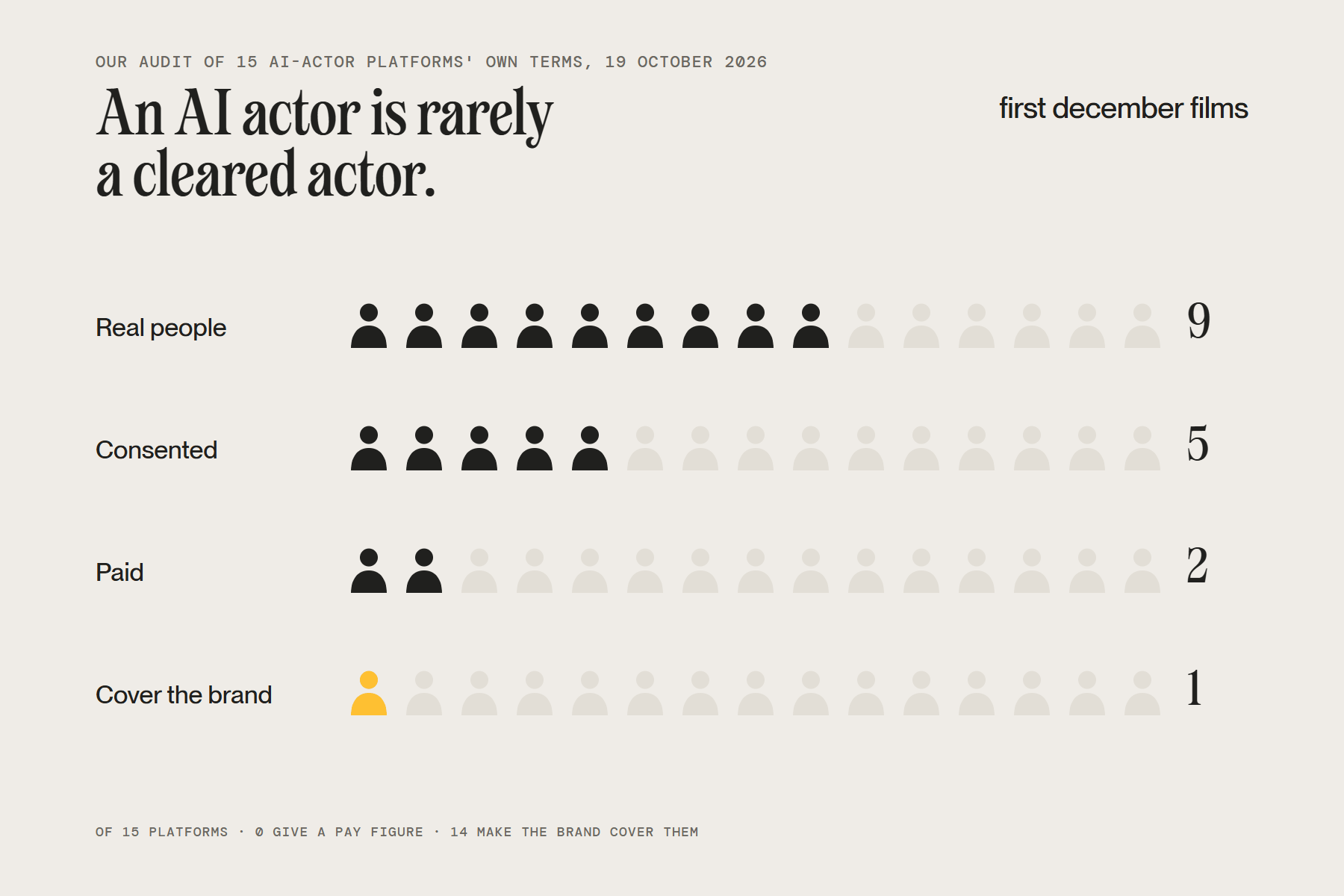
Four findings stood out.
The risk sits with the brand. Fourteen of the 15 make the customer indemnify the platform. Only Synthesia’s terms commit it to defend a customer against a claim that "the use of a Stock Avatar’s voice or likeness, as permitted hereunder, violates the applicable actor’s right to privacy or publicity", and "as permitted" excludes paid ads unless Synthesia agrees in writing (Synthesia terms).
Withdrawal can reach live ads. Arcads’ terms say the company "may ask the Client to delete any Videos from all supports where they are used in the event of a withdrawal request made by the Creator", with a charge of 100 euros a day for delay (Arcads terms). Most platforms say nothing about what happens to your running campaign if their actor withdraws.
Pay claims are thin, and one vanished. Synthesia says its stock-avatar actors "license their likeness for a period of three years in return for a flat fee" (Synthesia, 25 March 2025). From at least October 2025 to July 2026, HeyGen’s avatars page said its avatars were "built with consented data from real actors and talent" and that it was "compensating actors for each video generated with their likeness" (Wayback copy, 27 July 2026). The sentence is absent from the copy of 2 September 2026 and from the live page. We found no public explanation, and we have not counted it in the table.
Testimonial ads collide with the terms. Synthesia’s stock avatars may not "Endorse products or services"; Colossyan bars avatars "expressing any personal preferences or experiences as their own"; MakeUGC forbids output used to "fabricate testimonials" while selling testimonial-style UGC. A "this changed my skin" spot made with a stock avatar can breach the platform’s terms before it breaches any ad code.
What to ask an AI-actor vendor before a paid campaign: proof that the actor behind the avatar consented to advertising use in your category and media; whether and how the actor is paid; what happens to your live ads if they withdraw; whether the platform will indemnify you for likeness claims; and whether the output carries a watermark or content credentials.
What are the rules by market?
| Market | Consent to use a real person’s likeness or voice in an ad | Specific replica law | Label for synthetic people in ads | Union or industry terms |
|---|---|---|---|---|
| US, federal | False endorsement under the Lanham Act; FTC bans fake and AI testimonials | NO FAKES Act (S.4591) on the Senate calendar, not law | None | SAG-AFTRA 2025 Commercials Contracts |
| New York | Required; replica clauses void without a specific use; Fashion Workers Act for models | Yes, including dead performers (from 11 Dec 2025) | Yes, since 9 Jun 2026 ($1,000, then $5,000) | SAG-AFTRA |
| California | Prior consent for ads (Civil Code s.3344, minimum $750); replicas added from 1 Jan 2027 | Yes (AB 2602; AB 1836 for the dead, minimum $10,000) | No advertiser duty | SAG-AFTRA |
| Tennessee | Prior consent (ELVIS Act, since 1 Jul 2024) | Yes | None | SAG-AFTRA |
| United Kingdom | No image right; passing off; CAP Code urges written permission | None; government consultation promised | None; misleading ads judged case by case | Equity: no AI deal with producers yet |
| European Union | National law (for example Germany’s KUG s.22) plus GDPR | National: Italy (crime since 10 Oct 2025); Denmark and Spain bills | Yes, Article 50 deep fakes since 2 Aug 2026 | National unions |
| China | Written consent in advance (Advertising Law Art. 33) | Supreme People’s Court opinion, 7 Sep 2026 | Yes, since 1 Sep 2025; live commerce since 1 Feb 2026 | None found |
| South Korea | Publicity right for well-known people | None | Yes: AI Basic Act (22 Jan 2026); "virtual person" tag on ads (1 Jun 2026) | None found |
| Japan | Case law (Pink Lady, 2012); Justice Ministry guideline, Aug 2026, covers voices | None | None | Japan Actors Union guideline, 15 Oct 2026 |
| UAE | Prior official approval to depict public figures with AI | None | None found | None found |
| Saudi Arabia | SDAIA guidance: explicit consent (guidance, not law) | None | Guidance only | None found |
| India | High Court personality-rights orders; ASCI bans likeness without consent | None | ASCI label from late December 2026; platforms since 20 Feb 2026 | None |
Consent, replica and label rules for AI actors in ads, by market, as of 19 October 2026. Sources in the sections below.
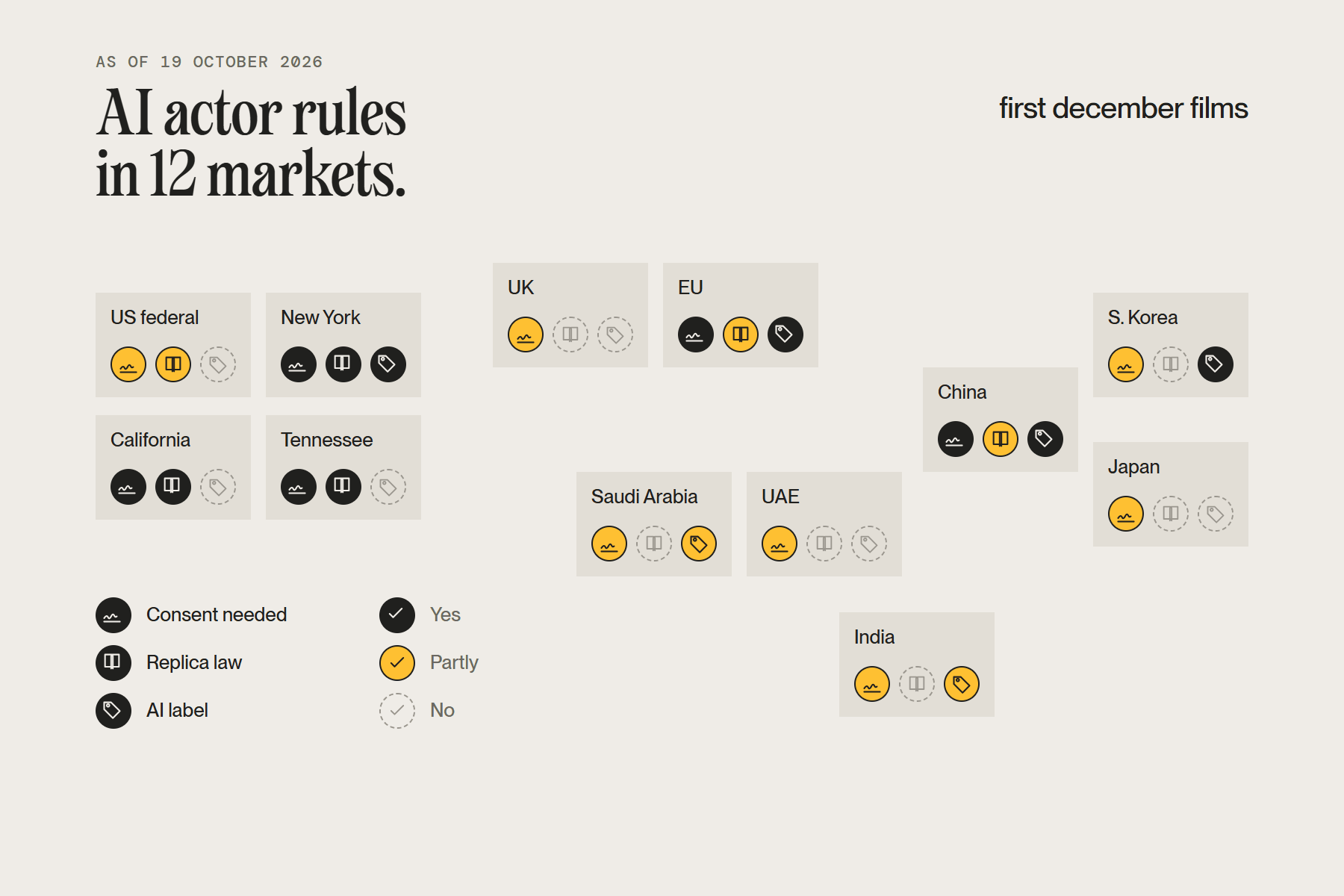
United States
There is no federal right of publicity. A brand that uses a recognisable person without permission risks a false-endorsement claim under the Lanham Act and, if the person appears to vouch for the product, the FTC’s testimonial rule. The real rules are in the states and the union contract. Tennessee’s ELVIS Act gives "Every individual" a "property right in the use of that individual’s name, photograph, voice, or likeness in any medium in any manner" (Tennessee Public Chapter 588). New York, California and Illinois police the contracts. The NO FAKES Act would set a federal floor of $25,000 per work for unauthorised replicas by anyone other than an online service, and would override new state claims in expressive works while keeping state laws that existed on 2 January 2025.
Sean Astin, SAG-AFTRA’s president, told the House Judiciary Committee in June 2026: "Every American deserves the right to own, as property, their voice and likeness." And: "Consent is not a nuisance." (written testimony)
United Kingdom
English law has no image right: "There is in English law no ‘image right’ or ‘character right’ which allows a celebrity to control the use of his or her name or image," the Court of Appeal said in the Rihanna T-shirt case (Fenty v Arcadia, 2015). False endorsement is passing off, as when the racing driver Eddie Irvine won £25,000 from talkSPORT in 2003 over a doctored photo of him holding a radio (Irvine v Talksport). The CAP Code tells marketers they are "urged to obtain written permission" before implying anyone’s approval (CAP Code section 6). The government said in March 2026 it would consider "whether it would be beneficial to introduce a new digital replica or personality right" and has promised a consultation; we found none open on 19 October 2026.
The pressure comes from Equity. In December 2025, 99.6% of film and TV members who voted in an indicative ballot said they were prepared to refuse digital scanning on set to win AI protections, on a turnout of 75.1% (IBC). "We need adequate AI protections which build on, not merely replicate, those agreed after the SAG-AFTRA strike in the USA over two years ago," said Paul W Fleming, Equity’s general secretary, after the vote (C21Media). Commercials are outside that dispute, but the same actors work in both.
European Union
The AI Act’s Article 50 makes labelling a deployer’s duty: whoever controls the AI use. The Commission’s guidelines say a brand that "merely commissions an advertising agency", without deciding whether and how the agency uses AI, is not the deployer, so in practice the duty usually sits with the agency or studio that generates the film, and the brand should put it in the contract. The guidelines also say ads "might be regarded as evidently creative or fictional works in certain, specific situations, but not in others"; where they are, the disclosure can be made in a way that does not spoil the work. Consent still comes from national law: Germany’s 1907 KUG s.22 says pictures of a person may be shown only with their consent, and relatives decide for 10 years after death (KUG s.22).
Three countries are going further. Italy made spreading AI-falsified images, videos or voices that cause unjust harm a crime punishable by one to five years in prison, in force since 10 October 2025 (Law 132/2025). Spain’s government sent Congress a bill on 7 July 2026 that treats using a person’s voice or image with AI "con fines publicitarios o comerciales" without authorisation as unlawful (Ministry of Justice). Denmark introduced its bill giving people rights over their own face and voice on 8 October 2026; the culture minister hopes it takes effect at the start of 2027 (Euronews). When the plan was announced, Denmark’s culture minister Jakob Engel-Schmidt said the bill sends "an unequivocal message that everybody has the right to their own body, their own voice and their own facial features" (The Guardian, 27 June 2025).
China
China has the most explicit consent rule for ads (written, in advance) and the most enforcement. The Beijing Internet Court awarded a voice actor 250,000 yuan (about $37,400) in April 2024 after the actor’s recordings were used without permission to build a text-to-speech product. In a typical case published on 16 October 2026, the same court held a company that commissioned AI voice-cloned sales videos jointly liable with the livestreamer because it "未对素材授权情况进行审查": it did not check the permissions behind the material (The Paper). That is the risk for any brand buying AI-actor content from a vendor: not checking counts as negligence. False ads attract fines of three to five times the ad spend, or 200,000 to 1 million yuan where spend cannot be calculated. Note one oddity: a lawyer quoted by Sixth Tone says AI avatars are "not considered people under Chinese law and therefore not legally considered advertisement endorsers", which removes the endorser rules but not the false-advertising ones.
South Korea and Japan
South Korea’s AI Basic Act, in force since 22 January 2026, requires generative AI operators to label realistic synthetic images, sound and video, with fines of up to 30 million won (about $22,500) after a grace period of at least a year. The Fair Trade Commission’s "virtual person" tag covers the advertiser’s side. Korea’s consumer agency found six deepfake celebrity endorsements among 38 illegal gambling ads it reviewed on Facebook (Financial News, December 2025).
Japan has no replica statute, but in 2026 it moved quickly. The Justice Ministry’s guideline, published in August 2026, says protected likeness includes a person’s voice and names impersonation ads on social media as a typical infringement (Ministry of Justice). The Tokyo District Court ruling of 30 September 2026 followed. Then on 15 October 2026 the Japan Actors Union, with about 2,600 members, published a voluntary guideline requiring prior permission at every stage of AI voice use, payment for it and heirs’ consent for the dead. "This is a major step toward protecting our rights," Yuko Sasaki of the union said of the ministry’s draft in July, in The Yomiuri Shimbun.
The Gulf
The UAE Media Council warned in September 2025 that using AI "to depict national symbols or public figures without prior official approval constitutes a clear legal violation of media content standards" (WAM). Saudi Arabia’s data and AI authority SDAIA tells creators to "Obtain explicit consent from individuals whose likeness is used in the creation of deepfakes" (SDAIA deepfakes guidelines), though that is guidance, not law. Brands in the region are already building their own AI faces: "Smart brands are quickly waking up to the benefits of building their own customised AI Ambassador," Lewis Davey, founder of the Dubai AI talent agency Pixel, told Campaign Middle East in April 2026.
India
India protects faces and voices through the High Courts, case by case. The Delhi High Court said in Anil Kapoor’s case in 2023 that AI tools "make it possible for any illegal and unauthorised user to use, produce or imitate any celebrity’s persona" (Indian Kanoon); since then courts have protected Arijit Singh’s voice, and in 2025 alone Aishwarya Rai Bachchan, Abhishek Bachchan, Karan Johar, Nagarjuna and Asha Bhosle. ASCI’s new guidelines ban using "a person’s likeness without consent" outright and require a label when a real person’s likeness or voice is replicated "even with their consent, for personalised messaging", the format Cadbury made famous in 2021 with Shah Rukh Khan. The Digital Personal Data Protection Rules’ consent duties apply from about May 2027 (DPDP Rules, Gazette of India).
There is no union contract for replicas in India, so the brand’s own paperwork is the only protection, for the brand and the actor. "No brand or agency wants to get sued," said Harsh Kapadia, chief creative officer of Grey India, in ETBrandEquity. For the full picture of Indian law on AI ads, including our count of 103 personality-rights orders, see our guide to whether AI ads are legal in India.
Will AI actors replace actors in ads?
For some roles, yes; for the roles that sell, not soon, and not cheaply. Our view, from making both kinds of film:
- Synthetic people will take background, crowd and illustration roles. That is where audiences accept them (44% for background in the YouGov poll) and where no one’s identity is at stake.
- Famous faces will stay expensive. A replica of a star pays per use, and the star’s agent prices the association, not the shoot day.
- Unknown faces and voices are most at risk. Stock avatars and voice libraries pay their performers little or nothing per ad, and India’s voice artists already feel it: the general secretary of the Association of Voice Artists, Amarinder Singh Sodhi, told The Hollywood Reporter India in July 2025 that a voice actor’s monthly projects had fallen from "around 15-20" to "maybe six or seven".
Practitioners disagree on how far it goes. Eline van der Velden, Tilly Norwood’s creator, says "she is not a replacement for a human being, but a creative work". Baek Seung-yup, chief executive of Sidus Studio X, which created the South Korean virtual model Rozy, argued in 2021 that "The biggest advantage of virtual influencers is that they have zero scandals." On the other side, the US union’s statement on Tilly Norwood said she "is not an actor, it’s a character generated by a computer program that was trained on the work of countless professional performers" (NBC News). And some brands have turned "real" into the message: Mint Mobile answered the Norwood launch with an ad starring a real customer named Tilly Norwood.
Our forecast, and it is only ours: within a year most large ad markets will require a label on synthetic people, and the price of a replica of a well-known face will not fall. The price of an anonymous face or voice will.
When does this guide not apply?
Skip it if your AI character is plainly not human: a mascot, an animal, a cartoon. The EU’s own example of something that is not a deep fake is talking mice in an ad.
Read the dubbing rules separately if you only translate a filmed actor’s voice and lip movements into other languages. New York exempts AI used "solely" for translation from its label, but the actor’s contract still has to allow it.
Do not use it for political ads or scam-ad takedowns. Political deepfakes have their own election rules, and impersonation scams belong with the platform’s report button and the police.
Check existing contracts. Many market-specific rules apply only to contracts signed after a date (New York and California from 1 January 2025, Illinois from August 2024). A 2019 buyout may still bind the actor, and may still not cover AI.
Ask a lawyer before you sign. We describe the rules and how productions handle them; we do not give legal advice, and our own contract wording is with our lawyer.
How did we get here, and what comes next?
The rules arrived in a rush. Japan’s Supreme Court set its publicity test in the Pink Lady case in 2012. China’s Civil Code protected portraits and voices from 2021. The 2023 Hollywood strike produced the first union replica terms, and Tennessee’s ELVIS Act followed in 2024. In 2025 came SAG-AFTRA’s commercials terms, China’s labelling rules and Tilly Norwood. 2026 brought the most: Korea’s AI Basic Act in January, India’s platform labelling rules in February, the NO FAKES Act’s committee vote in June, New York’s synthetic performer label in June, the EU’s Article 50 and Japan’s Justice Ministry guidance in August, ASCI’s guidelines, China’s Supreme People’s Court opinion and the Tokyo voice ruling in September, and Denmark’s bill and the Japan Actors Union guideline in October. Counting only the laws, court rulings, codes, guidelines and union contracts in our research timeline, there was one in each of 2012, 2020 and 2022, two in 2023, ten in each of 2024 and 2025, and sixteen in 2026 by 19 October.
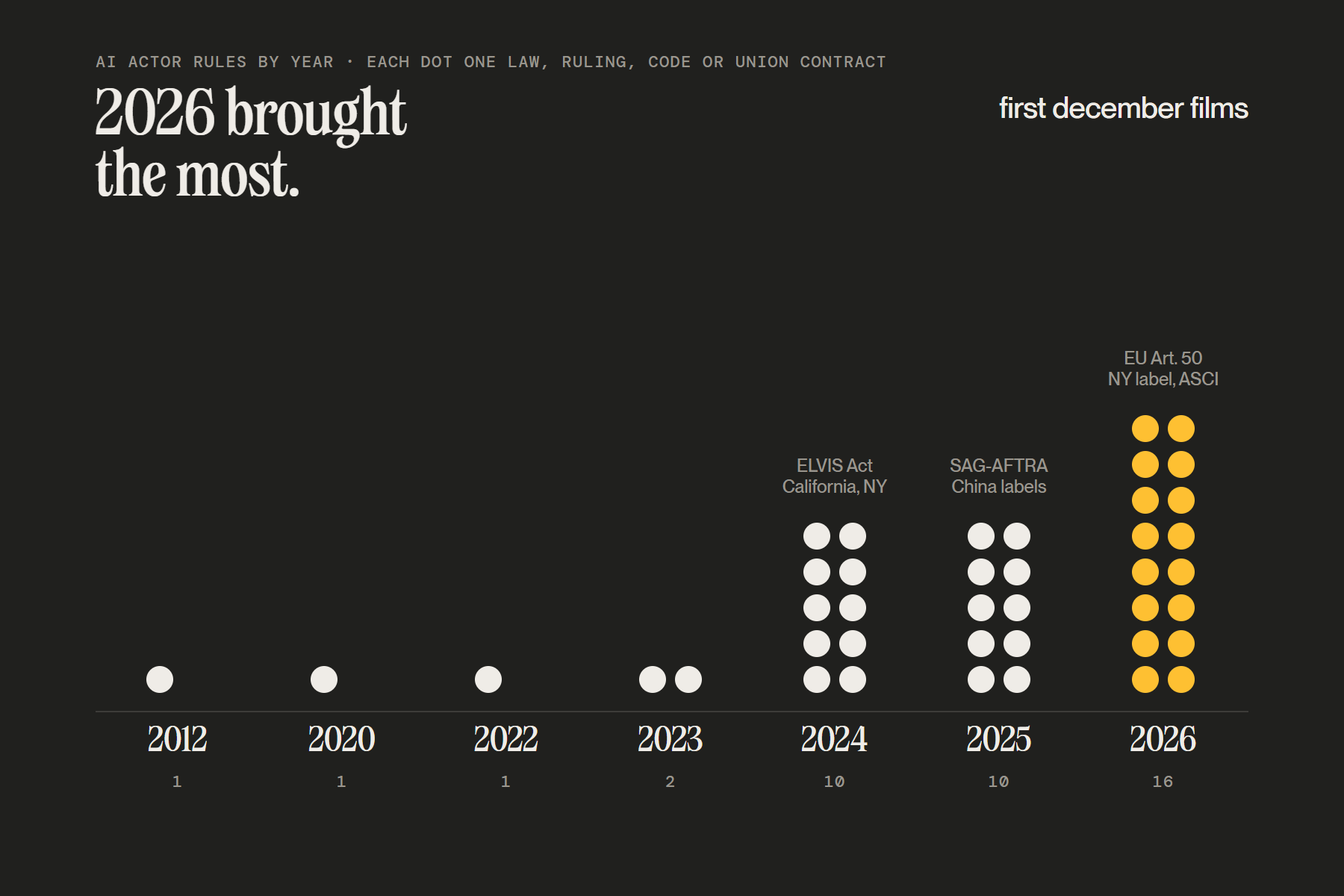
Dated changes ahead: the EU’s machine-readable marking duty for AI tools already on the market applies from 2 December 2026; ASCI’s guidelines take effect around 29 December 2026; California’s SB 1111 on 1 January 2027; Denmark hopes for early 2027; India’s data protection consent rules around May 2027. The NO FAKES Act has no floor vote scheduled.
Casting an AI actor for your next film?
Decide early which kind you need. A synthetic person for a crowd or a joke is cheap to clear; a replica of a known face needs a contract before anyone generates a frame; a stock avatar needs questions answered by the vendor, in writing.
If you are weighing AI for a film, paste your script into our script analyser for a free producer’s read, bring us the one scene everyone says can’t be done as a paid feasibility test, or send us the brief and a named producer will tell you which faces and voices you can generate, which you must license and how to label the result. You can read more about Ganesh Pareek, who oversees budgeting and AI policy at the house, on his page. For how the films themselves are made, see our guide to how AI commercials are made; for budgets, our AI ad film cost guide; and for spotting AI in finished ads, is that ad AI?
First December Films is an advertising film production company in Mumbai. Our work has won more than 150 international creative awards, including Cannes Lions, D&AD and One Show Gold Pencils.
Frequently asked questions
What is an AI actor?
An AI actor is a person on screen or a voice in an ad whose performance was generated by an AI model. In advertising it is one of three things: a digital replica of a real person, a stock avatar licensed from a real actor by a video platform, or a synthetic performer who resembles no one.
Do you need consent to use an AI version of a real actor in an ad?
Yes. Use a written, signed consent that names the exact use, products, media, term and fee. SAG-AFTRA’s 2025 commercials contract requires it, New York, California and Illinois void vague replica clauses, China requires written consent for anyone’s image in an ad, and India’s ASCI bans a person’s likeness without consent.
How much do actors get paid for an AI digital replica in an ad?
Under the 2025 SAG-AFTRA Commercials Contracts, a performer gets at least 1.5 session fees for every commercial their replica appears in, which is 1,282.80 dollars at 2026 rates, plus use and holding fees as if they had performed in person. Outside the US there is no published replica rate; fees are negotiated.
Do actors get paid every time their commercial airs?
Only for US network television, which pays per airing on a declining scale under the SAG-AFTRA contract. Cable, streaming and online use are paid in cycles of 13 or 52 weeks, plus holding fees to keep the ad on air. UK fees follow audience size or a licence period, and in India the contract decides.
Is it legal to use a fully AI-generated actor in an ad?
Yes, in every market we checked, but with conditions. New York requires a disclosure in ads with synthetic performers, the EU treats fully AI-generated actors as likely deep fakes that need a label, South Korea requires a virtual person tag, and SAG-AFTRA signatories owe notice and a contribution to the union’s funds.
Do AI actors in ads have to be labelled?
In a growing number of markets, yes. The EU has required deep fakes to be disclosed since 2 August 2026, New York since 9 June 2026, South Korea since 1 June 2026 and China since 1 September 2025. India’s ASCI guidelines require labels for synthetic influencers from late December 2026. The UK judges each ad on whether it misleads.
Can you use an AI look-alike of a celebrity in an ad?
Not without their consent. Courts in India, China and Japan, and state laws in the US, treat a recognisable face or voice as the person’s, however it was made. The UK treats a false endorsement as passing off. A look-alike that suggests a celebrity backs your product is the use regulators act on first.