

The short answer. Yes. No Indian law bans an ad because AI made it. Three rulebooks decide how you make one: the IT Rules 2026 make AI tools and platforms label realistic synthetic content, ASCI’s guidelines of 29 September 2026 ban fake proof and require a label where AI could mislead a buyer, and the High Courts stop anyone using a real person’s face or voice without consent.
Most of what you will read on this question gets one of those rulebooks wrong. On 10 October 2026, Google’s own AI answer for "are AI ads legal in India" told readers an AI label must cover 10% of the frame. That rule was in a draft that was dropped before the rules came into force. Six of the pages Google shows for this question and related searches still describe ASCI’s guidelines as a draft, more than a week after the final version came out.
We make AI, hybrid and live-action films, so we read these rules the way a producer has to: shot by shot, before anything is generated. This guide sets out what each rulebook asks, in its final form, and adds two things nobody has published. We counted 103 personality-rights orders from Indian courts since 2022, and we checked the YouTube uploads of 49 Indian AI ad films for the platform’s AI label.
A producer’s reading of the rules, checked against the primary documents on 10 October 2026. It is not legal advice; for a celebrity likeness, a voice clone or a regulated category, have a lawyer read the script.
Key takeaways
- No Indian law bans an AI ad. What is unlawful is a misleading claim, a fake endorsement, or someone’s face or voice used without consent, whether or not AI made it.
- The IT Rules 2026, in force since 20 February 2026, put the labelling duty on AI tools and platforms. Brands declare AI content when they upload to large platforms. There is no 10% size rule; audio disclosures must come first.
- ASCI’s final guidelines, released on 29 September 2026, ban four uses even with a label, require a label for six, and exempt five. They take effect three months after publication, in the second half of December 2026.
- In our reading, personality rights are the biggest legal risk. We found 103 court orders since January 2022, 57 of them in 2026 alone; 76 of the 99 we read in full name AI, and 82 name advertising or endorsement.
- Platform labels are not compliance. Only 3 of 23 Indian AI ad films uploaded to YouTube since 20 February carry YouTube’s AI label, and none of the six films that recreated a real person with AI.
- Television sits outside the IT Rules’ label duties but inside ASCI’s code, through Rule 7(9) of the Cable Television Networks Rules.
- The brand, the agency and the production house all carry responsibility under ASCI’s Code and the consumer protection rules. "The AI did it" is not a defence anywhere.
Is it legal to make an ad with AI in India?
Yes. India has no law that bans an advertisement because it was made with generative AI, and nothing we found proposes one. What the rules regulate is what the ad shows, who appears in it and where it runs. Three rulebooks do most of the work, and two older laws sit behind them.
| Rule | Who it binds | What it asks of an AI ad | In force | If you break it |
|---|---|---|---|---|
| IT Amendment Rules 2026 (MeitY) | AI tools and online platforms; uploaders on platforms with 50 lakh or more users declare AI content | Realistic synthetic audio and video labelled and tagged with metadata; deceptive fakes of real people or events barred | 20 February 2026 | Takedown within three hours of an order; account action; platforms lose safe harbour |
| ASCI Guidelines for Responsible Labelling of Synthetically Generated Content in Advertising | Advertisers, and under the ASCI Code all who commission, create, place or publish ads | No fake testimonials, results, places or faces; a label where AI could change what a buyer believes | Three months after publication (released 29 September 2026) | ASCI asks for withdrawal or change, then refers to regulators; on TV, the Cable TV rules bar ads that break the ASCI Code |
| Personality-rights orders of the High Courts | Anyone using a person’s name, face, voice or persona | Consent for a real person’s likeness or voice, including AI clones | Case by case; AI in orders since 2023 | Injunctions, takedown orders to platforms, damages |
| Consumer Protection Act 2019 and CCPA guidelines of 2022 | Manufacturers, advertisers, endorsers and advertising agencies | No misleading ads; endorsements must reflect genuine opinion | 2019 and 2022 | Penalties up to 10 lakh rupees (50 lakh for a repeat); endorsement bans |
| Criminal law: Bharatiya Nyaya Sanhita and the IT Act | Anyone | No cheating by impersonation, including by deepfake | 2024 (BNS); 2000 (IT Act) | Up to five years (BNS s.319) and three years (IT Act s.66D) |
Rules that apply to an AI ad film in India, as of 10 October 2026. Sources linked in the sections below.

The pattern behind the table is simple. The IT Rules aim at the platform, ASCI at the ad and the courts at the face. A film can pass one and fail another, which is why we check every AI shot against all three before anything is generated.
What do the IT Rules 2026 ask of an AI ad?
The IT Rules 2026 ask the AI tools that make synthetic video and the platforms that carry it to label realistic AI content, tag it with metadata and stop deceptive fakes. They put no labelling duty directly on the advertiser. They do make the brand declare its AI content when it uploads to a large platform, and they bar any content that passes off a real person or event as genuine.
The rules are the Information Technology (Intermediary Guidelines and Digital Media Ethics Code) Amendment Rules, 2026, notified by MeitY as G.S.R. 120(E) on 10 February 2026 and in force from 20 February. Everything turns on one new term, "synthetically generated information": audio, images or video created or altered by a computer "in a manner that such information appears to be real, authentic or true" and that shows a person or event as indistinguishable from a real one.
Three things fall outside that definition, and they cover most of what happens in a normal edit suite: routine or good-faith editing such as colour adjustment, noise reduction and compression; good-faith documents, presentations and illustrative material; and work done only for accessibility, translation or clarity. MeitY’s FAQ on the amendment puts the line plainly: "not every AI-assisted creation/editing qualifies as SGI." Its examples of what does qualify read like an AI ad film’s shot list: "an AI-generated realistic video clip of a person (virtual human) speaking in a manner that appears to be a real person speaking on camera", and a "synthetic voice (text-to-speech / voice cloning) that reproduces a natural person’s voice".
Who has to put the label on?
The tools and the platforms. A service that lets users create synthetic content must label what it produces and embed "permanent metadata", including a unique identifier, "to the extent technically feasible", and it may not offer a way to strip either (Rule 3(3)). The largest platforms, those with 50 lakh (5 million) or more registered users in India, must then ask every uploader whether the content is synthetic, check the answer with their own technical measures, and label it if it is (Rule 4(1A)). The FAQ describes the flow as a declaration of "AI-generated: Yes/No" at upload.
So under the IT Rules, the brand’s legal moment is the upload, and the obligation there is to answer honestly. A false "No" puts the upload, and potentially the account, at risk under the platform’s terms, which the rules now require platforms to repeat to users every three months.
YouTube has gone further than the rules ask. Since 27 May 2026 it shows its AI label directly below the player for "photorealistic and meaningfully AI altered or generated content", and it applies the label itself when "our systems detect significant photorealistic AI use", whether or not the creator declared it.
Does the label have to cover 10% of the frame?
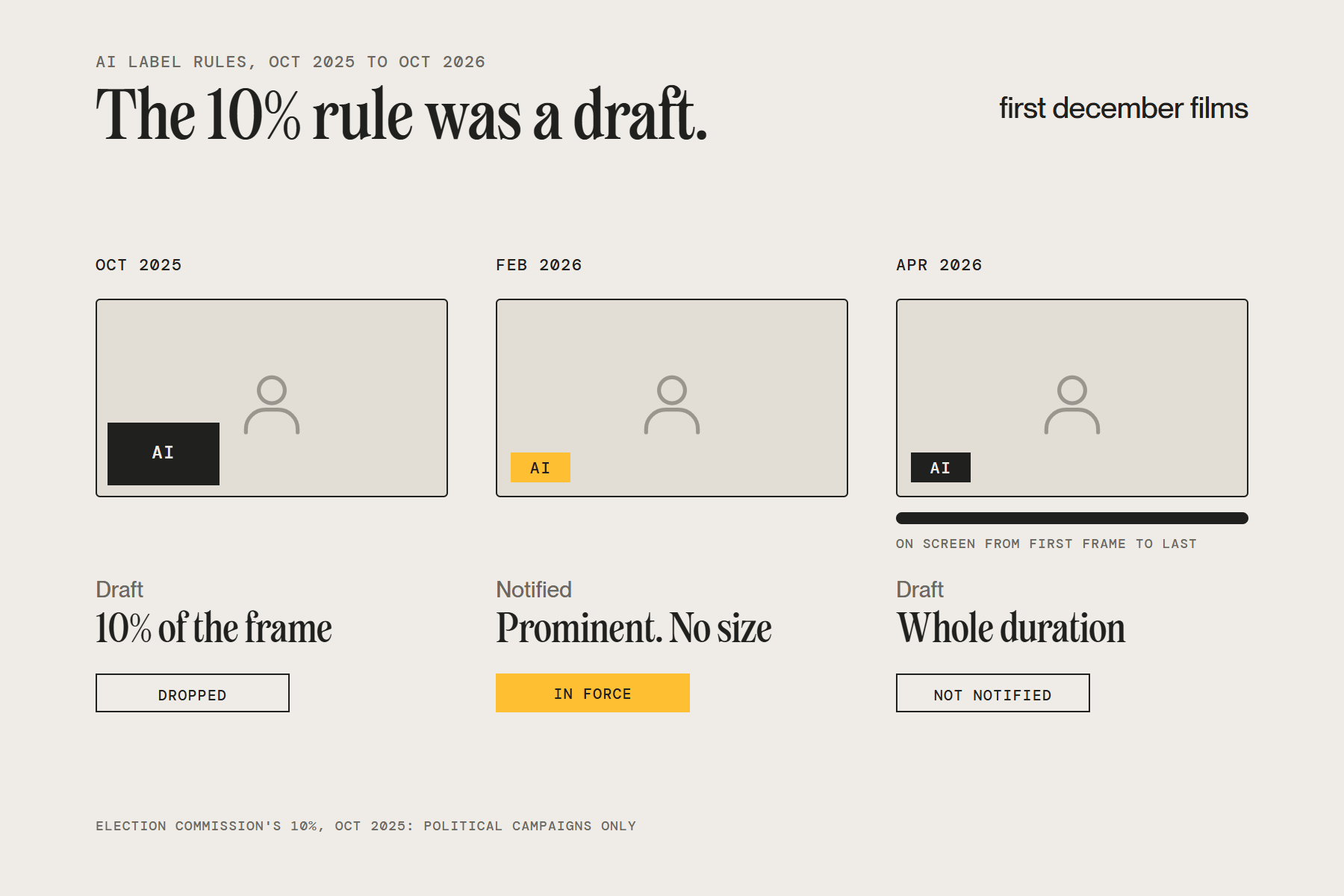
No. The notified rules set no size and no position for a visual label. Rule 3(3)(a)(ii) asks only for "prominent visibility in the visual display that is easily noticeable and adequately perceivable". For audio, the disclosure must be "prominently prefixed", which means it plays first; MeitY’s FAQ gives "This audio is synthetically generated" at the beginning as its example.
The 10% figure comes from two places, and neither applies to a brand’s film. MeitY’s draft of 22 October 2025 proposed a label "covering at least ten percent of the surface area of the visual display" or the first 10% of an audio clip. That wording was dropped before the rules were notified. Two days after the draft, the Election Commission of India told political parties and candidates to label AI campaign material over at least 10% of the screen. That direction binds election campaigns, not advertisers.
One change is still pending. On 21 April 2026 MeitY proposed rewording the rule so that a visual label must stay on screen "throughout the duration of the content". Comments closed on 7 May. As of 10 October 2026 it has not been notified, and MeitY’s rules page lists nothing newer than a corrigendum of 26 February. If it is notified, a platform label would run for the whole film, so plan graphics that could carry one without damaging the frame.
What do the IT Rules forbid outright?
The rules bar synthetic content that "falsely depicts or portrays a natural person or real-world event by misrepresenting, in a manner that is likely to deceive, such person’s identity, voice, conduct, action, statement" (Rule 3(3)(a)(i)). A label does not rescue it, because the labelling duty applies only to synthetic content that is not prohibited. The FAQ’s example is the advertising case exactly: "A deepfake video/audio falsely showing a celebrity endorsing a product/service or investment scheme, presented as genuine in order to mislead users."
Platforms now have to act fast. Content must come down within three hours of a court order or an authorised government notice, down from 36 hours, and complaints about impersonation, "including artificially morphed images", must be acted on within two hours. A platform that ignores the rules loses its safe harbour under section 79 of the IT Act, which is why platforms tend to remove first. A campaign built on a disputed likeness can disappear in the middle of its flight.
On 8 October 2026 MeitY also sent an advisory to every social media platform, reproduced in full by MediaNama, asking them to "identify and appropriately label/contextualise manipulated, synthetically generated or misleading content, particularly where such content is presented as depicting a current event". It is about public order, not advertising, but an ad that borrows the look of a news event now sits closer to the line.
What do ASCI’s AI guidelines ban, and what must be labelled?
ASCI’s guidelines sort every AI use in an ad into three groups: four things banned even with a label, six that must be labelled because they could change what a buyer believes, and five that need no label at all. The test is what the synthetic content does to the buyer’s understanding of the product, not whether AI was used.
The Advertising Standards Council of India released its draft on 12 May 2026 (the document itself is dated 8 May), took comments until 18 June after one extension, and published the final Guidelines for Responsible Labelling of Synthetically Generated Content in Advertising on 29 September. They "shall come into effect on the expiration of 3 months from the date of their publication". ASCI has not said which date it counts from. The guidelines were signed on 17 September and released on 29 September, which puts the start in the second half of December 2026. Google’s AI answer for "ASCI guidelines AI generated content" and at least one widely shared LinkedIn post give 17 December as settled. It is not.
The definition follows the IT Rules closely. Synthetically generated content is audio or video in an ad that is made or "materially altered using a computer resource, to appear real, authentic or true" and shows a person or event as if it were real. Three questions decide whether it needs a label: is it central to the ad’s persuasion, would it mislead about the product’s claims or performance if left unlabelled, and would leaving the label off create a false impression.
| ASCI’s group | What falls in it (final guidelines, clause) |
|---|---|
| Banned, even with an AI label | Fabricated endorsements or testimonials: AI used to show a real person used, approved or recommended something they did not (1A). Exaggerated results through AI visuals, such as a weight-loss "after" body the product cannot deliver (1B). A place that does not exist shown as real, such as a hotel or its facilities (1C). Unauthorised copyrighted work, deepfakes, or anyone’s likeness without consent (1D) |
| Label required | Synthetic influencers and brand ambassadors (2A). A real person’s face or voice replicated with consent for personalised messages (2B). Fabricated events or settings that could change how a buyer understands the product (2C). A product that does not exist yet, such as a render of an unbuilt housing project (2D). AI sound effects tied to a core feature, such as audio quality in a headset ad (2E). Paid product suggestions inside AI answers, labelled "Sponsored by [Brand]" (2F) |
| No label needed | Routine editing: colour, light, noise, blemish removal, formatting, copy, and voice modulation that does not impersonate (3A). Purely decorative backgrounds, skylines, music, jingles and crowd sound (3B). Obvious fantasy, such as a fairy fixing a product or a car turning into a spaceship (3C). AI-written copy and good-faith documents (3D). Subtitles, captions, translations and accurate audio description (3E) |
ASCI, Guidelines for Responsible Labelling of Synthetically Generated Content in Advertising, signed 17 September 2026, released 29 September 2026.
The label itself is left open. Brands may use the platform’s own label or their own, "such as but not limited to" "Audio/Video created using AI" or "Audio/Video enhanced using AI". There is no rule on size, position, duration or language. The guidelines say ASCI’s disclaimer rules apply "where applicable", but those rules exclude information required by law or the ASCI Code, so whether they govern an AI label is a question ASCI has not answered.
What changed between May and September matters for anyone who read the draft. The final text narrowed the definition to content that depicts a person or event as real. It dropped the draft’s named example of "an AI generated fake doctor promoting a supplement", though a fake expert is still misleading under the main ASCI Code. It removed the word "exaggerated" from the sound-effects item, so any AI sound central to a product’s promise now needs a label, inflated or not. It merged two product-performance items into one narrower clause, added the accessibility exemption, accepted platform labels, and deleted the draft’s line aligning itself with the IT Rules amendment.
ASCI’s chief executive, Manisha Kapoor, put the point of the final text in one sentence when it was released: "Importantly, it clarifies where the mere use of an AI label may not make an otherwise misleading advertisement acceptable." The UK’s advertising regulator says the same thing: disclosure alone "is very unlikely to mitigate the harm caused by a fundamentally misleading message."

Will a label hurt the film?
The industry is split, and both sides have data. A field test by researchers at NYU Stern and Emory found that telling viewers an ad was made with generative AI cut click-through rates by 31.5%. Tyroo’s Siddharth Puri told a MediaNama panel in November 2025 that A/B tests of a marker covering about a tenth of the frame moved results up 10 to 12% for one brand retailer and down 15% for smaller advertisers. On the other side, a MediaScience study of 900 US viewers, reported by ContentGrip, found labels did not reduce recall, and Ipsos found that 67% of Indians expect products and services that use AI to say so.
We have argued the creative side of this in public. When the draft came out, Ganesh told BestMediaInfo: "The moment you put an ‘AI generated’ label on an emotional brand film, you break the suspension of disbelief." Our conclusion is about the script, not the label. If a story only works when the audience believes a generated person or event is real, it is the wrong story to generate. Shoot it. If the story works with the audience knowing, the label costs little, and ASCI does not ask for one on fantasy, decoration or routine finishing anyway.
Can you put a real person’s face or voice in an AI ad?
Only with their consent, in writing, and in India that consent is the part of an AI ad most likely to end up in court. There is no statute on personality rights here. The High Courts have built the right through injunctions, and they are granting them faster every year as AI makes faces and voices cheap to copy.
We counted the orders. Between 1 January 2022 and 10 October 2026 we found 103 substantive personality-rights orders from Indian courts, indexed on IndianKanoon or reported by LiveLaw, Bar & Bench, MediaNama, SpicyIP, SCC Online, Verdictum and Storyboard18, and read 99 of them in full. Orders those sources missed are not in the count, so treat it as a floor.
| What we counted | Orders |
|---|---|
| Orders, January 2022 to 10 October 2026 | 103 (1 in 2022, 4 in 2023, 9 in 2024, 32 in 2025, 57 in 2026) |
| By court | Delhi High Court 78, Bombay High Court 17, Madras High Court 4, other courts 4 |
| Name AI, deepfakes, chatbots or voice cloning (of 99 read in full) | 76; inside the injunction itself in 67 |
| Name voice cloning or an AI voice | 26; 53 list the voice as a protected attribute |
| Use the words advertising, endorsement or sponsorship | 82 |
| Against unknown defendants ("John Doe" or "Ashok Kumar") | 77 of 103 |
| Against an identified brand selling its own product with the person | 3, none a national brand |
| Relief refused, or granted only in part | 6 refused, 11 narrowed |
First December Films count of personality-rights orders, January 2022 to 10 October 2026. Full dataset in our research notes.

The judges saw AI coming early. In September 2023 the Delhi High Court wrote, in Anil Kapoor’s case: "The technological tools that are now freely available make it possible for any illegal and unauthorised user to use, produce or imitate any celebrity’s persona, by using any tools including Artificial Intelligence." In July 2024 the Bombay High Court held, for Arijit Singh, that "Making AI tools available that enable the conversion of any voice into that of a celebrity without his/her permission constitutes a violation of the celebrity’s personality rights." And on advertising specifically, the Delhi High Court’s ruling in Digital Collectibles in April 2023 set the test brands should remember: where a celebrity’s identity is used "to promote the sale of a product or a service or to show its endorsement by the celebrity or an association with the celebrity, without their consent, it would amount to misrepresentation and cause likelihood of confusion in the market."

Two things in the data matter for brands. First, almost nobody has sued a brand yet. Most orders target anonymous pages running scam endorsements and AI voice ads, merchandise sellers and AI chatbot sites; we found 16 orders aimed at fake-endorsement ads by unknown advertisers and only three against an identified business using someone to sell its own product. Second, the orders bind the platforms. Platforms are named in 93 of the 103 orders, YouTube in 58 and Instagram in 64, and where an order sets a deadline to take content down it is usually 36 to 72 hours. A brand that used a contested face would lose the campaign before it lost the case.
The courts have also drawn limits. They have refused to remove parody (Jackie Shroff, 2024), declined "a blanket order" against thousands of links (Janhvi Kapoor, August 2026), and said personality rights cannot "extinguish an entire genre of expression including caricature" (Alakh Pandey, August 2026). Justice Anup Jairam Bhambhani of the Delhi High Court said in court in September that he is against blanket injunctions, and he is hearing several of these suits together; a ruling on how far the right reaches is pending. None of those limits helps an advertiser. Parody and criticism are protected; selling with someone’s face is the use every order restrains.
What about look-alikes and sound-alikes?
No Indian order we read uses the words look-alike or sound-alike in its relief, but the direction is clear. The Delhi High Court’s order for singer Jubin Nautiyal in February 2026 restrains AI voice models and "synthesized voices or digital avatars" that "imitate or mimic" him. Probir Roy Chowdhury, a partner at JSA, put the test to Storyboard18: "If an AI generated face, voice, style or persona is substantially evocative of a celebrity such that an average viewer would believe there is endorsement, association or involvement, courts can recognise this as actionable misuse." ASCI already treats it that way: its guidelines ban "a person’s likeness without consent", and in June 2023 an upGrad ad built on an AI look-alike of Google’s chief executive was pulled after ASCI intervened, despite a "purely coincidental" disclaimer.
What about people who have died?
The law is thinner here, and the risk is not. In 2023 the Delhi High Court refused relief to the father of the late actor Sushant Singh Rajput, holding that personality rights do not pass to heirs; "The law cannot allow itself to be a vehicle to promote celebrity culture," the court wrote. But ASCI’s ban on fabricated endorsements does not stop at death, and a late founder or freedom fighter shown approving a product is exactly that. Bajaj’s centenary film, directed by Rajkumar Hirani and made entirely with AI, recreated Mahatma Gandhi and Jamnalal Bajaj; it drew no regulatory action we could find, but it did draw critical commentary on whether Gandhi’s on-screen approval amounts to an endorsement he never gave. Our rule is the family’s or estate’s consent, a label, and no endorsement in their mouth.
What should the consent say?
Write it down before anyone generates a frame, and make it specific. ASCI’s Code already bars an ad from referring to a person in a way that gives the product an unjustified advantage without their permission, and makes the advertiser and agency produce "explicit permission from the person" when asked. The CCPA’s guidelines require "requisite permission" before an ad refers to anyone. From the orders, the ASCI text and the US union contracts that set the global benchmark, a consent for an AI likeness or voice should cover:
- The exact AI use: face, voice, body, de-ageing, a digital double, personalised messages.
- The media, territory and term, and every product the replica may appear with.
- The fee, including for each new generated performance.
- Approval of outputs before release, and who may edit them later.
- What happens to the model and the files when the term ends, and whether consent can be withdrawn.
The SAG-AFTRA 2025 commercials contracts in the US require a "reasonably specific description of intended use" and pay at least 1.5 session fees for each commercial that uses a replica performance. No Indian union contract covers this, so the brand’s paperwork is the only protection. India’s data protection law points the same way: a face or voice recording of an identifiable person is personal data, and the Digital Personal Data Protection Act’s consent duties apply from about 13 May 2027, under the DPDP Rules notified on 13 November 2025.
Our own rule, published on our AI ad films page, is written consent for every real face and voice, covering scope, duration, fee and where it runs, with SAG-AFTRA’s digital-replica terms as the benchmark, and no celebrity look-alikes at all.
Who is responsible when an AI ad breaks the rules?
Everyone who makes the ad shares the risk, and AI changes none of it. The advertiser carries the most, but ASCI’s Code and the consumer protection rules both reach the agency and the production house, and platforms carry their own duties under the IT Rules.
ASCI’s Code says responsibility "lies with all who commission, create, place or publish any advertisement, or assist in the creation or publishing" of one (ASCI Codes and Guidelines). The Central Consumer Protection Authority’s 2022 guidelines on misleading advertisements apply to advertisers, endorsers and any "advertising agency", which they define as a person "providing services in designing and production of advertisements". That definition reads on a production house. Guy Parker, chief executive of the UK’s Advertising Standards Authority, wrote in ASCI’s own AdNext report that "It was the AI who did it" is not a valid excuse.
| Who | Rule that reaches them | What they can face |
|---|---|---|
| Advertiser (the brand) | ASCI Code and AI guidelines; Consumer Protection Act 2019, s.21 and s.89; CCPA 2022 guidelines; the platform declaration under the IT Rules | ASCI request to withdraw or modify, then referral to the CCPA or the Ministry of Information and Broadcasting; CCPA penalty up to 10 lakh rupees (50 lakh for a repeat); for a false ad that harms consumers, prosecution of the manufacturer or service provider, up to two years (five for a repeat) |
| Agency and production house | ASCI Code ("all who commission, create, place or publish"); CCPA guidelines ("designing and production"); s.21(4) for anyone "party to the publication" of a misleading ad | ASCI action against the ad; CCPA penalty up to 10 lakh rupees; the contract with the brand |
| Endorser (a celebrity or influencer in the film) | Consumer Protection Act s.21(2) and (3); ASCI celebrity guidelines | Penalty up to 10 lakh rupees (50 lakh for a repeat) and a ban on endorsing for up to one year (three for a repeat), unless they did due diligence on the claims |
| The person whose face or voice was used | Personality-rights suits in the High Courts | Injunctions against everyone in the chain, takedown orders to platforms, damages |
| Platform | IT Rules 2026 | Loss of safe harbour if it fails to label, verify or take down |
| Anyone making a deceptive deepfake | Bharatiya Nyaya Sanhita s.319 (cheating by personation, up to five years); IT Act s.66D (up to three years) | Criminal prosecution |
Consumer Protection Act 2019 ss.21 and 89; CCPA guidelines of 9 June 2022; ASCI Code; IT Rules as amended in 2026; BNS 2023 s.319; IT Act s.66D. Penalties are maximums.
Enforcement so far has fallen on scams, not brands. ASCI’s only hard count of deepfake ads is "four other ads regarding deepfakes" reported to the information ministry between April and September 2024, and its 2025-26 annual report names deepfakes as a problem in offshore betting promotion without a count. We found no CCPA order against an AI-made ad up to 10 October 2026. The quiet will not last: ASCI’s guidelines give it a clause-by-clause rulebook for AI from December, and its complaints process is how most Indian ads get challenged.
Do Indian AI ads carry labels today?
Mostly not. We checked the YouTube uploads of 49 Indian brand ad films whose makers announced that AI was used. Only 3 of the 23 uploaded since the IT Rules took effect on 20 February 2026 carry YouTube’s AI label. None of the eight hybrid films carries it, and none of the six films whose AI recreated a real person’s face or voice.
Labels are one test of these films. For how audiences and award juries judged them, see our review of the best AI ads in India.

Here is how we built it. On 10 October 2026 we listed Indian brand films, uploaded between January 2025 and October 2026, where a brand release, the agency, the studio or the trade press said generative AI was used, and found each film’s official YouTube upload. A script then read each watch page for YouTube’s two current signals: the "AI" badge under the title and a "How this was made" panel that reads "Made with AI". We tested the script first on AI videos known to carry the label. That test caught something worth knowing: the older wording, "Altered or synthetic content", has gone from YouTube’s pages, so any checker still looking for it will report every labelled video as unlabelled. We also read each description for any mention of AI.
| Measure | Uploaded 1 Jan 2025 to 19 Feb 2026 | Uploaded 20 Feb to 10 Oct 2026 |
|---|---|---|
| Films in the sample | 26 | 23 |
| YouTube AI label on the upload | 1 (4%) | 3 (13%) |
| Description says AI was used to make it | 4 (15%) | 3 (13%) |
| Any disclosure: label, description or a reported on-screen label | 5 (19%) | 7 (30%) |
| Share of the window’s views on labelled uploads | 0.02% of 165 million | 2.3% of 440 million |
First December Films audit of YouTube uploads, checked 10 October 2026. Films whose AI use was announced; label status today, not at upload. Across both windows: fully AI films 3 of 27 labelled, hybrid films 0 of 8.
Read it with its limits. The samples are small, so one film moves a window by about four points. The label status is what shows today, and YouTube now adds labels on its own, so a film uploaded in 2025 can carry a label applied in 2026. The sample covers only films whose AI use was announced, and it includes films made by many production houses, ours among them. And a missing YouTube label is not by itself a breach: the duty to label sits with the platform, and much of this work, stylised or partly shot, may not count as content that "appears to be real". The labelled films were for Piramal Finance, Aditya Birla Capital, NEWME and Dhathri, the last on its AI studio’s channel.
What the audit does show is that a brand cannot treat the platform label as its compliance. Platform labels arrive late, apply to some uploads and not others, and do not follow the film onto television or into an Instagram cut. The only label a brand controls is the one in its own master.
Which AI shots need a label, consent or a rethink?
Most AI in a modern ad film needs nothing: grading, clean-up, backgrounds, crowds, fantasy and dubbing. A label is needed when AI creates something a buyer could rely on, such as a presenter, a product that is not built yet or the sound of the product itself. Consent is needed for any real person. And four uses are off the table whatever the label says.
We built this table from the three rulebooks, read clause by clause, for the shots that come up on real AI and hybrid briefs. The last column is our own practice where the rules leave a judgement call.
| AI use in the film | IT Rules 2026 (platform label) | ASCI guidelines (the ad itself) | Consent | Our call |
|---|---|---|---|---|
| Grade, clean-up, blemish removal, light fixes on real footage | Not synthetic content (routine editing is excluded) | No label (3A) | No | Nothing to declare |
| Generated background or set extension behind real actors | Possibly, if the result looks like a real place | No label if purely decorative (3B); banned if it shows a place that does not exist as real, such as a hotel (1C) | No | Generate the world; shoot anything the buyer will visit |
| AI crowd or extras | Possibly, if realistic | No label if decorative (3B) | No, unless someone in it resembles a real person | Fine, unless the crowd is the claim |
| Obvious fantasy: a talking animal, a car that turns into a spaceship | No: it does not appear real | No label (3C) | No | Use freely |
| AI dub of an actor into other languages, meaning unchanged | No: translation is excluded | No label (3E) | Yes, from the actor, for their voice | Put the voice rights in the contract |
| Synthetic narrator voice that resembles nobody | MeitY’s FAQ treats synthetic narration as synthetic audio | Not listed; no label unless it misleads | No | Label if listeners could take it for a named person |
| Invented presenter or brand ambassador | Yes: MeitY’s FAQ names a realistic "virtual human" | Label required (2A) | No, but check it resembles nobody real | Label on screen |
| A real actor de-aged, re-voiced or partly generated | Yes, if realistic | Banned if it overstates results (1B); otherwise the three-question test | Yes, written and specific | Consent rider, and a label where the change matters to the claim |
| A celebrity’s face or voice in personalised messages, with consent | Yes | Label required even with consent (2B) | Yes | Label every version |
| A celebrity’s face or voice in a mass ad, with consent | Yes | Not listed; the three-question test applies | Yes, and the ASCI Code needs "explicit permission" | Label it: viewers assume a celebrity in an ad was on set |
| A look-alike or sound-alike of a real person, without consent | Barred if it deceives | Banned (1D) | Not given | Never |
| An invented customer, doctor or expert giving a testimonial | Barred if presented as a real person | Banned (1A); misleading under the Code | Not applicable | Never |
| The product doing what it cannot, or AI "after" results | Not the issue | Banned (1B) | Not applicable | Never. Shoot the proof |
| A product that is not built yet, or AI sound of a core feature | Yes, if realistic | Label required (2D, 2E) | Not applicable | Label |
| A person who has died: a founder, a freedom fighter, a singer | Yes, if realistic | Banned if they appear to endorse what they never saw (1A) | Not required by heirs’ rights, per the Delhi High Court in 2023 | Family or estate consent, a label, and no endorsement in their mouth |
Our reading of the IT Rules as amended in 2026, ASCI’s guidelines of 29 September 2026 and the ASCI Code, 10 October 2026. Not legal advice.

How do the rules change on TV, platforms and in cinemas?
The rule set changes with the screen. The IT Rules’ labelling duties apply to AI tools and online platforms, so a television broadcast sits outside them, while ASCI’s code reaches television through law and every other medium through self-regulation.
Television. Rule 7(9) of the Cable Television Networks Rules says no advertisement that violates ASCI’s Code "shall be carried in the cable service" (MIB Programme and Advertising Code), and the government can stop transmission of a channel whose ads breach the advertising code. Whether ASCI’s AI guidelines count as part of "the Code" for that purpose has not been tested, but ASCI frames a breach of them as a breach of Chapters I and III of its Code, which certainly are. Our working rule: a television master follows ASCI’s three groups exactly as a digital one does.
YouTube, Instagram, Facebook and other large platforms. Declare the AI content at upload, expect the platform to verify it, and expect a platform label on realistic synthetic material, on YouTube since May placed directly under the player. This sits on top of anything ASCI requires inside the film, not instead of it.
Connected TV and streaming. The same film can reach a living-room screen through YouTube on a smart TV, where YouTube’s rules travel with it, or through a streaming service’s own ad break, where the service’s ad policy and ASCI’s code apply. Ask each platform for its AI policy in writing when you book.
Cinema. Ads shown in cinemas still need a CBFC certificate, as our TVC production guide explains. We found no CBFC rule specific to AI.
What a label looks like. Neither MeitY nor ASCI sets a size or duration. In the absence of one, the most defensible yardstick in India is ASCI’s own disclaimer standard for claims in video: lower-case letters at least 26 pixels tall on a 1080-line frame, held at least four seconds a line, in the language of the ad. ASCI has not said those rules apply to AI labels, so treat them as a floor you can defend, not a requirement. For audio-only ads, put the disclosure first, as MeitY’s FAQ does.
On our own AI work we deliver two masters, one labelled and one clean, and the brand and its agency decide in writing where each runs. Air India’s AI film, as aired, carries the line "Some content is computer-generated."
How does India compare with the EU, the UK, the US and Asia?
India is unusual in two ways. Its ad-specific AI code comes from a self-regulator, ASCI, not a statute, and its protection for faces and voices is built by judges case by case, not written into law. On who labels, India sits with China: the legal duty falls on AI tools and platforms, with users declaring at upload. The EU instead puts it on whoever controls the AI in the ad, and that can include an Indian company.
| Market | Must an AI ad be labelled? | Who carries the duty | Fake testimonials | A real person’s face or voice | Since |
|---|---|---|---|---|---|
| India | Platforms and AI tools label realistic AI content; ASCI requires a label in the ad where AI could mislead | Tools and platforms (IT Rules); the advertiser (ASCI) | Banned (ASCI 1A; CCPA guidelines) | Consent, enforced through High Court injunctions | 20 Feb 2026; ASCI from late December 2026 |
| European Union | Yes, if the ad contains a deep fake: realistic people, products or events | The deployer: the brand or agency that controls the AI use, including firms outside the EU aiming at EU audiences | Banned (Unfair Commercial Practices Directive) | National law, plus GDPR | 2 Aug 2026 |
| United Kingdom | No AI label rule; disclose only where leaving it out would mislead | The advertiser, even for automated or affiliate ads | Banned (CAP Code; DMCC Act 2024) | No image right; passing off for false endorsement | Fake-review ban April 2025 |
| United States (federal) | No | Not applicable | Banned, AI-written reviews included (FTC rule, up to $53,088 a violation) | State law and union contracts | 21 Oct 2024 |
| New York | Yes, for "synthetic performers": AI humans who resemble no real person | Whoever produces or creates the ad | Federal rule | Prior consent for a dead performer’s digital replica | 9 Jun 2026 |
| California | Labels are the AI provider’s job | Generative AI providers | Federal rule | Prior consent for advertising use; replica clauses void without a specific description of use | 2025 and 2026 |
| China | Yes, visible and embedded labels on all AI-generated content | Tools and platforms; users must declare | Banned as false advertising | Written consent to use anyone’s name or image in an ad | 1 Sep 2025 |
| South Korea | Yes, for AI operators’ outputs; a "virtual person" tag on AI endorsers in ads | AI operators; advertisers for virtual endorsers | Banned; AI fake-expert food ads banned from 27 Nov 2026 | Statutory protection for well-known people | 22 Jan 2026; endorser rule 1 Jun 2026 |
EU AI Act Art. 50 and Commission guidelines of 20 July 2026; CAP Code and ASA rulings; 16 CFR Part 465; NY Gen. Bus. Law s.396-b and Civil Rights Law s.50-f; Cal. Civ. Code ss.3344 and 3344.1, Lab. Code s.927, Bus. & Prof. Code s.22757; China’s AI labelling measures (2025), Advertising Law Art. 33 and Civil Code Arts. 1019 and 1023; Korea’s AI Basic Act Art. 31 and KFTC endorsement guidelines. Full sources in our research notes.
Three differences matter for anyone making one film for several markets.
The EU can reach an Indian production. The European Commission’s guidelines on Article 50, published on 20 July 2026, say "a company established in a third country that uses an AI system to generate a deep fake of a celebrity featured in an advertisement displayed in the Union is also a deployer". They also list an AI-generated celebrity influencer in an ad, and an AI product image that "can affect the audience’s perception", as deep fakes. A film that is legal to post in India unlabelled, leaving the platform to label it, can breach EU law if it is aimed at Europe. Fines run to €15 million or 3% of worldwide turnover, about $16.8 million at 9 October 2026 rates.
A label is not a defence anywhere. The UK’s Advertising Standards Authority has upheld complaints against ads that carried AI disclaimers, including a gambling ad labelled "ai-generated parody" that showed a footballer, and a supplement site whose AI "health professionals" came with a note calling them illustrative. Korea’s competition regulator says a "virtual person" tag does not cure an endorsement framed as real experience. That is the line ASCI drew in its first clause.
India protects famous faces, by lawsuit. China requires written consent before anyone’s name or image appears in an ad. Tennessee, California and New York write consent into statute with minimum damages, and New York requires prior consent even for the digital replica of a performer who has died. In India, protection comes from an injunction a person must go to court to get, which is why the orders protect film stars, singers, doctors, gurus and politicians. An ordinary person’s face has the same moral claim and far less practical protection, so a brand’s own consent paperwork carries more weight here than in markets with a statute.

How did India get here, and what comes next?
The past. In 2003, in ICC Development v Arvee Enterprises, the Delhi High Court held that publicity rights belong to individuals, not events. In 2012 it decreed an injunction against a jeweller that copied the Bachchans’ Tanishq hoardings, still a leading false-endorsement case. ASCI’s influencer guidelines of May 2021 required virtual influencers to disclose that they are not human. In August 2023 ASCI and Khaitan & Co published a white paper on generative AI in advertising, and in September 2023 the Anil Kapoor order became the first in our count to name AI. MeitY’s draft labelling rules came in October 2025, the final rules in February 2026, ASCI’s draft in May and its final guidelines in September.
The present. All three rulebooks are now in place, two in force and ASCI’s from December. Personality-rights orders are arriving at more than one a week: 57 in the first nine months and ten days of 2026. MeitY has said it will publish an AI regulation consultation paper, and the Copyright Office has held that AI output can be protected when a person causes it to be made.
What comes next. These are forecasts, and whose they are matters.
- ASCI’s AI guidelines take effect in the second half of December 2026, and ASCI plans a Centre for Responsible Innovation in AI in Advertising within 12 to 15 months of 17 September 2026 (Vision 2032).
- Ashwini Vaishnaw, the IT minister, said on 8 October 2026: "In a month’s time we should be able to publish the consultation paper" on AI regulation (Storyboard18). His secretary, S Krishnan, said the same day that the time to move beyond existing laws and voluntary compliance may have come: "Maybe some of those times have come."
- The draft requiring a platform label for the whole duration of a video could still be notified.
- The Delhi High Court’s pending ruling on the scope of personality rights will decide how far parody, fan content and look-alikes are protected.
- The data protection law’s consent duties start in May 2027.
Our forecast is narrower. The label will become routine, and the fights will move to faces. Within a year, we expect most disputes over AI ads in India to be about whose likeness or voice was used and on what paper, not about the size of a label.

When does this guide not apply?
Skip this if the film is political. Election advertising answers to the Election Commission, whose directions require AI campaign material to be labelled and unlawful AI content to be acted on within three hours. We do not make political work.
Skip it if the film is pure animation or obvious fantasy from start to finish. Nothing in it appears real, so neither MeitY’s definition nor ASCI’s labelling clauses are triggered. The ASCI Code on misleading claims still applies.
Skip it if you sell in a category with its own rulebook. Health, medicines, financial products, insurance and real estate have sector regulators whose claim rules are stricter than ASCI’s, and generated proof is where those rules bite first. We do not generate proof for health, medical or financial-return claims at all.
And skip it if a scammer is using your brand or your chief executive in a deepfake ad. That is a criminal and platform matter under the Bharatiya Nyaya Sanhita and the IT Act. The route is a police complaint and a takedown request, not a compliance review.
What should a brief for an AI ad film say?
A brief for an AI or hybrid film should settle five things in writing before anyone generates a frame: what the film may claim and show, every real person in it and their consent, the label plan, who owns what, and the record that proves the rest. Ganesh wrote in MediaBrief this March that we lock "AI boundaries plus rights clarity" before treatments and references, because "If it’s not written, it doesn’t exist."
- The claims and the proof. List every claim the film makes and the real footage, data or demonstration behind it. AI may dramatise a claim; it may not stand in for the proof.
- Every real person. Name each face and voice, living or dead, and attach the consent: the AI use, media, territory, term, fee, approval of outputs, and what happens when consent ends.
- The label plan. Decide shot by shot which of ASCI’s three groups each AI use falls in; order a labelled and a clean master; agree in writing where each runs and who declares the content at upload.
- Ownership and tools. India’s Registrar of Copyrights held on 31 August 2026 that an AI system cannot be an author, but the person who causes the work to be created can be (order). Say in the contract who that person is and who owns the generated assets, and ask which tools and licences the film will be made on.
- The record. Ask for a log of the human decisions at each stage. Ganesh’s point to BestMediaInfo in May was that every key element, "prop, copy, character likeness, setting", must be "locked and documented before motion generation begins", because "that locked approval is now your compliance paper trail."
That is the list we work to. Our AI ad films page publishes it as "Clean by design": commercial-licence tools only, written consent for every real face and voice, disclosure by function, a generation log on every film, client scripts that never train models, and a "Never" list that rules out fake testimonials, celebrity look-alikes and generated proof for health or financial claims. For what each route costs, see our guide to AI ad film cost in India. If one shot in your brief feels too risky to promise, our paid feasibility test of that scene is the place to start. Paste the script into our script analyser for a complexity read, or send us the brief.
Primary sources used in this guide
- MeitY, IT (Intermediary Guidelines and Digital Media Ethics Code) Amendment Rules, 2026, G.S.R. 120(E), 10 February 2026, and FAQ
- ASCI, Guidelines for Responsible Labelling of Synthetically Generated Content in Advertising, 29 September 2026, and the May 2026 draft
- MIB, Programme and Advertising Code (Cable Television Networks Rules, Rule 7)
- CCPA, Guidelines for Prevention of Misleading Advertisements and Endorsements for Misleading Advertisements, 2022
- Registrar of Copyrights, order in Diary No. 9356/2022-CO/A, 31 August 2026
- Delhi High Court, Anil Kapoor v Simply Life India, 20 September 2023; Bombay High Court, Arijit Singh v Codible Ventures, 26 July 2024
- European Commission, guidelines on Article 50 of the AI Act, 20 July 2026
First December Films is an advertising film production company in Mumbai. Our work has won more than 150 international creative awards, including Cannes Lions, D&AD and One Show Gold Pencils.
Frequently asked questions
Are AI-generated ads legal in India?
Yes. No Indian law bans an ad because it was made with AI. The rules control what it shows: platforms must label realistic synthetic content under the IT Rules 2026, ASCI bans fake testimonials, fake results and anyone’s likeness without consent, and the High Courts stop unauthorised use of a real person’s face or voice.
Do AI ads need a label in India?
Sometimes. Under ASCI’s guidelines an ad needs a label when AI could change what a buyer believes, such as a synthetic ambassador, a product that is not yet built or AI sound of a core feature. Routine edits, decorative backgrounds and obvious fantasy need none. Separately, large platforms ask uploaders to declare realistic AI content and label it themselves.
Does the AI label have to cover 10% of the screen?
No. The IT Rules notified in February 2026 ask only for a label that is prominent, easily noticeable and adequately perceivable, with the disclosure played first for audio. The 10% figure came from MeitY’s October 2025 draft, which was dropped, and from an Election Commission advisory that applies only to political campaigns.
When do ASCI’s AI labelling guidelines take effect?
Three months after publication. ASCI signed the final guidelines on 17 September 2026 and released them on 29 September, and it has not said which date it counts from, so they start in the second half of December 2026. The rest of the ASCI Code, including its rules on misleading claims and testimonials, already applies to AI ads.
Can a brand use a celebrity’s AI face or voice if the celebrity agrees?
Yes, with written consent that names the AI use, the media, the territory, the term and the fee. ASCI requires a label when such a replica is used for personalised messages, and we label it in a mass ad too. Without consent it is banned under ASCI’s guidelines and open to a High Court injunction.
Do AI ads on television need a label?
The IT Rules’ labelling duties apply to AI tools and online platforms, not to broadcast. ASCI’s guidelines do reach television, because the Cable Television Networks Rules bar any ad that breaks the ASCI Code. So a TV master follows the same three groups as a digital one: label where AI could mislead, and never fake proof or a person.
Who owns the copyright in an AI ad film in India?
A person, not the AI. On 31 August 2026 India’s Registrar of Copyrights held that an AI system cannot be named as an author, that the person who causes the work to be created can be, and that AI output can be protected. Settle in the contract who that person is and who owns the generated assets.