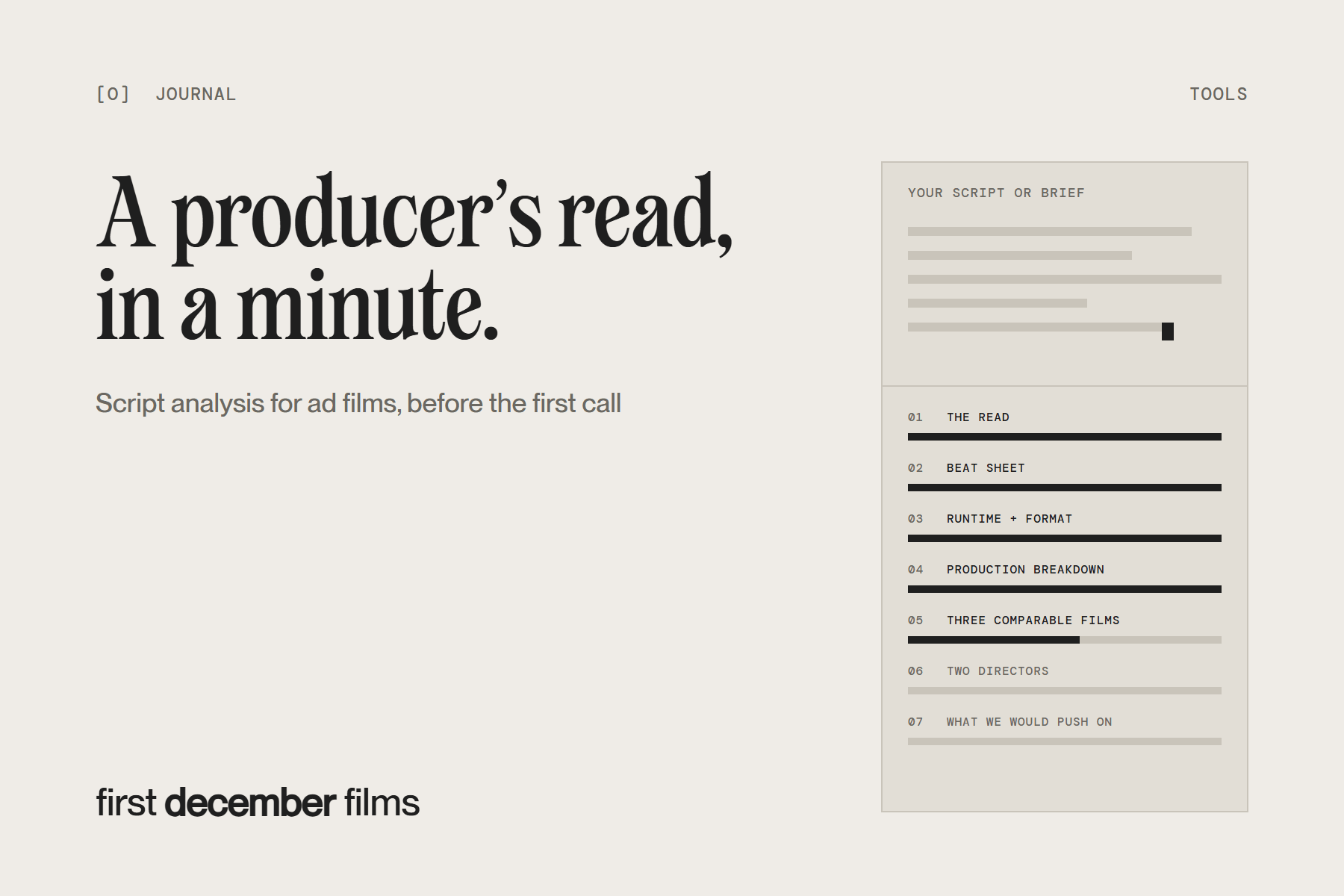
The short answer. Script analysis for an ad film is a producer’s read of the script before anyone commits to making it: what the idea actually is, the beats as written, how long it really runs, what it will take to shoot, which films it resembles, who should direct it, and what will be pushed back on. It is not the acting exercise the term usually means, and it is not Hollywood coverage. You can get one free in about a minute at 1stdecember.com/script.
Search for "script analysis" and you get two other things. Actors learning to break down a scene into objectives and beats, and a branch of psychotherapy with the same name. Neither helps a brand manager holding a 30-second script and a deadline.
This page is about the third kind, the one production houses do quietly before they quote, and how to get it done to your script before the first call.
Script analysis, coverage, and the producer’s read
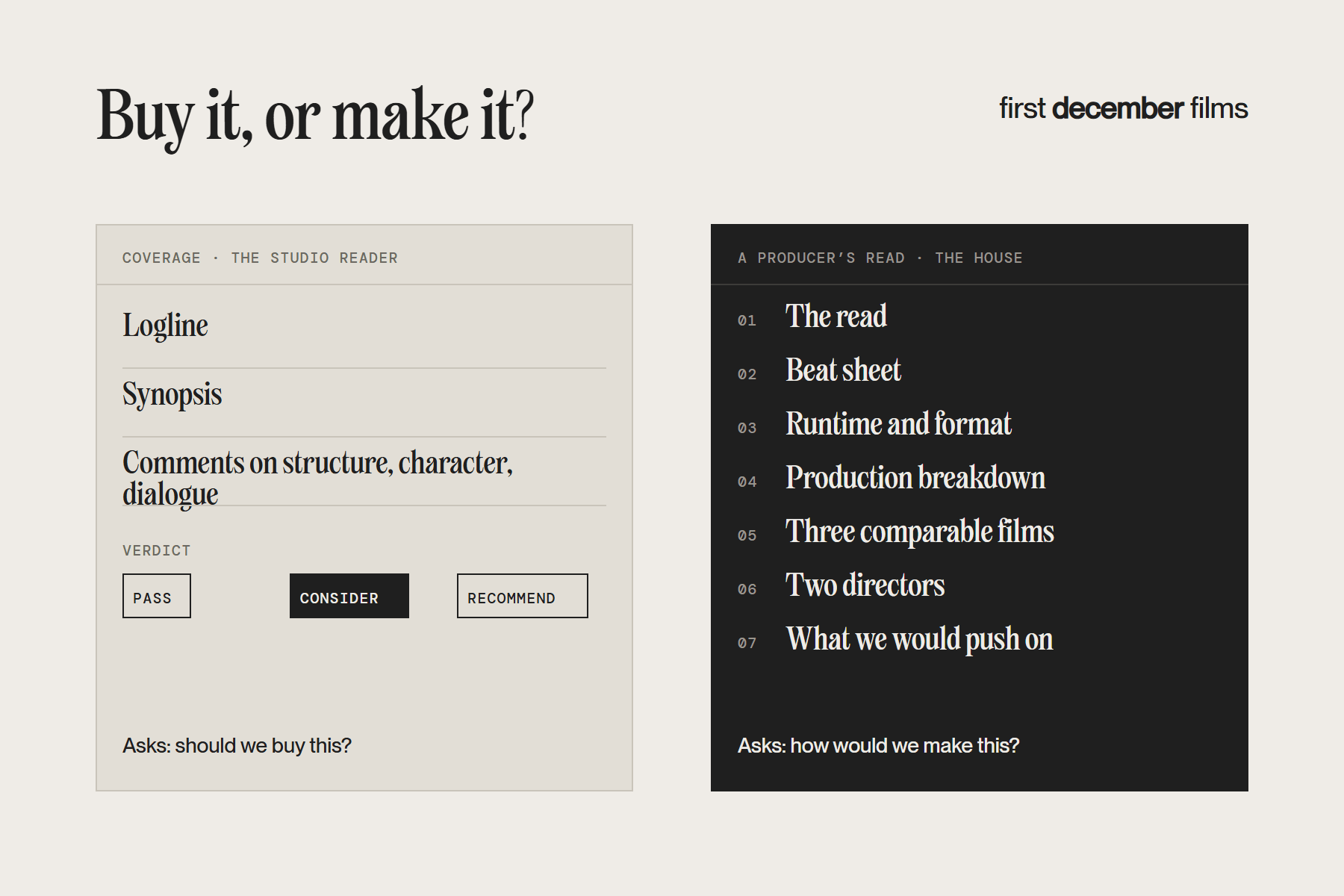
In film, the closest formal thing to script analysis is coverage. A reader at a studio or an agency writes a report on a screenplay: a logline, a synopsis, comments on structure, character and dialogue, and a verdict of pass, consider or recommend. That is how scripts move through Hollywood, and the three-word verdict has been the industry’s shorthand for decades.
Advertising has no coverage. Nobody at a production house writes "pass" on a script, because the script is not being bought. It has already been approved by a brand and an agency. The question a production house asks is different: how would we make this, and what does the client not yet know about making it.
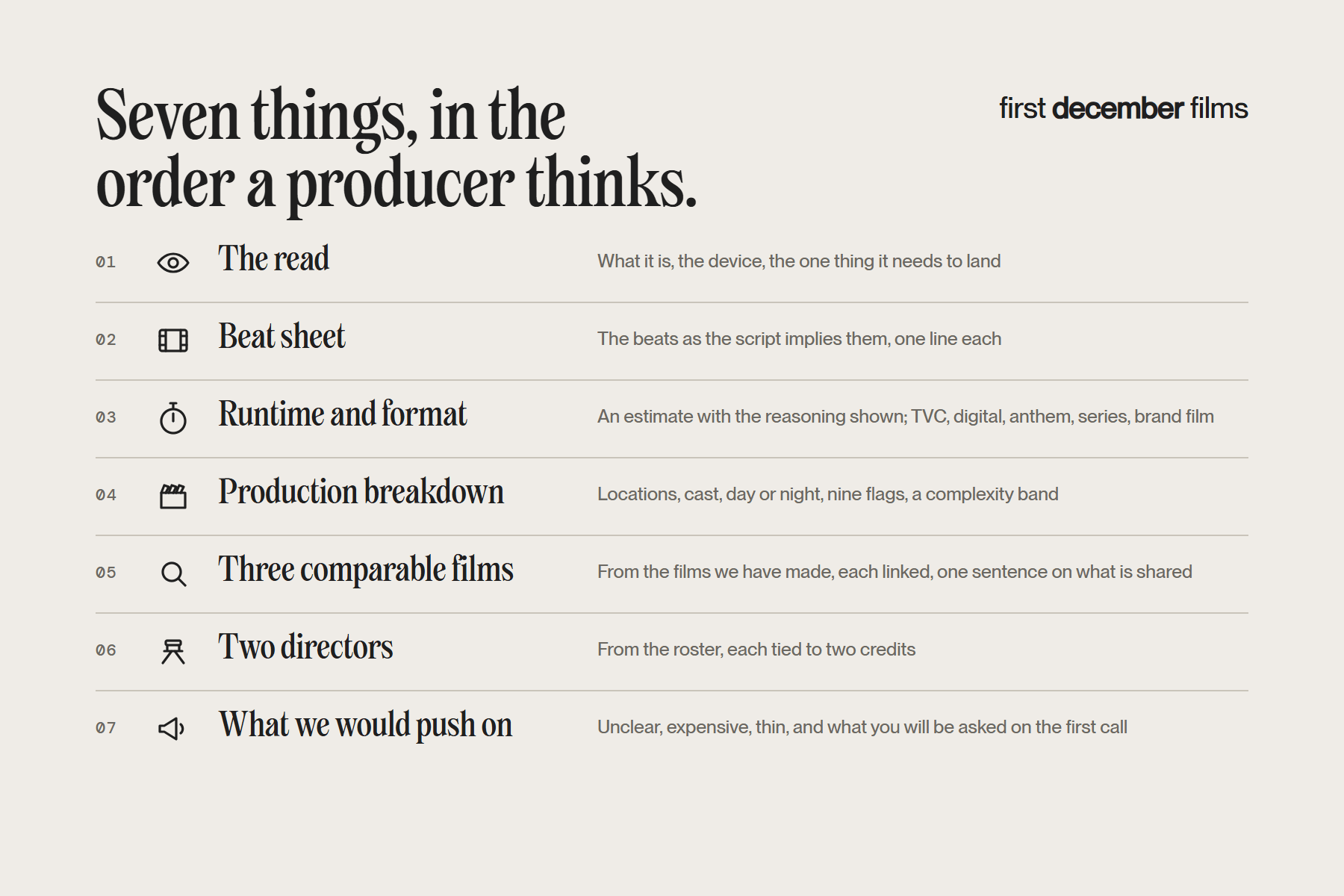
That is the producer’s read. It has seven parts, and they come in the order a producer thinks.
The seven things a producer’s read contains
- The read. What the script actually is in plain terms, the device it relies on, and the single thing it needs to land. One paragraph. If the device cannot be named, the script has a problem the dialogue will not fix.
- Beat sheet. The beats of the film as the script implies them, one line each. Ten beats in a 30-second script is the most common finding, and it means the first cut will run long.
- Runtime and format. An estimate with the reasoning shown: how many spoken lines, how many beats, what the cutdowns will lose. And the format the script reads as: TVC, digital film, anthem, series or brand film. Scripts are often written as one and briefed as another.
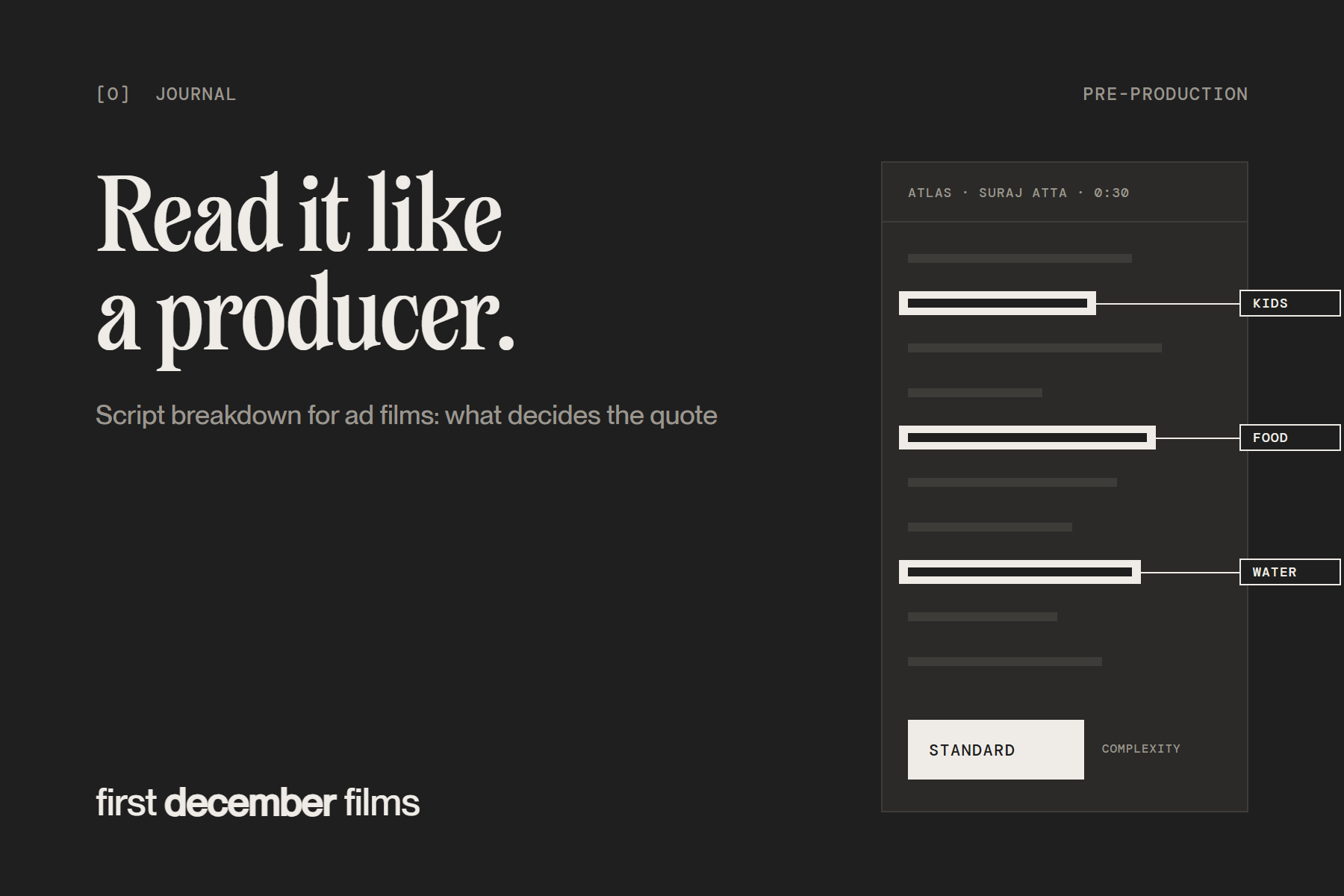
- Production breakdown. Locations, cast size, day or night, and nine flags: VFX, kids, animals, stunts, crowd, celebrity, water, period, vehicles. Then a complexity band, contained, standard or complex, with one sentence on what drives it. We wrote a full guide to the ad film script breakdown if you want the method.
- Three comparable films. Films this house has actually made that share a device, a tone or a production problem with the script, each with one sentence on what is shared.
- Two directors. From the roster, each tied to two credits, with a reason.
- What we would push on. What is unclear, what will get expensive, where the idea is doing the least work, and what the client will be asked on the first call.
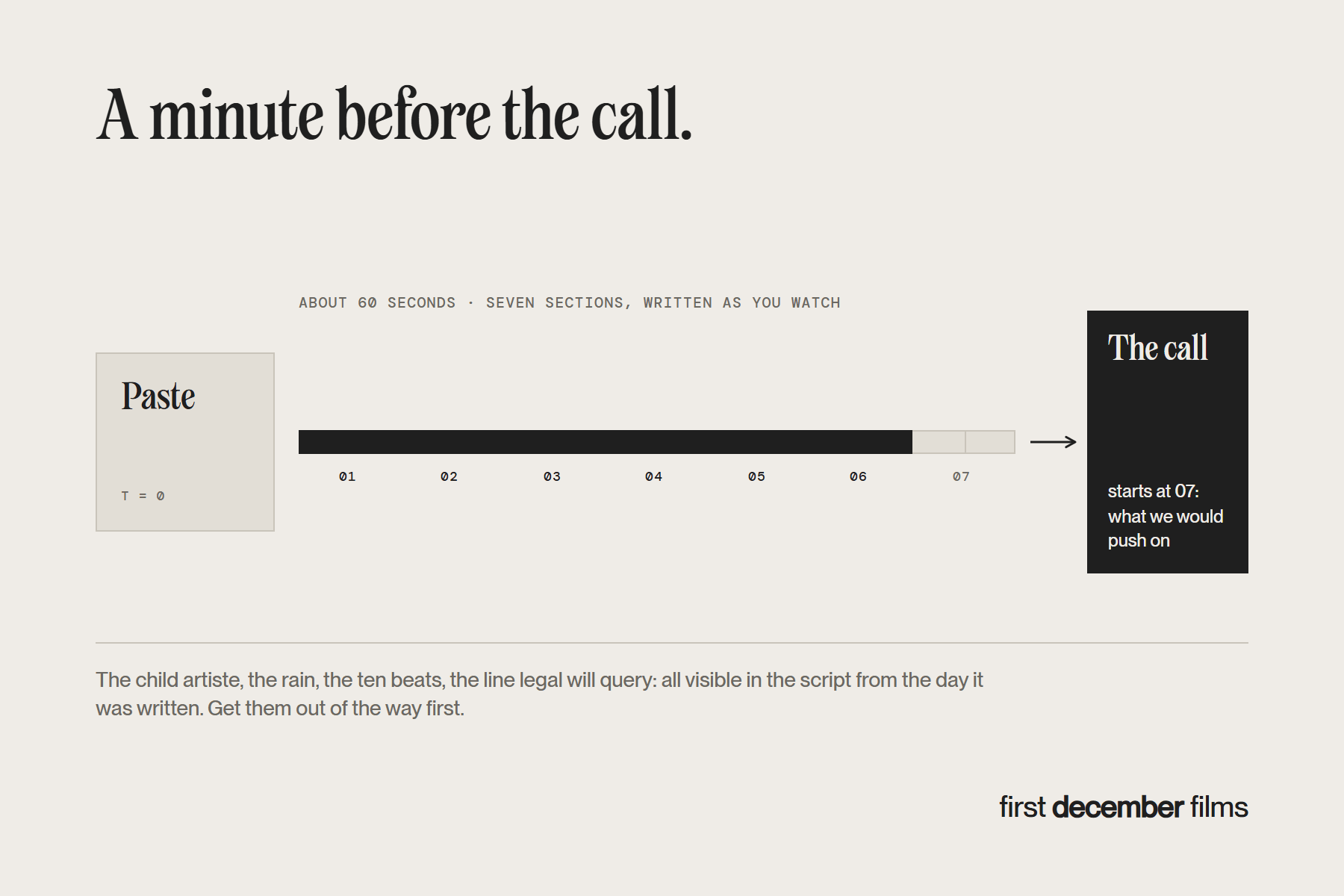
Everything a first production call is made of is in that list. The point of getting it before the call is that the call then starts at item seven.
What the script analyser does
The script analyser is that read, written by a model that has been given our catalogue and told to be honest rather than kind. You paste a script or a brief, add an email, and it writes the seven sections in front of you, one at a time, in about a minute.
Some specifics, because the specifics are what make it useful rather than generic.
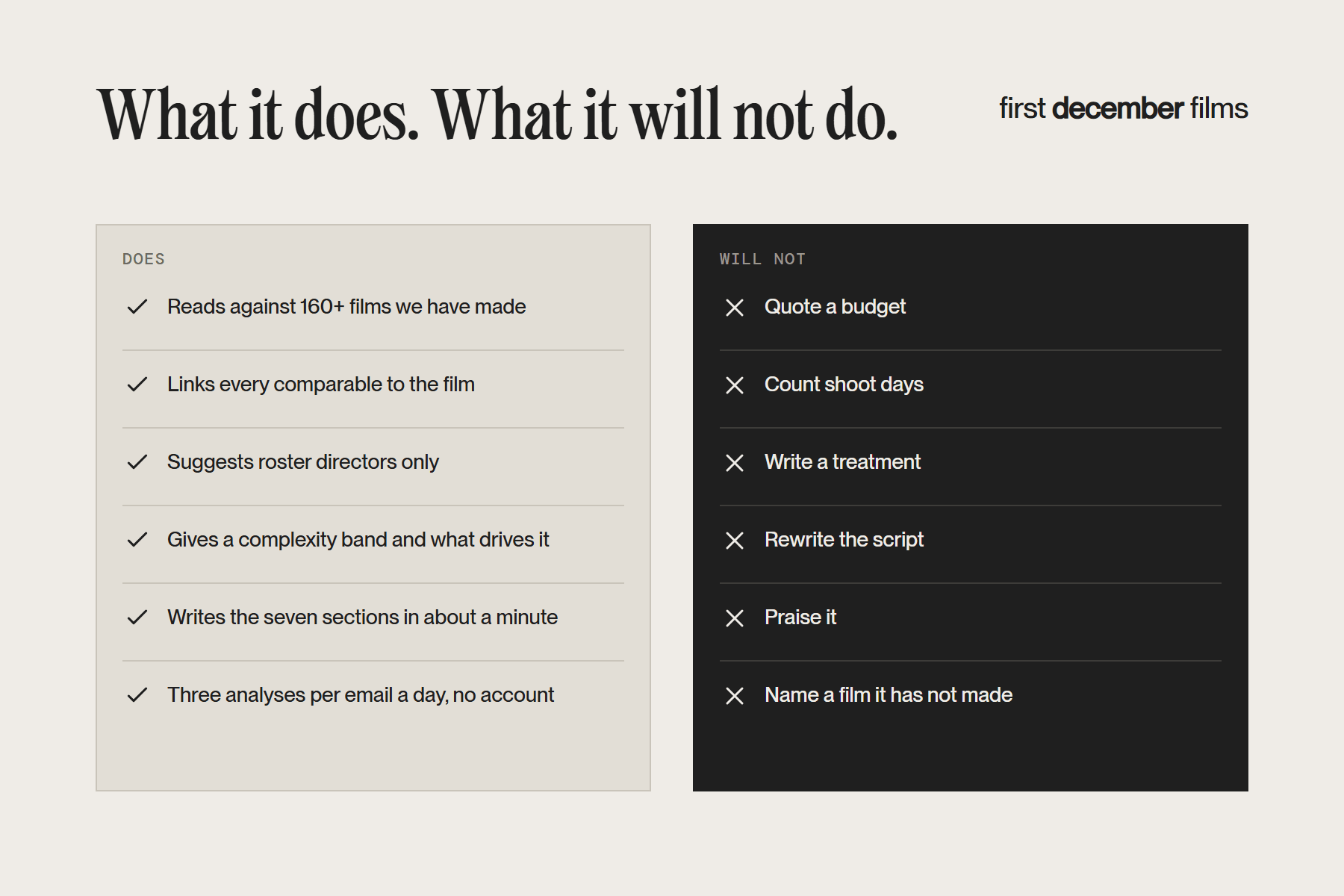
It reads against the films we have made. More than 160 of them, with nine directors on the current roster. When it names a comparable film, it links to that film on this site so you can watch it. It cannot name a film that is not in the catalogue and it cannot suggest a director who is not on the roster. If fewer than three honest comparables exist, it says so and gives fewer.
It gives a complexity band and never a budget. No rupee figures, no shoot-day count. A budget comes from a conversation with a producer, not from a tool, and a tool that guessed one would only anchor that conversation in the wrong place.
It does not write a treatment and it does not rewrite the script. It does not praise. If you paste something that is not a script or a brief, it says so and asks for the script.
It accepts a brief. One page is enough. For a brief it returns the read, three comparables, two directors, and the questions a producer would ask before recommending anything, which is usually the more useful document at that stage.
Three analyses per email address per day. Your script is stored encrypted, read only by the First December Films production team, never used to train any model, and deleted within two working days if you email mail@1stdecember.com with your reference. You keep a link to the analysis.
What honest feedback on a script actually looks like
Most feedback on an ad script is kind. Colleagues are kind, agencies are kind to clients, and a general-purpose chatbot asked to review a script will open with three strengths before it gets to anything useful.
Here is what the analyser said about one of our own test scripts, a 30-second film built on a ketchup heart in a child’s tiffin, with a Mumbai kitchen, monsoon rain, and forty children in a classroom. The "what we would push on" section, in its own words, condensed:
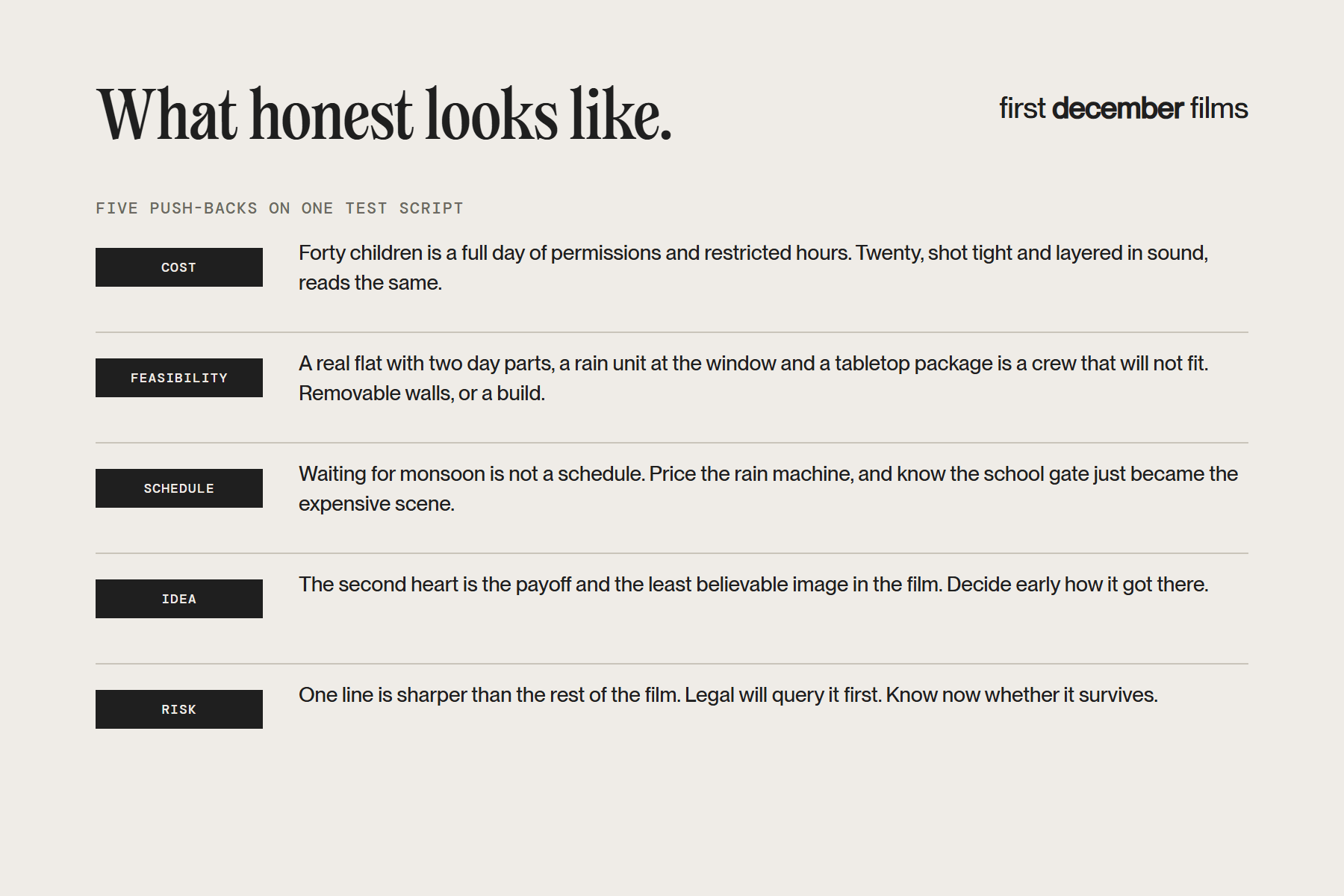
- Forty tiffins opening at once is one shot and a sound cue, but it is a full day of child artistes, guardians, permissions and restricted hours. Would twenty children shot tight and layered in sound give the same result, because the frame will not count them.
- A real Mumbai flat kitchen with two day parts, a rain unit outside the window and a tabletop package on the counter is a crew that will not fit. The honest options are a real flat with removable walls or a build dressed to look lived in.
- Waiting for monsoon is not a schedule. If the answer is a rain machine, the school gate exterior with umbrellas becomes the expensive scene, not the kitchen.
- The second ketchup heart, drawn back inside a washed lid, is the emotional payoff and also the least believable image in the film. Decide early whether the boy drew it in fresh ketchup or whether the audience is being asked to read a smear generously. The answer changes the styling and the shot.
- One line of dialogue is sharper than the rest of the film and will be the first thing a legal or brand team queries. Worth knowing now whether it survives.
See how we would make it.
Paste your script or brief into the Script Analyser and get a producer’s read in about a minute: what it is, how it would be produced, three comparable films we have made and two directors from our roster. Free. No budget, no praise, no rewrite.
None of that is about whether the script is good. It is about what making it will cost, in days, in permissions and in arguments, and where the idea is thinner than it looks. That is the read a brand never gets until the quote arrives, and by then the script is approved and the price is the conversation.
How to read the output
The seven sections are written to be read in order, but three of them deserve a second look.
Runtime and format. If the analyser says a script written as a 30 will play at forty seconds in a first cut, that is not a style note. Two beats have to go, and it is cheaper to choose them on paper than in the offline. If it says the script reads as a digital film rather than a TVC, ask why. Usually it means the idea needs more than thirty seconds to land, and the 30 will be the weakest version.
The complexity band. Read the sentence after the band, not the band. "Complex, driven by forty children on a school day and a rain unit in the same schedule" tells you exactly which two lines of the script are carrying the cost. Change those lines and the band moves. Our guide to what each budget tier actually buys is the companion to this: the band is where the script sits, the tier is what that costs.
What we would push on. This section is the reason the tool exists. Each bullet is a question you will be asked on the first call. Answer them before the call and the call is about the film.
The comparable films are worth watching, all three, because they are the fastest way to see what the script looks like when it is made. The directors are worth reading about for the same reason. Then read our guide to choosing a director for your film, because the treatment is still the thing to judge them on.
What the analyser will get wrong
It is a model. It will sometimes miss a flag a producer would catch, and it will sometimes raise one that a five-minute conversation would settle. It reads the script you paste and nothing else, so a script that assumes context the brand team has in their heads will be read without that context. That is usually a useful thing to discover.
It does not know your budget, your air date or your media plan, and it will not pretend to. The complexity band is a producer’s honest first judgement, not a quote.
And it cannot tell you whether the idea is any good. Nothing can, before the film exists. What it can tell you is whether the idea is doing the work, or whether the voice-over is.
How to prepare a script for analysis
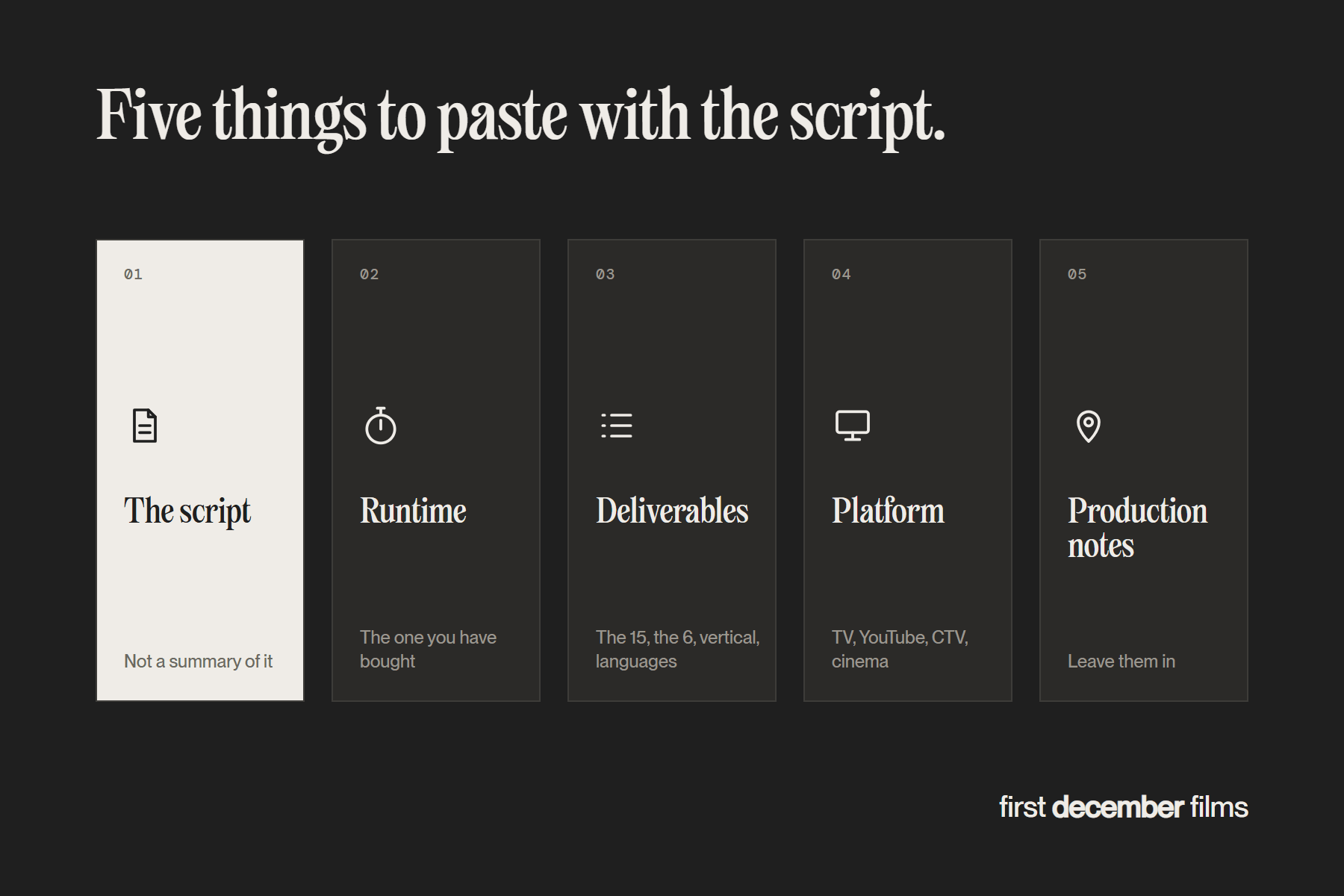
Five things make the read sharper.
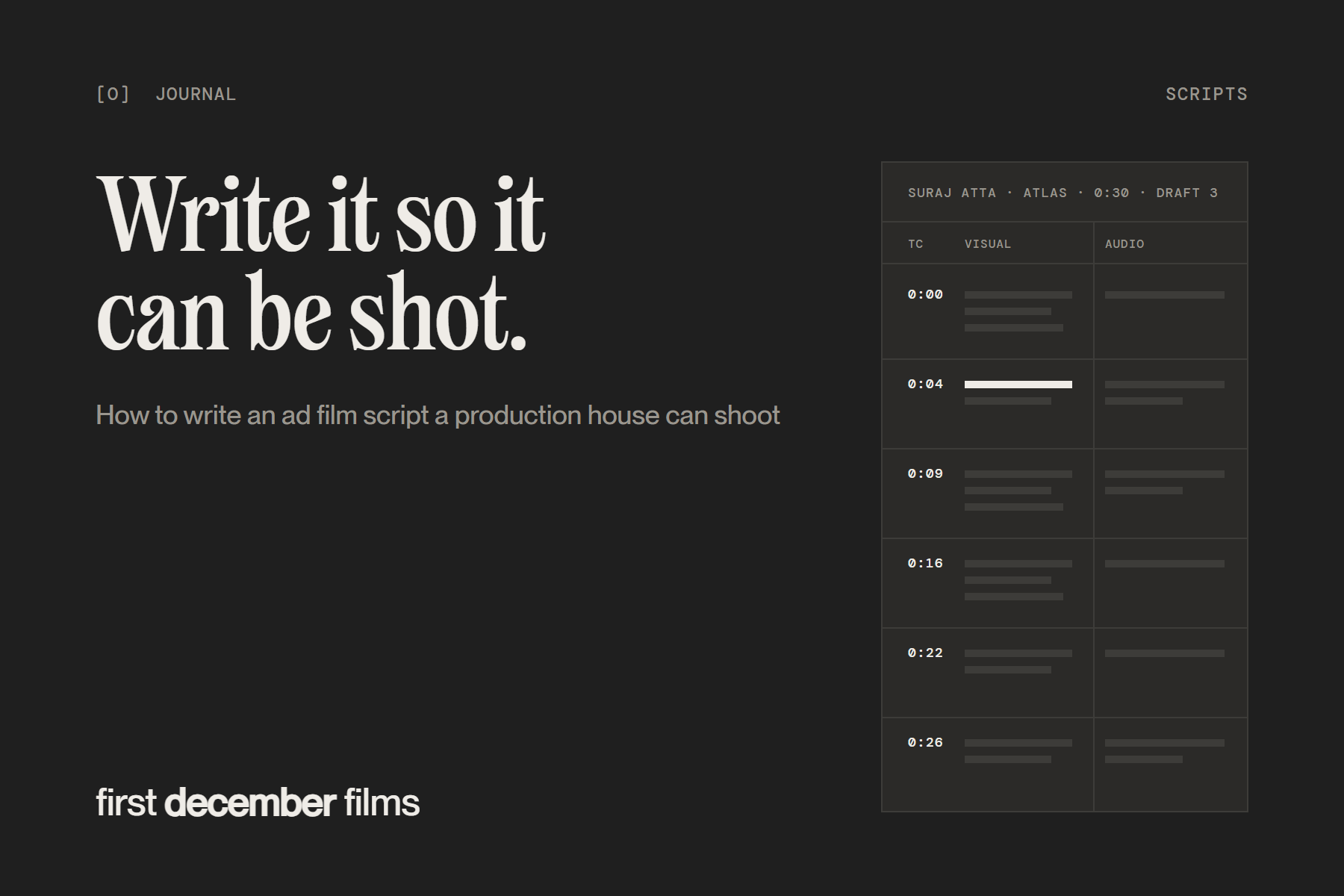
- Paste the script, not a summary of it. The visual column is where the flags live, and our guide to writing an ad film script shows the two-column format that keeps them visible. A paragraph describing the film hides them.
- State the runtime. A script with no runtime is analysed for the runtime it implies, which may not be the one you have bought.
- Name the deliverables. The 15, the 6, the vertical cut, the languages. The runtime section will tell you what each cutdown loses only if it knows they exist.
- Say where it airs. Television, YouTube, connected TV, cinema. Broadcast standard and a phone in a train are different films.
- Include the production notes. "Real kitchen, not a set" and "actual rain if the shoot lands in monsoon" are the lines a producer reads first. Leave them in.
If all you have is a brief, paste the brief. The questions it returns are the ones to answer before you write the script.
Who this is for
Brands and agencies with a script or a brief, before the first production call. Producers who want to know how a script reads to another house. Writers who want a production read rather than praise. Students who want to see what happens to a script after the writing is done.
It is not for anyone who wants a number. Numbers come from a conversation, and the analyser exists to make that conversation shorter and better.
Get the read before the call
The first production call on most films is spent discovering things that were visible in the script from the day it was written. The child artiste. The rain. The ten beats. The line legal will query.
Get those out of the way in a minute, on your own screen, before anyone is on a call. Then the call is about the film, which is what everyone wanted it to be about in the first place.
First December Films is an advertising film production company in Mumbai. Our work has won more than 150 international creative awards, including Cannes Lions, D&AD and One Show Gold Pencils. Paste your script into the analyser, or send us the brief and a producer will read it.
What is script analysis for an ad film?
A producer’s read of the script before anyone commits to making it: what the idea is and the device it relies on, the beats, a runtime and format estimate, a production breakdown with a complexity band, comparable films, suitable directors, and what a producer would push back on before the first call.
What is the difference between script coverage and a producer’s read?
Coverage is a reader’s report on a screenplay with a verdict of pass, consider or recommend, written to decide whether to buy it. A producer’s read is written after a script is approved, to work out how to make it and what the client does not yet know about making it.
Is there a free AI script analyzer for ad film scripts?
Yes. The First December Films script analyser at 1stdecember.com/script reads a script or brief against more than 160 films and nine directors and returns seven sections in about a minute. It is free, needs no account, and allows three analyses per email address per day.
Does the script analyser give a budget or a shoot-day count?
No. It gives a complexity band, contained, standard or complex, and one sentence on what drives it. Budgets come from a conversation with a producer. A tool that guessed a number would only anchor that conversation in the wrong place.
Is my script safe if I paste it into an online analyser?
With the First December Films analyser, the script is stored encrypted, read only by the production team, never used to train any model, and deleted within two working days if you email mail@1stdecember.com with your reference. Ask any other tool the same three questions before you paste.
Can I analyse a brief instead of a full script?
Yes. A one-page brief works. For a brief the analyser returns the read, three comparable films from the catalogue, two directors from the roster, and the questions a producer would ask before recommending anything, which is usually the more useful document at that stage.
How honest is AI feedback on an advertising script?
A general chatbot tends to open with praise. The First December Films analyser is instructed to be honest rather than kind, to name what will get expensive and where the idea is doing the least work, and never to praise or rewrite. It can still miss a flag a producer would catch, so treat it as a first read.