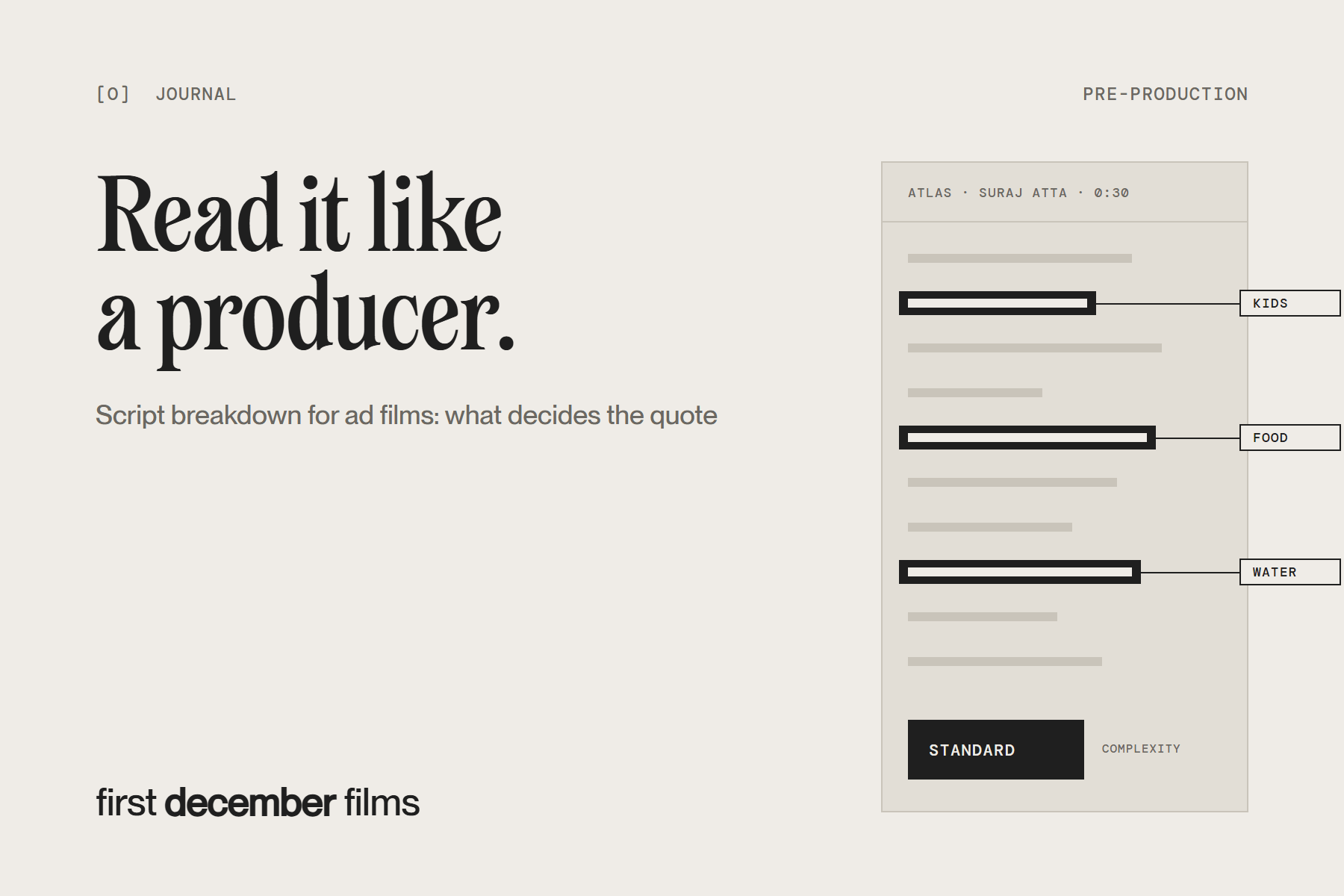
The short answer. A script breakdown for an ad film is a producer’s read of the script that turns every line into a production requirement: how many locations, how many people in front of the camera, day or night, and which of nine flags apply. VFX, kids, animals, stunts, crowd, celebrity, water, period and vehicles. The output is a complexity judgement, contained, standard or complex, and that judgement decides the quote before a single rate card is opened.
It takes an experienced producer about twenty minutes on a thirty-second script. It takes a brand about twenty minutes too, once you know what to look for. This is what to look for.
What a script breakdown is, and how the ad film version differs
In feature film, a script breakdown is the scene-by-scene listing of every element a screenplay needs, from cast and props to vehicles and effects, so that the schedule and budget can be built from it. That is the definition you will find on Wikipedia and in the StudioBinder guide that ranks first for the term. The 1st assistant director marks the script in colours, measures each scene in eighths of a page, and builds a stripboard.
An ad film breakdown is a smaller, earlier and blunter version of the same thing. Smaller because the script is a page. Earlier because it happens at bid stage, before there is a 1st AD, a schedule or even a director attached. Blunter because its job is a single judgement: how hard is this film to make, and what drives that.
So there are no eighths. Nobody counts pages when the whole film is 30 seconds. What a producer counts instead is locations, cast, day parts and flags, and then decides what the film is.
The first pass: locations, cast, day or night
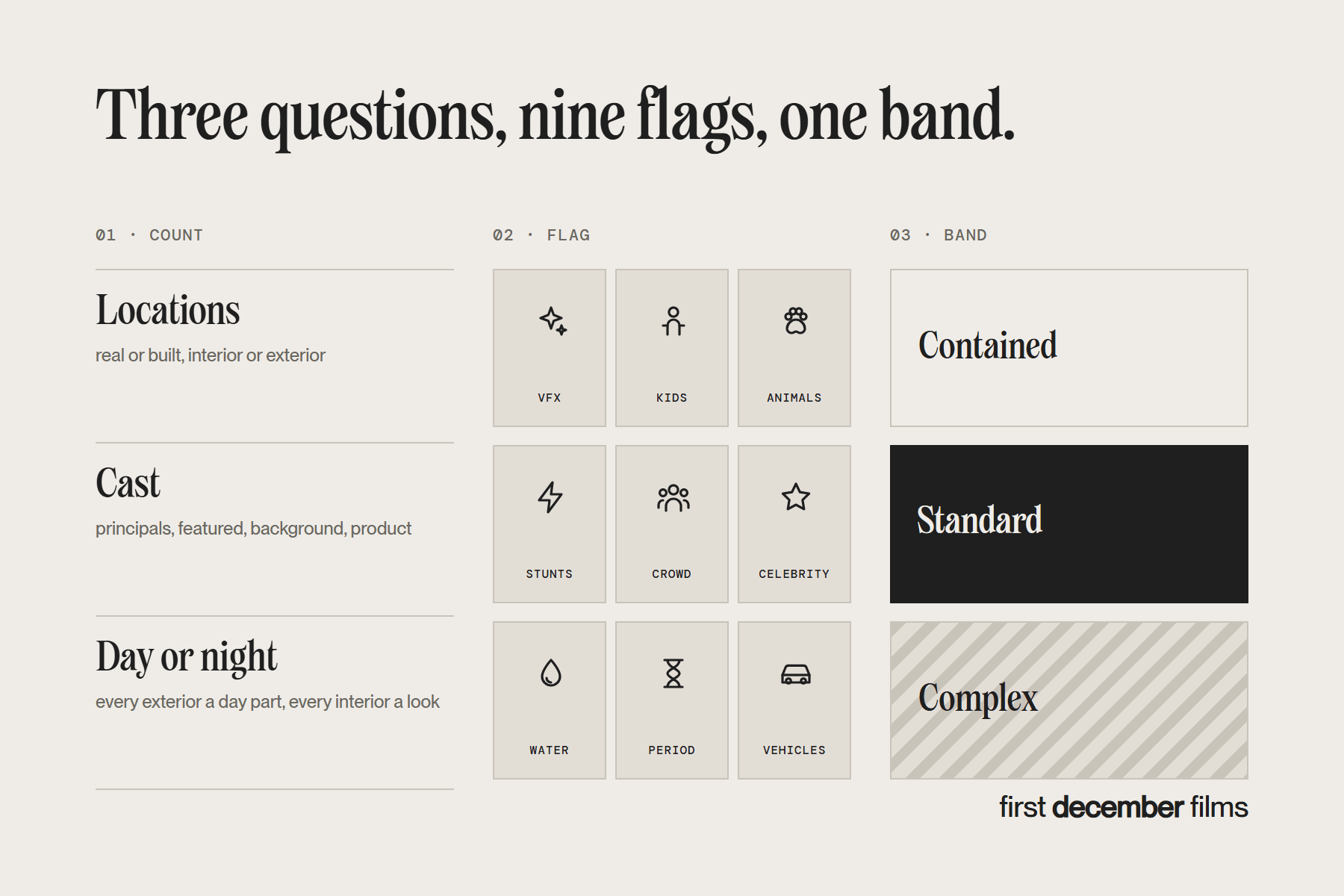
Read the script once for the idea. Then read the visual column again and write three numbers in the margin.
Locations. Count every distinct place the camera has to be, and note whether it is interior or exterior, real or built. Two rooms in the same flat are one location. A flat and a school gate are two. A flat, a school gate and a classroom are three, and three locations in a 30-second film is the point at which one shoot day becomes two.
Cast. Principals first, the people who speak or carry the story. Then featured extras, the faces the camera lands on. Then background. Then the product. Yes, the product is cast. A hero pack that has to be shot beautifully is a tabletop unit, and a tabletop unit is a separate crew, sometimes a separate day.
Day or night. Every exterior has a day part and every interior has a look. A kitchen at 6.40 in the morning and the same kitchen in the evening is one location with two lighting setups, which means one location that costs like two. Night exteriors in a city are their own category: permissions, generators, a crew on a night rate, and a neighbourhood that would prefer you were not there.
Those three numbers are the skeleton of the quote. The flags put flesh on it.
The nine flags that change a shoot
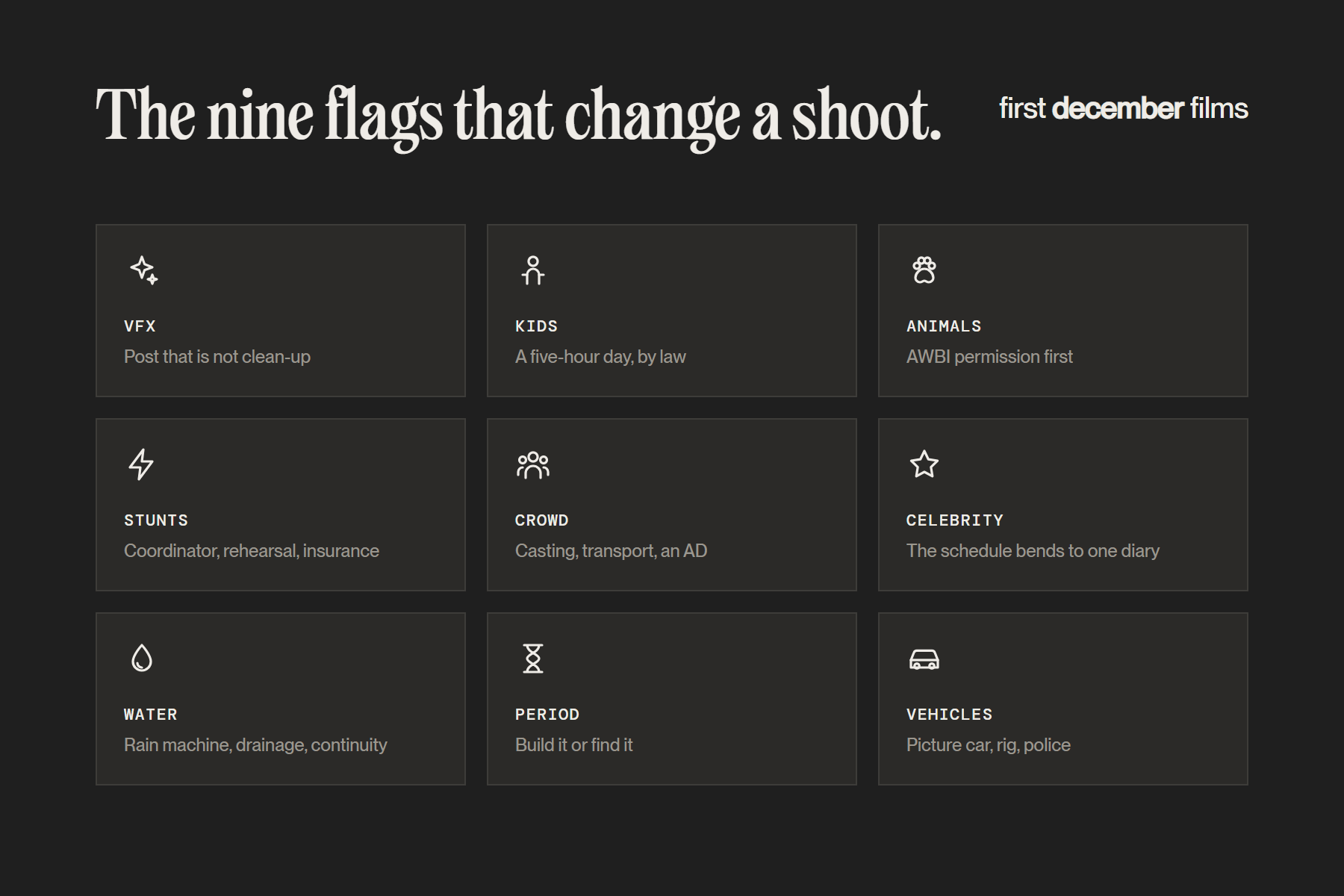
These are the nine things we check on every script that comes into First December Films. They are the same nine our script analyser is built to check, because they are the nine that move an Indian ad budget.
- VFX. Anything the camera cannot photograph. Clean-up is cheap. A crowd extended in post, a product that does something impossible, or a sky that has to be replaced is not.
- Kids. A child artiste in India needs prior permission from the District Magistrate, may work no more than five hours a day and no more than three hours without a break, and requires one responsible adult for every five children on set, under the Child Labour (Prohibition and Regulation) Amendment Rules, 2017. A child on set halves the usable day.
- Animals. Any animal in an ad film needs pre-shoot permission from the Animal Welfare Board of India and a post-shoot no-objection certificate. The Board will not issue a direct NOC without the pre-shoot permission, except for background, computer-generated, stock and foreign footage. Dogs and cats need their vaccination records submitted. Budget the fees, the handler and the weeks of lead time.
- Stunts. Anything a performer could be hurt doing. A stunt coordinator, rehearsal time, insurance, and a director who has shot action before.
- Crowd. A crowd written as a number is a shot. A crowd on the day is casting, transport, food, wardrobe and a 1st AD who can move eighty people between takes.
- Celebrity. The fee is the headline. The schedule is the cost: a shoot day that bends around one person’s availability, an entourage, a usage term and a legal team on the approvals.
- Water. Rain, sea, pool, a glass that spills. Water is continuity, drainage, electrical safety and a second wardrobe. Rain machines are the most common water flag in Indian scripts because nobody can schedule the monsoon.
- Period. Any era that is not now. Art direction, wardrobe, vehicles and locations that have to be found or built, and a frame that cannot contain a single modern object.
- Vehicles. A car in a script is a picture car, a driver, a tracking vehicle, a road permission and, in a city, police coordination. A car that moves is a rig. A car that crashes is stunts and VFX at once.
One flag rarely changes the band on its own. Three together always do.
Complexity: contained, standard or complex
After the numbers and the flags, the producer writes one word.
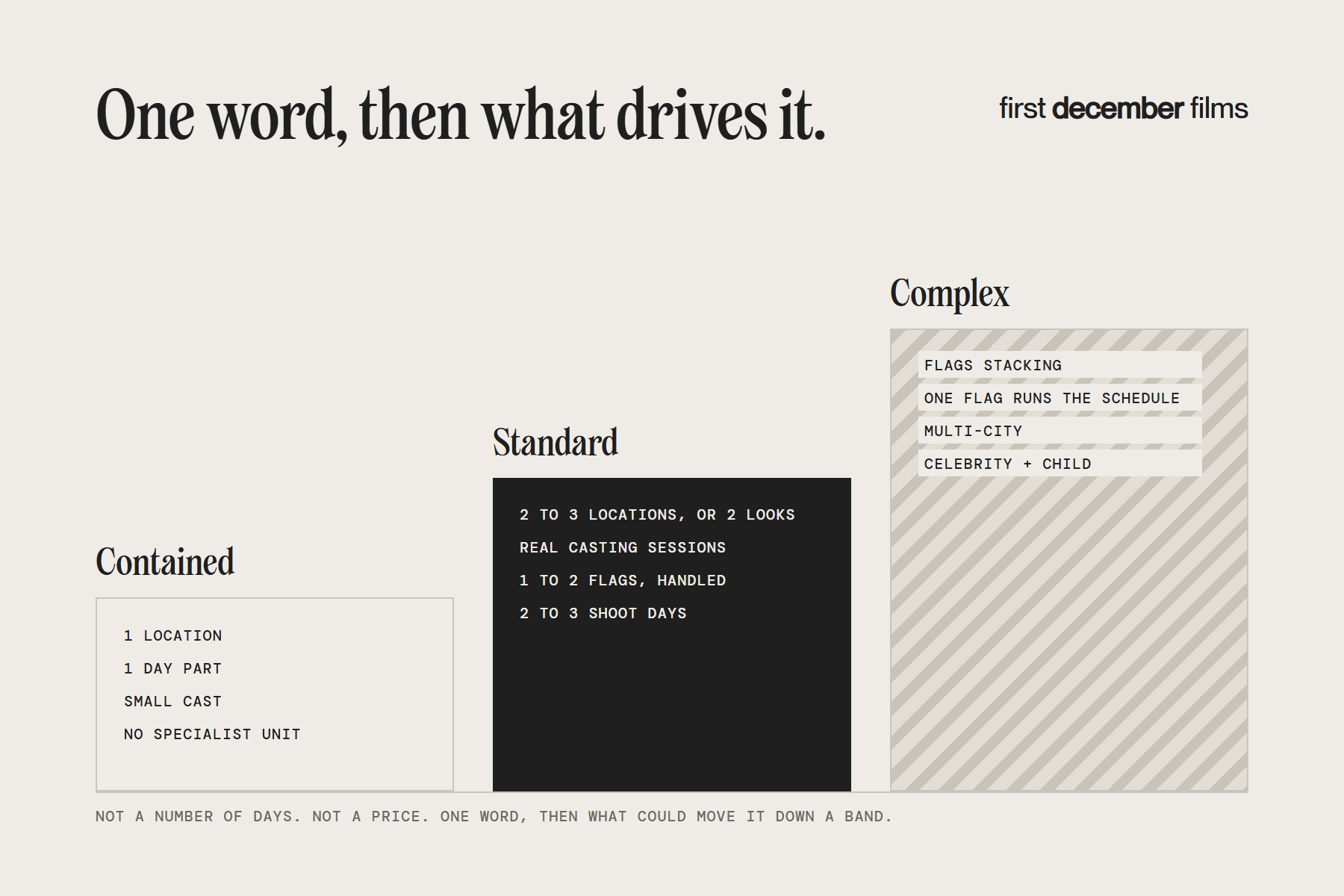
Contained means one location, a small cast, a single day part and no flags that need a specialist unit. One shoot day, a compact crew, a straightforward post. A conversation in a living room. A product on a table with hands.
Standard means two or three locations or a second day part, a proper cast with real casting sessions, one or two flags handled by people who do that for a living. Two to three shoot days. Most national television commercials in India live here.
Complex means the flags are stacking, or one of them is big enough to run the schedule on its own. Forty children on a school day. A rain unit and a hero food shot in the same schedule. A crowd that has to be built in post. Multiple cities. Anything with a celebrity and a child in the same frame.
See how we would make it.
Paste your script or brief into the Script Analyser and get a producer’s read in about a minute: what it is, how it would be produced, three comparable films we have made and two directors from our roster. Free. No budget, no praise, no rewrite.
Notice what the band does not say. It does not say a number of shoot days and it does not say a price. That is deliberate. At bid stage a number is a guess dressed as a fact, and it becomes the ceiling the client negotiates down from. A band plus one sentence on what drives it is more honest, and it starts the right conversation, which is about what could move the film down a band.
We covered what each tier of budget actually buys in our guide to ad film production cost in India. The band is how a producer gets from the script to that tier.
A worked breakdown
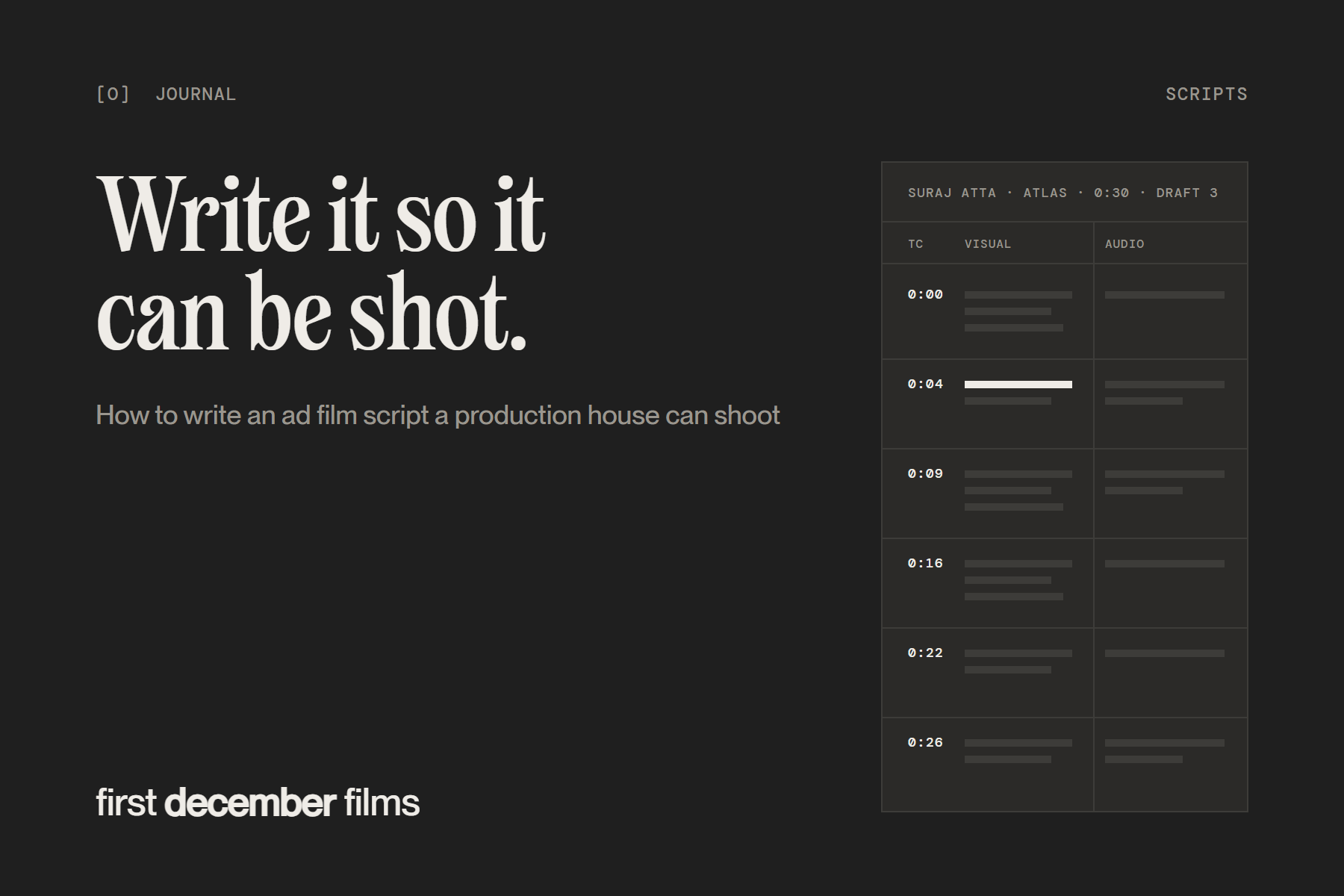
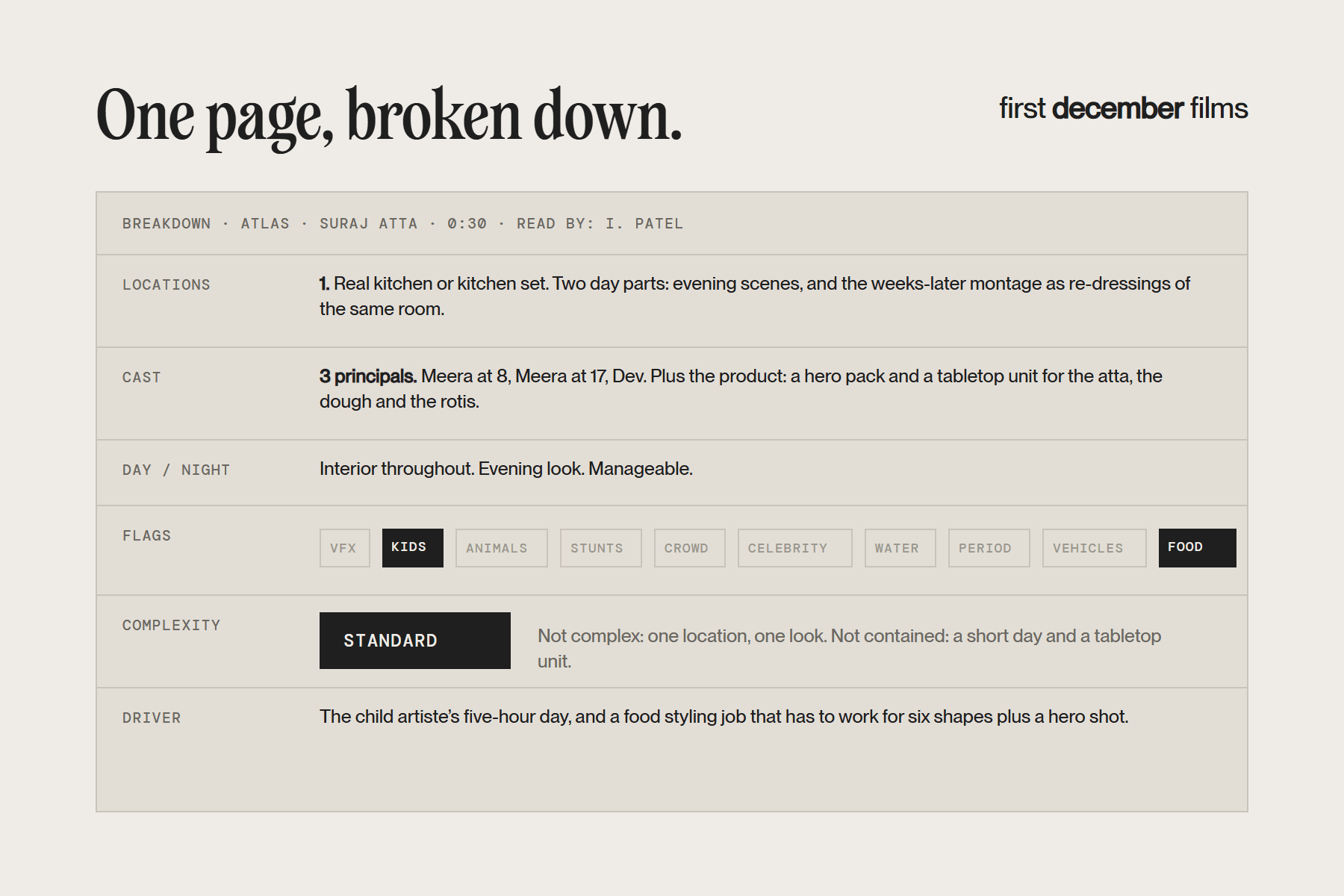
Take the sample script from our guide to writing an ad film script: a father, a daughter who rolls rotis shaped like countries, a steel dabba where he keeps them, a pack shot. Here is the breakdown a producer would write.
Locations. One. A real kitchen, or a kitchen set. Two day parts: the evening scenes and the "weeks later" montage, which reads as different days but can be shot as different dressings of the same room.
Cast. Three principals: Meera at 8, Meera at 17, Dev. Two actors playing one character across nine years is a casting problem before it is anything else. Then the product, which is a hero pack and a tabletop unit for the atta, the dough and the rotis.
Day or night. Interior throughout, evening look. Manageable.
Flags. Kids: yes, a child artiste under twelve, so District Magistrate permission and a five-hour day. Food: yes, and food styling is the hidden flag here, because rotis shaped like Australia, Italy, Sri Lanka and Chile do not happen by accident. That is a stylist, templates, spares, and time. Everything else: no.
Complexity: standard. Driven by the child artiste’s short day and a food styling job that has to work for six different shapes plus a hero shot. Not complex, because it is one location and one look. Not contained, because the day is short and the tabletop wants its own unit.
What a producer would push on. Whether the "weeks later" cuts need wardrobe changes or can be sold with lighting and props. Whether the 17-year-old Meera is a second actor or the first one aged up, which is a VFX flag in disguise. Whether the dabba reveal, the emotional shot of the film, has been given enough time in a five-hour day.
That is the whole breakdown. Half a page. It tells the client what the film costs in kind before anyone says what it costs in rupees.
Kids and animals: the two flags with a rulebook
Most flags are judgement calls. Two are law, and both are regularly missed by scripts that arrive from outside the industry.
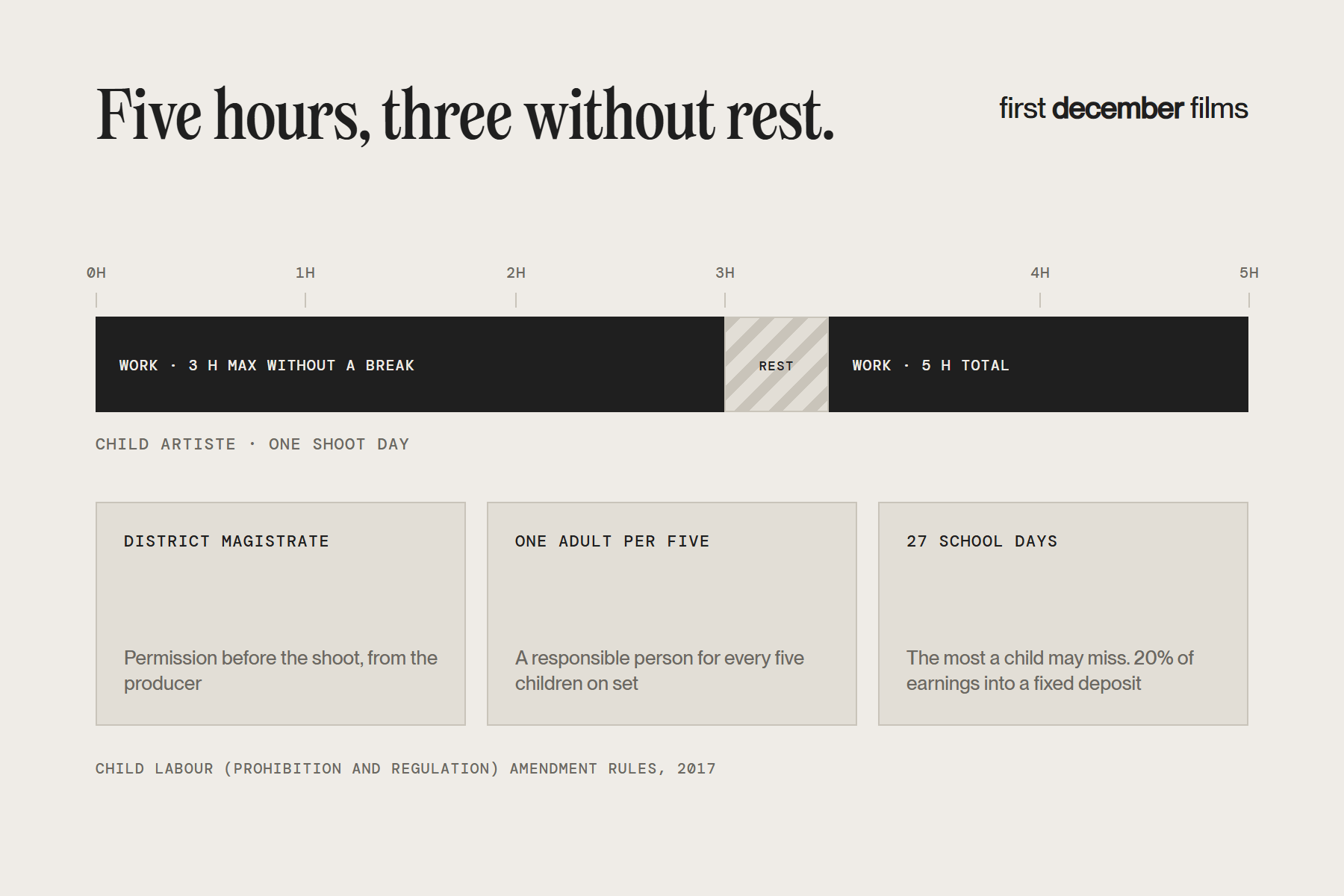
Child artistes are governed by the 2017 amendment rules to the Child Labour (Prohibition and Regulation) Act. The producer needs the District Magistrate’s permission before the shoot. The child may work for a maximum of five hours in a day and not more than three hours without a rest. There must be one responsible person for every five children. A child may not miss more than 27 days of school for the work, and 20 percent of the child’s earnings go into a fixed deposit in the child’s name. Every one of those is a scheduling constraint, and the five-hour cap is the one that decides the shoot. A film whose emotional shot is a child’s face gets one attempt at the golden hour, not three.
Animals are governed by the Performing Animals (Registration) Rules, 2001, administered by the Animal Welfare Board of India. Pre-shoot permission first, then a post-shoot NOC, and the Board publishes the fees: Rs 25,000 for the pre-shoot application and Rs 30,000 for a direct post-shoot NOC. The permission carries lead time, and the shoot carries a handler, a vet where the Board asks for one, and photographs of the animal being transported. A dog that wanders through one shot of a 30-second film is a month of paperwork.
Neither flag is a reason to cut the child or the dog. Both are a reason to know, at script stage, that the day just got shorter and the calendar just got longer.
From breakdown to quote
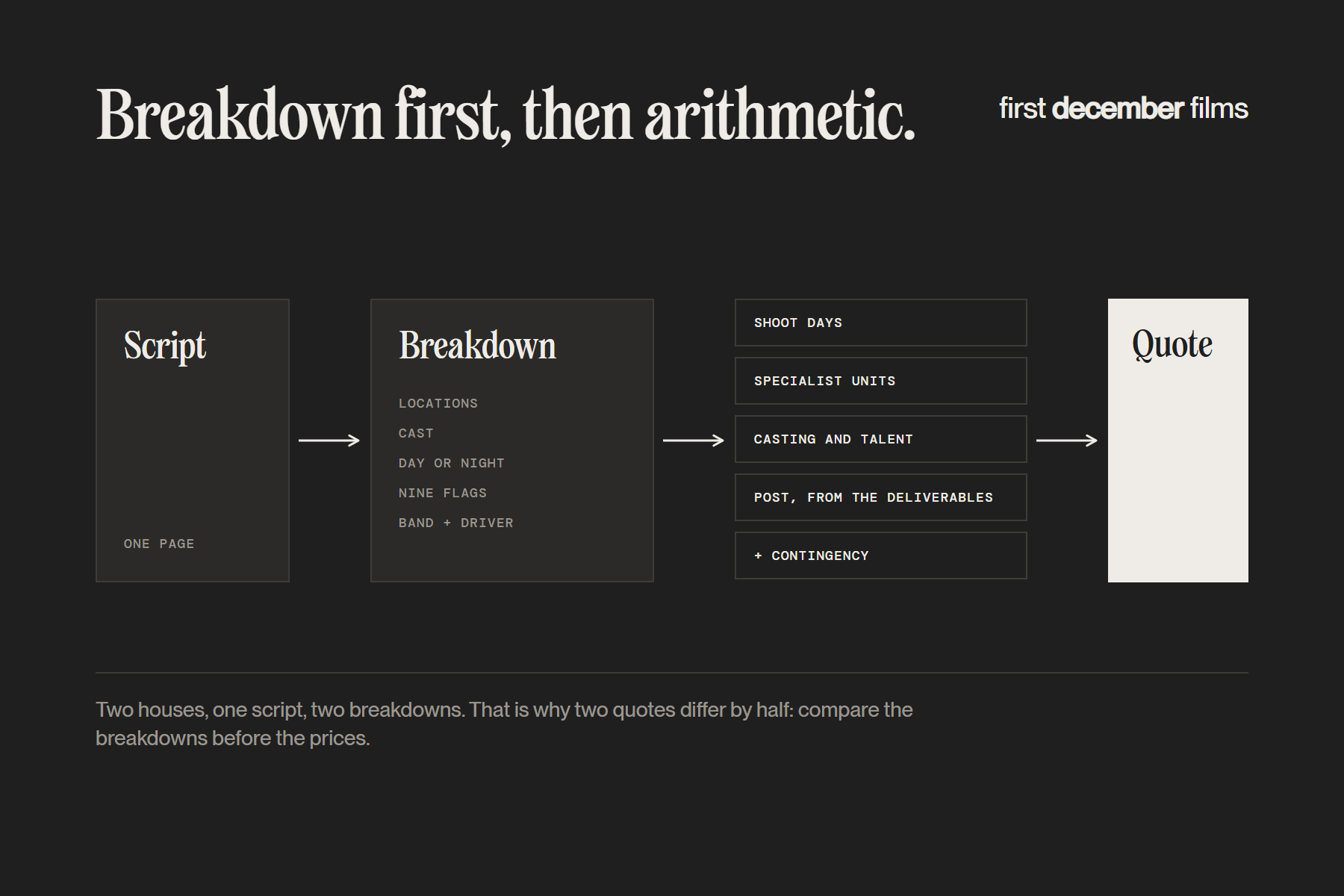
Once the band is set, the rest of the quote is arithmetic. Locations and day parts become shoot days. Cast becomes casting sessions and talent fees. Flags become specialist units: a tabletop crew, a rain unit, a stunt coordinator, a VFX supervisor on set. Shoot days become crew, equipment and food. Post is scoped from the deliverables list, which is why the cutdowns and language versions should be in the brief and not discovered after the offline.
Then a contingency, which for a standard Indian shoot is usually a fixed percentage, because a shoot day is the most expensive thing to add after the quote is signed. What happens after the quote is awarded, the pre-production meeting, the shoot and post, is in our guide to the TVC production process in India.
This is the order it happens in, and it explains something clients often find odd: two production houses reading the same script will send back quotes that differ by half. Usually they did not read the script the same way. One counted three locations and one counted two. One priced the classroom as forty children and one as twenty shot tight. One saw the rain and priced a machine. The other hoped for June.
Compare breakdowns before you compare prices. It is the only way the prices mean anything.
Do the breakdown yourself before the bid
You do not need a producer to do the first pass. You need twenty minutes and the visual column of your own script.
Count the locations. Count the people. Mark day or night. Go down the nine flags and tick the ones that apply. Write one of three words. Then write one sentence on what drives it.
If you would rather see how a producer at First December Films does it, paste the script into our script analyser. It returns the production breakdown as one of seven sections: locations, cast size, day or night, the nine flags, and the complexity band with the sentence on what drives it. It also returns three comparable films from the ones we have actually made and two directors from our roster, and it will tell you what we would push on. It takes about a minute, it does not quote a budget, and your script is stored encrypted and deleted within two working days if you ask.
The breakdown is not the boring part of making a film. It is the part where the film gets decided.
First December Films is an advertising film production company in Mumbai. Our work has won more than 150 international creative awards, including Cannes Lions, D&AD and One Show Gold Pencils. If you have a script and want to know what it will take to make, paste it into the analyser or send us the brief.
What is a script breakdown in ad film production?
A producer’s read of the script that turns every line into a production requirement: locations, cast size, day or night, and flags such as VFX, kids, animals, water and vehicles. The result is a complexity band, contained, standard or complex, that shapes the quote before any rate card is opened.
How is an ad film breakdown different from a feature film breakdown?
It is smaller, earlier and blunter. A feature breakdown is scene by scene, measured in eighths of a page, and done by the first AD to build a schedule. An ad film breakdown covers one page, happens at bid stage before a director is attached, and produces a single complexity judgement.
What flags make an ad film shoot more expensive?
Nine recur: VFX, kids, animals, stunts, crowd, celebrity, water, period and vehicles. One flag rarely changes the complexity band on its own. Three together always do, and the costliest combinations pair a short day, such as a child artiste, with a unit that needs time, such as rain or a hero food shot.
What are the rules for child artistes in Indian ad films?
Under the Child Labour (Prohibition and Regulation) Amendment Rules 2017, the producer needs District Magistrate permission, the child may work at most five hours a day and three hours without rest, one adult supervises every five children, school absence is capped at 27 days, and 20 percent of earnings go into a fixed deposit.
Do I need permission to use animals in an ad film in India?
Yes. The Animal Welfare Board of India issues a pre-shoot permission and then a post-shoot no-objection certificate under the Performing Animals (Registration) Rules 2001. A direct NOC is not issued without pre-shoot permission, except for background, computer-generated, stock and foreign footage.
Why do quotes from different production houses vary so much for the same script?
Usually because the breakdowns differ, not the rates. One house counted three locations, another two. One priced forty children, another twenty shot tight. One budgeted a rain machine, the other hoped for monsoon. Compare the breakdowns before you compare the prices.
Can I get a script breakdown done for free?
Yes. The First December Films script analyser at 1stdecember.com/script returns a production breakdown as one of seven sections: locations, cast size, day or night, the nine flags, and a complexity band with one sentence on what drives it. About a minute, no budget figure, three analyses per email a day.