The short answer. An ad film script is one page with a header and two columns: what the viewer sees on the left, what the viewer hears on the right, timed to the second. Thirty seconds holds about 75 words of audio. The cutdowns, the 15 and the 6, are decided before the master is written, not after the edit is locked. And every line in the visual column is a line item on a quote, so the budget is set the day the script is.
That is the whole format. Everything else on this page is about what a producer does with it once it lands in the inbox, because that is where most scripts die.
We read scripts every week at First December Films. Some arrive as three lines on WhatsApp, some as twelve pages with mood boards. The good ones share a shape, and the shape has very little to do with how well they are written.
What an ad film script actually is
An ad film script is a shooting document, not a piece of writing. It tells a director, a producer and a client the same thing at the same time: what will be on screen, what will be on the soundtrack, and how long each of those moments lasts.
That makes it a different object from a screenplay. A feature script alternates action lines and dialogue and lets pace emerge. A 30-second film has no room for pace to emerge. The timing has to be visible on the page, which is why the format separates picture from sound and lines them up side by side, a convention Boords sets out in its guide to the TV commercial script format.
Indian production houses expect the same thing. Send a script as a paragraph of prose and the first thing a producer does is rewrite it into two columns so the shot count and the audio length can be checked. Save them the step.
The format: one page, two columns
The header carries the facts that stop confusion later: brand, product, working title, runtime, language, draft number and date, and who wrote it. Draft numbers matter more than they look. A shoot with two versions of the script in circulation is a shoot where somebody films the wrong line.
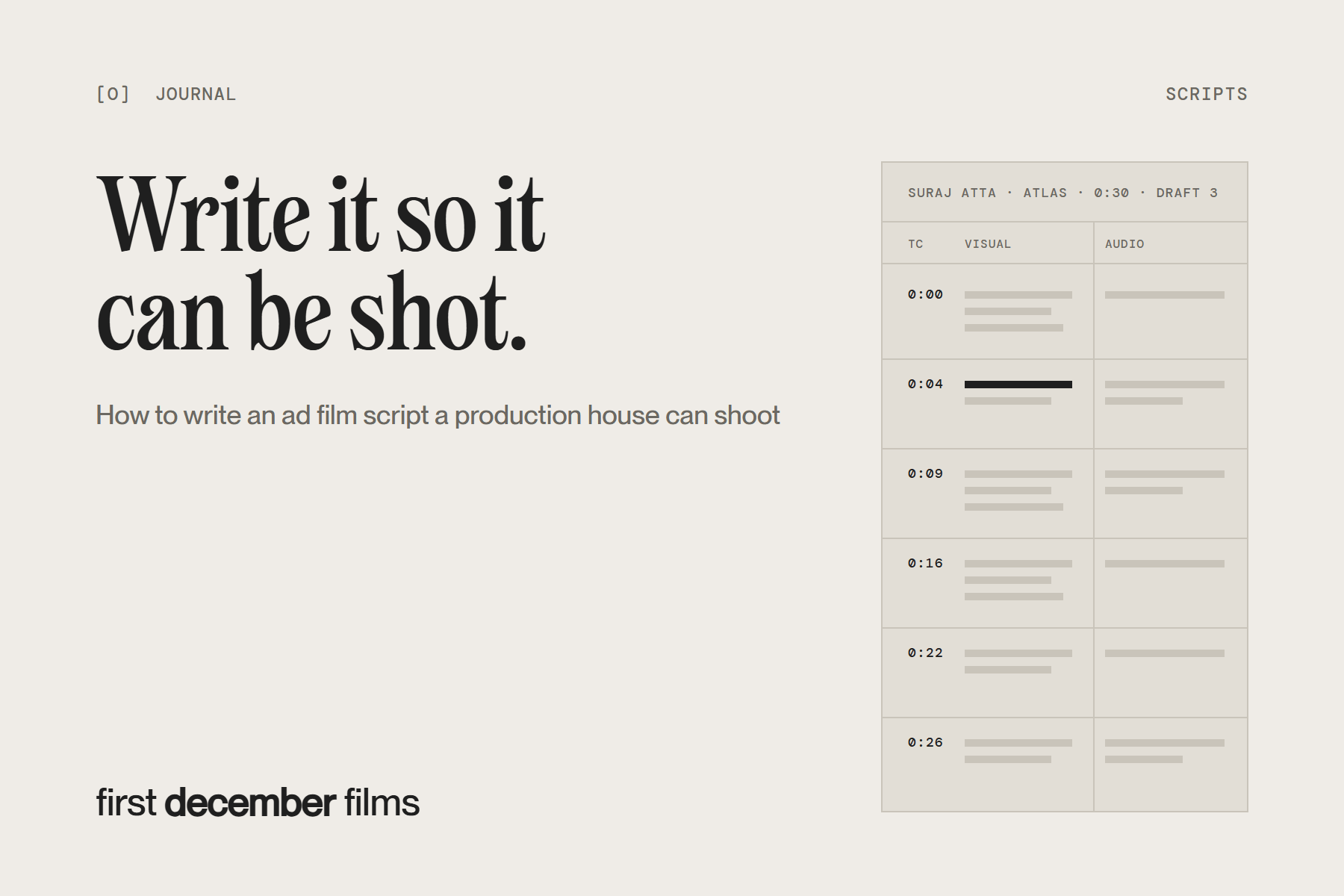
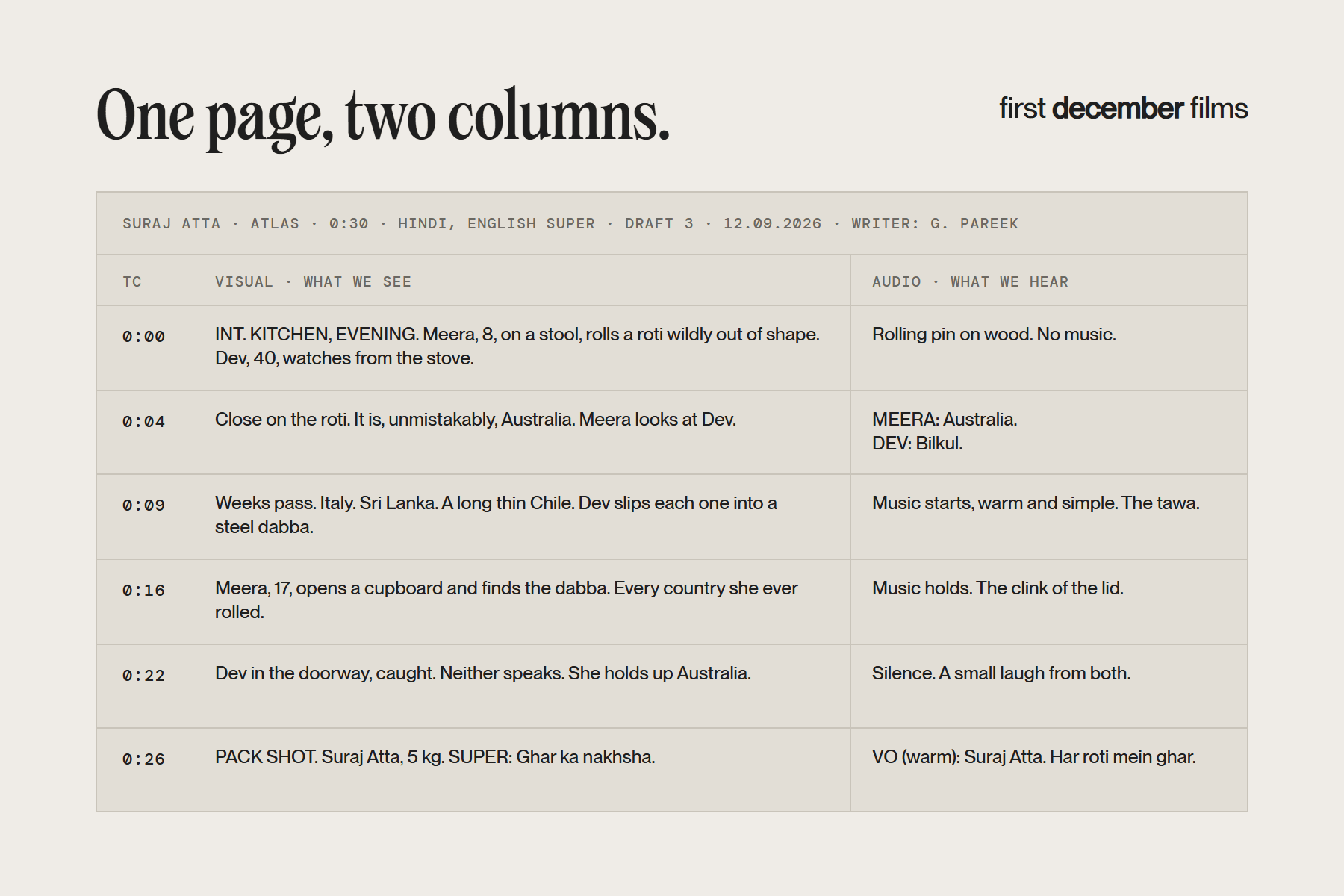
Below the header, the two columns. The left column answers "what do we see". The right column answers "what do we hear". Each row is one moment, and the timecode sits at the start of the row so the sum of the rows can be checked against the runtime.
Here is a script written to that shape. It is a sample, for a fictional atta brand, and we will use it again in our guide to the ad film script breakdown to show how a producer breaks it down.
ATLAS. Suraj Atta, 30 seconds, Hindi with English super. Draft 3.
0:00 to 0:04. VISUAL: INT. KITCHEN, EVENING. MEERA, 8, stands on a stool rolling a roti that is wildly out of shape. Her father, DEV, 40, watches from the stove. AUDIO: Sound of a rolling pin on wood. No music.
0:04 to 0:09. VISUAL: Close on the roti. It is, unmistakably, the shape of Australia. Meera looks at Dev. AUDIO: MEERA: Australia. DEV: Bilkul.
0:09 to 0:16. VISUAL: Quick cuts over the following weeks. A roti shaped like Italy. Sri Lanka. A long thin Chile. Dev cooks each one and, when Meera is not looking, slips it into a steel dabba instead of the plate. AUDIO: Music starts, warm and simple. Sound of the tawa.
0:16 to 0:22. VISUAL: Meera, older now, 17, opens a cupboard looking for something. She finds the dabba. Inside, dried and stacked, every country she ever rolled. AUDIO: Music holds. The clink of the dabba lid.
0:22 to 0:26. VISUAL: She turns. Dev is in the doorway, caught. Neither says anything. She holds up Australia. AUDIO: Silence, then a small laugh from both.
0:26 to 0:30. VISUAL: PACK SHOT. Suraj Atta, 5 kg. SUPER: Ghar ka nakhsha. AUDIO: VO (male, warm): Suraj Atta. Har roti mein ghar.
Count the audio. Two words of dialogue, one line of voice-over, and a lot of sound design. That is deliberate, and it brings us to the number that decides most scripts.
How many words fit in thirty seconds
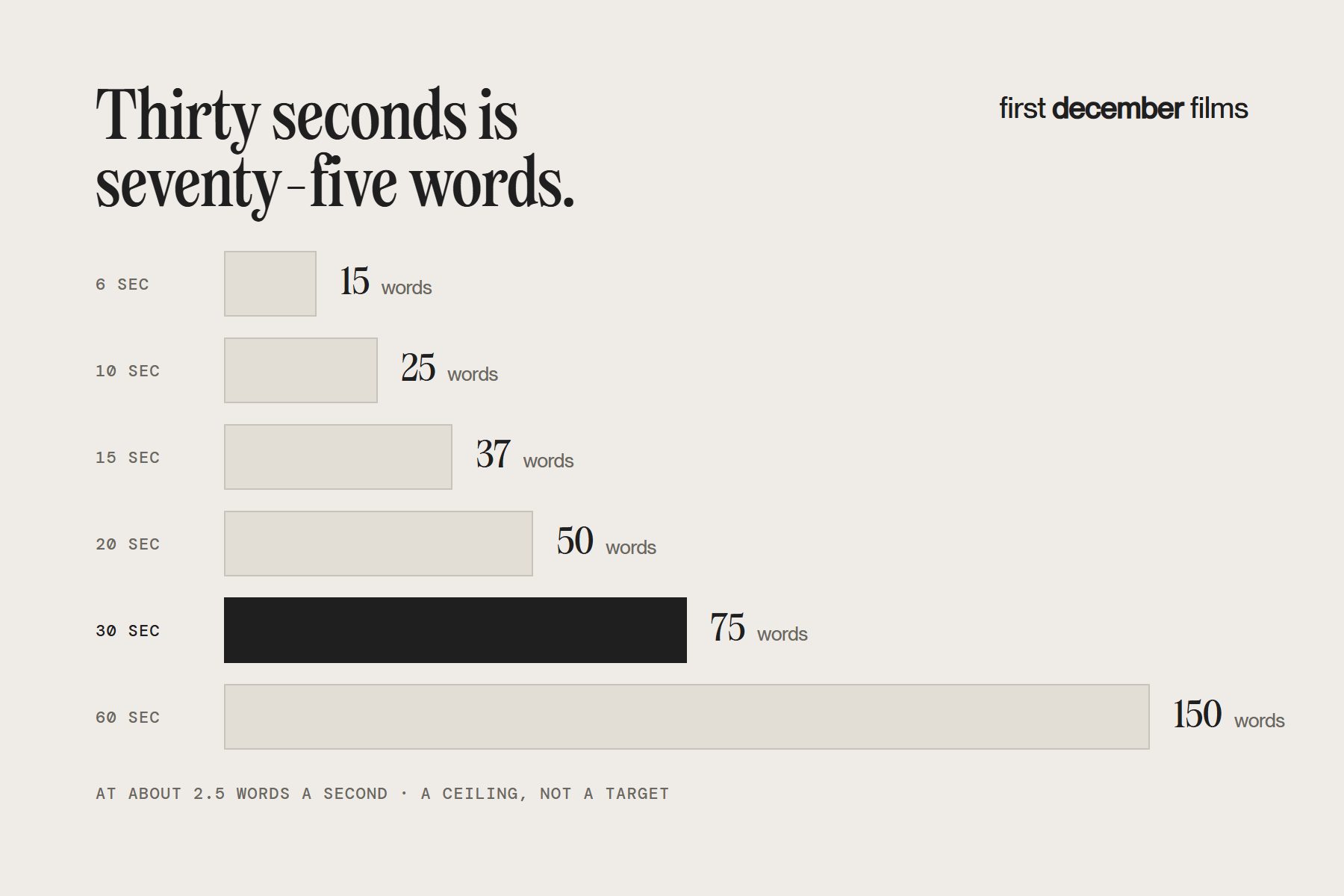
About 75. A professional voice reads conversational copy at roughly 2.5 words a second, which puts a 30-second spot between 65 and 85 words if the voice never stops, according to the timing guides published by voice-over studios such as Abe’s Audio and Killerspots. Warm reads land nearer 2.2 words a second. Energetic reads push towards 3.
That is the ceiling, not the target. Every second the voice is talking is a second the picture cannot breathe. The sample above uses fewer than twenty spoken words in thirty seconds and nobody watching would call it slow.
Two things change the maths in India.
The first is language. A line written in English and then dubbed into Hindi, Tamil or Bengali almost always runs longer than the original. In our experience the safe habit is to write the master a beat short and let the language versions fill it, rather than writing to the limit in English and then cutting words the client has already approved.
The second is the super. Text on screen is read at reading speed, not listening speed. A super that arrives under a voice-over competes with it. Give the super its own second or drop it.
Write the six before the thirty
This is the part that separates scripts written by people who have been through a post-production schedule from scripts written by people who have not.
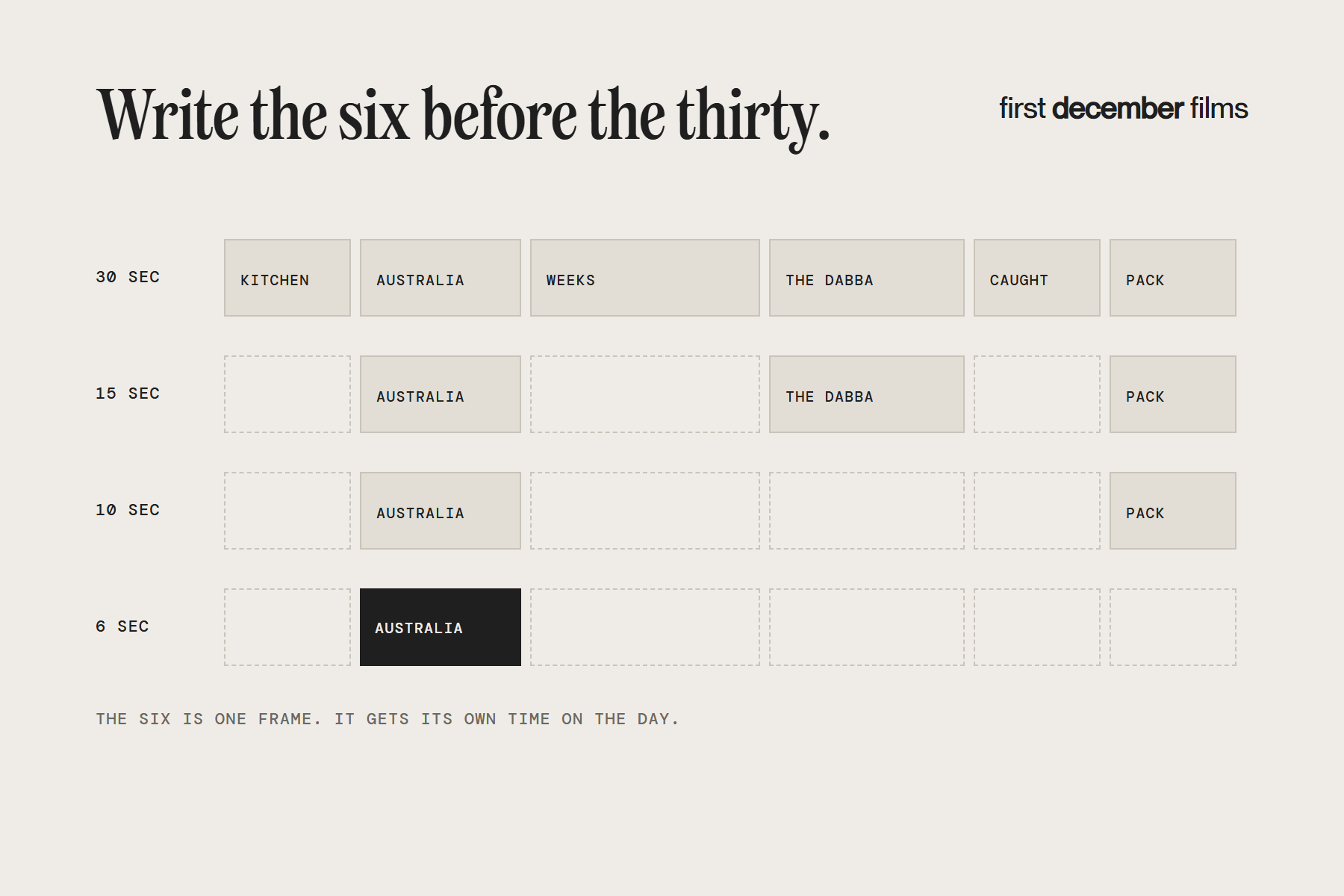
Indian television sells airtime in ten-second units, so the broadcast family is usually a 30, a 20, a 15 and a 10. Digital adds the 6-second bumper and the vertical cut. Every one of those is a different film, and the smaller ones are not trims of the bigger one. A 15 that is a 30 with the middle cut out feels exactly like that.
So decide the cutdowns at the script stage. Write one line under the script that says which beats survive in the 15 and which single image is the 6. Then look at that single image and ask whether it can be shot properly.
In the sample, the 6 is the Australia roti and Meera’s face. That is a food styling job and a child actor’s expression, and it wants its own time on the day. When our script analyser read a test script built on a ketchup heart, its note on the bumper was blunt: the shot needs dedicated tabletop time and should not be scavenged from master coverage. That is the right instinct. The smallest film in the family is often the hardest frame to get.
Every line is a line item
A producer does not read a script the way a client does. A client reads for the idea. A producer reads for the invoice.
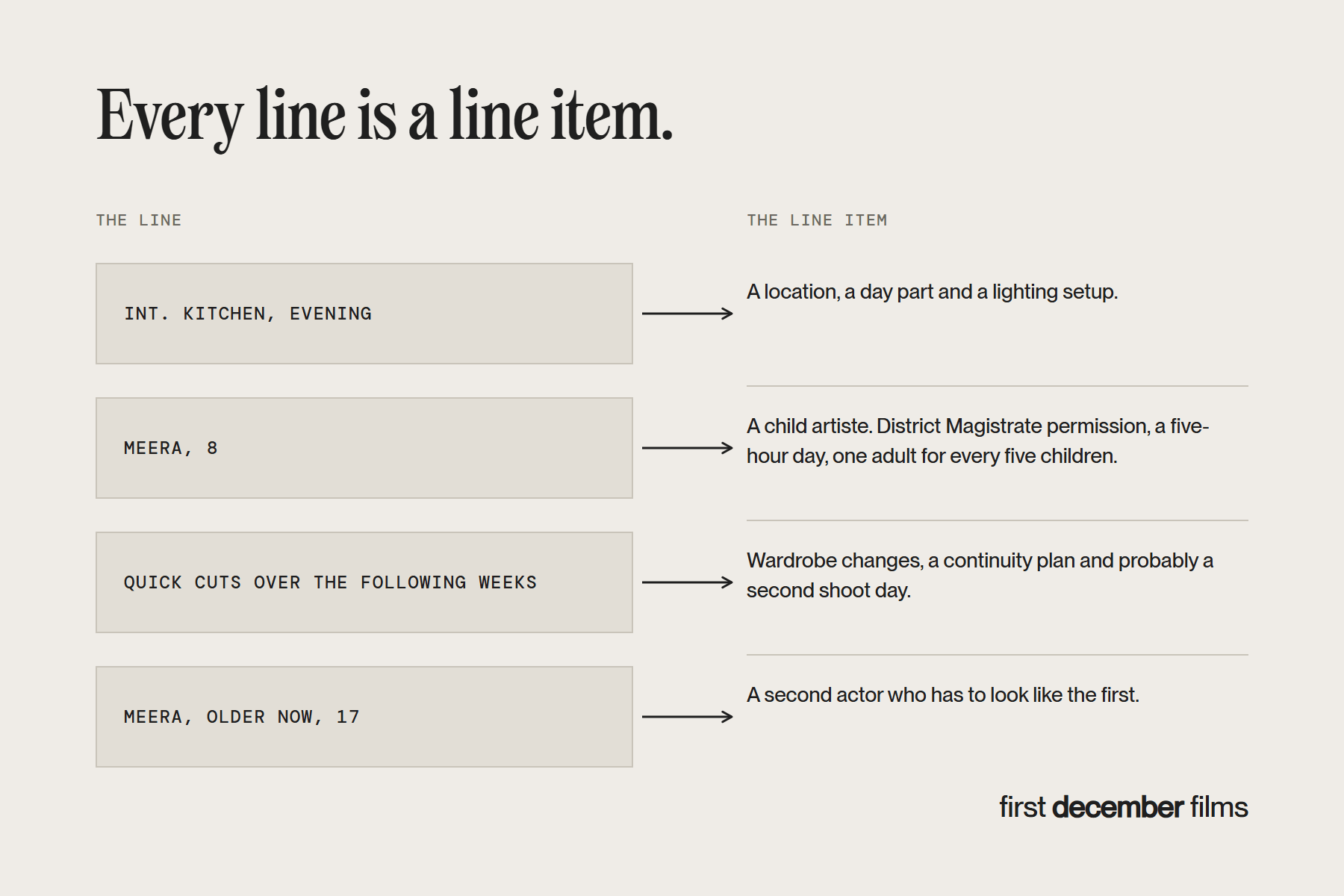
"Evening kitchen" is a location, a day part and a lighting setup. "Meera, 8" is a child artiste, which in India means permission from the District Magistrate before the shoot, a working day capped at five hours with no more than three hours without rest, and one responsible adult for every five children on set, under the Child Labour (Prohibition and Regulation) Amendment Rules of 2017. "Quick cuts over the following weeks" is a wardrobe change, a continuity plan and probably a second day. "Meera, older now, 17" is a second actor who has to look like the first.
See how we would make it.
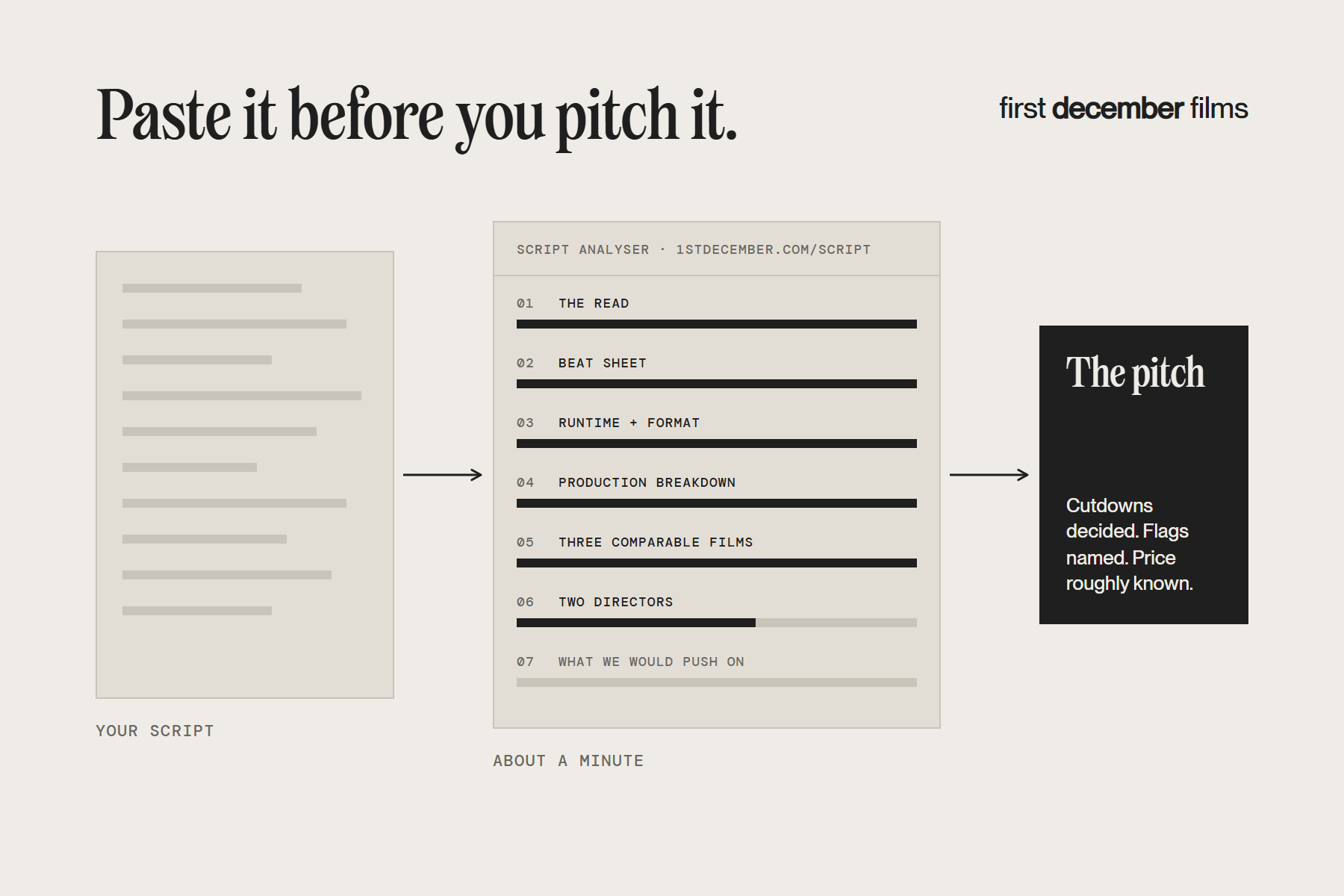
Paste your script or brief into the Script Analyser and get a producer’s read in about a minute: what it is, how it would be produced, three comparable films we have made and two directors from our roster. Free. No budget, no praise, no rewrite.
None of that is a reason not to write it. All of it is the price of writing it, and the price is fixed the moment the line is on the page. We wrote in our guide to ad film production cost in India that the most common place a budget breaks is a script written for the wrong budget. The quote stage does not create that problem. It reveals it.
The habit that helps: when a draft is done, read the visual column once more as a shopping list. Every location, every person, every animal, every drop of water, every night, every vehicle. If the list surprises you, the quote will surprise you more.
Beats, not shots
How much direction should the script contain? Less than most first drafts do.
A script describes beats: the moments the film has to hit, in order. It does not describe lenses, camera moves or the colour of the wall. Those belong to the director’s treatment, which is the document a production house sends back once the script is awarded. Write "close on the roti, it is Australia" and stop. Do not write "slow push-in on a macro lens as the roti rotates into frame". The first is a beat any good director can find ten ways to shoot. The second is a shot only one director wanted, and it may not be the director you get.
Ten beats in thirty seconds is too many. Six to eight is the working range for a dialogue-light film, fewer if there is a conversation. Our analyser made exactly that call on a test script: ten beats, one line each, would play at thirty-five to forty seconds in a first cut, so two of them would have to go before the film reached broadcast length. Better to cut them on paper.
And find the device. Every script that works relies on one thing: an accidental heart, a roti shaped like a country, a stranger on a plane who says the wrong four words. Know what yours is, and know the single thing it needs to land. If you cannot name that in one sentence, the script is not finished, however polished the dialogue is.
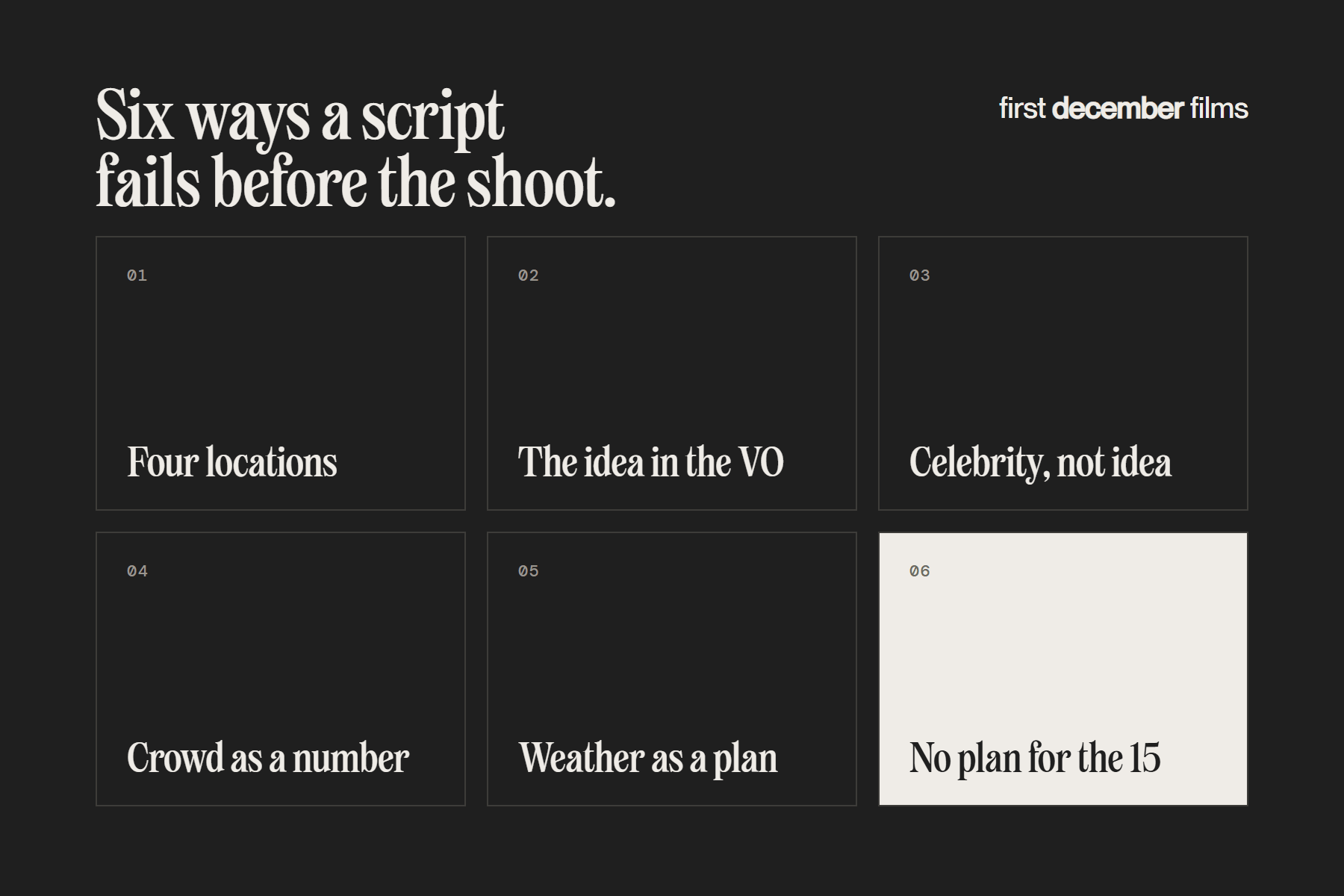
Six mistakes we see in scripts every month
These are not writing faults. They are production faults that happen to live in a script.
- Too many locations for the runtime. Four locations in thirty seconds is four company moves, or two shoot days, for a film where three of the locations are on screen for two seconds each.
- The idea lives in the voice-over. If the film makes no sense with the sound off, it will make no sense on a phone in a train. Put the idea in the picture.
- A celebrity instead of an idea. A famous face carries a weak script for about a week. It also adds an entourage, a usage term and a date the whole shoot bends around.
- A crowd written as a number. "Forty children open their tiffins" is one shot and a sound cue. It is also a full day of child artistes, guardians and permissions. Twenty children shot tight and layered in sound will read the same.
- Weather as a plan. "Real rain if the shoot lands in monsoon" is not a schedule. The India Meteorological Department.pdf) puts the normal onset over Mumbai at 11 June and withdrawal by mid-October, and nobody has ever booked a crew around it. Write the rain machine in and price it.
- No idea what the 15 is. The master is approved, the offline is locked, and then someone asks for the 15. Now the cut has to be invented from coverage that was never planned for it.
Before you send it: get it read
A script is finished when someone who will have to make it has read it. Not a colleague, not the brand manager who briefed it. Someone who reads for the invoice.
That is why we built the script analyser. Paste the script, add an email, and in about a minute it returns what a producer at First December Films would tell you before the first call: what the script is and the device it relies on, the beats as written, a runtime and format estimate with the reasoning shown, a production breakdown with a complexity band, three comparable films from the films we have actually made, two directors from our roster, and the things we would push on. It is written by a model that has read our catalogue of more than 160 films and is told to be honest rather than kind. It does not quote a budget and it does not rewrite the script.
Three analyses per email address per day. Your script is stored encrypted, read only by our production team, and deleted within two working days if you ask. We explain what each of the seven sections means, and how to read them, in our guide to ad film script analysis.
Use it before the pitch, not after. A script that has already survived a producer’s read walks into the room with its cutdowns decided, its flags named and its price roughly known. That is a different meeting.
The script is the cheapest draft of the film
Every version of the film after the script costs more to change. A beat cut on paper costs nothing. The same beat cut in the offline cost a shoot day. Cut in the online, it cost the grade too.
So spend the time on the page. Two columns, timed to the second, seventy-five words or fewer, the six decided before the thirty, and the visual column read once as a shopping list. Do that, and the production house you send it to will spend the first meeting talking about the film instead of the bill.
First December Films is an advertising film production company in Mumbai. Our work has won more than 150 international creative awards, including Cannes Lions, D&AD and One Show Gold Pencils. If you have a script, paste it into the script analyser and see how we would make it, or send us the brief.
How do you write an ad film script?
Write a header with brand, product, working title, runtime, language, draft number and date. Then two columns: what the viewer sees on the left, what the viewer hears on the right, one row per beat with a timecode. Keep spoken audio under about 75 words for 30 seconds and decide the cutdowns before the master.
What format do production houses expect for a commercial script?
The two-column AV script. Visual column on the left, audio column on the right, rows aligned so picture and sound line up in time, a timecode at the start of each row, and a header carrying the runtime and draft number. A script sent as prose gets rewritten into this format by the producer anyway.
How many words fit in a 30-second commercial script?
About 65 to 85 words of spoken audio, with 75 the common figure, because a professional voice reads at roughly 2.5 words a second. Treat that as a ceiling, not a target. Hindi and regional dubs usually run longer than the English master, so write the master a beat short.
How many beats should a 30-second TVC script have?
Six to eight for a dialogue-light film, fewer if there is a conversation. Ten beats in thirty seconds usually plays at 35 to 40 seconds in a first cut, which means two beats get cut in the edit. Cutting them on paper costs nothing. Cutting them in the offline costs a shoot day.
What is the difference between an ad film script and a screenplay?
A screenplay alternates action and dialogue and lets pace emerge over ninety minutes. An ad film script is a timed shooting document: picture and sound side by side, every row with a timecode, written so a producer can count locations, cast and shoot days straight from the page.
Should an ad script include camera directions?
Only when a shot is the idea. Describe beats, the moments the film must hit, and leave lenses, camera moves and colour to the director, who sets them out in a treatment after the script is awarded. An over-directed script narrows the field of directors who can make it well.
How do I get feedback on an ad script before sending it to a production house?
Paste it into the First December Films script analyser at 1stdecember.com/script. In about a minute it returns a producer’s read: the device, the beat sheet, runtime and format, a production breakdown with a complexity band, three comparable films, two directors, and what would be pushed on. Free, three per email a day.