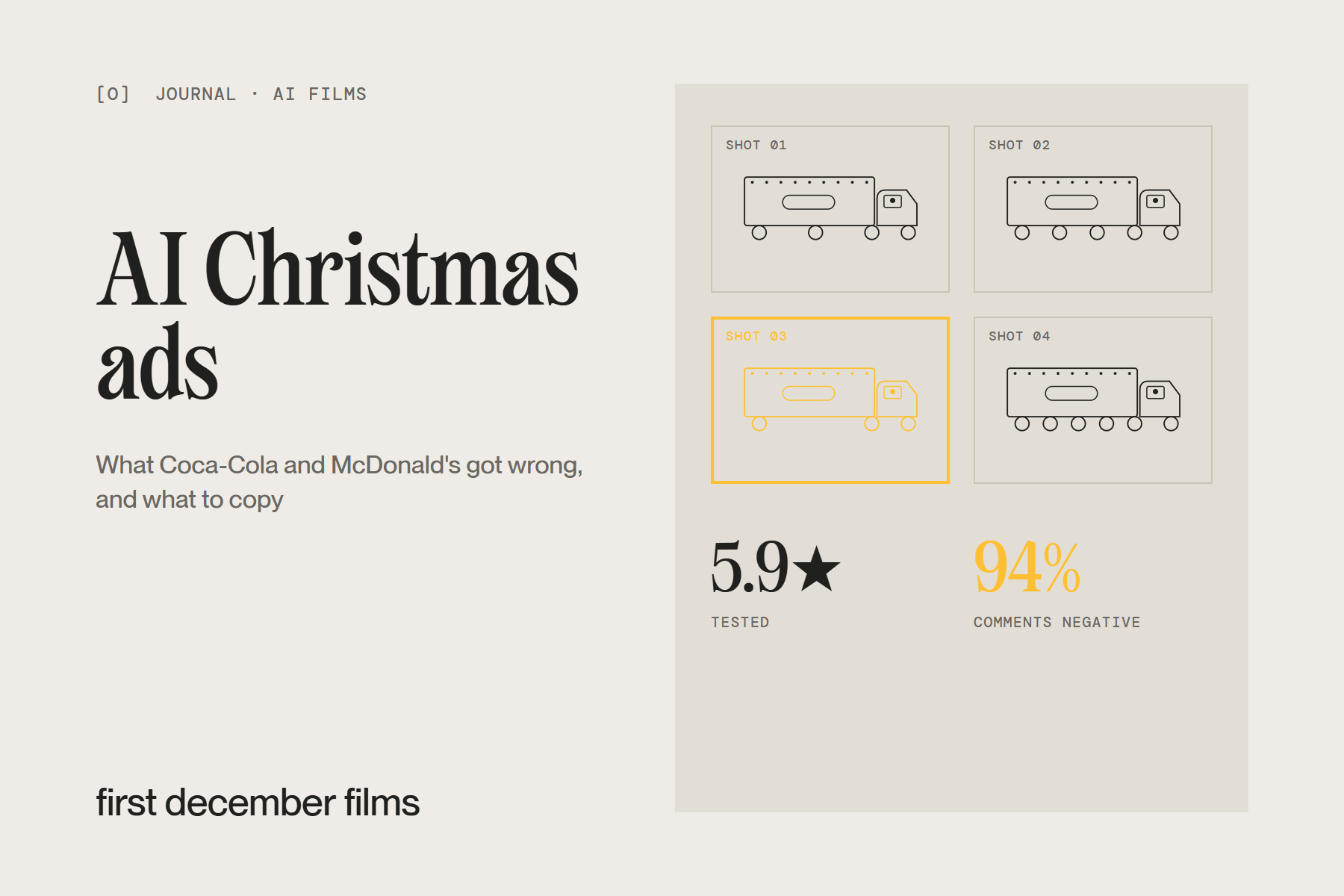
The short answer. Coca-Cola’s AI Christmas ads got System1’s top score in 2024 and 2025, yet 94% of the top comments we sampled on the 2025 film were negative. McDonald’s Netherlands pulled its AI ad after three days. Coca-Cola went wrong in the craft, McDonald’s in the idea. Copy Coca-Cola’s familiar assets and testing, and lock every shot before it moves.
The Coca-Cola AI ad is now the most argued-about Christmas commercial of the decade, and most of what is written about it stops at the backlash. We make live-action, hybrid and fully AI films for brands in India and abroad, so we read these films the way a producer reads a rough cut: who made them, in how long, what went wrong on screen, and whether it mattered to the people who buy the product. For this piece we re-opened every brand statement, maker interview and test result we could find, and ran our own audit of 3,906 top YouTube comments on 31 uploads of AI holiday ads and on non-AI Christmas ads from the same seasons.
Published 26 October 2026 by Ganesh Pareek. Sources were read and YouTube data pulled on 24 October 2026. Coca-Cola had not announced its 2026 holiday film on that date; we will update this post the week it lands.
Key takeaways
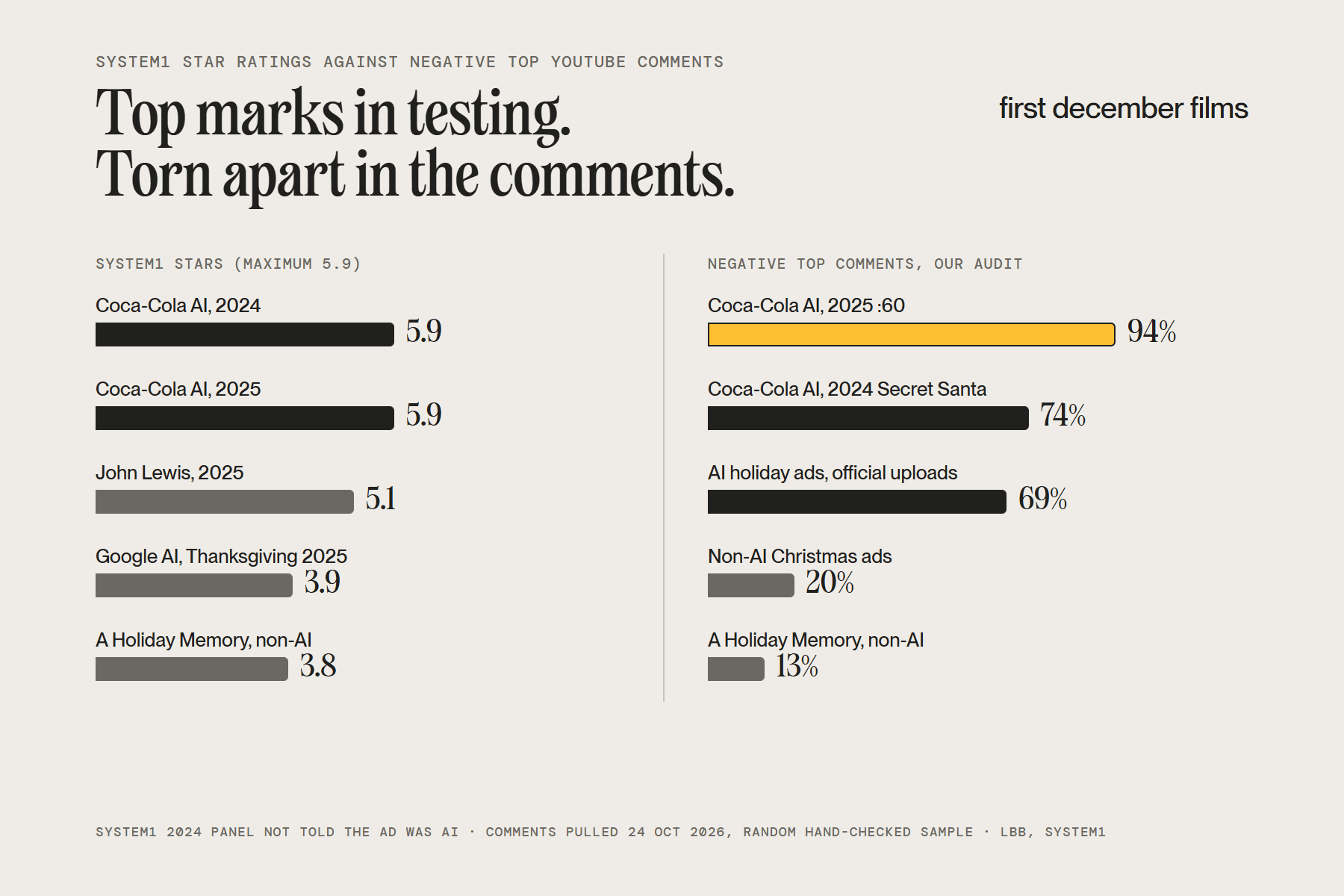
- Coca-Cola’s AI remakes of "Holidays Are Coming" tested at System1’s maximum of 5.9 stars in both 2024 and 2025. Its traditionally made 2025 film, A Holiday Memory, scored 3.8.
- Viewers who comment saw it differently. In our audit, 69% of hand-checked top comments on official uploads of AI holiday ads were negative, against 20% on non-AI Christmas ads from the same seasons.
- Coca-Cola’s failure was craft continuity. Its own behind-the-scenes film says the 2024 production needed "extensive post-production fixes" because the trucks’ wheels "looked like they were sliding instead of rolling", and in 2025 only two of eleven truck scenes showed the same truck.
- McDonald’s Netherlands failed on the idea and on control. It released a film calling Christmas "the most terrible time of the year" on 6 December 2025, removed it on 9 December, and its two credited directors said they resigned over a "lack of creative oversight".
- AI holiday ads are common and mostly ignored. Our dataset of 242 AI commercial campaigns holds 12 Christmas-season films from six markets; only the Coca-Cola and McDonald’s films drew published backlash.
- For Christmas 2026, the brands that come out well will generate what a camera cannot, keep real people in the story, lock every hero asset as a still before it moves, and decide how they will disclose AI before launch, not after the comments arrive.
The three AI Christmas ads at a glance
| Coca-Cola 2024 | Coca-Cola 2025 | McDonald’s Netherlands 2025 | |
|---|---|---|---|
| Film | Holidays Are Coming, three AI versions (Secret Santa, Silver Santa, Unexpected Santa) | Holidays Are Coming :60 and Fantastical :90 | It’s the most terrible time of the year, 45 seconds |
| Released | UK release 5 November 2024; on UK TV from 14 November | 3 November 2025 | 6 December 2025 |
| Where it ran | UK, US (12 cities got local versions) and other markets | US, plus a version in Europe; not the UK | Netherlands |
| Made by | Secret Level, The Wild Card, Silverside AI | Secret Level, Silverside AI; agency WPP Open X, led by VML | TBWA\Neboko; The Sweetshop, directing duo MAMA credited |
| What the AI made | People, Santa, trucks, snow, the whole picture; music re-scored by human musicians | Animals, Santa, trucks; music by real artists | The whole picture, with a rewritten Andy Williams song |
| Tested | System1: 5.9 stars of 5.9 | System1: 5.9 stars | Behavio pretest: branding near benchmark, message missed |
| Online reaction | Heavy criticism; comments hidden on the brand upload | Most talked-about Christmas ad on social media; 94% negative in our comment sample | Comments switched off, then the video made private |
| Outcome | Kept, and remade in 2025 | Kept; UK reran the 1995 classic | Removed 9 December 2025 |
The three AI Christmas ads compared. Sources are cited in each section below.
What is an AI Christmas ad?
An AI Christmas ad is a holiday commercial whose picture, sound or both were mostly made by generative AI models rather than filmed or animated by hand, with people directing, choosing and editing the output. The term covers fully generated films, such as Coca-Cola’s, and hybrids that add generated shots to live action.
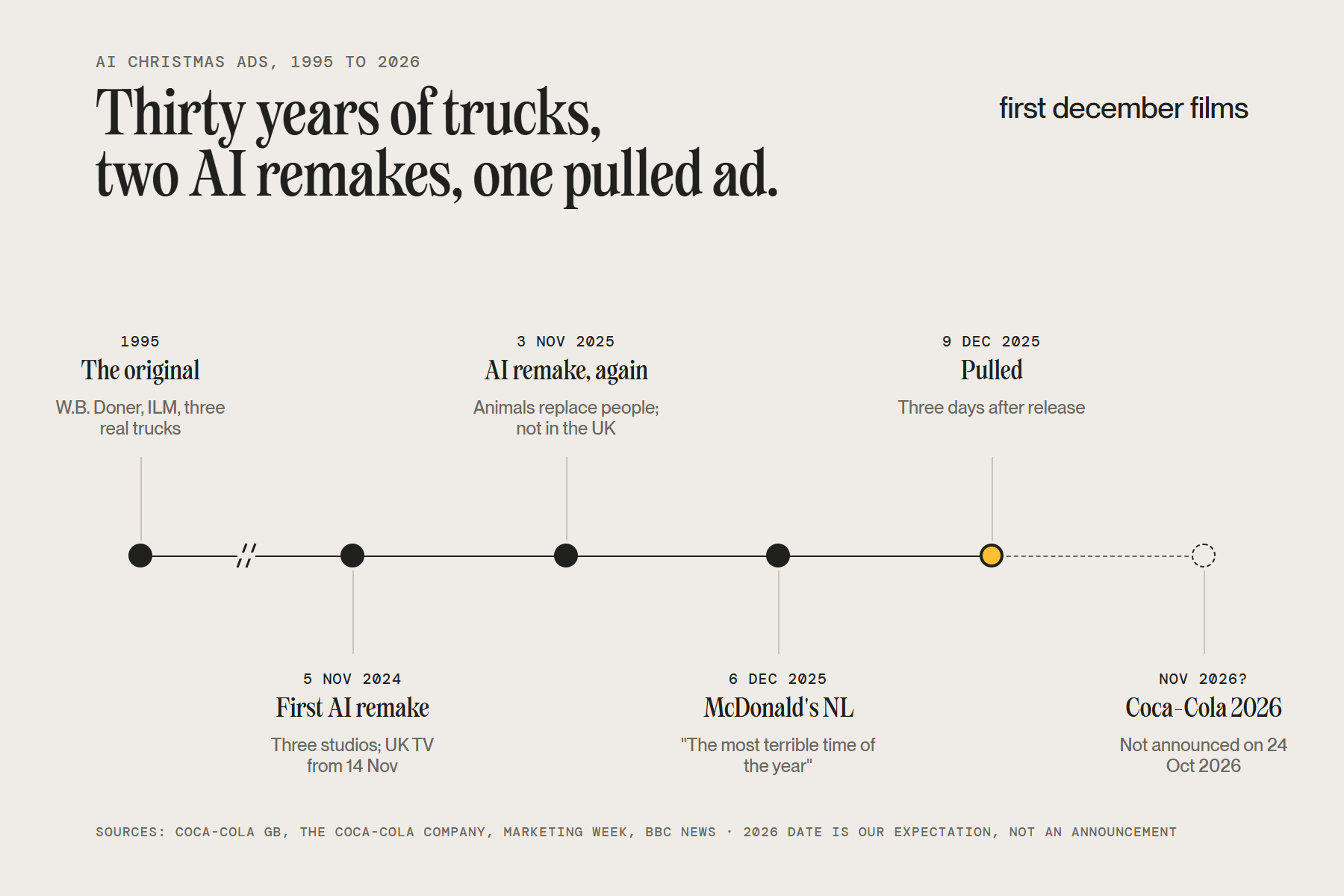
The genre has a short history. Coca-Cola’s original "Holidays Are Coming" was made in 1995 by the American agency W.B. Doner with effects by Industrial Light and Magic, using three custom-built 40-foot trucks, each a "light brite" on wheels with "more than 30,000 bulbs", according to Coca-Cola Australia’s history of the trucks (archived copy; the page is no longer live). For nearly thirty years the film came back each November; in Coca-Cola’s own UK research, 44% of British consumers said the ad marks the official start of their Christmas season (Marketing Week, November 2023). That is the asset Coca-Cola chose to rebuild with AI in 2024, and that weight is why the reaction was so loud.
In our dataset of 242 AI commercial campaigns released between January 2024 and October 2026, described in The State of AI Commercials 2026, 12 are Christmas or holiday-season films, from the US, the UK, the Netherlands, India, Brazil and Asia-Pacific. Only three drew published backlash: Coca-Cola’s two and McDonald’s Netherlands’. The rest, from Uswitch in Britain to Kansai Nerolac in India, passed almost without comment. The question this piece answers is why those three, and what a brand planning a 2026 film should take from them.
What happened with Coca-Cola’s AI Christmas ad in 2024?
Coca-Cola Great Britain announced on 5 November 2024 that "For the first time, Coca‑Cola will introduce an AI-generated reinterpretation of the classic advert" (Coca-Cola GB). A 16-second version replaced the original on UK television from 14 November, and Marketing Week called it "the first time Coca-Cola has produced an ad fully generated by AI" (Marketing Week, 14 November 2024).
Three studios made three films. Coca-Cola named them as "Secret Level Entertainment Studio (Los Angeles), The Wild Card (Kuala Lumpur) and Silverside AI Tech Lab (San Francisco)", with spots called Silver Santa, Secret Santa and Unexpected Santa (The Coca-Cola Company, 10 December 2024). In North America the films were localised, so viewers in Boston saw the trucks pass a "Welcome to Boston" billboard; Pratik Thakar, Coca-Cola’s global head of generative AI, told Digiday that "Twelve different cities will have that geo-located" content.
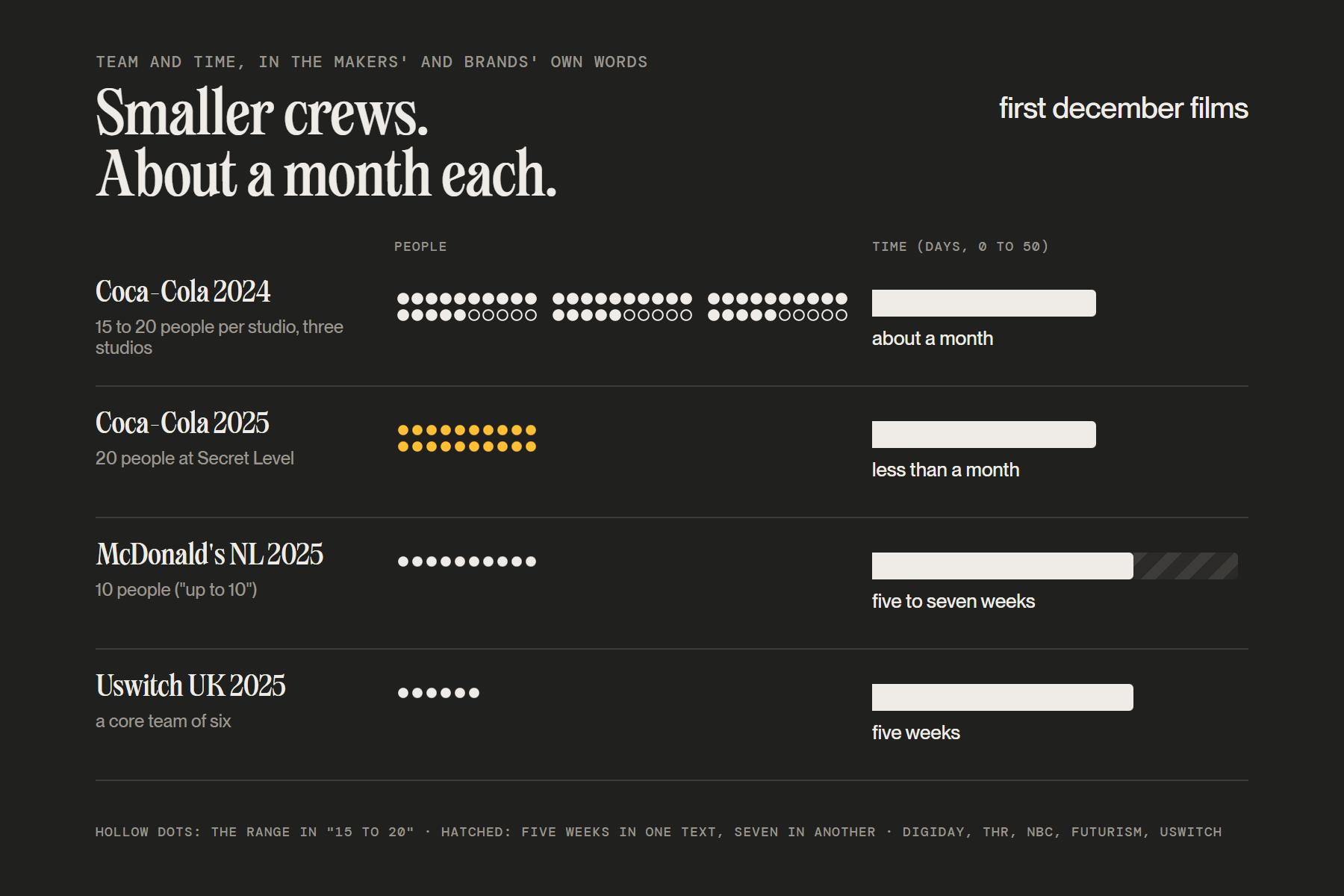
The tools were Leonardo, Luma and Runway, "with a new model, Kling, brought in near the end of production", according to Forbes (16 November 2024). The crews were not tiny. Thakar put them at "around 15 to 20 people per production house", plus about 20 musicians who re-scored the music, and said the real people whose likenesses appear in Secret Santa gave consent and were paid (Digiday, 20 November 2024). Silverside’s founders described "about seven people iterating every few hours, including members of the Coca-Cola team" (FutureWeek, February 2025).
Then the comments came. The animator Alex Hirsch, creator of Gravity Falls, posted that Coca-Cola "is ‘red’ because it’s made from the blood of out-of-work artists" (NBC News, 18 November 2024). Viewers pointed at the trucks, the faces and the flat warmth. Coca-Cola restricted the YouTube page and hid comments (MediaPost, 25 November 2024). The film carried a small on-screen line, "Created with Real Magic AI", which MediaPost described as "easy to miss".
Coca-Cola stood by it. "We didn’t start by saying: ‘OK, we need to do this with AI,'" said Javier Meza, then its European chief marketing officer; the brief was to bring the ad "into the present", and AI was the answer the team reached (Marketing Week). In April 2025 he said the remake was done "in one month at a tenth of the price it would have cost before" (Marketing Week). By November 2025 he was more careful: "I think we’re already seeing faster and better," he told The Drum. "But not yet cheaper" (The Drum, 12 November 2025).
What changed in Coca-Cola’s 2025 AI ad?
Coca-Cola went again. On 3 November 2025 it launched "Refresh Your Holidays", a campaign "anchored by three new films": "A Holiday Memory" and "two AI-driven reimaginations of the classic 1995 Coca‑Cola spot", made with Secret Level and Silverside AI (The Coca-Cola Company). The campaign was developed by WPP Open X, led by VML (Marketing Dive). The AI films came as a :60 and a "Fantastical :90", the second "Airing exclusively in the USA".
The biggest change was the cast. The people were gone, replaced by "polar bears, penguins, puppies and rabbits, among others" watching the trucks go by. Thakar explained why: "Last year it was difficult to get those expressions from animals so we had to use human faces. Now technology has evolved to where we can" (The Hollywood Reporter, 3 November 2025). He added: "Last year people criticized the craftsmanship. But this year the craftsmanship is ten times better." The same report says some Latin markets got a third, traditionally shot version without the animals.
Coca-Cola also changed where it ran the film. In Britain, where the 2024 version had replaced the original on television, Coca-Cola reran the classic instead, "foregoing its much-criticised AI ad in the UK" (Consultancy.uk, reporting Kantar, 11 December 2025). A 2025 AI version was released in Europe, according to Kantar’s analysis reported by Research Live. The official :60 upload on Coca-Cola’s YouTube channel says nothing about AI in its title or description.
The reaction was faster than in 2024. Sprout Social found the ad generated "nearly 50,000 social media posts and more than one million engagements", the most talked-about Christmas ad, with "Just 37%" of sentiment positive against 83% for John Lewis (Campaign, 20 November 2025). The BBC later quoted a 61% positive figure from the same company; the two numbers do not reconcile, and neither report gives its method. Thakar’s answer on stage at Adweek’s Brandweek was blunt: "You either lead with it, or you keep crying about it" (Adweek, 4 November 2025).
How big was the crew behind each AI Christmas ad?
Smaller than a shoot, larger than the "made by AI" headlines suggest, and never one person with a prompt. These are the makers’ own numbers.
| Film | Who made it | Team, as published | Time, as published |
|---|---|---|---|
| Coca-Cola 1995 original | W.B. Doner (agency), Industrial Light and Magic (effects) | Three 40-foot truck props | Not published |
| Coca-Cola 2024 | Secret Level, The Wild Card, Silverside AI | "around 15 to 20 people per production house", plus about 20 musicians (Thakar); "about seven people iterating every few hours" at Silverside | "in one month" (Meza, April 2025) |
| Coca-Cola 2025 | Secret Level, Silverside AI, with WPP Open X and VML | "This new ad was done by 20 people" (Jason Zada, Secret Level); "five specialists" refined "over 70,000 video clips" (Coca-Cola’s own behind-the-scenes film); about 100 people across the campaign (Wall Street Journal, via Futurism) | "less than a month" (Zada); "In just 30 days" (behind-the-scenes film) |
| McDonald’s Netherlands 2025 | TBWA\Neboko, The Sweetshop and its AI unit The Gardening Club | "Ten people" (Melanie Bridge, The Sweetshop, in a deleted post); "up to 10" AI and post specialists (The Sweetshop’s statement) | "five weeks, full-time" (the post) or "seven weeks" (the statement) |
| Uswitch UK 2025 | Particle6 | "a core team of just six people" | "just five weeks" |
Team size and production time for AI Christmas ads, in the makers’ and brands’ words. Sources: Digiday, FutureWeek, Marketing Week, The Hollywood Reporter, Coca-Cola YouTube, Futurism, NBC News, Uswitch, Particle6.
Two things stand out. First, time saved was the real gain. Coca-Cola’s global chief marketing officer Manolo Arroyo said production used to "start a year in advance" and "Now, you can get it done in around a month" (via The Verge, relaying The Wall Street Journal). Zada said a piece like this would take "months and months" in traditional animation and his studio did it in "less than a month", but added: "We tell our clients this is not about spending less money. It’s about using budgets more efficiently" (The Hollywood Reporter, 6 November 2025).
Second, the hours did not shrink. The Sweetshop’s chief executive wrote that "the hours that went into this job far exceeded a traditional shoot" (Quartz). That matches what we see on our own AI work: the Air India film we made for McCann used "About a hundred shots in 102 seconds", "chosen from 600+ generations", as published on our AI ad films page. The crew is smaller. The selection work is enormous.
Why did McDonald’s pull its AI Christmas ad?
McDonald’s Netherlands released a 45-second film on its YouTube channel on 6 December 2025 and removed it on 9 December, telling the BBC the moment served as "an important learning" as it explored "the effective use of AI" (BBC News, 10 December 2025). Over a reworked version of the Andy Williams song "It’s the Most Wonderful Time of the Year", it showed December going wrong and told viewers to "hide out in McDonald’s till January’s here" (NBC News, 11 December 2025). McDonald’s switched comments off first and then set the video to private, according to the Dutch trade title Adformatie. When it went, it had about 20,000 YouTube views (Futurism).
The agency, TBWA\Neboko, had set out to "challenge the conventions of holiday advertising", its chief creative officer Darre van Dijk said at launch, aiming for "not an almost-AI film, but one with real production value combined with the craziness that AI makes possible" (LBB, 1 December 2025). The insight was real: MediaTest research found "two-thirds of Dutch consumers crave more time for themselves in December" (The Stable).
Three things went wrong, and only one is about AI.
The idea was a complaint. McDonald’s own statement concedes it: the film "was intended to reflect the stressful moments that can occur during the holidays in the Netherlands, but we recognize that for many of our guests, the season is ‘the most wonderful time of the year'" (The Drum, 11 December 2025). "The McDonald’s ad emphasizes all that is negative about the holiday season, and the suggestion that McDonald’s is a respite from such negative experiences is not credible," said David Stewart, emeritus professor of marketing at Loyola Marymount University (Los Angeles Times, 10 December 2025). A pretest by the Dutch research firm Behavio, run before the backlash, found branding and category recognition near benchmark but said McDonald’s positioning as a calm spot in the December rush did not reach viewers (Adformatie, June 2026).
The directors were cut out. The film was credited at launch to the Los Angeles directing duo MAMA. Mark Potoka and Matt Spicer told the Los Angeles Times that "With lack of creative oversight and not being able to speak to or see what was made or able to effect the work as directors we ethically felt it was right to resign from the project and production company at large." When the credited directors of a film say they could not see what was made, the problem is the process, not the software.
The defence made it worse. The Sweetshop’s statement said "This wasn’t an AI trick. It was a film" and described seven weeks in which "we hardly slept, with up to 10 of our in-house AI and post specialists at The Gardening Club working in lockstep with the directors" (Futurism). A separate, since deleted post by its chief executive said "Ten people, five weeks, full-time" (via NBC News). Emlyn Davies of the production company Bomper Studio replied: "What about the humans who would have been in it, the actors, the choir?" (AFP via BNN Bloomberg).
Ten months later, McDonald’s Netherlands’ brand lead Brett Gaasbeek gave the clearest account. "The insight did land with Dutch people, but the AI debate and the English-language song piled on top of each other. Then you get more haters than lovers, and it could have caused brand damage in other countries. So we withdrew it," he told Adformatie on 13 October 2026 (our translation from Dutch). Asked about AI in creative work now, he said it is "op dit moment een no-go" (a no-go for now).
Did the AI Christmas ads actually work?
By the measure brands pay for, Coca-Cola’s did. By the measure the internet uses, none of them did. Both statements are true, and the gap between them is the most useful thing in this story.
System1 asks panels of ordinary viewers how an ad makes them feel and turns that into a star rating predicting long-term growth. Coca-Cola’s 2024 AI film scored "tops marks with 5.9 stars", the maximum, against a soft-drinks average of 3.0, and the cutdown came "2nd place out of 438 ads in its category, beaten only by… the original version of itself" (LBB, 15 November 2024). The catch: "test audiences were not informed that this ad had been AI generated". System1’s Andrew Tindall had expected the opposite. "Everything I know points to this AI Christmas remake being a bad idea for effectiveness," he wrote, before reporting the score, and then: "I wonder if the results would be different if we told people it was made by AI first" (The Drum).
In 2025 the AI :60 scored 5.9 again, and in viewers’ associations "'Animals’ and ‘Christmas’ come out high … AI isn’t mentioned" (System1, 20 November 2025). On System1’s 2025 festive tracker, Coca-Cola’s traditionally made A Holiday Memory scored 3.8 stars, John Lewis’s "Where Love Lives" 5.1 and Google’s AI-made Thanksgiving ad 3.9 (System1 festive ad tracker 2025). Coca-Cola’s Islam ElDessouky called the 2025 film "one of our top-tested ads in history, period" (Marketing Dive, 5 November 2025).
Other measures disagree in detail. DAIVID, which measures emotional response, found none of the three 2024 AI films in its top 30 of more than 90 Christmas ads, and the warmest AI version "was still 38% less likely to make people feel warmth than the 2020 version" (Search Engine Journal, 22 November 2024). Kantar’s facial coding found the 2025 animals "scored more strongly on most metrics" than the 2024 people, and that "branding tends to be a little bit lower in generative AI ads" (Research Live, 17 December 2025). In Kantar’s 2025 UK Christmas study of 4,050 consumers, Coca-Cola came second, with the rerun 1995 classic, not the AI film.
Our reading: the familiar assets did the work. The trucks, the lights, the jingle and thirty years of repetition carried both AI films through testing. System1’s 2024 rankings make the same point: ads that re-aired earlier work or used recurring characters averaged 5.6 stars, against 3.9 for completely new creative (Marketing Week, 20 November 2024). As Tindall put it, "this is a sprinkle of AI on top of years of the world’s best marketing." McDonald’s had no such cushion: a new idea, a negative one, made in a way viewers could see.
What viewers said: our audit of 3,906 YouTube comments
Tests use panels who were not told about AI. Comment sections are the opposite: self-selected, loud and fully aware. To measure that side properly we pulled the top comments on 31 YouTube uploads on 24 October 2026: official uploads of AI holiday ads, re-uploads of the McDonald’s film and the 2024 Coca-Cola spots, and a control set of 11 non-AI Christmas ads from the same seasons, including John Lewis, Sainsbury’s, M&S, Disney and Coca-Cola’s own A Holiday Memory.
| AI holiday ads, official uploads (9 films) | Non-AI Christmas ads, same seasons (11 films) | |
|---|---|---|
| Top comments that mention AI | 29% | 3% (almost all under A Holiday Memory) |
| Negative about the ad | 69% | 20% |
| Positive about the ad | 13% | 58% |
| Negative and about AI | 25% | 0% |
| Median likes per 1,000 views | 2.71 | 4.59 |
Reaction to AI holiday ads against non-AI Christmas ads from the same seasons, top YouTube comments, pulled 24 October 2026. Negative and positive shares come from a random sample of 406 hand-checked comments.
The sharpest comparison sits inside one campaign. Coca-Cola released its AI :60 and its non-AI A Holiday Memory on the same day. In our sample, 94% of top comments on the AI film were negative and 13% on A Holiday Memory. The non-AI film also earned about 1.8 times as many likes per view (10.64 per 1,000 views against 5.81). Many of A Holiday Memory’s comments mention AI, mostly to praise it for not using any.
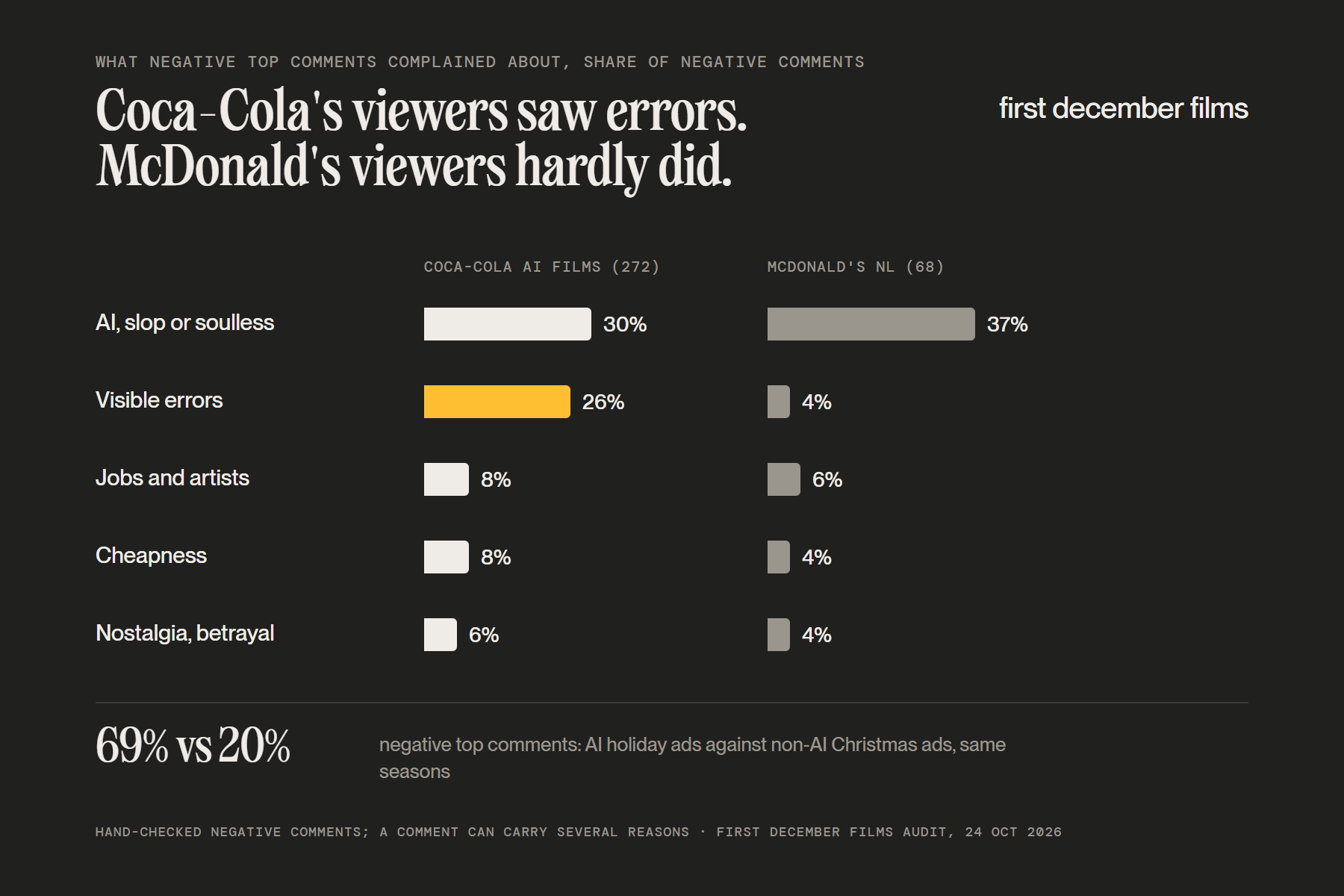
The reasons viewers gave were not mainly about jobs. Across 365 hand-checked negative comments on AI holiday films, a third (33%) called the film AI slop or soulless, 21% pointed at visible errors, 7% raised jobs and artists, 7% cheapness and 5% nostalgia. One in seven (14%; 16% for Coca-Cola) talked about switching brands. The most-liked comment on the 2025 Coca-Cola film, with about 20,000 likes, reads "I really miss pre-AI internet". The error comments are specific: "The truck has a different number of wheels in every shot."
The two brands drew different complaints. Visible errors made up 26% of negative comments on Coca-Cola’s AI films and 4% on the McDonald’s film, where viewers mostly objected to AI itself or to the film’s message. That matches the trade verdicts: Coca-Cola was criticised for how its film looked, McDonald’s for what its film said.
The backlash also travels backwards. On Coca-Cola Great Britain’s upload of the classic ad from 2020, none of the 58 comments dated two or more years old mention AI; 45 of the 115 newer ones do. The AI films have changed how people talk about the original.
Two limits matter. Top comments over-represent the loudest viewers, and YouTube has hidden dislike counts since 2021, so this is a measure of the vocal audience, not of all viewers. And likes per view on brand channels are inflated by paid views, which is why we lean on comment tone. Stance was coded blind on a random sample of 787 comments against a written codebook by three independent AI coding passes, not by human coders; a keyword count over all comments agreed with the hand codes on which comments mention AI 95% of the time. Method, scripts and anonymised data are in our research files.
What did Coca-Cola get wrong?
Coca-Cola’s mistakes are the ones any producer would catch on a rough cut. They are craft mistakes, and every one of them has a fix.
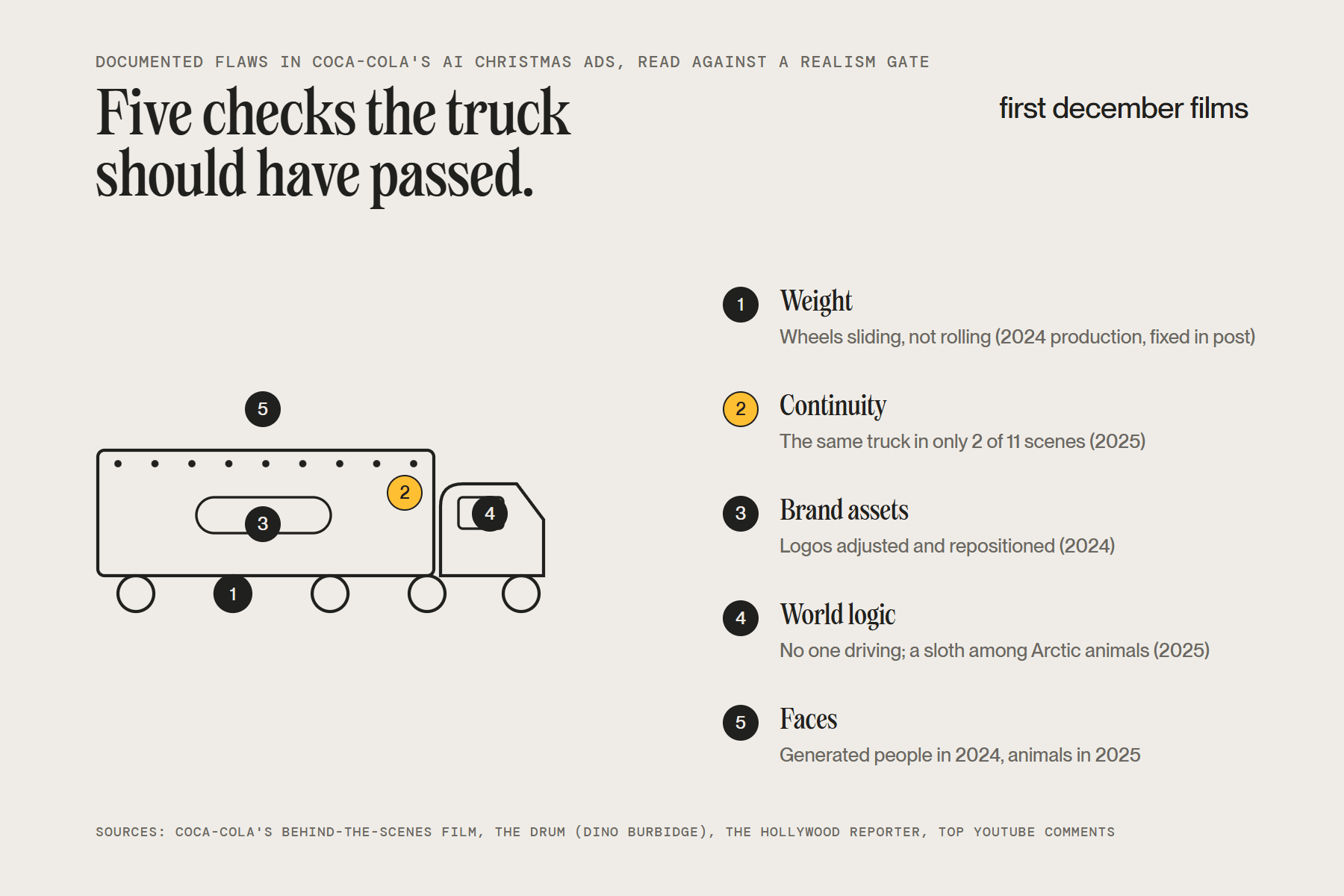
On our own AI films, every shot passes a realism gate before it is approved. As published on our AI ad films page, the reviewer checks "walking, hands, faces, eyes, weight, background people, clothing, objects, perspective, texture, light and morphing", and "One wrong behaviour sent it back, however good it looked." Here is how the documented flaws in Coca-Cola’s films read against that list.
| What a realism gate checks | What happened | Who said so |
|---|---|---|
| Weight and physics | "Extensive post-production fixes were required. Wheels looked like they were sliding instead of rolling" (2024 production) | Coca-Cola’s own behind-the-scenes film, 2025 |
| Objects and continuity | "Only two of the 11 truck scenes feature the same truck, specifically the same wheel layout" (2025) | Dino Burbidge, The Drum, 4 November 2025 |
| Brand assets | "Logos had to be adjusted and repositioned" (2024) | Coca-Cola’s behind-the-scenes film |
| Faces | 2024 used generated human faces; in 2025 Coca-Cola swapped them for animals because, its AI head said, the expressions were now possible | Pratik Thakar, The Hollywood Reporter |
| World logic | Viewers spotted a sloth among the Arctic animals and trucks with "no one even driving" (2025) | Top YouTube comments, our audit |
Documented flaws in Coca-Cola’s AI Christmas ads, read against the realism gate we use on our own AI films.
The truck is the brand asset. It is the one object in the film that thirty years of advertising have taught people to recognise, and it changed shape between shots. "Coke shouldn’t obsess over details because everyone will notice. It should obsess over details," Burbidge wrote (The Drum). Coca-Cola’s response, from Meza at Web Summit, was "Mistakes happen. Just fix them. Move on" (The Drum). That works for a small error. It does not work for the hero object.
The faces were the deeper problem. "Humans are incredibly effective at noticing AI that is not actually a human," Coca-Cola’s own chief executive James Quincey said in November 2025 (Marketing-Interactive). The 2025 switch to animals fixed that, and Kantar’s facial coding rewarded it. As Kantar’s Lynne Deason put it, "we don’t know what a hedgehog looks like when it gasps with surprise." Generated animals get more creative licence than generated people.
The communication came last. Thakar said in 2024 that the one thing he would do differently was "communicate with people like you much [in] advance and tell our story in much more detail" (Digiday). In 2025 the brand published a behind-the-scenes film on launch day, which helped tell the story, but the ad itself said nothing about AI on YouTube, and System1 advised that "the brand is wise not to mention AI in the ad itself."
What Coca-Cola got right deserves the same weight. It kept the familiar assets, which the testing shows carried the films. It used human musicians and paid the real people in the 2024 film. It tested before launch in North America and Europe. It moved from faces to animals once the faces failed. And it read the market: in 2025 it kept the AI film off UK television, where the classic matters most, and made a traditionally shot version for some Latin markets.
What did McDonald’s get wrong?
McDonald’s got the order wrong. It started with an AI production idea and wrapped a brief around it, where Coca-Cola, whatever else went wrong, started from a brief and reached for AI. Van Dijk’s launch line, "not an almost-AI film", made the technology the headline. "When AI becomes the idea rather than the enabler, the story loses meaning," said Virginia Ngai of the consultancy Prophet (Marketing-Interactive, November 2025).
It then paired that with the riskiest possible message for the season. "Christmas is sacred territory, both emotionally and culturally. You cannot enter it without humility. AI only amplifies what you feed it," said Vinit Patil, creative director at SW Network in Mumbai (Storyboard18, 16 December 2025). Guy Bradbury of M&C Saatchi was shorter: "Prompts are only as good as the taste of those that use it" (The Drum).
And it had no plan for the reaction. Comments went off, then the film went private, then the makers defended their hours in public, then the directors said they had resigned. Not every Dutch viewer hated it. Adformatie’s editor-in-chief Susanne van Nierop said the film had "really nice things" in it, singling out a tram scene that "could have come straight out of a romantic comedy" (our translation, Adformatie). Behavio’s own reading was that the data pointed to a campaign that went just too far in form rather than an idea that was fundamentally wrong (Adformatie, 12 December 2025). A brand that had decided in advance how it would answer could have kept the film and taken the argument.
What other AI holiday ads show
Most AI Christmas ads are not news. These are the other Christmas and holiday-season films in our dataset whose makers say AI made them, with what we could find about their reception.
| Brand and film | Market, release | Maker | AI role | Told viewers? | Reaction found |
|---|---|---|---|---|---|
| Uswitch, first Christmas TV ad | UK, 4 December 2025 | Particle6 | Fully generated, 20 seconds, script pre-cleared with Clearcast | No AI wording on YouTube | None published; 4 YouTube comments |
| Google, Planning a Quick Getaway? | US, 31 October 2025 (Thanksgiving) | Google Creative Lab | Fully generated with Veo 3 | No on-screen label | System1 3.9 stars; 20.8 million views |
| Agoda, Leo’s Magical Travel Adventures | Asia-Pacific, 10 December 2024 | Agoda in-house | Fully generated (ChatGPT 4.0, Midjourney) | Yes, in the YouTube description | None published |
| Coca-Cola Vietnam, Tet 2026 | Vietnam, 23 December 2025 | Not named on the page we read | AI combined with handcraft | No | 54% negative in a small comment sample |
| JSW MG Motor, Believe In A Little Magic | India, 22 December 2025 | Green Chutney Films | "crafted entirely using artificial intelligence" | #AI tag | 7 YouTube comments |
| Maruti Suzuki Arena, Victoris | India, 24 December 2025 | Not stated | Extent not stated | "wholly or partly AI-generated" | 8 YouTube comments |
| Tata Power, Christmas film | India, 20 December 2024 | Rediffusion’s RAID Studio | Fully generated, AI music too | Not checked (no official upload found) | None published |
| Kansai Nerolac, Santa’s Home Makeover | India, 24 December 2024 | Rediffusion’s RAID Studio | "100% AI-generated" | No | 1 YouTube comment |
| Shopping Bela Vista, Natal 2025 | Brazil, December 2025 | Viamídia | AI images with real Salvador locations | Not checked | None published |
| Waaree Solar Americas | US, 30 December 2024 | Pulp Strategy | Made with Sora | Not checked | None published |
Other AI Christmas and holiday-season ads, 2024 and 2025. Sources: brand releases, trade press and official YouTube uploads, read 24 October 2026.
The pattern is plain. Backlash followed household names that remade or rewrote a tradition people love. Smaller brands making new, light, product-led films drew no argument, though in India the near-silence in the comments says more about attention than approval. Particle6, which made the Uswitch film, says "The AI served the brand rather than announcing itself" (Particle6 case study); that is the maker’s own claim, but the comments do not contradict it.
Where India differs
Christmas is a smaller festival in India than Diwali, and AI festive films here have mostly run in the Diwali to New Year window, without anything like the Coca-Cola reaction. The three Indian AI Christmas films we found on YouTube drew 7, 8 and 1 comments. Indian makers have talked about craft, not backlash: "Getting Indian skin tones right is actually tougher than it seems," said Neilloy Chakravarty, head of Rediffusion’s RAID Studio (afaqs, December 2024). The rules also differ: India’s ASCI labelling guideline exempts "Fantastical Elements", which are obvious, unrealistic effects, so a talking Santa may need no label in India where an AI human face in a realistic scene would. Indian marketers are reading the McDonald’s case closely. "Everyone wanted to ‘do something with AI’ rather than solve a human problem with creativity powered by AI," said Raghav Bagai, co-founder of SW Network (Social Samosa, October 2025).
What should brands copy for Christmas 2026?
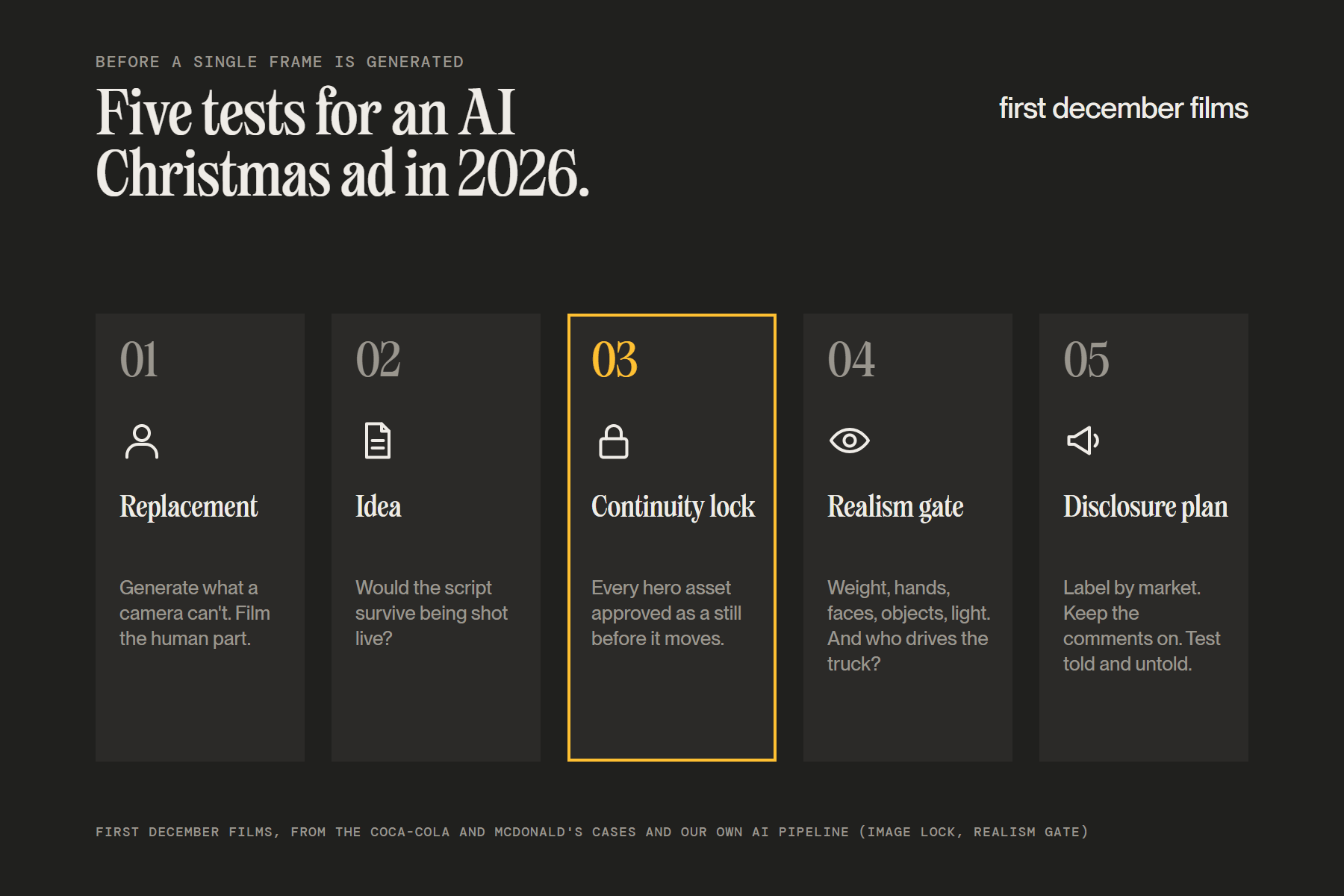
Our position, from the evidence above and from making AI films ourselves: use AI for a Christmas film when it lets you make something a camera cannot, keep real people in the story, and treat the generated footage with the discipline of a shoot. Here are the five tests we would put any 2026 AI holiday script through before a single frame is generated.
- The replacement test. Is AI replacing something people already love, such as real faces, a choir or a tradition, or making something a camera could not? Coca-Cola’s 2024 film put generated human faces on screen and paid for it. The 2025 animals tested better because nobody knows how a hedgehog gasps. Generate the impossible part; film the human part.
- The idea test. Would the script survive if you shot it live? McDonald’s would not have. Its problem was a message that called Christmas terrible, and AI only made it easier to make. Judge the script before anyone mentions the tools. As I wrote in March 2026, AI "multiplies options; without a strong point of view, it multiplies noise" (MediaBrief).
- The continuity lock. Approve every hero asset as a still before anything moves: the truck, its wheel layout, the logo, Santa’s face. On our films this is the image lock, where "Every frame approved as a still before it moves" is the key sign-off, and a change to character, costume or location after it "resets the scene", as published on our AI ad films page. Count the wheels before you count the views.
- The realism gate, plus world logic. A named person checks every shot against a written list: weight, hands, faces, eyes, objects, light, morphing. Add the questions a child would ask. Which animals live in the Arctic? Who is driving the truck? One wrong behaviour sends the shot back.
- The disclosure and comments plan. Decide before launch how you will label AI in each market and what you will say when people ask. Do not hide the comments. Test the film twice if you can, once with viewers told it is AI, because Tindall’s caveat is the open question nobody has answered for Christmas. Keep the humans visible in the story you tell: the musicians, the consented performers, the crew.
The label question is not simple, and we have said so in public. "The moment you put an "AI generated" label on an emotional brand film, you break the suspension of disbelief," I told BestMediaInfo in May 2026. Audiences say they want to know: 86% of Australians believe brands should clearly disclose when ads are made mainly with AI (YouGov, May 2026). Our approach is to disclose by function and to deliver every film as a labelled master and a clean master, so the brand can meet each market’s rule without remaking the film.
When AI is the wrong choice for a holiday ad
Skip generative AI for your Christmas film, or keep it to backgrounds and effects, if any of these is true:
- Your story rests on real human faces and performances. Close-ups of family, children or a choir are where viewers spot generated people fastest. Film them.
- You are remaking an ad people love without a reason the audience can see. Coca-Cola could absorb that risk with 5.9-star assets and an advertising budget of AU$8.4 billion in 2025, about US$5.9 billion (Mediaweek; converted at the ECB rate of 23 October 2026). Most brands cannot.
- The message is negative or ironic about the season. McDonald’s showed what happens when the medium already makes people suspicious.
- Nobody senior will own the reaction. If your plan is to switch off comments, you are not ready.
- Your market’s rules need labels you are not prepared to show. Check them first, as set out below.
Live action is not automatically safer. The non-AI M&S food ad of 2025 drew 83% negative comments in our sample, almost all about its casting. Christmas audiences punish anything that feels wrong. AI simply gives them one more thing to notice.
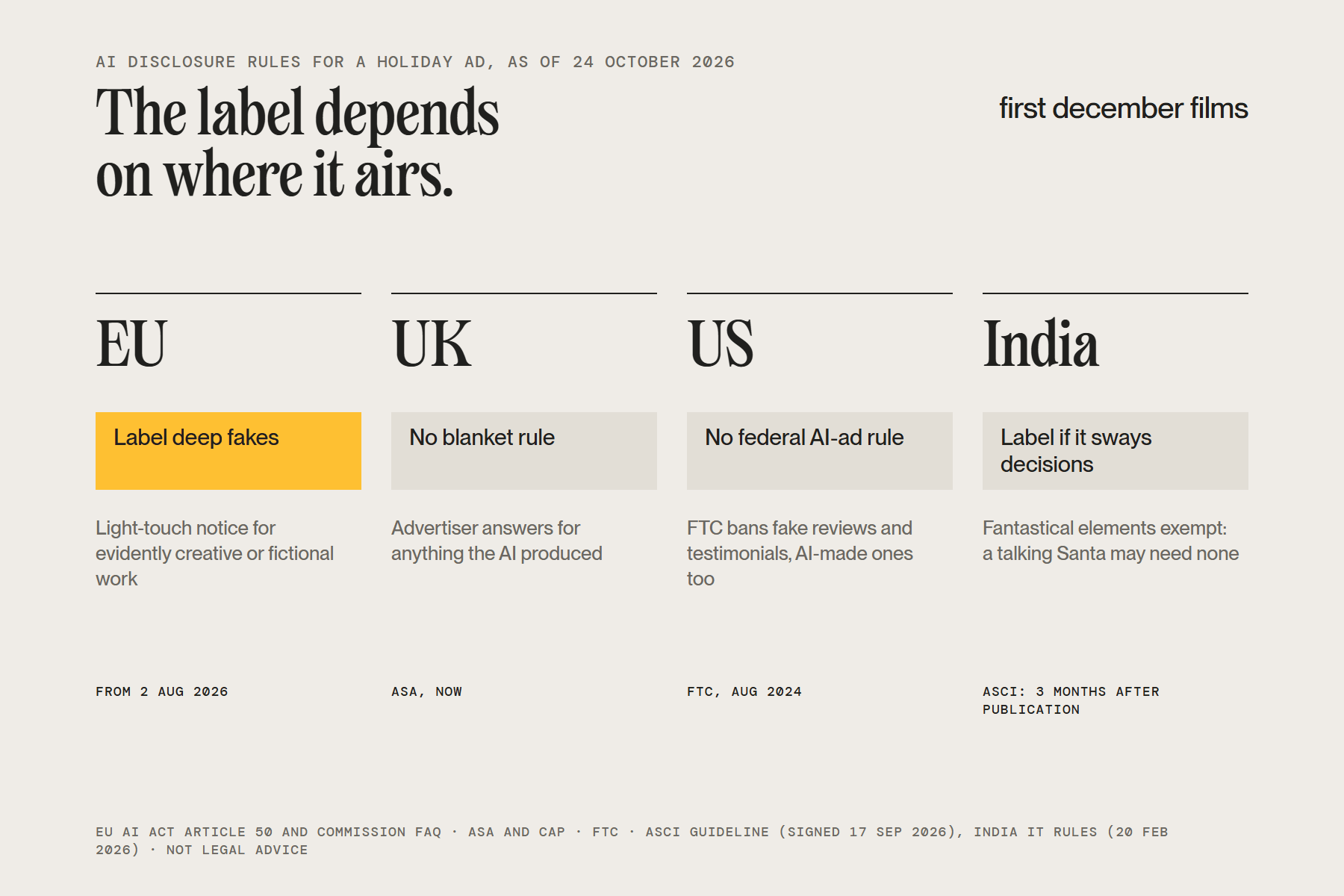
What are the rules for an AI Christmas ad in 2026?
| Market | What applies to an AI holiday ad | In force |
|---|---|---|
| European Union | AI Act Article 50(4): those who use AI to make deep fakes "shall disclose" it; for evidently artistic, creative or fictional work, disclosure "in an appropriate manner that does not hamper the display or enjoyment of the work". An advertiser stays responsible even when contractors make the film. Earlier content does not need relabelling | 2 August 2026 (machine-readable marking by providers of systems already on the market from 2 December 2026) |
| United Kingdom | "There is no blanket legal requirement in the UK to disclose the use of AI in ads" (ASA). The advertiser remains responsible for anything an AI tool produces, and a label will not save a misleading ad | Now |
| United States | No federal AI-ad disclosure rule found. The FTC’s rule on fake reviews covers AI-generated reviews and testimonials | August 2024 |
| India | ASCI guideline: labels are mandatory where synthetic content "materially influences consumer decisions"; no label for "Fantastical Elements"; suggested wording "Audio/Video created using AI". IT Rules: platforms must show a prominent label on synthetic content | ASCI: three months after publication (signed 17 September 2026). IT Rules: 20 February 2026 |
AI disclosure rules for holiday ads by market, as of 24 October 2026. Sources: EU AI Act Article 50, European Commission FAQ, ASA, FTC, ASCI guideline.
Whether a generated Santa or a talking polar bear counts as a deep fake at all is debatable. The AI Act defines a deep fake as content that "resembles existing persons, objects, places, entities or events and would falsely appear to a person to be authentic or truthful". Our reading, which is not legal advice: a realistic generated human in a family scene needs a label in the EU, while an obviously fantastical film falls under the light creative-work rule. India’s rules are covered in detail in our guide to whether AI ads are legal in India, and consent for real faces and voices in AI actors in ads.
What to expect from Coca-Cola’s 2026 holiday ad
On 24 October 2026, Coca-Cola had announced no 2026 holiday film. Coca-Cola Great Britain is running its first public vote on where the Christmas truck tour should stop, open from 20 October to 3 November 2026, without any mention of an ad (Coca-Cola GB). On 22 October the company completed a review of its marketing agencies: "WPP Open X will continue to serve as Coca-Cola’s global creative partner", the group that led the 2025 campaign, while Omnicom becomes its media partner in North America (The Coca-Cola Company).
The last two films were announced on 5 November 2024 in Britain and launched on 3 November 2025. Coca-Cola’s people have said they will keep going: "We’re going to keep going at it, to be honest with you, because it’s giving us the measurements, the metrics and the business results," ElDessouky told Marketing Dive in November 2025. Our forecast, and it is only that: a third AI version is likely, early in November, with even fewer generated humans and more care over the trucks. The test to watch is whether the wheels match from shot to shot. We will update this section when the film is out.
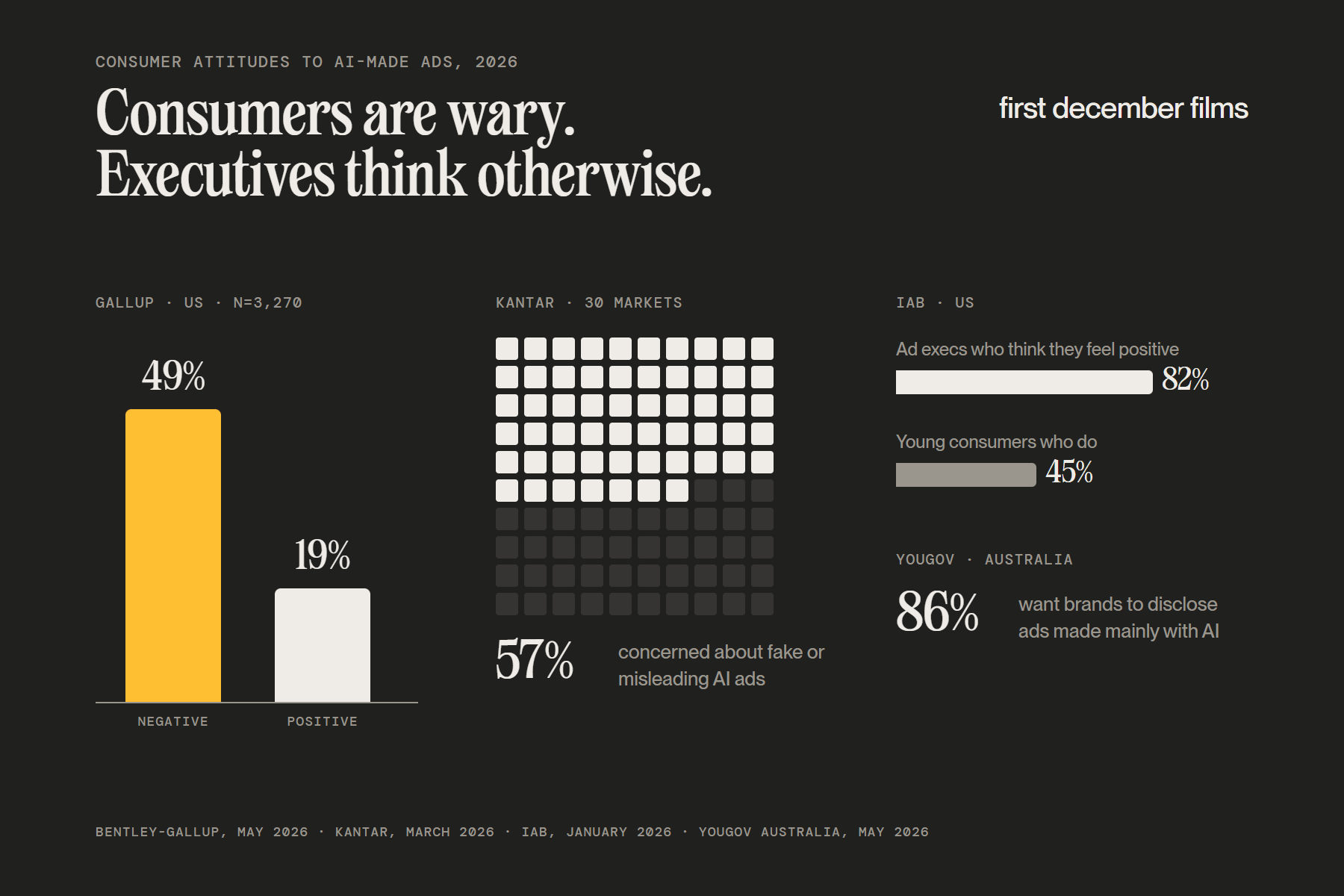
Consumers remain wary in 2026. In a Bentley-Gallup survey of 3,270 US adults in May 2026, 49% viewed businesses’ use of AI to make ads negatively and 19% positively, and 62% said AI-generated people or voices are unacceptable even when disclosed (Gallup). Across 30 markets, 57% of consumers express concern about fake or misleading AI ads, with positivity highest in Africa and the Middle East at 74% and lower in Europe (49%) and Asia-Pacific (47%) (Kantar, March 2026). The industry reads it more kindly than consumers do: 82% of ad executives believe young consumers feel positive about AI ads, against 45% of those consumers (IAB, January 2026). A brand planning Christmas 2026 should plan for the comments as carefully as for the test.
Planning an AI film for the holidays?
The films that came out of 2024 and 2025 well made one choice early: what to generate, what to film and what to tell the viewer. Coca-Cola made it late and McDonald’s did not make it at all.
If you are weighing AI for a festive campaign, bring us the one scene everyone says can’t be done as a paid look-development and feasibility test, paste your script into our free script analyser for a producer’s read, or send us the brief and a named producer will tell you which shots to generate, which to shoot and how to label the result. For how AI commercials are made stage by stage, read our production pipeline guide; to spot AI in other brands’ ads, see is that ad AI?.
First December Films is an advertising film production company in Mumbai. Our work has won more than 150 international creative awards, including Cannes Lions, D&AD and One Show Gold Pencils.
Frequently asked questions
Is the Coca-Cola Christmas ad made with AI?
The 2024 and 2025 versions of Holidays Are Coming were made with generative AI, by Secret Level, Silverside AI and, in 2024, The Wild Card. In 2025 Coca-Cola also released a traditionally made film, A Holiday Memory, and in the UK it reran the 1995 original instead of the AI version.
Why did people dislike Coca-Cola’s AI Christmas ad?
Critics objected to AI replacing artists and to visible flaws. Coca-Cola’s own behind-the-scenes film says the 2024 trucks needed fixes because their wheels looked like they were sliding, and a columnist counted only two of eleven truck scenes in 2025 showing the same truck. In our comment audit, a third of negative comments called the film soulless.
Did Coca-Cola’s AI Christmas ad perform well?
In testing, yes. System1 gave the 2024 and 2025 AI films its maximum 5.9 stars, though its 2024 panel was not told the ad was AI. Online, the reaction was far worse: 94% of the top YouTube comments we sampled on the 2025 film were negative.
Why did McDonald’s pull its AI Christmas ad?
McDonald’s Netherlands removed the film on 9 December 2025, three days after release, after criticism of its message that Christmas is the most terrible time of the year and of its AI look. Its credited directors said they resigned over a lack of creative oversight.
How many people made Coca-Cola’s AI Christmas ad?
In 2024 Coca-Cola said about 15 to 20 people per production house worked on the films, plus about 20 musicians. In 2025 Secret Level’s founder said the ad was done by 20 people in less than a month, and Coca-Cola’s own film credits five specialists who refined over 70,000 clips.
Is the 2026 Coca-Cola Christmas ad made with AI?
As of 24 October 2026, Coca-Cola had not announced a 2026 holiday film, so no answer is possible yet. Its last two holiday films were announced on 5 November 2024 and 3 November 2025, and its executives have said they will keep using AI.
Do AI Christmas ads need a label?
It depends on the market. In the EU, deep fakes must be disclosed from 2 August 2026, with a lighter rule for obviously creative work. The UK has no blanket rule. India’s ASCI guideline requires labels where AI content influences decisions but exempts obvious fantasy, such as a talking Santa.