
The short answer. You usually cannot tell an AI commercial by watching it: in recent studies people spot AI video at about the rate of a coin toss. Check the evidence instead: the platform’s AI label, the file’s Content Credentials, a SynthID watermark and the maker’s own statement. Of the 48 commercials we checked, 41 used AI on the record, in six different ways.
People ask this about one ad at a time. Is the trivago commercial AI? Was the Dunkin’ Super Bowl ad AI? Is the Xfinity Jurassic Park spot? The answers online are mostly guesses: forum threads, videos that freeze a frame and point at a hand, and AI answers that repeat both. We make AI films and live-action films for a living, so we did the slower thing. We checked 48 commercials from seven markets against what their makers said in public, and looked at whether each one told viewers. This page gives the answers, the list, and the four checks that work on a finished commercial when your eyes do not.
Published 15 October 2026. Every entry in the list was checked against its sources on 15 October 2026; YouTube labels and views were read the same day.
Key takeaways
- "Made with AI" means six different things in advertising: a fully generated film, a hybrid of live action and generated shots, an AI-dubbed or lip-synced version, AI versions made at scale, AI used only for concepts, or an ad about AI that was shot with a camera.
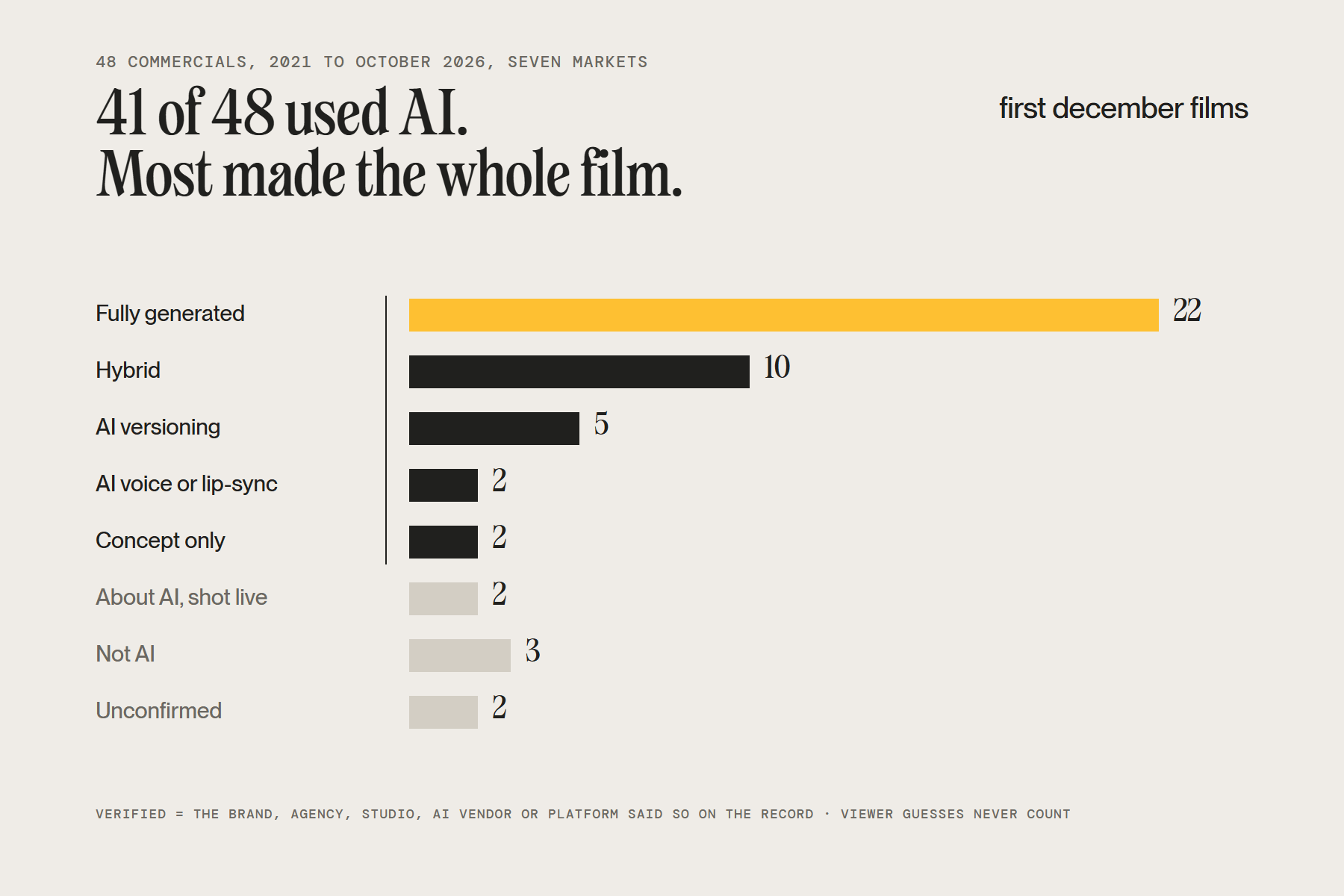
- Of 48 commercials checked, 41 used AI on the record: 22 fully generated, 10 hybrid, 5 AI versioning, 2 AI voice or lip-sync and 2 concept-only. Three that people searched for were not AI, and two remain unconfirmed.
- Viewers are close to guessing. A September 2026 study found people identified 2026-generation deepfake videos correctly 52.6% of the time; a 2024 review of 56 studies put video detection at 57.31%, not significantly above chance.
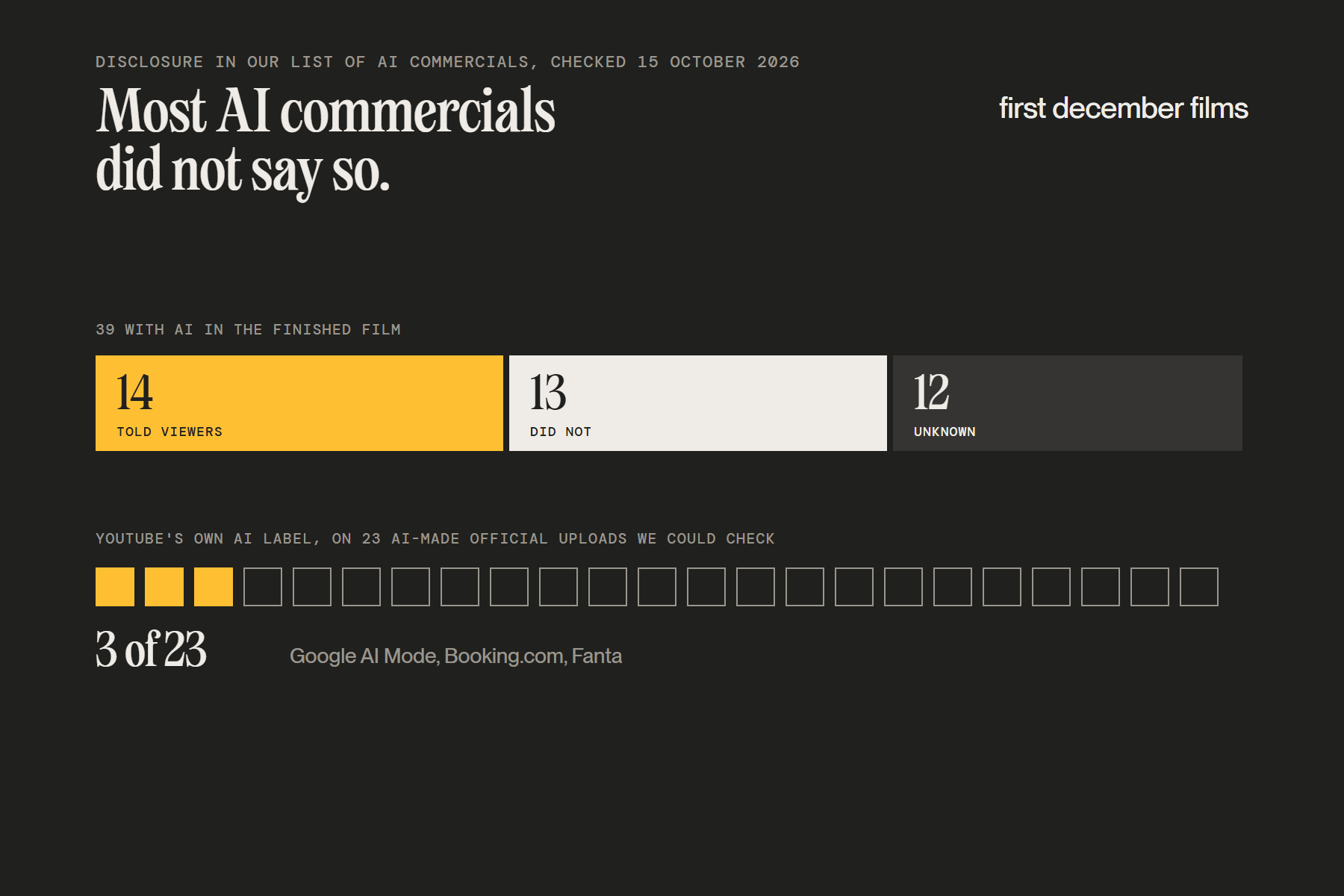
- A missing label proves nothing. Only 14 of the 39 commercials with AI in the finished film told viewers anywhere, and YouTube’s AI label appeared on 3 of the 23 AI-made uploads we could check.
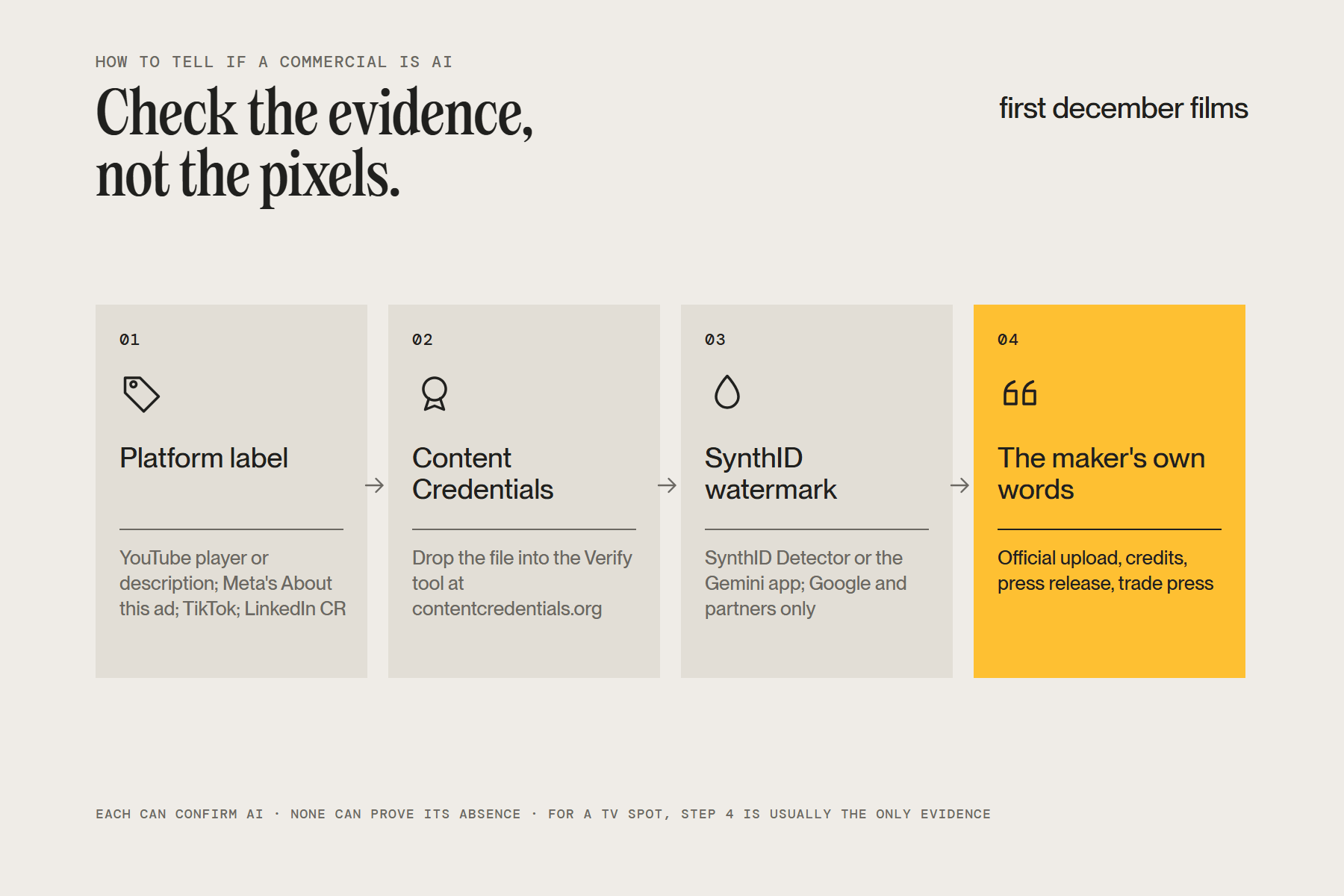
- The reliable checks are, in order: the platform’s label, Content Credentials, a SynthID watermark, and the maker’s own words in credits, press releases and trade press.
- Labels are becoming law. China has required them since 1 September 2025, India’s platforms since 20 February 2026, New York ads with synthetic performers since 9 June 2026, and the EU from 2 August 2026.
What counts as an AI commercial?
An AI commercial is an advertisement in which some or all of the picture or sound was produced by a generative AI model rather than recorded by a camera or microphone. In the UK it is an AI advert; in India, an AI ad film or AI TVC (television commercial, the Indian term for a broadcast ad).
The trouble with "is it AI?" is that the honest answer is often "partly". Our list sorts every commercial into one of these roles, using the makers’ own description of what the AI did.
| Role | What the AI did | Example from the list | In our list |
|---|---|---|---|
| Fully generated | Made every frame of picture; humans wrote, directed, edited and finished | Coca-Cola, Holidays Are Coming, 2024 and 2025 | 22 |
| Hybrid | Added generated shots, worlds or faces to live-action footage | Microsoft Surface, 2025: AI shots, hand close-ups filmed live | 10 |
| AI versioning | Made many versions of one film for people, places or shops | Cadbury, Shah Rukh Khan-My-Ad, India, 2021 | 5 |
| AI voice or lip-sync | Translated a filmed actor’s voice and mouth into other languages | trivago with Jürgen Klopp, 2025 | 2 |
| Concept only | Wrote the script or made the storyboards; the film was shot | Google Pixel 10, Vanilla, 2025 | 2 |
| About AI, shot live | Sold an AI product; made with cameras and actors | Anthropic, Super Bowl LX, 2026 | 2 |
| Not AI | Rumoured, then denied or shown to be in-camera | Xfinity, Jurassic Park, 2026 | 3 |
| Unconfirmed | Nobody involved has said either way | Dunkin’, Good Will Dunkin’, 2026 | 2 |
The 48 commercials in our list, by what the AI actually did.
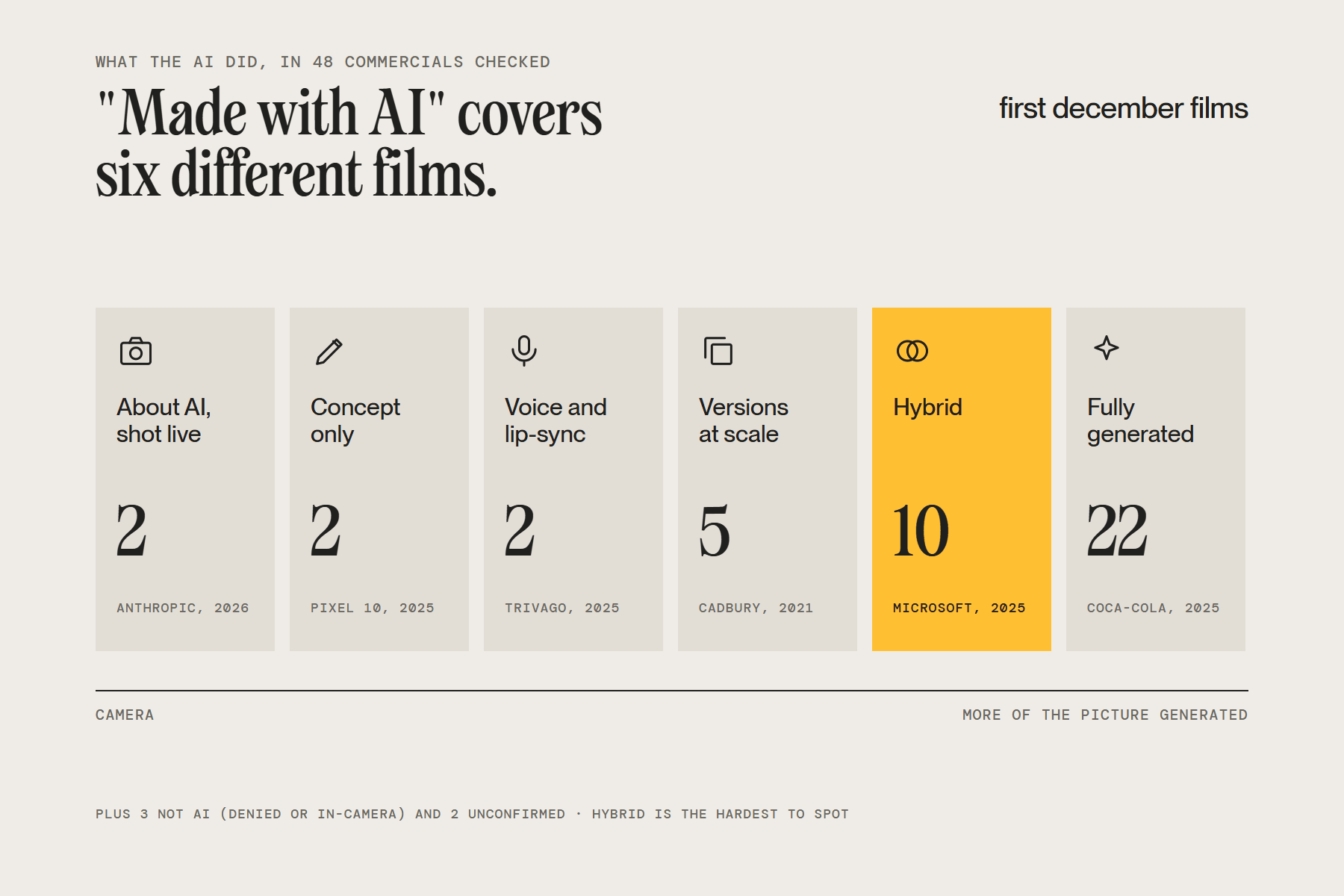
The roles matter because they need different checks and different labels. A dubbed trivago spot shows a real man filmed on a real set; only his mouth and voice changed between languages. A fully generated Coca-Cola truck was never photographed at all.
Is that commercial AI? Answers for the ads people search for
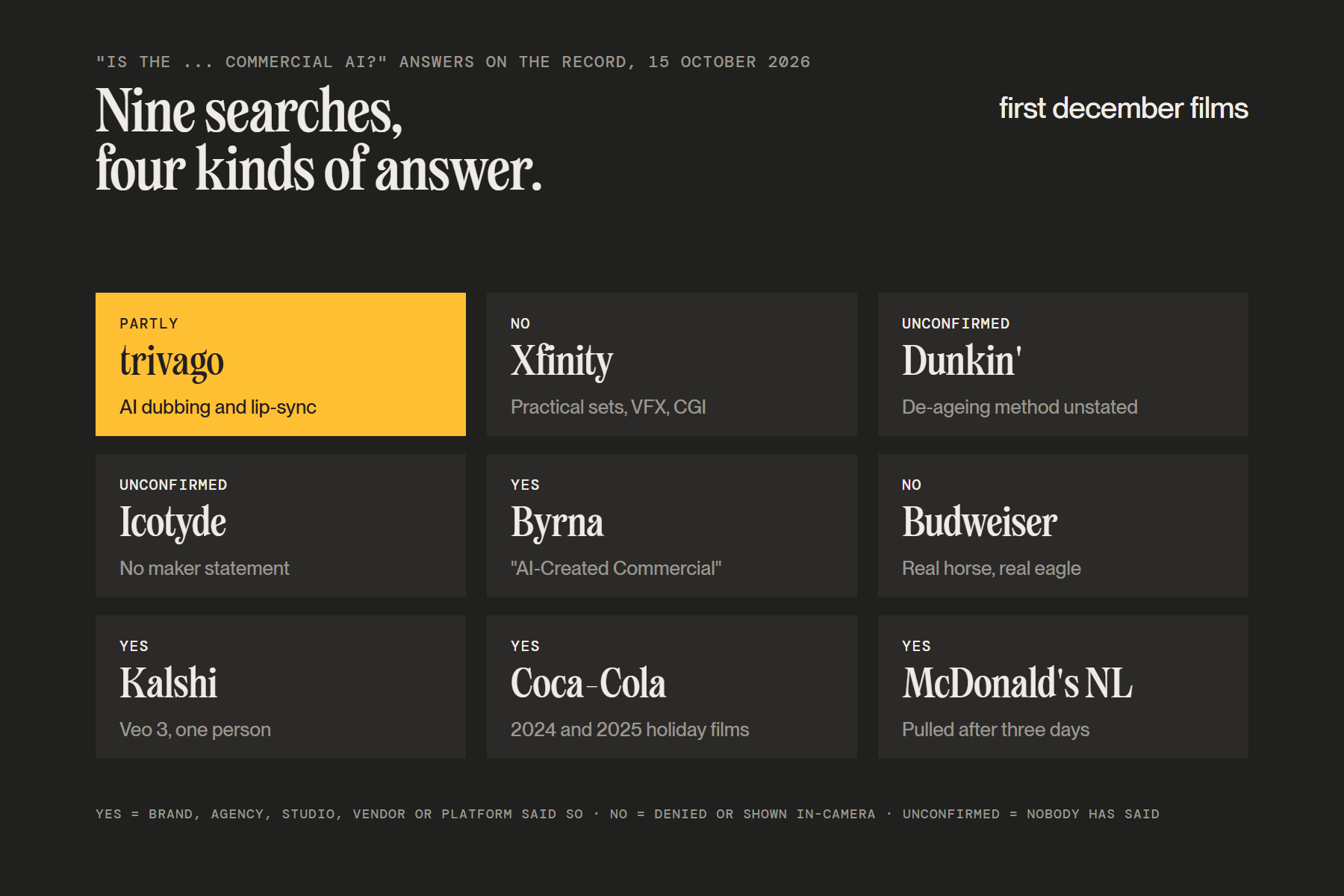
These are the commercials people most often ask about by name, with the answer the public record supports. "Yes" means a brand, agency, studio, AI vendor or platform said so on the record; "No" means someone involved denied it or showed how it was made; "Unconfirmed" means nobody involved has said.
| Search | Answer | What the record shows |
|---|---|---|
| Is the trivago commercial AI? | Partly | Filmed live with Jürgen Klopp in English, then AI translated the voices and mouth movements for nearly 20 markets |
| Is the Xfinity Jurassic Park commercial AI? | No | Xfinity said no AI was used: practical sets, green screen VFX and CGI |
| Was the Dunkin’ Super Bowl commercial AI? | Unconfirmed | Shot on film with digitally de-aged stars; Dunkin’ has not said how the de-ageing was done |
| Is the Icotyde commercial AI? | Unconfirmed | No statement from Johnson & Johnson or an agency on how the unicorn was made |
| Is the Byrna commercial AI? | Yes | Byrna’s own release calls it an "AI-Created Commercial" |
| Is the Budweiser Super Bowl ad AI? | No, on the evidence | A real Clydesdale and a real eagle were reported; Anheuser-Busch has said nothing about AI |
| Are the Kalshi ads AI? | Yes | The 2025 NBA Finals spot was made by one person with Google’s Veo 3 |
| Is the Coca-Cola Christmas ad AI? | Yes | The 2024 and 2025 Holidays Are Coming films were generated by AI studios |
| Was the McDonald’s AI ad real? | Yes | McDonald’s Netherlands’ December 2025 film was AI-generated and pulled after three days |
Is the trivago commercial AI?
Partly. The trivago ads with Jürgen Klopp were filmed live in English with Klopp in front of a camera. trivago then used AI to localise them: "the AI changes the actors’ mouth movements to match each respective language", Skift reported on 5 February 2025, as the spots rolled out in nearly 20 markets. trivago did the same in its December 2023 brand refresh, which introduced "a new ‘trivago guy'" and, in the company’s words, "localized TV ads in more than ten different languages, all featuring the same actor" (trivago, 14 December 2023).
What is not on the record: that the Klopp ads are fan-made parodies (Google’s AI Overview said so on 15 October 2026 and cited nothing that supports it), or that Klopp was "removed" from a later version with AI (a claim in one viewer’s upload). We found no trivago statement on either. The "Auto-dubbed" tag on some of trivago’s 2026 uploads is YouTube’s own automatic dubbing, not a disclosure by trivago.
Is the Xfinity Jurassic Park commercial AI?
No. Xfinity’s Super Bowl LX spot, which brought back the original Jurassic Park cast looking as they did in 1993, drew a wave of "this is AI" comments for its de-aged faces. Xfinity answered on Instagram that no AI was used and that the spot "was made with a combo of practical sets, green screen VFX, and CGI" (Newsweek, 4 February 2026). The confusion is understandable: digital de-ageing and AI face replacement now look alike to most viewers, and both are done in post-production.
Was the Dunkin’ Super Bowl commercial AI?
Unconfirmed. Good Will Dunkin’, also from Super Bowl LX on 8 February 2026, was "Shot on real film and styled to feel like a long-lost 1995 pilot", Adweek reported, with its stars digitally de-aged. Creative Bloq noted "there’s some debate as to whether the de-ageing is the work of CGI or AI" (10 February 2026). We found no statement from Dunkin’ either way. The honest answer: a live-action film with digital faces, method undisclosed.
Is the Icotyde commercial AI?
Unconfirmed. Johnson & Johnson’s Icotyde campaign started on 14 July 2026, with a spot that, in MediaPost’s description, suggests the drug’s results are as "unbelievable" as a unicorn walking past a doctor’s office. The unicorn is plainly not a real animal, but nobody involved has said whether it was generated or built by a VFX team. Searches for "is the Icotyde commercial AI" are rising; the answer stays open until the maker says.
Is the Byrna commercial AI?
Yes. Byrna’s own release, published through GlobeNewswire on 25 August 2025, is headlined "Byrna’s ‘We Don’t Sell Bananas’ AI-Created Commercial Surpasses 66 Million Views" and says the company used "available AI tools with proprietary technical and creative processes" to "generate professional-quality commercials in days rather than weeks" (via StockTitan). Byrna does not say which parts were generated, and its YouTube upload carries no AI label.
Is the Budweiser Super Bowl ad AI?
No AI has been reported. Budweiser’s American Icons spot for Super Bowl LX starred a real Clydesdale and a real bald eagle named Lincoln; KBIA, citing the trade paper Stable Express, reported that Budweiser cast the eagle "rather than rely on a computer-generated image". Anheuser-Busch’s own release says nothing about AI. That is second-hand evidence, so treat it as "no, on the evidence", not as a certainty.
Are the Kalshi ads AI?
Yes. Kalshi’s NBA Finals spot, shown on 11 June 2025, was made by one AI director, PJ Accetturo, with Google’s Veo 3. He told The Verge it took about 300 to 400 generations to get 15 usable clips, and Kalshi told NPR the cost of prompting was under 2,000 US dollars. The same maker posted a follow-up, YOLO, in July 2025.
Is the Coca-Cola Christmas ad AI?
Yes, both recent ones. Coca-Cola’s 2024 and 2025 remakes of Holidays Are Coming were made by AI studios Secret Level and Silverside AI (with The Wild Card in 2024). Of the 2025 film, Coca-Cola’s head of generative AI, Pratik Thakar, said: "Leveraging advanced GenAI tools, we controlled every cinematic detail, from camera angles to physics-driven realism" (Coca-Cola, 3 November 2025). Its 2023 Masterpiece film is a different case: Ajab Samrai of Blitzworks told D&AD that people thought it was "all AI-generated from the first second to the last", and "I even had to tell Reuters, the news agency, that this isn’t the case."
Which commercials are AI? The verified list
The list below covers 48 commercials from 2021 to October 2026 across the US, the UK, Europe, India, the Middle East, Japan and Latin America. Our rule for "verified": the brand, the agency, the production or AI studio, the AI vendor or the platform said so on the record, or a named journalist reported the maker saying so. Viewer guesses never count. "Told viewers?" records whether the ad itself, its title or description, a YouTube label or a brand post said AI was used; "not found" means we looked and found nothing, which is different from proof that nothing exists.
Fully generated commercials
| Ad | First shown | Market | What the AI did, in the makers’ words | Told viewers? |
|---|---|---|---|---|
| Coca-Cola, Holidays Are Coming | November 2024 | US, global | Three AI remakes of the 1995 film by Secret Level, Silverside AI and The Wild Card | Not checked |
| Coca-Cola, Holidays Are Coming | 3 Nov 2025 | US, global | Generated by Secret Level and Silverside AI; "done by 20 people" (Jason Zada) | Reported on the ad; not on YouTube |
| Toys"R"Us, The Origin of Toys"R"Us | 24 Jun 2024 | US | "almost entirely created with Sora, with some corrective VFX" | Announced as Sora |
| Kalshi, NBA Finals spot | 11 Jun 2025 | US | One maker, Veo 3, 15 usable clips from 300 to 400 generations | Maker’s upload only |
| Kalshi, YOLO | 10 Jul 2025 | US | Follow-up by the same AI team | Maker’s upload only |
| Popeyes, Wrap Battle | July 2025 | US | "the first ever AI diss track music video" (Popeyes) | Yes, brand post |
| Byrna, We Don’t Sell Bananas | 22 Jul 2025 | US | "AI-Created Commercial" (Byrna); parts not itemised | Not on YouTube |
| Google AI Mode, Planning a Quick Getaway? | 31 Oct 2025 | US | Google’s first TV ad "created entirely with generative AI (Veo 3)" | YouTube label only |
| Svedka, Shake Your Bots Off | 8 Feb 2026 | US | Touted as the first "primarily" AI-generated national Super Bowl spot | Not found |
| McDonald’s Netherlands, It’s the most terrible time of the year | 6 Dec 2025 | Netherlands | 45 seconds "produced with generative AI clips"; pulled 9 December | Video removed |
| Vodafone, The Rhythm of Life | 2 Dec 2024 | Europe, global | "AI was used as the production tool" (Vodafone) | Not found |
Fully generated commercials, US and Europe. Dates are first airing or official upload.
| Ad | First shown | Market | What the AI did, in the makers’ words | Told viewers? |
|---|---|---|---|---|
| Vodafone Germany, TikTok presenter ads | September 2025 | Germany | AI-generated presenter, confirmed in replies to viewers | Only when asked |
| Fanta, Haunted Universe | 24 Aug 2026 | Global | "Content was generated using artificial intelligence" (Fanta upload) | Yes, and YouTube label |
| Jeep, A Tire Story | By July 2026 | US, online | "generated using AI workflows powered by Google Veo and Luma Dream Machine" | Not found |
| ITV for Sheepbridge Interiors | September 2024 | UK (UTV) | ITV’s first GenAI-created TV advert, with human voice-over | Not found |
| Uswitch, Christmas TV ad | December 2025 | UK | Made "through its AI-powered pipeline" by six people (Particle6) | Not found |
| Volvo with Electromin, Come Back Stronger | February 2025 | Saudi Arabia | Billed as "Saudi Arabia’s first AI generated brand film" | Not found |
| Tata Gluco+, Piyo Goodness. Karo Greatness | 20 May 2025 | India | "100% AI-crafted narrative" (RAIDS) | Not on YouTube |
| Emami DermiCool, DermiCool Warriors | 1 May 2025 | India | "Fully AI-Generated Ad Film" (Emami) | Yes, in the YouTube title |
| Bajaj Group, Kathni Karni Ek Si | 19 May 2026 | India | Directed by Rajkumar Hirani and "entirely crafted using Artificial Intelligence" | Yes, in the description |
| Air India, There is an Air About India (our film) | 18 Sep 2026 | India, global | About a hundred shots "chosen from 600+ generations" | Yes, a line on the master |
| Porsche, The Pisanos (spec film, not commissioned) | January 2025 | Online | An independent director’s Veo 2 spec ad; about 12 days of generating | Yes, as a spec film |
Fully generated commercials, the UK, the Middle East, India and online.
Hybrid commercials: live action plus generated shots
| Ad | First shown | Market | What the AI did, in the makers’ words | Told viewers? |
|---|---|---|---|---|
| Microsoft Surface Pro and Surface Laptop | January 2025 | Global | AI shots; "closeups of hands typing on keyboards had to be shot live" | No, until Microsoft said so in April |
| Under Armour, Anthony Joshua | 5 Mar 2024 | Global | "Ai video, Ai photo, 3D CGI, 2D VFX ... 35mm film" (director Wes Walker) | Yes, in the description |
| Under Armour, Chile hockey teams | Not dated | Chile | One-night live shoot with 80 people; fire generated in Runway | Not checked |
| Coca-Cola, Masterpiece | 6 Mar 2023 | Global | "about 60-80% of all the vignettes ... had some touch of AI" (Electric Theatre Collective) | Not found |
| Heinz, A.I. Ketchup | 26 Jul 2022 | US, Canada | DALL-E 2 images of ketchup cut into a conventionally made film | Yes, it is the idea |
| Salomon, global brand film | February 2026 | Global | "a hybrid production combining live action and artificial intelligence" | Not checked |
| Booking.com, The Easiest Way to Anywhere | 8 Jun 2026 | US, global | Live action with "purposeful AI post enhancements" | Yes, on the ad and YouTube label |
| Ito En, Oi Ocha green tea | September 2023 | Japan | An AI-generated presenter, confirmed about a month after release | Not at launch |
| Agoda India, What A Save | 20 Apr 2026 | India | "first shot as live-action footage with dummy props" so the AI had context for lighting | Not found |
| Volkswagen do Brasil, VW 70 anos | 4 Jul 2023 | Brazil | Late singer Elis Regina’s face recreated on a body double; AI by Flow VFX | No; raised in a complaint to Brazil’s ad regulator |
Hybrid commercials. The share of AI in each is rarely published.
AI voice, dubbing and versioning
| Ad | First shown | Market | What the AI did, in the makers’ words | Told viewers? |
|---|---|---|---|---|
| trivago, Jürgen Klopp ads | Early 2025 | Nearly 20 markets | Changed "the actors’ mouth movements to match each respective language" | Not found |
| trivago, brand refresh | December 2023 | 10+ languages | Localised TV ads "all featuring the same actor" | Not checked |
| Cadbury, Shah Rukh Khan-My-Ad | 23 Oct 2021 | India | Shop owners made their own versions with Rephrase.ai | Not found |
| Cadbury Dairy Milk Silk, The Story of Us | 28 Jan 2024 | India | Couples’ own love stories "brought to life with generative AI technology" | Yes, in the YouTube title |
| Agoda India, Ayushmann Khurrana videos | 6 Mar 2024 | India | One recorded video, AI-changed voice-over and lip-sync per destination | Not checked |
| Shriram Life Insurance, Rahul Dravid | 1 Dec 2025 | India | Dravid "brought to life entirely through AI-generated expressions, voice, and movements" | Not found |
| Sprite India, Sharvari Wagh city films | April 2026 | India | "hyper-localized ad films" with the brand ambassador | Not checked |
AI voice, lip-sync and versioning. The person on screen was usually filmed for real.
Concept-only, about AI, denied or unconfirmed
| Ad | First shown | Market | What the record shows | Verdict |
|---|---|---|---|---|
| Google Pixel 10, Vanilla | 23 Sep 2025 | US, global | Veo 3 storyboards, then "human directors" made the final spots | Concept only |
| Under Armour, The Ultimate Team Talk | 7 Aug 2023 | UK, Europe | Speech written with ChatGPT, performed live by Ashley Walters | Concept only, credited on the ad |
| Anthropic, Super Bowl LX | 8 Feb 2026 | US | Shot in Los Angeles "with actors and production crews" | About AI, shot live |
| Google Gemini, Dear Sydney | July 2024 | US | An ad about using Gemini; pulled after backlash | About AI, shot live |
| Xfinity, Jurassic Park | 8 Feb 2026 | US | Practical sets, green screen VFX and CGI, per Xfinity | Not AI |
| Budweiser, American Icons | 8 Feb 2026 | US | Real horse and real eagle reported | Not AI, on the evidence |
| Porsche, The Coded Love Letter | 19 Dec 2025 | Global | "handcrafted by Parallel Studios" (Porsche) | Not AI |
| Dunkin’, Good Will Dunkin’ | 8 Feb 2026 | US | Shot on film; de-ageing method not stated | Unconfirmed |
| Icotyde, Unbelievable | 14 Jul 2026 | US | No maker statement found | Unconfirmed |
The ones that are not what they seem.
Three things stand out. India has as many verified AI commercials in this list as any region but the US, and most of them use AI to multiply a filmed star (Cadbury, Agoda, Shriram, Sprite) rather than to replace the camera. Many of the "AI ads" argued over at Super Bowl LX in February 2026 were ads for AI products, not ads made with AI; Anthropic’s, for one, was shot with actors and crews. And two of the most-searched commercials, Xfinity’s and Budweiser’s, were not AI at all, while two more remain unconfirmed.
How the list was built. Every source was opened on 15 October 2026 and every quoted phrase was checked by script against the saved page. Official YouTube uploads were read for titles, descriptions and YouTube’s "How this content was made" panel as a signed-out viewer in India; a label shown only in some regions or apps would be missed. Shares of AI inside hybrid films are almost never published, so the list records what the makers said, not our estimate. We will update the list after the 2026 holiday season and Super Bowl LXI.
How can you tell if a commercial is AI? Four checks that work
You can tell whether a commercial used AI by checking four kinds of evidence in this order: the platform’s label, the file’s Content Credentials, an invisible watermark, and the maker’s own statement. Each check can confirm AI. None can prove its absence.
1. Look for the platform’s AI label
Most large platforms now label AI content, but each puts the label somewhere different, and ads are often handled differently from posts.
| Platform | When it labels | Where to look |
|---|---|---|
| YouTube | Creators must disclose realistic AI, such as a real person saying something they did not or "a realistic scene that didn’t actually occur"; YouTube also labels files with C2PA data and content its systems detect | On the player for photorealistic content; otherwise under "How this content was made" in the expanded description |
| Meta (Facebook, Instagram) ads | Ads made with Meta’s AI tools; since 1 June 2026 also ads detected as made with other AI tools | "About this ad" in the three-dot menu; next to "Sponsored" only for photorealistic AI people made with Meta’s tools |
| TikTok | Creator labels, plus automatic labels from Content Credentials and its own invisible watermark | An AI-generated label in the app; TikTok has labelled "over 3 billion pieces of content as AI-generated" |
| Images and videos signed with C2PA Content Credentials | A "CR" icon on the media; click it to see whether AI was used | |
| Broadcast TV and streaming | No viewer-facing provenance standard | Only what the ad itself says on screen |
Where AI labels appear, as of 15 October 2026. Sources: YouTube Help, Meta (updated 1 June 2026), C2PA on TikTok (July 2026), LinkedIn Help.
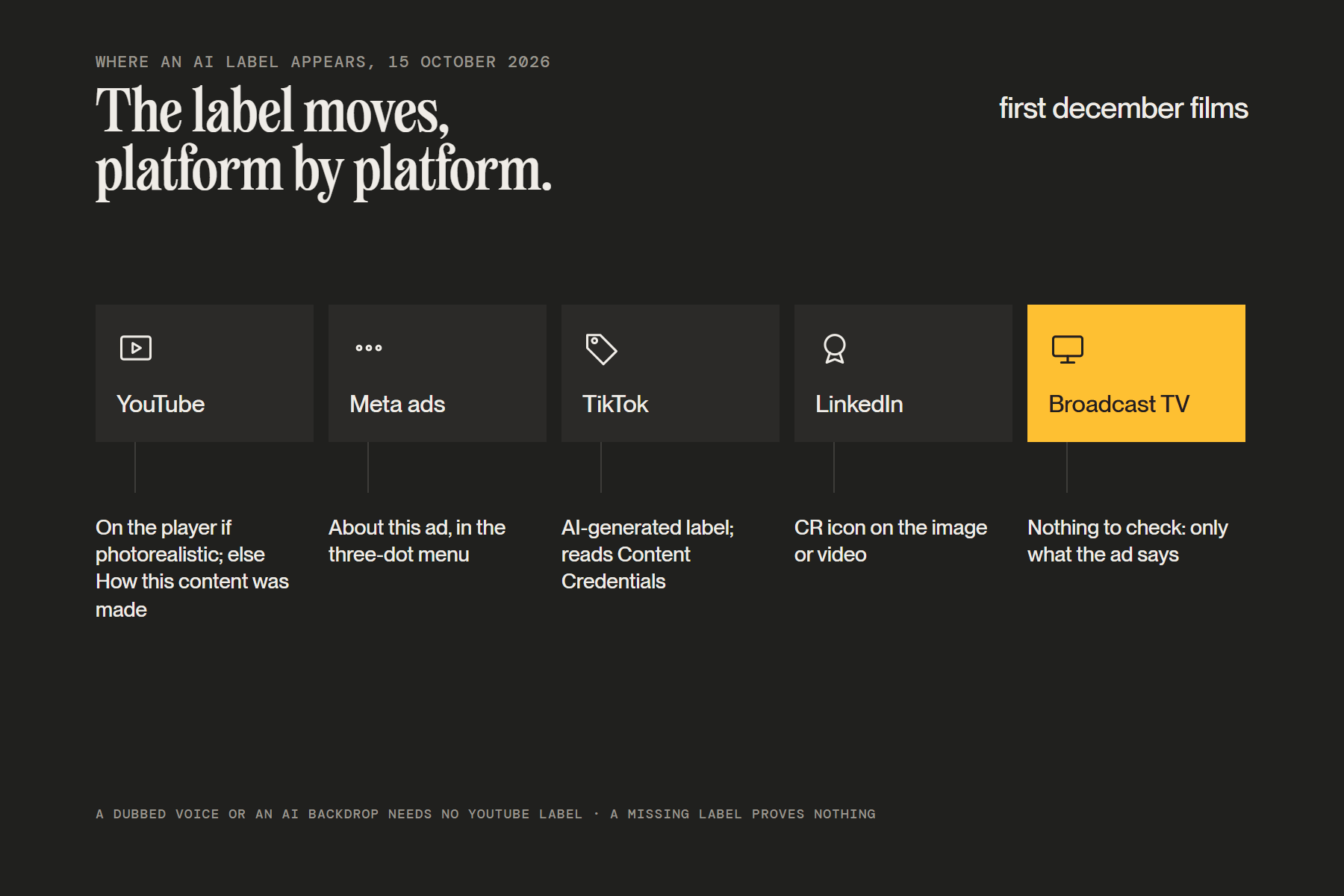
YouTube says creators do not need to disclose "Cloning one’s own voice to create voice overs or dubs" or "AI generating or extending a backdrop", which is why a dubbed or hybrid commercial can be honest and still unlabelled. YouTube’s "Captured with a camera" badge does not work in reverse either: "If it’s missing, it doesn’t mean the content has modified audio or visuals" (YouTube Help).
2. Check the file’s Content Credentials
Content Credentials are a signed record, defined by the open C2PA standard, of who made a file, with which tools, and whether AI was used. The standard’s makers call them "a nutrition label for digital content". If you have the video file or a link to it, drop it into the free Content Credentials Verify tool, which reads MP4, MOV and image files.
The catch is that the record rarely survives the trip to your screen. OpenAI, which attaches C2PA data to its images, says such metadata "can be stripped, lost through uploads and downloads, or broken by transformations like file format changes, resizing, or screenshots" (OpenAI, 19 May 2026). A commercial re-encoded for broadcast, or ripped and reposted, usually arrives with none.
3. Check for an invisible watermark
Google’s SynthID is a watermark hidden in the pixels and audio of content made with Google’s models, built to survive cropping, filters and compression. Anyone can now upload a file to the SynthID Detector, which also reads content from OpenAI, NVIDIA and Kakao, Google says, with Apple "soon" (Google DeepMind). The Gemini app runs the same check on video up to 90 seconds and 100 MB and reports where it found the mark, for example "SynthID detected within the audio between 10-20 secs" (Google, 18 December 2025).
Read a negative result carefully. The detector says of itself: "This is not a general AI detector." A miss "does not totally rule out AI generation"; the film may come from a model that does not use SynthID, such as Kling, Runway or Midjourney, none of which was named as a partner on any page we read.
4. Find the maker’s own words
For a broadcast commercial this is the strongest evidence there is, and it is where every "Yes" in our list came from. Look, in this order, for:
- The official upload. The brand’s own YouTube or social post: title, description and the "How this content was made" panel.
- Credits. The agency, production company and director. Credits databases and the production company’s own site list them; an AI studio in the credits, such as Secret Level or Silverside AI, settles most questions.
- The press release. Brands that use AI on purpose usually announce it, as Byrna, Emami and Bajaj did.
- Trade press. Ad Age, Adweek, Campaign, The Drum, LBB, afaqs and exchange4media interview the makers. A named journalist quoting the maker counts; an anonymous aggregator does not.
- The maker’s reply. Brands answer in comments, as Xfinity and Vodafone Germany did when viewers asked.
Mike Caulfield, co-author of the book Verified, put the logic simply to NPR: "It might be easy to fake a video but it’s hard to get into a time machine and build yourself ten years of history talking about Chicago hot dogs" (KPBS, 30 November 2025). Check the source as well as the pixels.
Can you tell an AI ad apart just by watching it?
Mostly, no. Studies with today’s video models find people at or near chance, and they tend to assume what they see is real.
| Study | What people judged | Correct |
|---|---|---|
| DF26, Czech Technical University in Prague, September 2026 (preprint) | Deepfake videos from 2026 models including Veo 3.1 and Kling 3.0 | 52.6% |
| Diel and others, review of 56 papers, 86,155 people, December 2024 | Deepfake video across studies | 57.31%, not significantly above chance |
| Microsoft AI for Good Lab, about 287,000 judgements, May 2025 | AI and real images | 62% |
| Ipsos and Syracuse University, 3,000 US viewers, May 2026 | Whether a Sora 2-generated ad was AI | 25% of viewers were at least somewhat confident it was |
How often people identify AI correctly. Sources: DF26 on arXiv, Diel and others, Microsoft on arXiv, Ipsos.

The Ipsos and Syracuse report, which tested 20 ads (half human-made, half generated with Sora 2), concluded that "viewers are not equipped to detect AI in advertising". Andrew Tindall of System1, which tests ads for brands, wrote in The Drum on 8 September 2026: "people often can’t tell when AI has been used until you tell them. The good ones don’t give it away in the execution." He also reported a study in which "25% of genuine human-made ads were rated as AI-generated".
There is a counter-view, and it is worth hearing. NielsenIQ’s 2024 neuroscience study of more than 2,000 people found that "Consumers intuitively identified most of the AI-generated ads", which they found more "annoying" and "boring" (NIQ, 12 December 2024). Those were 2024-generation ads. And in Australia, Tom Wenborn of the agency Thinkerbell ran a test with a real model and an AI one and concluded: "For now it looks like there’s still a difference people are picking up on when it comes to people" (B&T, 11 March 2026). People still catch weak AI, especially faces. They miss well-made AI, and they wrongly accuse real work.
Hany Farid, a UC Berkeley professor who studies manipulated media, told NPR: "I’ve been doing this every day for a long time, and it’s really hard." If the expert finds it hard, a viewer pausing a 30-second spot should not expect certainty.
Which visual tells still work, and which ones mislead?
Visual tells are the errors AI video still makes and a camera does not. They can raise a suspicion; they cannot settle the question. Our own AI films pass a realism gate of twelve checks before any shot leaves the studio: "walking, hands, faces, eyes, weight, background people, clothing, objects, perspective, texture, light and morphing. One wrong behaviour sent it back, however good it looked" (First December Films). Turned around, those are the places a viewer should look.
Tells that still catch AI commercials
- The hero object changes between shots. Viewers caught Coca-Cola’s 2025 film on its own trucks: "In some shots, the trucks feature an extra row of wheels in the middle", Campaign US reported. Watch the product, logo or vehicle across cuts.
- Text and signs. "AI text is still pretty messed up in both AI videos and photos, especially when it’s small," Jeremy Carrasco, a video producer who teaches AI literacy, told Arizona’s Family on 16 July 2026. Il Sole 24 Ore spotted signs "written in a non-existent language" in the Coca-Cola film.
- Motion and weight. People in the UC Berkeley study relied most on "motion (mentioned by 66%), followed by hands" (Davodi, Barrington, Farid and Cooper, 2026). Feet that slide, objects with no weight, a bike passing through a car.
- A camera nobody is holding. "There isn’t a real person behind the camera. So a lot of the times, the camera movement doesn’t make sense," Carrasco told NPR.
- Sound that does not match the picture. Voices that sound close when the speakers are far away, or audio that is too clean. "Audio is still a major giveaway," director Erica Gorochow, who made a Google holiday social ad with AI, wrote in February 2026.
- Short shots. Today’s models make short clips: Google’s Veo 3.1 generates 4, 6 or 8 seconds at a time and Kling 3.0 up to 15. A spot built from many very short, perfectly framed shots is consistent with AI, though plenty of live-action edits look the same.
Why the tells fail on a finished commercial
A commercial is not a raw AI clip. It has been chosen from hundreds of generations, cut fast, graded and mixed by professionals, and often combined with live action. Microsoft’s Surface ad ran for about three months before Microsoft explained it was partly AI. Paused shot by shot, the film "reveals AI artifacts", PetaPixel wrote, but its fast transitions make them "barely perceptible when viewing at full speed". Microsoft filmed the hand close-ups live because the AI could not handle that kind of intricate movement, which is the hybrid method in one sentence: shoot what AI gets wrong, generate the rest.
Hybrid work is the hardest of all. A study of partly edited real footage, FakeParts, found it "reduces human detection accuracy by up to 26%" compared with fully fake video (arXiv, August 2025). The tells you have learned are tells of fully generated clips.
Real commercials that got called AI
Suspicion now runs ahead of the evidence. Quip’s March 2026 toothbrush spot, built with "a physical set, a human model and miniatures", drew instant accusations. "The first thing that came was, ‘This is AI,' or, ‘Why are you using AI?'" CEO Meredith Glansberg told Modern Retail; the brand released its behind-the-scenes film early. Xfinity’s de-aging and Coca-Cola’s Masterpiece went the same way. Kolina Koltai of the investigative group Bellingcat named the bigger risk: "It’s not that someone’s going to believe a fake video, it’s that people won’t believe real videos."
For brands, the lesson from Quip is practical: if a film was made in camera and looks unreal on purpose, keep the behind-the-scenes footage ready to post.
How many AI commercials tell you they are AI?
Few, so far. Of the 39 commercials in our list where AI is in the finished picture or sound, 14 (36%) told viewers somewhere: on the ad, in the title or description, in a YouTube label or in a brand post. Thirteen did not, and for 12 we could not establish either way. On the stricter test of a disclosure on the ad itself or on the brand’s own upload or post, 10 of 38 brand-commissioned ads (26%) did.
YouTube’s own AI label was rarer still. We found it on 3 of the 23 AI-made official uploads we could check: Google’s AI Mode spot, Booking.com’s 2026 campaign and Fanta’s Haunted Universe. Google’s AI Mode spot carries the YouTube label but, according to The Decoder, no label on the ad itself. Our own Air India film carries the line "Some content is computer-generated." on its master, as our AI ad films page shows; like most uploads in the list, the brand’s YouTube upload has no YouTube label.
Disclosure does not buy goodwill on its own. Booking.com labelled its June 2026 campaign on the ad and on YouTube, and the most-liked comments still objected. Gallup’s May 2026 survey of 3,270 US adults found 62% say AI-created people or voices in ads are unacceptable "even when businesses clearly disclose that AI was used" (Gallup, 19 August 2026). Yet Duane Varan of MediaScience, whose study with the Ehrenberg-Bass Institute found labels did not hurt ad performance, said: "What we discovered is consumers are accepting of AI if they know" (Marketing Dive, 12 June 2026).
Do AI ads have to be labelled? The rules by market
Yes in China, India, the EU and New York, in different ways; not as a blanket rule in the UK or US federal law. The rules below decide whether an ad will tell you it is AI. They are a summary of what each rule says, not legal advice.
| Market | Who must label | What the rule says | From |
|---|---|---|---|
| China | AI services, platforms and users | A conspicuous label at the start of an AI video and around the player, plus labels in the file’s metadata | 1 Sep 2025 |
| India (law) | Platforms | Realistic synthetic content must carry labels that are "prominent, easily noticeable, and adequately perceivable" | 20 Feb 2026 |
| India (advertising code) | Advertisers | ASCI’s guidelines require a label for synthetic influencers, AI likenesses of real people and fabricated events, and ban faked endorsements even with a label | About 29 Dec 2026 |
| New York, US | Anyone producing an ad | Must "conspicuously disclose" a synthetic performer; fines of 1,000 then 5,000 US dollars | 9 Jun 2026 |
| European Union | Advertisers and agencies using AI; AI providers | Deepfakes must be disclosed, in a way that does not spoil a creative work; AI output must be machine-marked | 2 Aug 2026; marking for existing systems by 2 Dec 2026 |
| California, US | Large online platforms | Must detect and show provenance data embedded in content | 1 Jan 2027 |
| United Kingdom | No AI-specific rule | "There is no blanket legal requirement in the UK to disclose the use of AI in ads"; disclose where viewers would otherwise be misled | Now |
| Award shows | Entrants | Cannes Lions makes AI disclosure mandatory at entry; D&AD asks for a structured AI disclosure in all categories | 2025 and 2026 |
Labelling rules that apply to ads, as of 15 October 2026. Sources: CAC and China Law Translate; Khaitan & Co; ASCI guidelines; Cooley on New York; European Commission; California AB 853; ASA; Cannes Lions; D&AD.
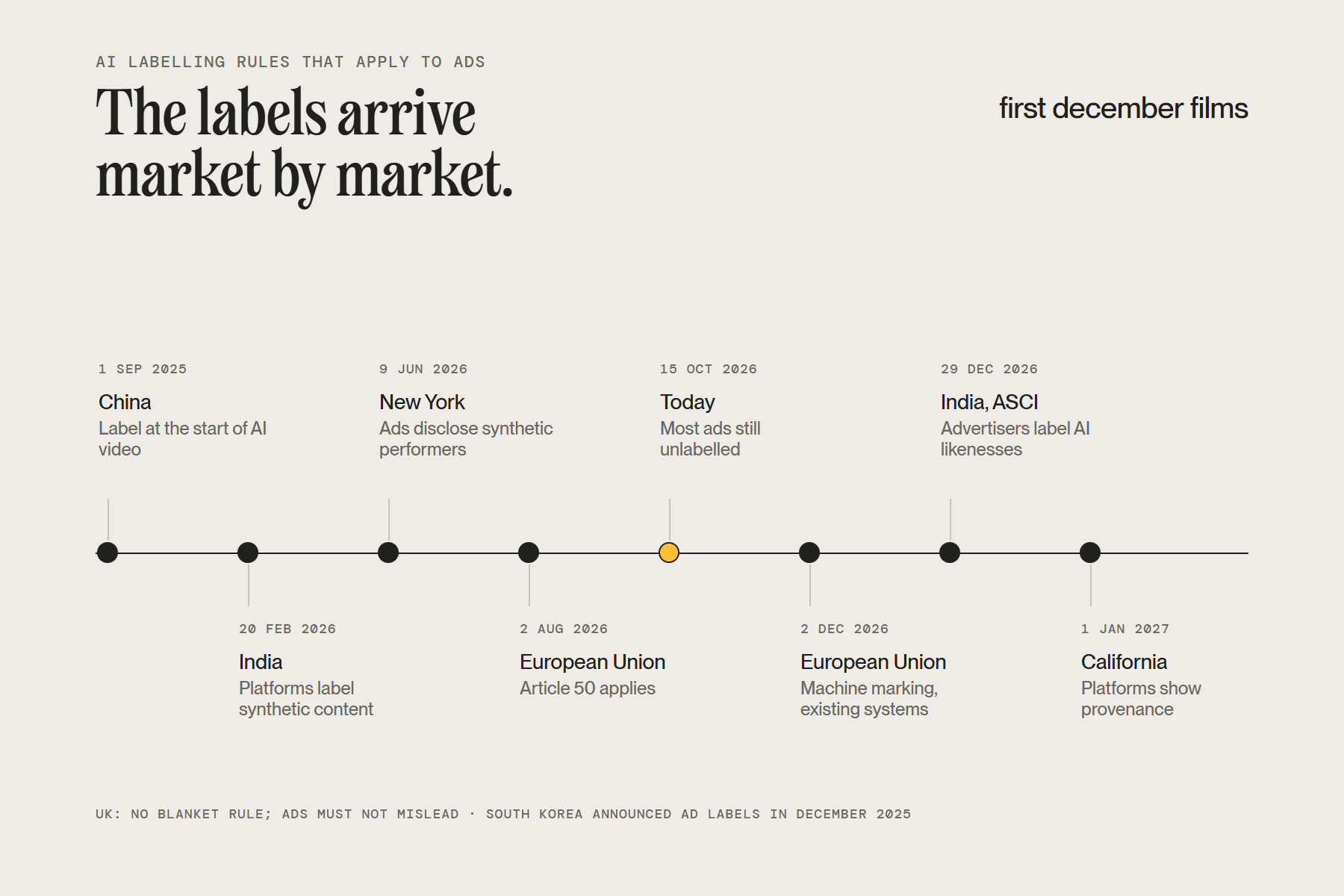
South Korea announced in December 2025 that advertisers will have to label AI-generated ads and that platform users will be barred from removing those labels (Euronews, 10 December 2025). The New York law exempts AI used only to translate a human performer, which is how a dubbed ad like trivago’s can run there without a synthetic-performer label. For India in detail, see our guide to whether AI ads are legal in India.
India’s ad regulator was explicit that a label is not a licence. "Importantly, it clarifies where the mere use of an AI label may not make an otherwise misleading advertisement acceptable," Manisha Kapoor, CEO and Secretary General of ASCI, said when the guidelines were released (exchange4media, 29 September 2026).
Why are there so many AI ads now?
Because they got cheaper, faster and good enough at the same time. Gallup found that 79% of Americans had seen ads in the past 30 days that looked AI-made. The published numbers explain the pull for brands: Kalshi’s prompting cost under 2,000 US dollars; Byrna says it can make commercials "in days rather than weeks"; Emami says its DermiCool film cost 15 to 20% of what a similar CG-heavy film would have (Storyboard18, 2 July 2025). Video models arrived in quick succession: OpenAI previewed Sora in February 2024, Google’s Veo 3 added sound and dialogue in May 2025, Sora 2 followed in September 2025, Veo 3.1 in October 2025 and Kling 3.0 in February 2026. (OpenAI then closed Sora in April 2026.)
The pull from audiences is weaker. In the Harris Poll for the 4As, 73% of consumers said they would be "less likely to trust an ad" they suspected was made with AI (Marketing Brew, 24 June 2026). In Australia, 45% told YouGov they would trust a brand less if its ads were mainly AI-made (YouGov, May 2026). In the UK, DoubleVerify found 49% react badly to AI ads that look "low-quality, uncanny or strange", against 29% for polished ones (Advanced Television, 6 August 2026). And System1 gave Coca-Cola’s 2025 AI film its maximum 5.9 stars, while noting "the brand is wise not to mention AI in the ad itself" (System1, 20 November 2025).
Quality decides the reaction more than the method does. That is the uncomfortable result for anyone hoping "AI or not" is a moral line viewers can see.
What should a brand do about it?
Our position, from making both kinds of film: disclose by function, keep the proof, and stop treating "AI" as one thing.
- Say what the AI did. Our AI work ships with a labelled and a clean master, with AI "disclosed by function": concepting, pre-vis, image generation, video generation, compositing, enhancement or finishing (First December Films). A dubbed film and a generated film should not carry the same label, and viewers deserve to know which they are watching.
- Decide the label at the brief, market by market. The same film may need an on-screen line in India or China, a synthetic-performer notice in New York and nothing beyond honesty in the UK. Planning it late means re-cutting masters.
- Keep the paperwork. Consent for every real face and voice, a log of which shots were generated, and the behind-the-scenes material that lets you answer "is it AI?" in one reply, whichever way the answer goes.
- Expect to be asked. Every famous AI ad in our list was questioned within days. Every real ad that looked unreal was questioned too.
Not everyone in our house thinks a label belongs on every frame. Ganesh Pareek, our partner and creative director, warned when ASCI published its draft that "The moment you put an ‘AI generated’ label on an emotional brand film, you break the suspension of disbelief" (BestMediaInfo, 18 May 2026), and argued that every element should be "locked and documented before motion generation begins". His conclusion was the same as ours: "ASCI is not slowing AI advertising down. It is forcing the industry to grow up."
Our own record in this list: Air India’s There is an Air About India (2026), a fully AI film with McCann, about a hundred shots chosen from 600+ generations; 32 fully AI founder films for Razorpay that aired during IPL 2026; and the vivo X300 Pro launch film, a hybrid that won a Bronze for AI-Integrated Live Action Film at the Good Ads Matter Awards 2026, shared with Old Monk Studio. How each kind of film is made is set out in our guide to how AI commercials are made.
When does this guide not apply?
Skip it if you are verifying news footage, a political ad or a suspected scam. Those need forensic analysts, reverse searches of the source account and, for scams, your bank or the platform’s report button. Researchers testing deepfake detectors found that the accuracy score (AUC) of open-source detectors fell by half on video from the wild (Deepfake-Eval-2024), so a free detector website is not an answer either.
Skip it if you need certainty about a hybrid film. Makers almost never publish which shots were generated, and no check above can tell you. Our list records what they said, nothing more.
Read it with a date. This list reflects the record on 15 October 2026. Brands confirm AI weeks after launch (Ito En did, about a month after release), labels are added and removed, and new rules take effect in December 2026 and January 2027.
What changes next?
Three dated changes are coming. The EU’s machine-marking duty for AI systems already on the market applies from 2 December 2026; India’s ASCI guidelines take effect at the end of December 2026; California’s large platforms must show provenance data from 1 January 2027. Google is opening its SynthID Detector to everyone (trade press dated the change to 7 and 8 October 2026), and OpenAI now adds SynthID to its images and audio.
Detection will not settle the matter. "Platforms like Instagram will do good work identifying AI content, but they’ll get worse at it over time as AI gets better," Instagram’s head, Adam Mosseri, wrote in December 2025 (Modern Retail). The UC Berkeley team warned that better AI may "erode trust in all video". Our forecast, and it is only ours: within a year most AI commercials in the EU, India and China will carry a label, but broadcast television will still carry no provenance a viewer can check, so the maker’s own word will remain the best evidence for a TV spot. Brands that publish how their films were made will be believed; brands that wait to be asked will be accused, whichever way the answer goes.
For India’s AI commercials in more depth, see our review of the best AI ads in India, and for what AI, live action and hybrid each cost, our AI ad film cost guide.
Making a film people will ask about?
Every commercial in this list was questioned the week it aired. The ones that held up had decided early what had to be real, what could be generated, and what they would say about it.
If you are weighing AI for a film, paste your script into our script analyser for a free producer’s read, bring us the one scene everyone says can’t be done as a paid feasibility test, or send us the brief and a named producer will tell you which shots to generate, which to shoot and how to label the result. You can see the films Atul Kattukaran has directed on his director page.
First December Films is an advertising film production company in Mumbai. Our work has won more than 150 international creative awards, including Cannes Lions, D&AD and One Show Gold Pencils.
Frequently asked questions
How can you tell if a commercial is AI?
Check the evidence rather than the pixels. Look for the platform’s AI label, drop the file into the Content Credentials Verify tool, check it in the SynthID Detector or the Gemini app, and find the maker’s own statement in the credits, press release or trade press. Visual tells such as warped text or changing objects can raise a suspicion but rarely settle it.
Which commercials are made with AI?
Confirmed examples include Coca-Cola’s Holidays Are Coming films of 2024 and 2025, Toys R Us in 2024, Kalshi’s NBA Finals spot, Google’s AI Mode ad, Svedka at Super Bowl LX, McDonald’s Netherlands, Byrna, Volvo in Saudi Arabia, Tata Gluco+ and Air India. Our list checks 48 commercials and records what the AI did in each.
Is the trivago commercial AI?
Partly. The Jürgen Klopp ads were filmed live in English with Klopp on set, then AI translated the voices and matched the mouth movements for nearly 20 markets, as trivago told Skift in February 2025. Claims that the ads are fan-made parodies, or that Klopp was removed with AI, have no trivago statement behind them.
Is the Xfinity Jurassic Park commercial AI?
No. Xfinity said no AI was used in its Super Bowl LX spot with the original Jurassic Park cast, and that it was made with practical sets, green screen VFX and CGI. The de-aged faces made many viewers assume AI, because digital de-ageing and AI face replacement now look alike on screen.
How many commercials are made with AI now?
Nobody publishes a full count. In Gallup’s May 2026 survey, 79% of Americans said they had seen ads in the past 30 days that looked AI-made. Of the 48 well-known commercials we checked, 41 used AI on the record, but only 22 were fully generated; the rest used AI for shots, voices, versions or concepts.
Do AI ads have to be labelled?
It depends on the market. China has required labels since September 2025, Indian platforms since February 2026, New York ads with synthetic performers since June 2026, and the EU from August 2026. The UK has no blanket rule, though ads must not mislead. India’s ASCI guidelines for advertisers take effect at the end of December 2026.
Why are there so many AI ads now?
Because AI video got cheaper, faster and good enough at the same time. Kalshi’s prompting cost under 2,000 US dollars, Byrna says it makes commercials in days rather than weeks, and new models arrived every few months from 2024 to 2026. Audiences are less keen: 73% in a Harris Poll said they trust a suspected AI ad less.