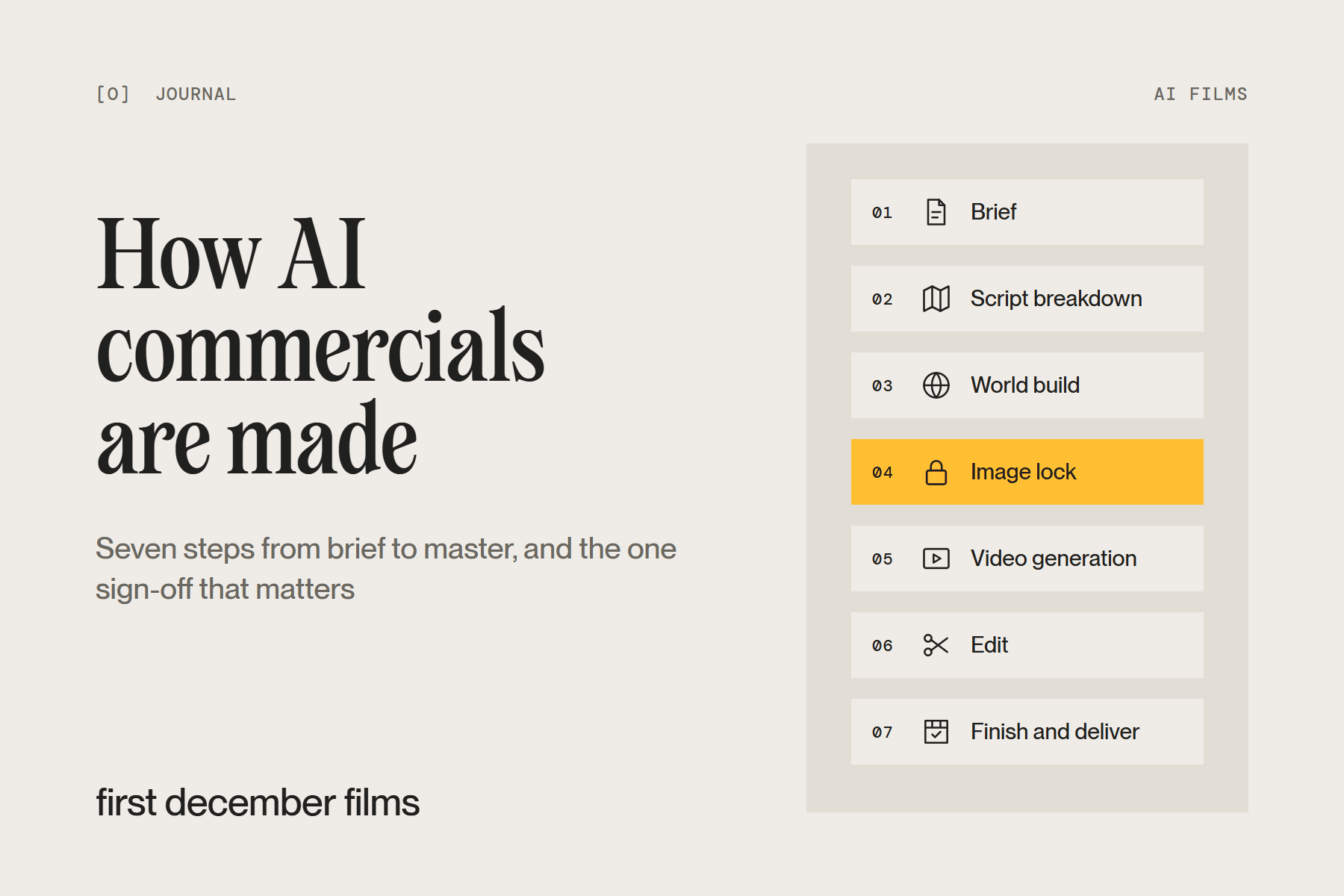
The short answer. A professional AI commercial is made in seven steps that mirror a live shoot: brief, script breakdown, world build, image lock, video generation, edit, and finishing to a labelled and a clean master. The craft moves upstream. Every character, product and location is approved as a still before anything moves, most generations are thrown away, and the finish is still done by an editor, a colourist and a sound team.
Search for how AI commercials are made and you will mostly find tools that promise an ad in minutes, and tutorials that turn one prompt into one clip. That is a different product. A commercial a brand will put on television or in a cinema, under its own name, goes through approvals, rights checks and a finish that no prompt covers. We make these films. This year we made Air India’s 102-second AI film with McCann and 32 fully AI founder films for Razorpay’s IPL season, a hybrid film for Malaysia Airlines, and the live action we have shot since 2010. So this is the producer’s version: what happens at each step, who signs off, how many generations a usable shot takes, how long it all takes, and what the paperwork looks like in each market.
Published 13 October 2026. Model specifications and rules checked 12 and 13 October 2026.
Key takeaways
- An AI commercial is an edit of many short generations. Today’s video models deliver 2 to 15 seconds per generation, so a 30-second spot is built shot by shot, like a film, and cut together.
- The decisive sign-off is the image lock: every character, costume, product and location approved as a still before any of it moves. A change after that point resets the scene.
- Most of the work is choosing. In the published record a usable shot took between about 3 and 27 generations, fewest where the stills were locked first, and Coca-Cola’s 2025 holiday films were cut from more than 70,000 clips.
- One person can make a 30-second joke spot in two or three days, as Kalshi’s 2025 NBA Finals ad showed. Brand films in the same record ran at one to two finished seconds per calendar day, and McDonald’s Netherlands’ took ten people five weeks, more hours than a shoot.
- Humans still finish the film: edit, grade, sound, music, and often a live-action element. Coca-Cola’s 2025 music was performed by real artists.
- The paperwork is part of the pipeline: written consent for any real face or voice, a label decision for each market, a labelled and a clean master, and a log of the human decisions behind the generations.
What is an AI commercial?
An AI commercial is an advertising film in which some or all of the footage is generated by AI video models instead of being photographed by a camera. In India the same film is called an AI ad film or an AI TVC (television commercial); in the UK, an AI advert.
"Made with AI" covers three very different films, and the difference decides the pipeline, the cost and the label. Our verified list of 48 AI commercials sorts real examples by what the AI did.
| Type | What is generated | What stays real | Published example |
|---|---|---|---|
| Fully AI | Every frame of picture | Script, direction, edit, grade, sound, often music and voice | Coca-Cola, Holidays Are Coming, 2024 and 2025; Kalshi, NBA Finals, 2025; Air India, There is an Air About India, 2026 (ours) |
| Hybrid | Worlds, extensions, impossible shots, versions | People, product and performance shot on set | Salomon, 2026: "a human protagonist shot in live action, with environments generated in AI"; Under Armour Chile, 2025 |
| AI-assisted | Voice, dubbing, lip-sync or language versions | The whole shoot | trivago with Jürgen Klopp, 2025: filmed in English, then AI-translated for nearly 20 markets |
Sources: Runway on Salomon, May 2026; Skift on trivago, February 2025.
This guide follows the fully AI pipeline, because it is the one most people have never seen, and marks where a hybrid film differs. If you are still deciding which of the three your brief needs, our guide to AI ad film cost and the AI, live action or hybrid choice starts there.
How is an AI commercial made, step by step?
An AI commercial is made in the same order as a live shoot, with a different tool at each stage: plan first, build the look second, generate third, edit and finish last. Our AI ad films page sets out the pipeline in six stages; here the last one is split in two, because a buyer signs off the edit and the finish separately.
| Step | Live-shoot equivalent | What happens | Sign-off | What goes wrong if it is skipped |
|---|---|---|---|---|
| 1. Brief | Brief | Story, audience, deliverables, markets, and what must stay consistent | Client | "Make it cinematic" becomes endless versions of nothing |
| 2. Script breakdown | Pre-production, shot list | A production map of scenes, characters, locations and risk areas; each shot marked to generate, shoot or composite. No generating yet | Client | The hard shot is discovered in week three |
| 3. World build | Casting, wardrobe, art department, recce | The asset bible: approved characters, costumes, locations, products and scene rules, each as reference stills | Client | A face that drifts from shot to shot |
| 4. Image lock | The storyboard, shot for real | Every frame of the film approved as a still before it moves | Client: the key sign-off | Design changes made in motion, where every fix means regenerating shots |
| 5. Video generation | The shoot | Each locked still turned into motion, generated as coverage: several takes, angles and lengths per shot | None: production | Generating "pretty clips" the cut cannot use |
| 6. Edit | Offline edit | Selects, rough cut, a gap list, and targeted generation for what the cut is missing | Client | Approving clips one by one instead of the film |
| 7. Finish and deliver | Online, grade, mix, QC | Clean-up, upscale, grade, sound design, music, voice, versions, a labelled and a clean master, the generation log | Client | A master that fails a broadcaster, a platform or a lawyer |
The seven steps of an AI commercial. Steps 1 to 4 and 6 to 7 carry a client sign-off; generation does not.

Step 1: what does the brief need to say?
An AI brief needs everything a live-action brief needs, plus one list a live brief rarely writes down: what must stay the same in every shot. A face, a product, a logo, a colour, a costume. A camera keeps those consistent for free. A model has to be made to.
It should also say how many films it is, in which ratios and languages, for which markets, and where each version will run, because each answer changes the pipeline. A vertical 9:16 version, for instance, is usually a separate generation rather than a crop; on our own films 16:9, 4:3 and 1:1 come from one generation and 9:16 from another. The markets decide the label (see the paperwork section below), and the label decides how many masters you need.
Step 2: why is there no generating in the script breakdown?
Because the expensive mistakes are made before the first prompt. The script breakdown is a production map: every scene, character, location and prop, and the risk in each. A producer marks which shots a model will handle well, which it will fight, and which should be shot or composited instead.
That last decision is where hybrid films are made. Microsoft’s 2025 Surface ad was largely generated, but "any intricate movement such as closeups of hands typing on keyboards had to be shot live", PetaPixel reported. Salomon’s 2026 campaign shot its runner over two days near Paris with a crew of 60 and generated the environments around him. Our hybrid films for Malaysia Airlines and vivo work the same way: we shoot the plates first and extend them with AI, so the AI inherits real light instead of inventing it. The same reading of a script for a live shoot is in our guide to script breakdown for ad films.
Step 3: what goes into the world build?
The world build produces the asset bible: the film’s casting, wardrobe and art department, approved as reference images before any scene is made. Each character is designed and fixed from several angles. Each costume, location and product gets its own references, and the scene rules are written down: light, lens, palette, what this world never shows.
This is where most of the human design work sits, and it is where the biggest published delays happened. Svedka’s Super Bowl LX ad was made in "under one month of production", according to ComfyUI’s case study with its maker Silverside AI, but Sazerac, Svedka’s owner, told TechCrunch it took "roughly four months to reconstruct the Fembot and train the AI to mimic facial expressions and body movements". Coca-Cola’s 2025 films began with people drawing: Jason Zada of Secret Level told The Hollywood Reporter that "There was a lot of hand-drawn character designs."
Holding those references steady is the hard part, and practitioners describe it in the same terms everywhere. PJ Accetturo, who made Kalshi’s NBA Finals spot alone, advised in his published workflow, quoted by Business Insider: "Each prompt should fully describe the scene as if Veo 3 has no context of the shot before or after it. Re-describe the setting, the character, and the tone every time to maintain consistency." In India the first problem is often casting. "Getting Indian skin tones right is actually tougher than it seems," Neilloy Chakravarty, head of Rediffusion’s AI studio, told exchange4media after its Tata Power film in December 2024.
If the film uses a real person’s face or voice, the consent paperwork belongs here too, before a single likeness is generated.
Step 4: what is image lock, and why does it matter most?
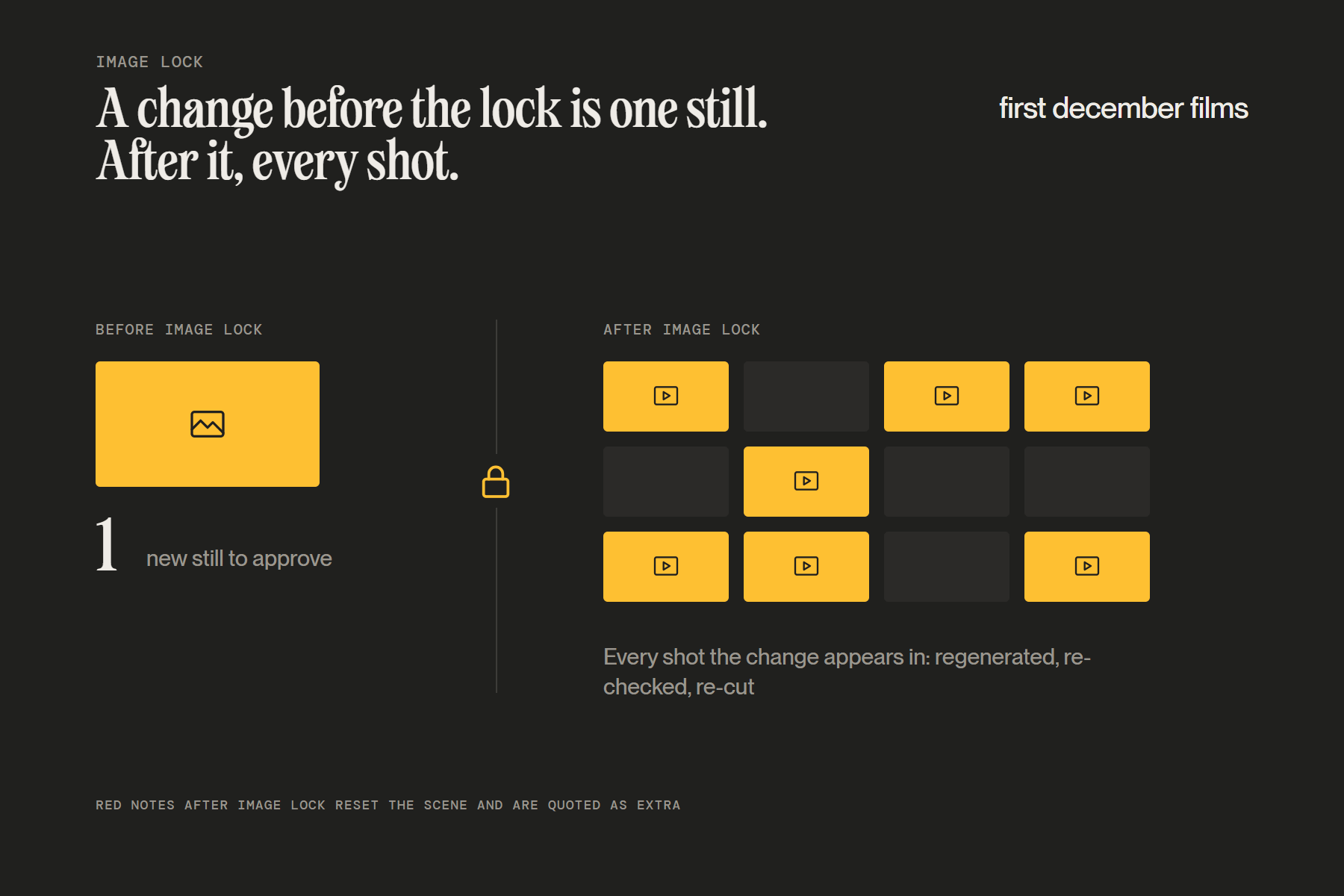
Image lock is the point at which every frame of the film has been approved as a still image, before any of it is animated. It is the AI equivalent of the camera rolling: after it, the film’s design is fixed.
It matters because changing a design is cheap in a still and expensive in motion. A redesigned costume in a still is one image. The same change after video generation has started means regenerating every shot the costume appears in, then re-cutting them. Our working rule, published on our AI ad films page, is that "Video generation is production, not the place to redesign a character, a location or a costume. Those decisions belong upstream, at the image lock."
Not every studio works this way, and the disagreement is worth knowing before you sign. Silverside AI, which made Coca-Cola’s and Svedka’s AI films, sells the opposite as a feature. "Before, all the steps of the creative process needed to be locked. This process allowed us to keep revising all the decisions," its co-founder PJ Pereira said in a ComfyUI case study of the Svedka film. Amy Remley, Svedka’s global vice president for integrated marketing, said in the same study: "Nothing is locked ever. Ever. We shipped to NBC and I’m still getting calls like, ‘Hey, can we tweak it?'" Johnny Rohrbach, another Silverside founder, called it "the beauty and the pain of AI, is that iteration is infinite" in a February 2026 interview. Open-ended revision suits a brand with a Super Bowl budget and an in-house team that wants to keep changing its mind. For a fixed budget and an air date, we think a lock is what makes the date.
It also matters for compliance. Ganesh Pareek, our partner and creative director, told BestMediaInfo in May 2026 that every key element, "prop, copy, character likeness, setting", has to be "locked and documented before motion generation begins", because "that locked approval is now your compliance paper trail."
Step 5: how is the footage generated?
Each locked still becomes the first frame, or the reference, for a short generated clip. Studios generate the way crews shoot: several takes of each shot, at different lengths and from different angles, so the editor has coverage to cut. Most video models now take a reference image, a first and last frame, or several "ingredients" (Google’s word for reference images of characters, objects and style), so the locked stills steer the motion.
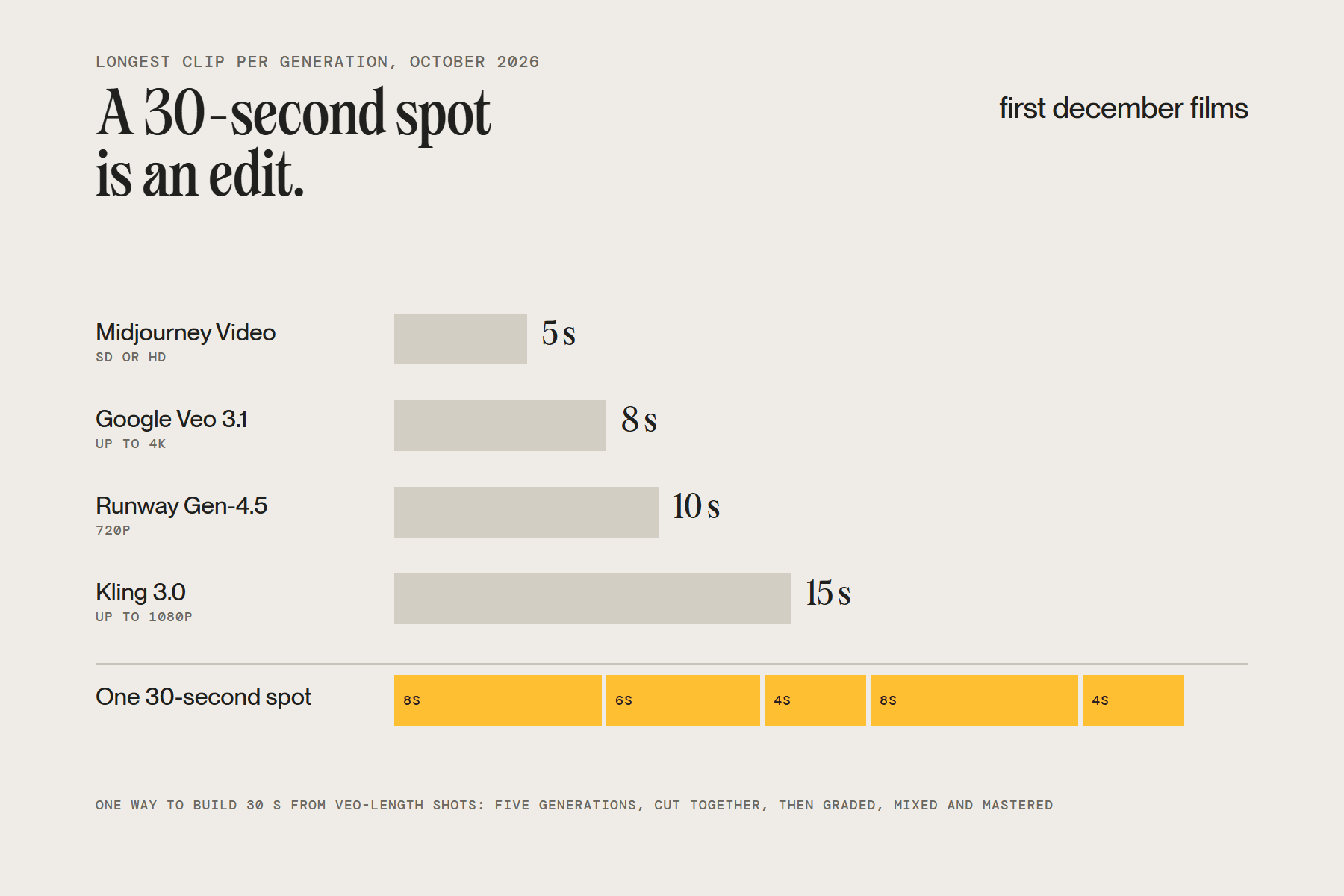
No video model makes a commercial in one generation. As of October 2026, Google’s Veo 3.1 makes clips of 4, 6 or 8 seconds, Kling 3.0 makes 3 to 15 seconds, and Runway’s Gen-4.5 makes 2 to 10. A 30-second spot is therefore an edit of at least four generated shots, and usually far more. Air India’s film runs about a hundred shots in 102 seconds.
Nothing gets signed off at this stage, on purpose. Generation is production, and a client approving clips one at a time is approving a film that does not exist yet. Melanie Bridge, chief executive of the production company The Sweetshop, described its McDonald’s Netherlands film the way any producer would describe a shoot: the team "generated what felt like dailies", thousands of takes, then "shaped them in the edit just as we would on any high-craft production", per Futurism.
Step 6: how is an AI commercial edited?
The edit works like any offline edit, with one addition: the edit asks for the shots it needs. The editor builds a rough cut from the selects, and the gaps in the cut become a list for targeted generation. On Air India, "Editing began while generation was still running. The rough cut showed what the film was missing, so the next prompt was written for the cut, not for a pretty clip," as our AI ad films page records.
This is also where most generations die. Every shot is checked against the realism problems a model still makes (more on that below), and one wrong behaviour sends it back however good it looks.
The edit is bigger than most clients expect. "On a typical 30-second FMCG spot, I spend more hours in the edit than in generation," and "the client never sees this work directly", Mohammad Nasravi, an in-house AI creative director for an Iranian FMCG group, wrote on his own site in July 2026. PJ Pereira of Silverside described the editor’s role growing in the same way to LBB in August 2025: an editor who for 20 years had only decided "where a shot starts and when a shot ends" now shapes what gets made.
Step 7: what happens in finishing and delivery?
Finishing turns approved generations into a master a broadcaster, a cinema or a platform will accept. It is the most traditional part of the pipeline and the part DIY tutorials skip. "Post-production is still largely traditional, with unchanged timelines and costs. VFX bills reduce, but do not disappear," Dipankar Mukherjee, chief executive of the Indian AI studio Studio Blo, told Social Samosa in June 2026. Gavin McLeod of the Australian agency Emotive put it more bluntly to LBB: "A lot of people underestimate how much post-work is needed on AI jobs."
- Clean-up and upscale. Generated shots are cleaned of artefacts and brought up to the delivery resolution. Runway Gen-4.5 outputs 720p and Kling 3.0 up to 1080p; Veo 3.1 offers 4K on Google’s enterprise platform. Upscalers such as Topaz Video carry footage to 4K. Our own generation standard today is 1080p.
- Grade. A colourist matches shots made by different generations and sometimes different models.
- Sound, music and voice. Usually human, because sound gives AI away fastest. "Audio is still a major giveaway that the piece is AI-generated," wrote Erica Gorochow, who directed an AI holiday spot for Google, in February 2026; her team used human actors for the voices. Coca-Cola’s 2025 films used music "performed and sung by real artists", the company said. Toys"R"Us’s 2024 film was "almost entirely created with Sora, with some corrective VFX and an original music score", per its release.
- Versions. Cutdowns, ratios and languages. Count each one as a deliverable.
- Two masters. A labelled master that carries the disclosure your markets require, and a clean master for uses where a label is not required, with the choice of where each runs agreed in writing.
- A generation log. A record of the human decisions at each stage, for copyright, awards and platform checks.
How is it different from a live-action shoot?
The order is the same; the weight moves. A live shoot spends its money and anxiety on a few days on set. An AI film spends them before generation, in the world build and the image lock, and after it, in the edit and the finish.
| Live-action commercial | AI commercial | |
|---|---|---|
| Where the decisions are made | Pre-production meeting, then on set | World build and image lock, as stills |
| What "the shoot" is | One to three days with a crew of dozens | Days to weeks of generation by a small team, often running alongside the edit |
| What limits a shot | Budget, weather, permissions, physics | Consistency, hands, faces, product accuracy, clip length |
| When a change is cheap | Before the shoot | Before image lock |
| Who is in the room | Director, DOP, crew, cast | Director, AI artists, producer, editor, often an AI supervisor |
| What stays the same | Edit, grade, sound, music, versions, delivery | Edit, grade, sound, music, versions, delivery |
| New paperwork | Talent releases, location permits | Likeness and voice consent, tool licences, label plan, generation log |
A live shoot and an AI film, stage by stage. Our TVC production guide covers the live-action side in full.
Under Armour’s 2025 Chile commercial shows the hybrid middle: one shoot day with 80 people on set, including 40 players, and around 500 generated shots across iterations, according to Runway’s account of the job by Chilean studio Tropico.
How many generations does one usable shot take?
Between about 3 and 27 video generations in the productions that published both numbers, and far more for a brand’s hero film. Generation is cheap per clip and expensive in total, because most of what is generated is thrown away.
| Production | Generated | Kept | Generations per kept shot | Source |
|---|---|---|---|---|
| A 15-shot FMCG spot, Iran, 2026 (board locked first) | 45 to 75 clips reviewed | 15 shots | 3 to 5 | Mohammad Nasravi, own site, Jul 2026 |
| Kalshi, NBA Finals, 2025 (30 s) | 300 to 400 generations | 15 usable clips | 20 to 27 | PJ Accetturo, via The Verge, Jun 2025 |
| Coca-Cola, Holidays Are Coming, 2024 (Secret Level’s part) | 18,000+ images | 34 shots | About 530 images per shot | Secret Level, behind-the-scenes film, Jan 2025 |
| Toys"R"Us, Origin, 2024 (about 60 s) | "hundreds of iterative shots" | "a couple dozen" | About 8 or more | Toys"R"Us release, Jun 2024 |
| Air India, There is an Air About India, 2026 (102 s, ours) | 600+ generations reviewed | 101 shots | About 6 | Our AI ad films page |
| Coca-Cola, Holidays Are Coming, 2025 (60 s and 90 s) | 70,000+ raw clips | Not published | Not computable | Futurism and Stash, Nov 2025 |
| Under Armour Chile, 2025 (hybrid) | About 500 shots across iterations | Not published | Not computable | Runway customer story, Oct 2025 |
Generations made against shots kept, as published by the makers. Definitions differ: some count every generation, some count shots reviewed.
Our reading of the spread: the ratio falls when the design is settled before motion. The two lowest ratios, Nasravi’s three to five takes a shot and our six on Air India, both come from pipelines that lock the stills first, so generation explores movement, not what a character looks like. A one-person spot made at speed has no separate design stage, so design and motion are searched for in the same generations. The design work does not vanish; it moves into the still stage, where Secret Level’s artists made more than 18,000 images for 34 shots of Coca-Cola’s 2024 film.
Some shots never settle. In India, recreating an older Bandra for Tiger Shroff’s childhood scenes in Ugaoo’s September 2026 hybrid film, "Some shots reportedly went through more than 113 versions before the team was satisfied", afaqs reported. Either way, budget for choosing, not for prompting: the hidden cost line in an AI commercial is the hours spent reviewing what will not be used.

How long does an AI commercial take, and how many people?
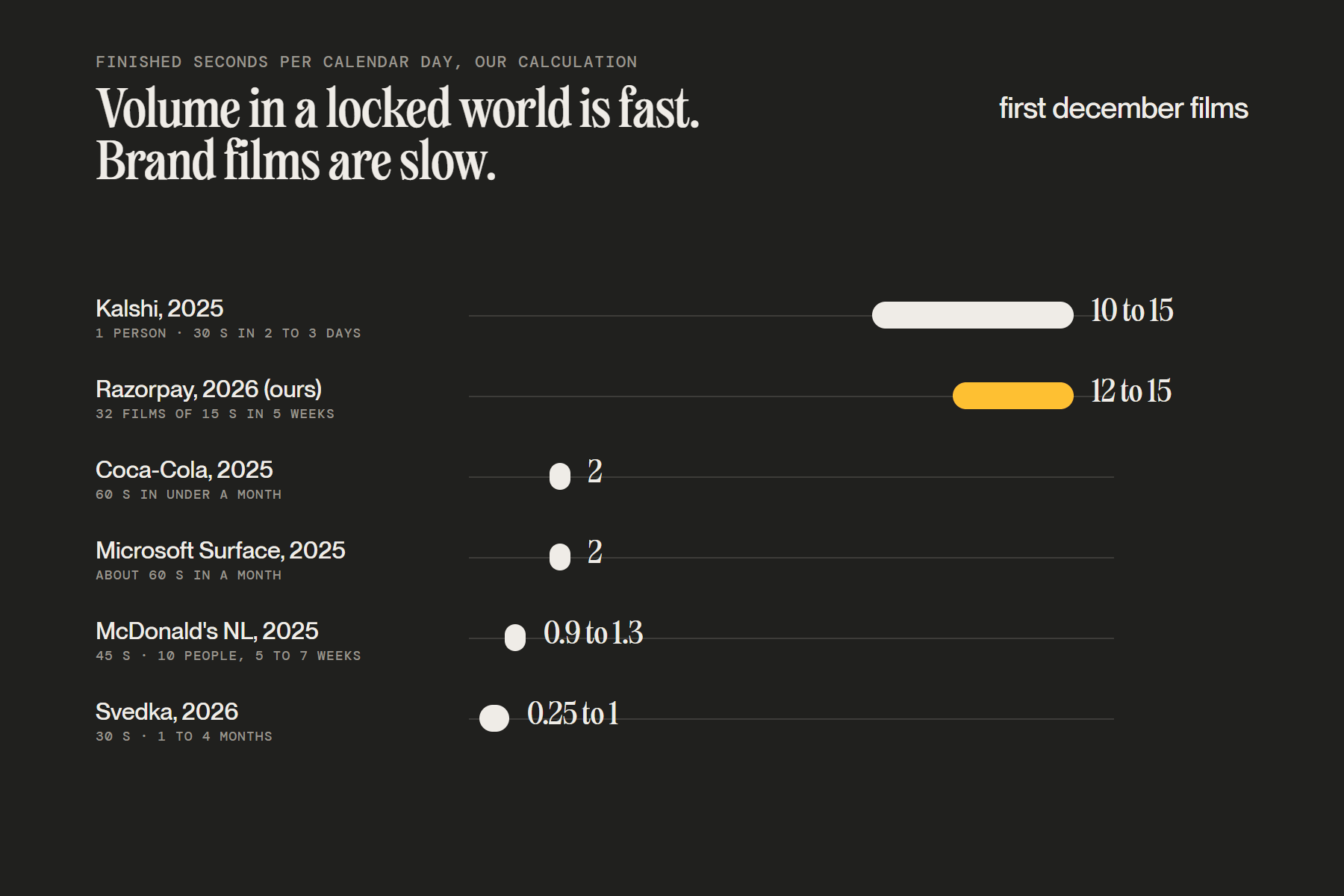
A single brand film in the published record took between two or three days and four months, with core teams of one to about twenty people. The spread is not about the model. It is about polish, brand codes and approvals.
| Production | Type | Team | Calendar time | Finished seconds per calendar day |
|---|---|---|---|---|
| Kalshi, NBA Finals, 2025 | Fully AI, 30 s | 1 person | 2 to 3 days | 10 to 15 |
| Razorpay, IPL 2026 founder films (ours) | Fully AI, 32 films of 15 s | Not published | 5 days of set-up and a test film, then about one film a day, 32 films in five weeks | About 12 to 15 |
| Coca-Cola, Holidays Are Coming, 2024 (Secret Level’s part) | Fully AI, 34 shots | 17 artists on three continents | Under 3 weeks | Not computable |
| Coca-Cola, Holidays Are Coming, 2025 | Fully AI, 60 s plus a 90 s cut | "20 people" (Zada); a core of five AI specialists | "less than a month" | About 2 |
| Microsoft, Surface, 2025 | Hybrid, about 60 s | Microsoft’s in-house Visual Design team; size not published | About a month | About 2 |
| McDonald’s Netherlands, 2025 | Fully AI, 45 s | 10 people | 5 weeks full-time (the studio’s first statement said seven) | About 0.9 to 1.3 |
| Svedka, Super Bowl LX, 2026 | Primarily AI, 30 s | "as many brains and hands" as a traditional ad | Under a month of production; about four months including the character rebuild | About 0.25 to 1 |
| Under Armour x Anthony Joshua, 2024 | Hybrid | Not published | 3 weeks, ideation to delivery, per the director | Not computable |
Team and time on published AI commercials. Seconds per day are our calculation from the published runtime and calendar time. Sources: The Verge and NPR (Kalshi); our AI ad films page (Razorpay); The Hollywood Reporter and Silverside AI (Coca-Cola); MediaPost (Microsoft); NBC News (McDonald’s); ComfyUI and TechCrunch (Svedka); TechCrunch (Under Armour).
Three things stand out.
Volume in a locked world is fast. The two quickest rows, Kalshi and our Razorpay series, ran at 10 to 15 finished seconds a day. Kalshi’s was one person making a deliberately chaotic spot; Razorpay’s was a series in one white world, where the look was set once in five days and then reused for every founder. Once the world is locked, each new film is mostly generation and edit.
Brand films are slow. Coca-Cola, Microsoft, McDonald’s and Svedka all ran at one or two seconds a day or less. Their films had to carry brand codes, characters and a polish standard that a joke spot does not.
AI can take longer than a shoot. Melanie Bridge, chief executive of The Sweetshop, which produced the McDonald’s Netherlands film, said "the hours that went into this job far exceeded a traditional shoot. Ten people, five weeks, full-time," as NBC News reported. The film was withdrawn within days after an online backlash. In India, a Moonshot film for Tata Consumer Products hit "errors weeks into production, abandoned versions mid-way and restarted", Storyboard18 reported in June 2026.
Not everyone agreed it was a lot of people: Emlyn Davies of the Welsh studio Bomper replied that "Ten people on a project like this is a tiny amount compared to shooting it traditionally live action," AFP reported. Both can be true: fewer people, more hours each. Kim Young-ki, chief executive of the Korean AI studio The Ape Squad, told The Korea Times: "I actually put in more of my own time when directing AI videos than when directing live-action." Erica Gorochow wrote that everyone assumes "AI is cheap and easy", and called her Google spot’s two-week deadline "a sprint through process unknowns".
The people are not interchangeable either. "There is definitely a misconception that everyone can be an AI artist. It isn’t the case," Toby Walsham, founder of the UK studio Made By Humans, told LBB. Accetturo, whose one-person spot set the speed record above, said on a podcast in October 2025 that "Most AI filmmakers that don’t have a film background are struggling because they don’t understand storytelling."
On our own pipeline, once the image lock is signed off, a 15 to 30 second film takes about a day of generation. A campaign takes longer to set up than to run.
What resets the clock?
Three things, in our experience: a character changed after image lock, a location changed after motion has started, and notes with no priority. Speed in an AI film is clarity, early lock and parallel generation, multiplied together; lose one and the others stop helping.
The fastest way to protect the schedule is to sort every note by the stage that owns it. We ask one question of each note: am I changing what the scene is, or how it moves?
| Note | Examples | Where it is fixed |
|---|---|---|
| Green | Motion, timing, camera | In video generation, from the approved image |
| Amber | Action, angle, expression | May need a new image or a new motion pass |
| Red | Character, costume, location | Back to the image stage; after image lock it resets the scene and is quoted as extra |
Notes sorted by the stage that owns them, as published on our AI ad films page.

Which tools are used at each stage?
Most studios use several models and switch between them shot by shot, because each one is better at different things and the leaders change every few months. The table shows what the main video models deliver per generation as of October 2026, from each maker’s own documentation.
| Model | Clip per generation | Resolution | Useful for |
|---|---|---|---|
| Google Veo 3.1 | 4, 6 or 8 seconds | 720p, 1080p or 4K, 24 fps | Reference images, first and last frame, native audio, Content Credentials |
| Kling 3.0 (Kuaishou) | 3 to 15 seconds | Up to 1080p | Multi-shot sequences, several characters, native audio in five languages |
| Runway Gen-4.5 | 2 to 10 seconds | 720p | Consistent characters from a single reference; Aleph edits existing video |
| Midjourney Video | 5 seconds, extendable to 21 | SD or HD | Image-to-video from Midjourney stills |
| Luma Ray3.2 | Up to 20 seconds when modifying video | 1080p, 16-bit EXR | Compositing-ready frames for VFX pipelines |
Video models by output. Sources: Google Cloud, updated 10 Oct 2026; Kling, Feb 2026; Runway; Midjourney; Luma.
Around the video models sit image models for the world build and image lock, node-based tools such as ComfyUI for studios that train their own character and world models (Silverside used it on Svedka), voice tools such as ElevenLabs, upscalers, and the same editing, grading and sound software as any commercial.
Two warnings for buyers. First, tools disappear. OpenAI discontinued the Sora app on 26 April 2026 and its API on 24 September 2026, per its help centre; the Toys"R"Us film was made on a model that no longer exists. A studio’s pipeline should outlive any one model. Second, licences differ by tier. Google extends its generative AI indemnity to generally available Veo models used through its enterprise API, per Google Cloud’s terms, not to consumer apps. Adobe’s indemnity for partner models in its enterprise Firefly product is "limited to generally available Google and OpenAI media generation models" and "does not cover trademark, publicity rights, or privacy rights claims", per Adobe. ElevenLabs says its free plan "does not include a commercial license". Ask which tier every shot in your film was made on.
What goes wrong, and how is it caught?
Generated footage fails in predictable places, and a professional pipeline checks for each of them on every shot. On Air India every shot passed a realism gate: walking, hands, faces, eyes, weight, background people, clothing, objects, perspective, texture, light and morphing. One wrong behaviour sent it back, however good it looked.
The failures the published record shows most often:
- Faces and characters that drift between shots. The reason the world build exists.
- Hands and fine movement. Microsoft shot its typing close-ups live rather than generate them.
- Product and text accuracy. Logos, labels and packaging are the brand’s, and models still bend them. Hybrid films shoot the product.
- Physics and weight. Wheels that slide, feet that skate, objects that float. In Coca-Cola’s 2024 film, "Wheels looked like they were sliding instead of rolling", the company’s own making-of film said a year later.
- Hallucinations in the background. Svedka’s film had "A dedicated final pass" that "cleaned remaining hallucinations", per ComfyUI’s case study.
- Too much polish. A frame that looks designed rather than observed reads as AI before anyone can say why. On Air India each new shot was tested against six words: rooted, Indian, observed, layered, imperfect, human.
Viewers find the failures a review missed, and they look at the hero object first. Among the 300 top comments under Coca-Cola’s 2025 behind-the-scenes film, read for this guide in October 2026, viewers pointed out trucks with mismatched wheels and a logo that "glitches right at the end of the advert". The most-liked criticism there was of the AI voices in the making-of, not the pictures. And publishing the effort did not earn credit: in a 152-comment Hacker News thread on the McDonald’s Netherlands film, commenters asked how the work could take ten people seven weeks, and one replied: "This isn’t really a field where you get points for effort."
Audiences notice the difference between polished and careless work. In a DoubleVerify study reported by Advanced Television in August 2026, 49% of UK consumers said they would feel negatively toward a brand whose AI ads look low-quality, uncanny or strange, against 29% when the AI advertising looks polished and professional. Kantar’s analysis of 356 AI-generated ads found the same spread of effectiveness as ads made by traditional means, with a warning that "Where generative AI feels obvious or if something doesn’t look quite right, that can create a sense of confusion", Research Live reported in December 2025.

What paperwork does an AI commercial need?
More than a live shoot, and it has to be planned at the brief, because it changes what you generate and how many masters you deliver. Brands feel it first in legal and purchasing. Asked in a February 2026 interview about the toughest challenge for businesses putting AI to work, Silverside’s Johnny Rohrbach answered: "the hardest part honestly at this point in general is procurement". The rules differ by market; these are the ones that touch production, as of October 2026.
| Market | What it asks of an AI commercial | Source |
|---|---|---|
| European Union | Since 2 August 2026, AI Act Article 50: deployers of realistic synthetic content must disclose it; for creative and fictional work the disclosure can be made "in an appropriate manner that does not hamper the display or enjoyment of the work". Machine-readable marking falls on the tool providers, with a grace period to 2 December 2026 for systems already on the market. Fines reach €15 million or 3% of worldwide turnover | European Commission FAQ; Cooley, Aug 2026 |
| United Kingdom | "There is no blanket legal requirement in the UK to disclose the use of AI in ads." The test is whether the ad misleads; AI depictions of real people must not imply an endorsement, and liability stays with the advertiser | ASA, 2026; Lewis Silkin, Jun 2026 |
| United States | Union performers: under the SAG-AFTRA 2025 Commercials Contracts, a digital replica needs clear and conspicuous consent, 48 hours’ notice and 1.5 times the session fee per commercial. New York: since 9 June 2026, a conspicuous disclosure when an ad uses a synthetic performer, with fines of $1,000 and then $5,000 per violation | DLA Piper, Apr 2025; Cooley, Jan 2026 |
| India | Since 20 February 2026, the IT Rules require prominent labels on realistic synthetic content on platforms. ASCI’s final guidelines (29 September 2026, in effect three months later) ban fabricated testimonials and the use of anyone’s likeness without consent, even with a label | Freshfields, Feb 2026; medianews4u, Sep 2026 |
| China | Since 1 September 2025, AI-generated video carries a visible label at the start and around playback, plus a label in the file’s metadata that no one may remove | Cyberspace Administration of China, Mar 2025 |
| Platforms | YouTube asks for disclosure of realistic AI content and may apply a label automatically to files carrying C2PA Content Credentials, a label creators cannot adjust | YouTube Help |
| Awards | Cannes Lions makes AI disclosure mandatory at entry; D&AD asks for a structured disclosure of any AI involvement, case films included | Cannes Lions; D&AD |
Rules that change how an AI commercial is made or delivered, October 2026. This is a production checklist, not legal advice.
Four habits cover most of it. Get written consent for every real face and voice, covering scope, duration, fee and where it runs, before the world build. Decide the label per market at the brief. Deliver a labelled and a clean master. Keep a generation log, because the US Copyright Office’s position is that AI output is protected "only where a human author has determined sufficient expressive elements" (January 2025), and the log is how you show which elements a human determined. The Indian rules in detail are in our guide to whether AI ads are legal in India.
How did AI commercials get here, and what comes next?
The pipeline above is about two years old. Before 2024, AI in ads meant personalisation and stunts; since then it has meant footage.
- 2021. Cadbury Celebrations’ Shah Rukh Khan "My Ad" campaign in India used machine learning to recreate Shah Rukh Khan’s face and voice naming local shops, for more than 2,500 business owners, and later won a Cannes Lions Grand Prix for Creative Effectiveness, according to Wavemaker.
- 2023. "Pepperoni Hug Spot", a spec ad made with GPT-4, Midjourney, Runway Gen-2, ElevenLabs and Soundraw, showed what text-to-video could not yet do, as shots reported.
- June 2024. Toys"R"Us premiered a brand film made almost entirely on OpenAI’s Sora at Cannes Lions.
- November 2024. Coca-Cola’s AI remake of Holidays Are Coming, made by three studios in Los Angeles, Kuala Lumpur and San Francisco.
- February 2025. Volvo’s first ad created solely by AI, made by the agency LION for Saudi Arabia, narrated in Arabic with an English version. LION’s approach turned "months into weeks", Communicate reported.
- June 2025. Kalshi’s NBA Finals spot, made on Veo 3 by one person in two to three days, aired in YouTube TV’s stream of Game 3 of the Finals.
- November and December 2025. Coca-Cola’s second AI holiday film, cut from more than 70,000 clips, scored the maximum 5.9 stars with System1’s test audiences; McDonald’s Netherlands withdrew its AI Christmas film after a backlash.
- 2026. Svedka ran what its makers billed as the first primarily AI-generated commercial in Super Bowl history in February; OpenAI closed Sora in April; the EU’s transparency rules applied from August; ASCI published India’s final AI labelling guidelines in September. This year we made Air India’s AI film and Razorpay’s 32 founder films.
The direction of travel is more AI footage, with more scrutiny. In the IAB’s July 2026 survey of US video ad buyers, nearly two in three used generative AI for digital video creative, a third of their ad assets would use it this year, and they forecast 43% by 2027 (IAB). A year earlier, buyers in the same survey had forecast 40% for 2026, so adoption is rising a little more slowly than the industry expected. The share of D&AD entries declaring AI more than doubled to 27.6% in 2026. Audiences are less keen: in Gallup’s May 2026 survey of 3,270 US adults, 62% said AI-created people or voices in ads are unacceptable even when disclosed (Gallup). Our forecast, and it is only ours: the films that work will look less like AI demos and more like films, with real people and products at the centre and AI doing what a camera cannot.

When should you not make your commercial with AI?
Skip it if the film has to prove something real: a product working, a result, a customer’s story, food as it really is. ASCI’s guidelines ban fabricated testimonials and misleading results even with a label. Shoot it.
Skip it if the face is famous and the consent is not signed. A celebrity or a founder can be shot, or generated under written consent; never the second without the first.
Skip it if you cannot sign off what each scene is early. AI is fast only after the image lock. If your approvals take three weeks per round, a shoot may be quicker.
Think twice if it is one 30-second film with no reuse. The set-up of the world costs the same for one film as for thirty. Our AI ad film cost guide shows where that leaves the budget.
And remember the record is thin. The benchmarks above come from the minority of makers who published numbers, most of them self-reported. They show the shape of the work, not a price list.
How should you brief an AI commercial?
Send a studio the brief that lets it plan the pipeline above. A brief that only asks for a price gets a price for a clip.
- The idea and the job of the film. What it must make people feel or do, and whether anything on screen has to be true.
- What must stay consistent. Product, packaging, logo, colours, any recurring character.
- Real people. Whose face or voice appears, and whether written consent exists or is needed.
- Deliverables. Number of films, lengths, ratios (and whether 9:16 is needed), languages, cutdowns.
- Markets and media. Where each version runs, which decides the label and the masters.
- Sign-off chain. Who approves the world build and the image lock, and how long a round takes on your side.
- References. Films, frames and worlds you like, and ones you do not.
- Timeline and budget band. The air date, and the range you can work in.
For the best Indian examples of what this produces, and the ones that went wrong, see our review of the best AI ads in India.
Get a producer’s read on your AI film
Every AI commercial on this page was decided before anyone generated a frame: what had to stay consistent, what had to be real, and who would sign off the stills.
If one scene in your script feels too specific, too risky or too hard to keep believable, bring it to us as a paid one-scene feasibility test before full production. You can paste your script into our script analyser for a free producer’s read, or send us the brief and a named producer will tell you which shots to generate, which to shoot and which to blend.
First December Films is an advertising film production company in Mumbai. Our work has won more than 150 international creative awards, including Cannes Lions, D&AD and One Show Gold Pencils.
Frequently asked questions
How are AI commercials made?
A professional AI commercial goes through seven steps that mirror a live shoot: brief, script breakdown, world build, image lock, video generation, edit, and finishing. Characters, products and locations are approved as stills before anything moves, each shot is generated several times as coverage, and an editor, colourist and sound team finish the film into a labelled and a clean master.
How long does it take to make an AI commercial?
It ranges from two or three days to several months. Kalshi’s 30-second NBA Finals spot took one person two to three days, while Coca-Cola’s 2025 holiday film took under a month and McDonald’s Netherlands’ took ten people five weeks. In our pipeline a 15 to 30 second film takes about a day of generation once the stills are locked.
How many people does it take to make an AI commercial?
Published teams run from one person to about twenty at the core. Kalshi’s spot was made by one AI director; Secret Level used 17 artists on its part of Coca-Cola’s 2024 film; McDonald’s Netherlands used ten specialists. Brand films still need a director, producer, AI artists, an editor, a colourist and a sound team.
Which AI tools are used to make commercials?
Studios use image models for the world build and image lock, then video models such as Google Veo 3.1, Kling 3.0 and Runway Gen-4.5, which each make clips of 2 to 15 seconds. Voice tools, upscalers and the usual edit, grade and sound software finish the film. Most studios switch models shot by shot.
What is image lock in AI film production?
Image lock is the point at which every frame of an AI film has been approved as a still image, before any of it is animated. It works like the camera rolling on a live shoot: after it, a change to a character, costume or location means regenerating every shot it appears in, so it is the key client sign-off.
Do AI commercials have to be labelled?
It depends on the market. India’s IT Rules require labels on realistic synthetic content on platforms, the EU AI Act requires disclosure of realistic synthetic content, New York requires it for synthetic performers, and the UK has no blanket rule. Plan the label at the brief and deliver a labelled and a clean master.
How much does an AI commercial cost?
Published figures run from under 2,000 US dollars of prompting for Kalshi’s one-person spot to brand films made by teams of ten to twenty over several weeks. The footage itself is cheap; the cost sits in people, choosing between generations, finishing and rights. Our AI ad film cost guide compares AI, hybrid and live action in detail.