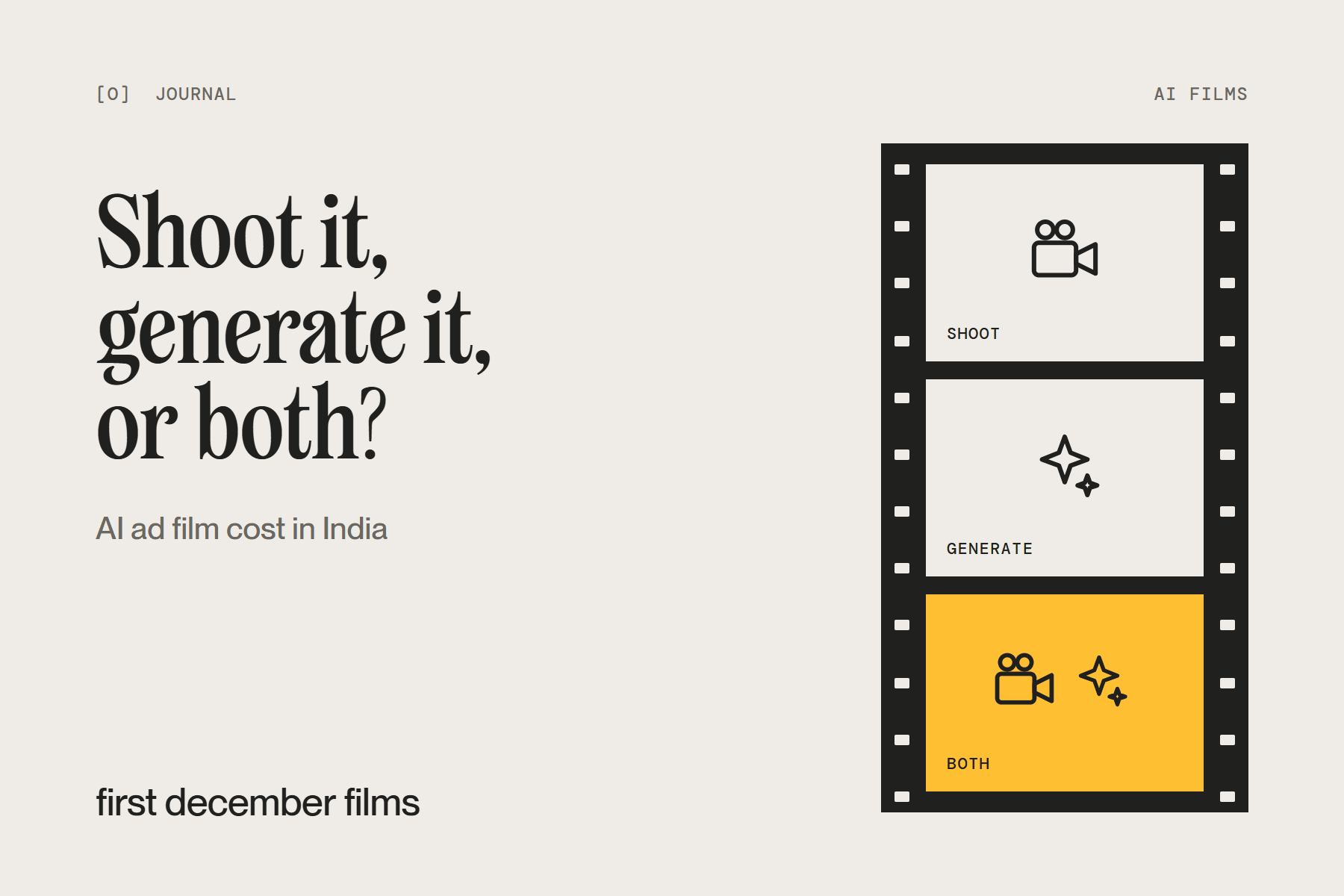
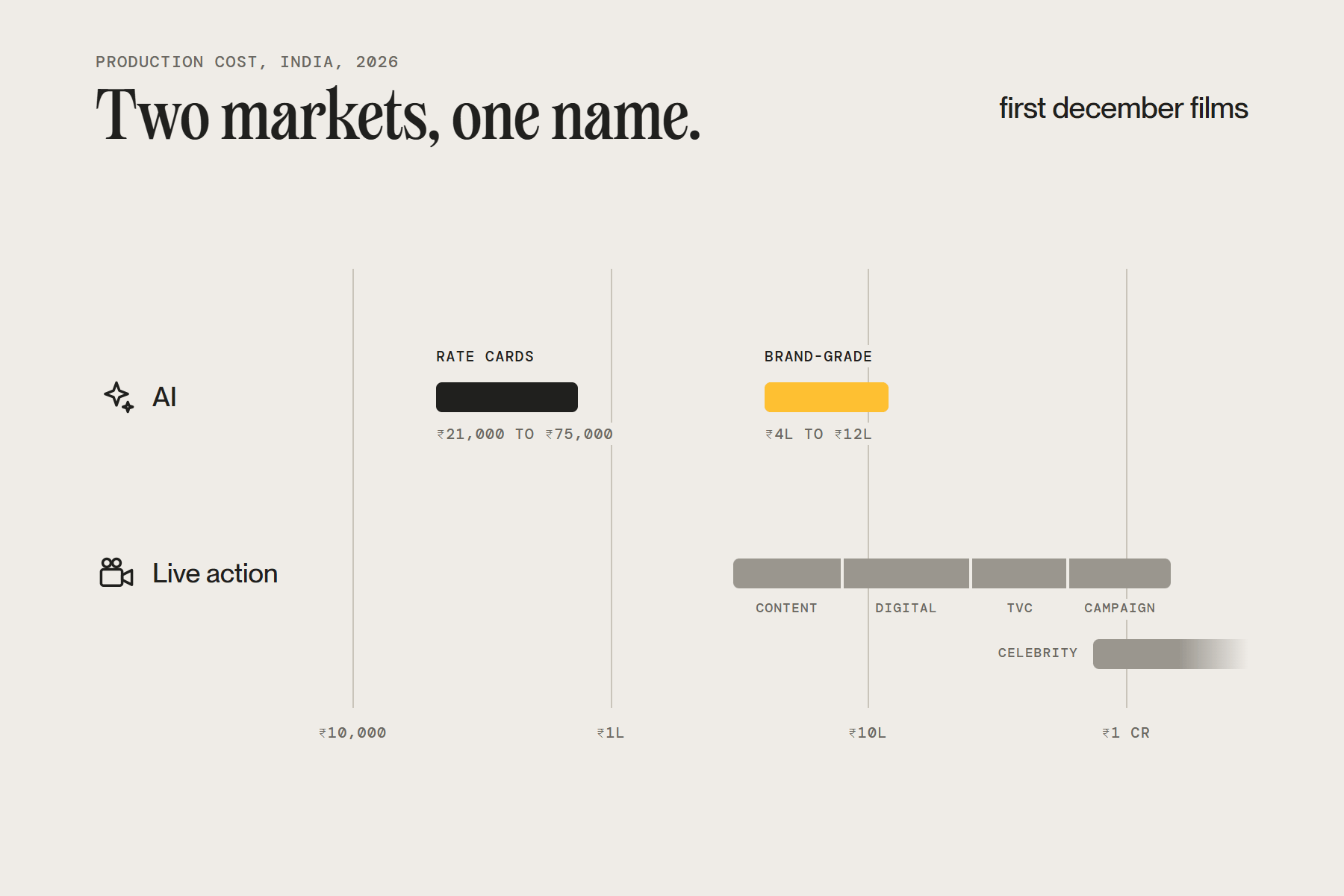
The short answer. In India in 2026, studio rate cards start a 30-second AI ad film at ₹21,000 to ₹75,000, while AI films made to a brand’s television standard are reported at roughly ₹4 to 12 lakh, against about ₹25 lakh for a broadcast live-action TVC in our own guide. Choose AI when nothing on screen has to be real, live action when the promise is a real person or product, and hybrid in between.
Most of what you will read on this question is written by studios that sell only one of the three. We make ad films for a living, mostly with cameras and increasingly with AI inside them. Our vivo X300 Pro launch film, directed by Atul Kattukaran, won a Bronze, shared with Old Monk Studio, in the AI-Integrated Live Action Film category at the Good Ads Matter Awards 2026. So this is the producer’s version: what each route costs, where the money actually goes, and how to decide one shot at a time.
Key takeaways
- Two different products are sold as "AI ad films" in India: studio-made digital films whose 30-second entry prices run from ₹21,000 to ₹75,000, and brand-grade films reported in the trade press at several lakh rupees.
- Published savings claims run from 30% to 95%. They disagree because each one is measured against something different: a shoot, a CG film, a fantasy epic.
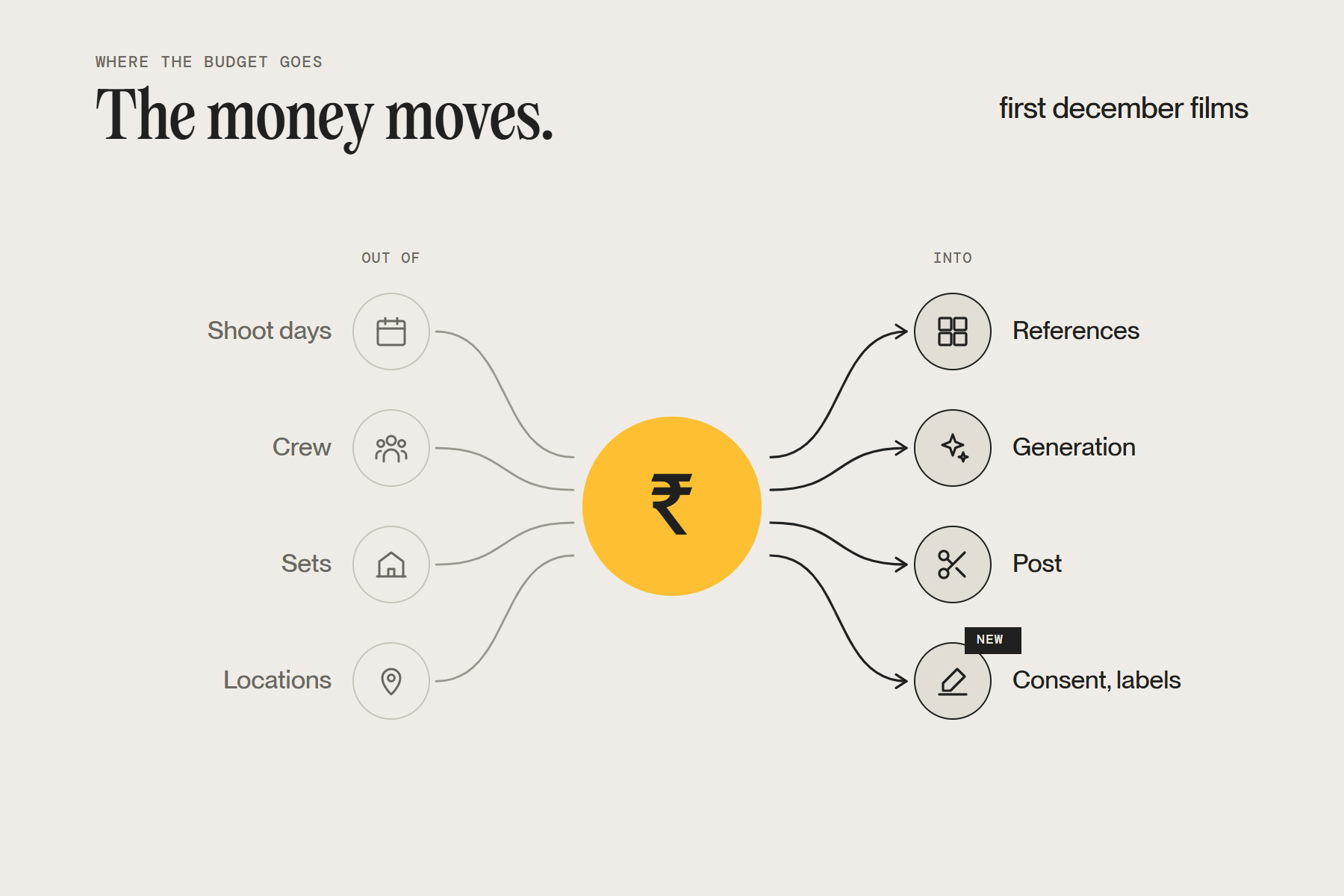
- AI does not delete the budget. It moves money out of shoot days and locations and into look development, generation, post and compliance.
- Generated footage for a 30-second film costs about ₹11,500 to ₹34,600 at Google’s published Veo price, so in a brand-grade film the money goes to people, not the model.
- Shoot the people, the product and the proof. Generate the world, the scale and the versions.
- Since 20 February 2026, realistic AI footage carries a label on Indian platforms, and ASCI’s final AI guidelines, released on 29 September 2026, ban fake testimonials and exaggerated results outright.
What does an AI ad film cost in India in 2026?
An AI ad film in India costs anywhere from under a lakh to the low tens of lakhs, because two different markets use the same three words.
The first market is the published price list. On 5 October 2026 we read the rupee prices published by 20 Indian AI video studios and vendors, 112 price points in all. Six of them publish a rate card for a 30-second film, and their entry prices run from ₹21,000 to ₹75,000, with a median of about ₹45,000. Their top packages reach ₹1.25 to 1.5 lakh, and some add GST on top. These are prices for digital and social films with a fixed number of revisions, made quickly, often by small teams.
The second market is what brands report paying for AI films made to the standard of their television work. Nobody publishes those as a price list. They surface in trade interviews, and they sit higher. Carol Goyal of Aesthetic Intelligence Lab told Storyboard18 in July 2025 that AI-led campaigns which would cost ₹50 to 60 lakh conventionally can come in at ₹8 to 12 lakh, depending on scale and scope. Sanjeev Jasani, formerly COO of Cheil India, told exchange4media in August 2025 that a TVC which cost ₹20 to 25 lakh can now be made at similar quality for about ₹4 to 5 lakh. AI director Akshay Srivastava’s rule of thumb, reported by BestMediaInfo in June 2026, is to budget the script as if it were a real shoot and then cut that to a third.
Films at that standard are already on Indian television. Tata Gluco+'s 2025 film, conceived by VML and made entirely with AI by Rediffusion’s RAIDS studio, aired during the IPL, and TVS billed its Jupiter ad as the first fully AI-generated TV ad for a scooter brand in India when it debuted the same season.
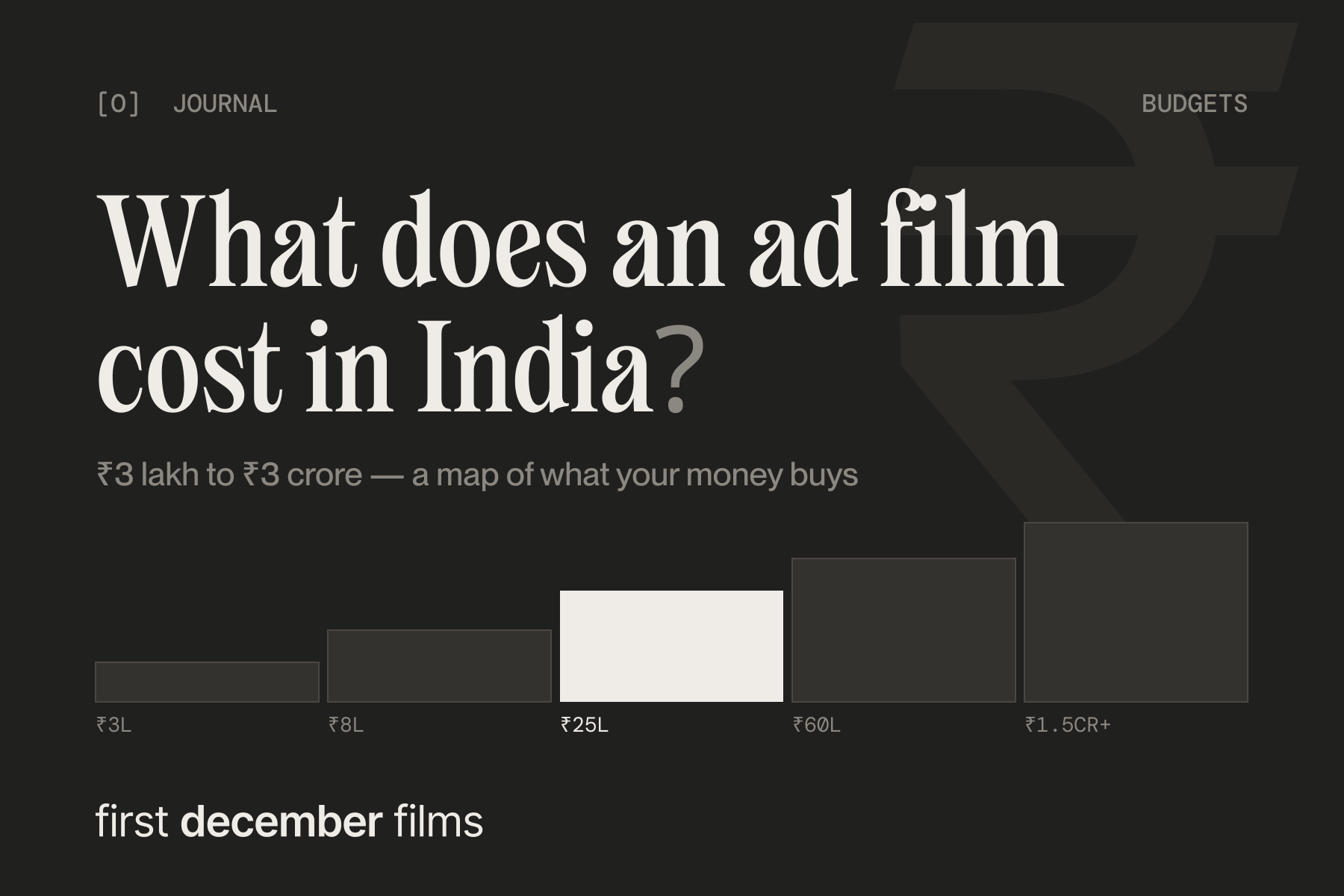
For the live-action side, here are the tiers from our guide to ad film production cost in India, next to the AI numbers above.
| Route | What it costs in India, 2026 | What you usually get | Source |
|---|---|---|---|
| AI, studio rate cards | ₹21,000 to ₹75,000 to start for 30 seconds (median about ₹45,000); top packages ₹1.25 to 1.5 lakh | Digital and social films, fixed revisions, small team | Six published rate cards, read 5 Oct 2026 |
| AI, brand-grade | About ₹4 to 5 lakh for what would be a ₹20 to 25 lakh TVC; ₹8 to 12 lakh for what would be a ₹50 to 60 lakh campaign | Consistent characters and product, full edit, grade and sound, TV delivery | exchange4media, Aug 2025; Storyboard18, Jul 2025 |
| Hybrid | Set by the shoot days you keep, plus compositing in post | Real people and product on set, generated worlds and extensions | Our view; Studio Blo sells a single AI shot inside a live film |
| Live action, digital film | ₹8 to 25 lakh | A proper director, DOP and crew, one or two shoot days | Our cost guide |
| Live action, national TVC | ₹25 to 60 lakh | Broadcast standard, two to four shoot days, a crew of forty to eighty | Our cost guide |
| Live action, celebrity | Production from about ₹75 lakh, before the fee | Everything above, built around one person’s calendar | Our cost guide |
All production cost only. Media is a separate, usually larger, budget. GST at 18% is extra on most quotes.
Why do "AI is cheaper" claims range from 30% to 95%?
Every savings figure in circulation is true for the film it was measured on, and each was measured against something different.
| Claim | Who said it | Compared with |
|---|---|---|
| An AI film may cost 5 or 10% of a shoot, but will look only 5 or 10% as good | Devaiah Bopanna, Moonshot, in BestMediaInfo, Jun 2026 | A live shoot, with a warning attached |
| 15 to 20% of a similar CG-heavy film | Kaushik Vedula, Emami, on DermiCool Warriors, in Storyboard18, Jul 2025 | A CG film, not a shoot |
| One-fifth the cost and a quarter of the time | Rahul Regulapati, Galleri5, to Reuters, Apr 2026 | Mythology and fantasy filmmaking |
| About ₹4 to 5 lakh against ₹20 to 25 lakh | Sanjeev Jasani, ex-Cheil India, in exchange4media, Aug 2025 | A TVC "at similar quality" |
| A third of the shoot budget | Akshay Srivastava, AI director, in BestMediaInfo, Jun 2026 | The same script budgeted as a shoot |
| A 30 to 40% saving, and not plug-and-play | Aniket Sakpal, Agency09, in Storyboard18, Jul 2025 | Live production |
| Not always cheaper, especially with celebrities or real locations | Harikrishnan Pillai, TheSmallBigIdea, in Storyboard18, Jul 2025 | Any production with talent |
Put the rupee claims on one scale and four of the seven land in the same place: an AI film at roughly 13 to 25% of what it replaced. Goyal’s ₹8 to 12 lakh against ₹50 to 60 lakh and Jasani’s ₹4 to 5 lakh against ₹20 to 25 lakh both work out to that range, and so do Emami and Galleri5. The two ends sit far apart: 5 to 10% of a shoot at one end, 60 to 70% of live production at the other.
The extremes tell you more than the middle. The biggest savings compare AI against the most expensive way of making the same pictures: a CG world, a battle, a god. The smallest come from people who still pay for the edit, the grade, the sound and the voice. BestMediaInfo’s own reporter concluded that real savings are less dramatic than the 80 to 90% figures usually quoted.
The vendor pages add a second distortion. Twelve of the 20 studios we read make a percentage claim, from roughly half to 95%, with 60 to 80% the most repeated. Where they say what they compare against, most price a basic TVC at ₹2 lakh to ₹5 lakh, a fifth or less of where our national TVC tier starts. DigiStreet, one of those vendors, warns on its own cost page that 90% savings claims usually assume the creative labour costs nothing.
The useful reading is simpler. AI saves the most where the camera was the expensive part, and the least where people were. If your budget is mostly shoot days, sets, travel and locations, AI can cut it hard. If it is mostly talent, edit and finish, it will not.

Where does the money go in an AI ad film?
AI does not delete an ad film budget. It moves money between the four buckets every film already has, and it adds a few lines a live shoot never needed.
Our cost guide sorts every rupee of a live-action film into pre-production, production, post-production and talent. Here is what each route does to them.
| Bucket | Live action | Hybrid | Fully AI |
|---|---|---|---|
| Pre-production | 10 to 15% of the budget: treatment, casting, recce, permissions | The same, plus planning which plates to shoot for the generated shots | Grows: reference boards for every character, costume, location and product, approved before anything is generated |
| Production | The largest bucket: shoot days, crew, camera, lights, sets, locations | Shoot days stay for the people and the product; some sets and locations move to generation | Shoot days disappear; generation replaces them: credits, GPU time and AI artists working in layers |
| Post-production | Edit, grade, sound, music, VFX, versions | Grows: compositing generated shots into real footage and matching the light | Stays largely traditional: edit, clean-up, grade, sound, music, upscaling for delivery |
| Talent | Actors, usage terms, celebrity entourage | Unchanged for everyone on camera | Shrinks for invented people; returns as voice actors, licensed music and consent fees for any real likeness |
| New lines | None | Labelled and clean masters; consent records | Labelled and clean masters; consent records; a log of the human decisions behind the generations |
The trade interviews back the table. Studio Blo’s Dipankar Mukherjee told Social Samosa in June 2026 that post-production stays largely traditional in time and cost, and that VFX bills fall but do not disappear. Carol Goyal told Storyboard18 that the savings often move into prompt engineering, voice licensing, GPU compute and human quality checks. Srivastava puts generation credits alone at ₹40,000 to ₹1,00,000 per finished minute, with an editor at ₹25,000 to ₹30,000 a project and a colourist and sound team on top.
What does the footage itself cost?
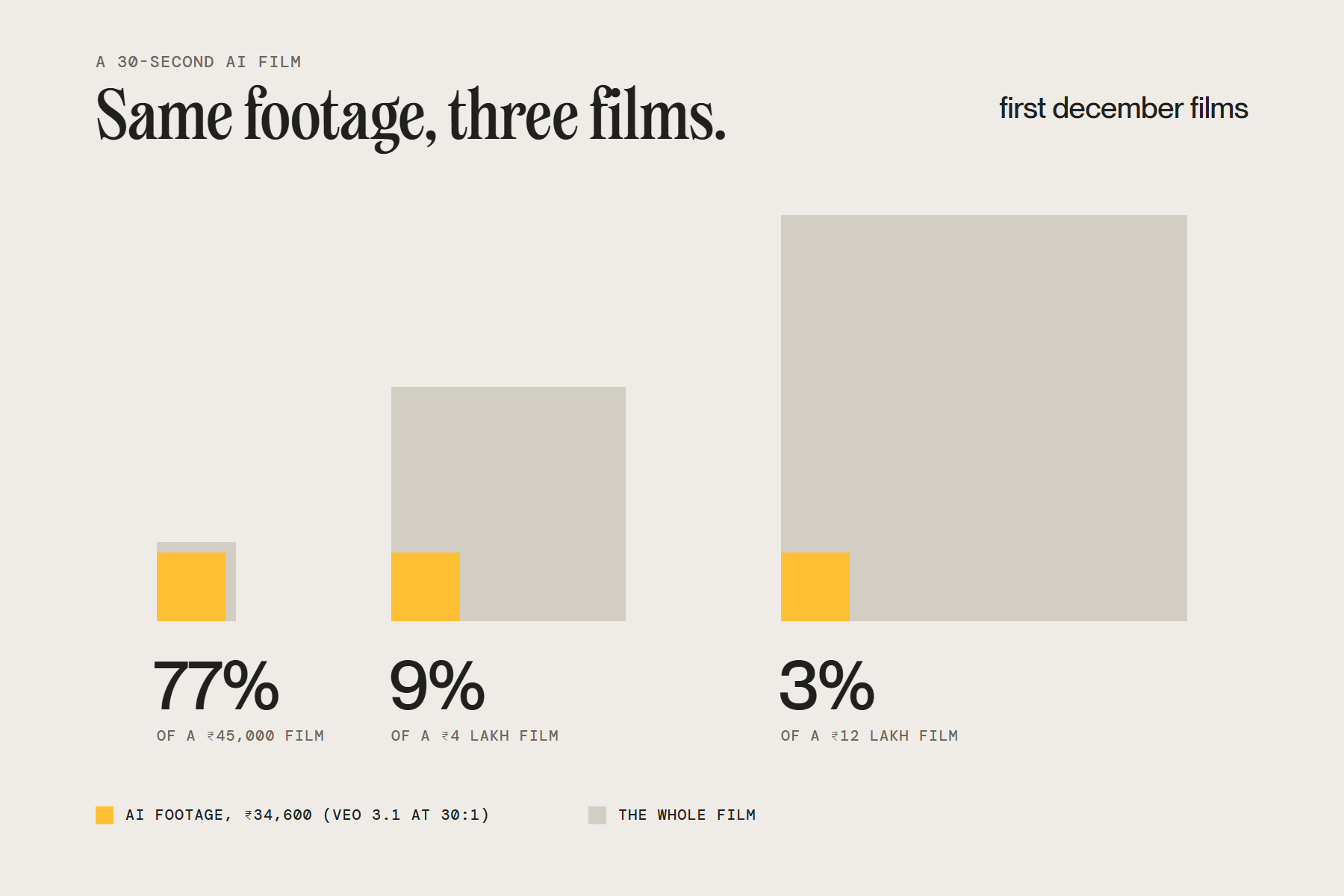
Google prices its Veo 3.1 video model at $0.40 a second for 1080p footage with sound, and its cloud catalogue lists that at about ₹38 a second, as of October 2026. AI films are generated the way live films are shot, with many takes for every one used; AJIO’s 2025 AI campaign made more than 200 clips for a 22-scene film. At ten seconds generated for every second kept, a 30-second film needs 300 seconds of footage, about ₹11,500 at Google’s price. At thirty to one it needs 900 seconds, about ₹34,600. Kling 3.0’s API comes to roughly ₹4,800 and ₹14,500 for the same two ratios.
In a brand-grade film of ₹4 to 12 lakh, that footage is the cheapest line on the budget: even at thirty to one it is about 9% of a ₹4 lakh film and 3% of a ₹12 lakh one. The money goes to the people: the director, the AI artists, the editor, the colourist, the sound designer, and the days it takes to keep one face the same face for thirty seconds.
In a rate-card film at about ₹45,000, the same footage would take about 77% of the price. That suggests what the cheapest AI films economise on: fewer attempts per shot and cheaper model tiers, which is to say less choosing.
Why thirty AI films cost less each than one
An AI film has set-up costs that do not shrink with runtime: the approved look, the character and product references, and the days a team spends learning what this brand’s world should look like. On one 30-second film that set-up is heavy. Across a campaign it is spread thin.
The Indian examples that report the biggest gains are all volume stories. Mondelez India’s Nitin Saini told Storyboard18 that Cadbury Silk produced more than 500,000 unique videos, a scale traditional production cannot match. Carol Goyal said the Tata Gluco+ campaign cut turnaround by over 70% and delivered regional variants within a week. And ET BrandEquity reported in June 2026 that Tata Power had released more than 100 fully AI-generated films in a year, across ads, consumer education and internal communications.
So ask a different question before you ask about price: how many films is this? If the answer is one, the savings are real but modest. If it is twenty versions in six languages, they are large.
AI, live action or hybrid: how do you decide?
Decide shot by shot, not film by film. Run every shot in the script through five questions, in this order.
- Does a real face or performance carry the shot? Shoot it. Keeping one face consistent across angles is exactly what AI studios price as complexity (Studio Blo prices by consistency, specificity and control), and a viewer who knows the face notices any drift first. If the face belongs to a real person, their written consent and fee come before anything else.
- Does the product have to be exactly right? Shoot it, or composite a real packshot. ASCI’s final AI guidelines prohibit exaggerated results outright, and a generated product is always one prompt away from looking better than the real one.
- Is the shot impossible, unsafe or ruinously expensive to shoot? Generate it, or extend a real plate. A world, a crowd, a period street, a storm, a mythological army.
- Will the shot exist in many versions? Build it so AI can make the versions, and pay a person who knows each market to check every one. When Sprite made AI city versions of its 2026 summer film, one widely discussed observation, reported by Storyboard18, was that the Kolkata frame showed Sydney’s Harbour Bridge instead of the Howrah Bridge.
- Does the film’s promise depend on "this really happened"? Shoot it. Realistic AI footage of people or events now carries a label on Indian platforms, a label that says AI sits badly on a film whose whole claim is that something real happened, and in testing, disclosure has cut clicks by almost a third.
When every shot lands on "generate", make the film fully AI. When every shot lands on "shoot", make it live action and use AI where Ganesh Pareek put it in his BRIEF26 note for MediaBrief in March: for compression, meaning logistics, iterations and prep, and never as a substitute for taste or judgment. Most scripts land in between. That is hybrid.

| AI | Hybrid | Live action | |
|---|---|---|---|
| Cost in India, 2026 | From ₹21,000 to ₹75,000 on studio rate cards; about ₹4 to 12 lakh reported for brand-grade films | Set by the shoot days you keep | ₹3 lakh to ₹1.5 crore and above, by our tiers |
| Time | Four days for AJIO’s 2025 campaign; 30 days for Emami’s; months for a team building its first workflow | The shoot schedule, plus more post | Six to ten weeks from approved script to master |
| What you control | The world, the scale, the style | People and product on set; the world in post | Everything in front of the camera, nothing after the shoot without a reshoot |
| Best for | Fantasy, scale, impossible physics, many versions | Real people in impossible places; real products in made worlds | Performance, faces, food, celebrities, proof |
| Watch out for | Sameness, a mandatory label, faces that drift | Matching light between two pipelines | The cost of a reshoot |
One script, three ways
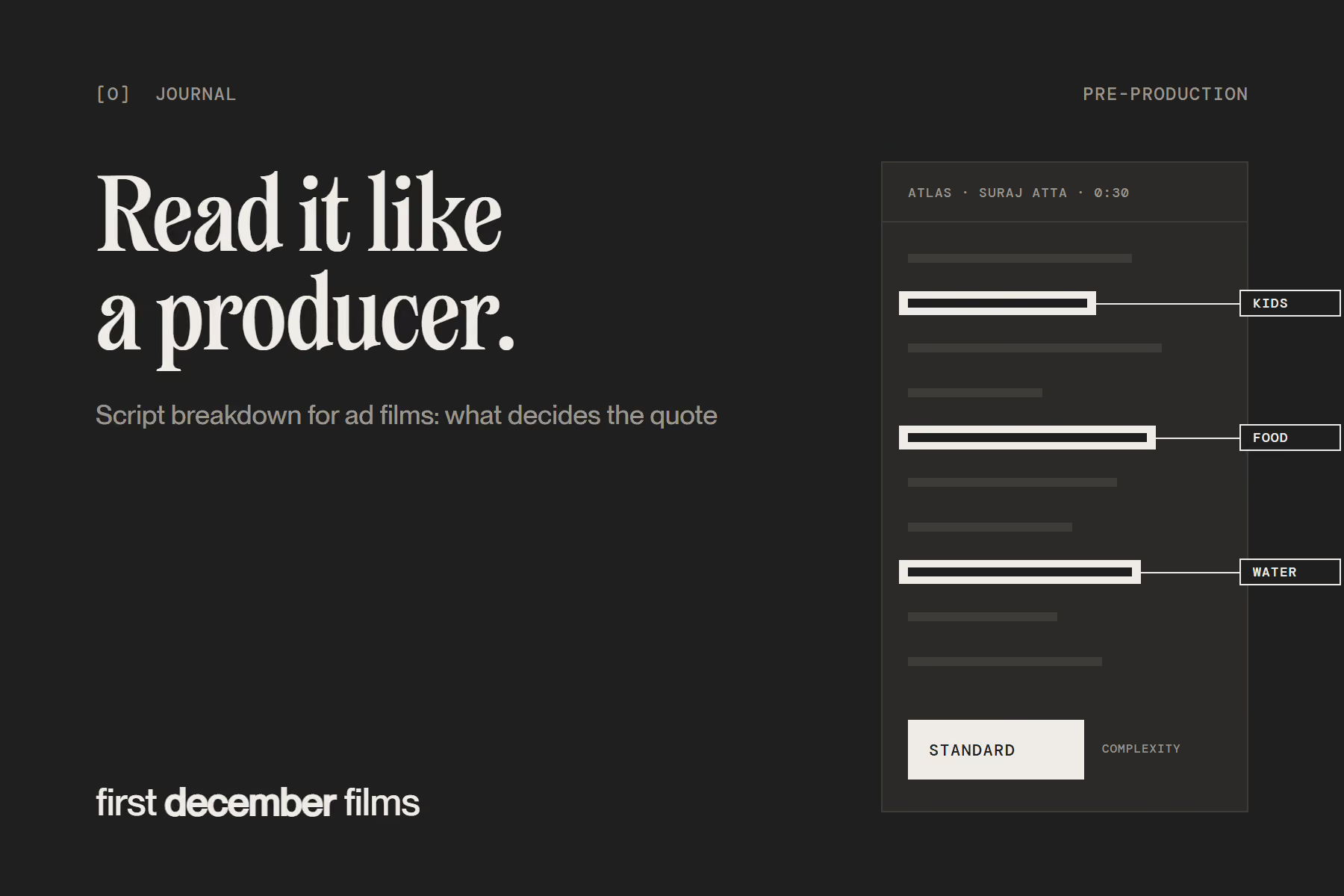
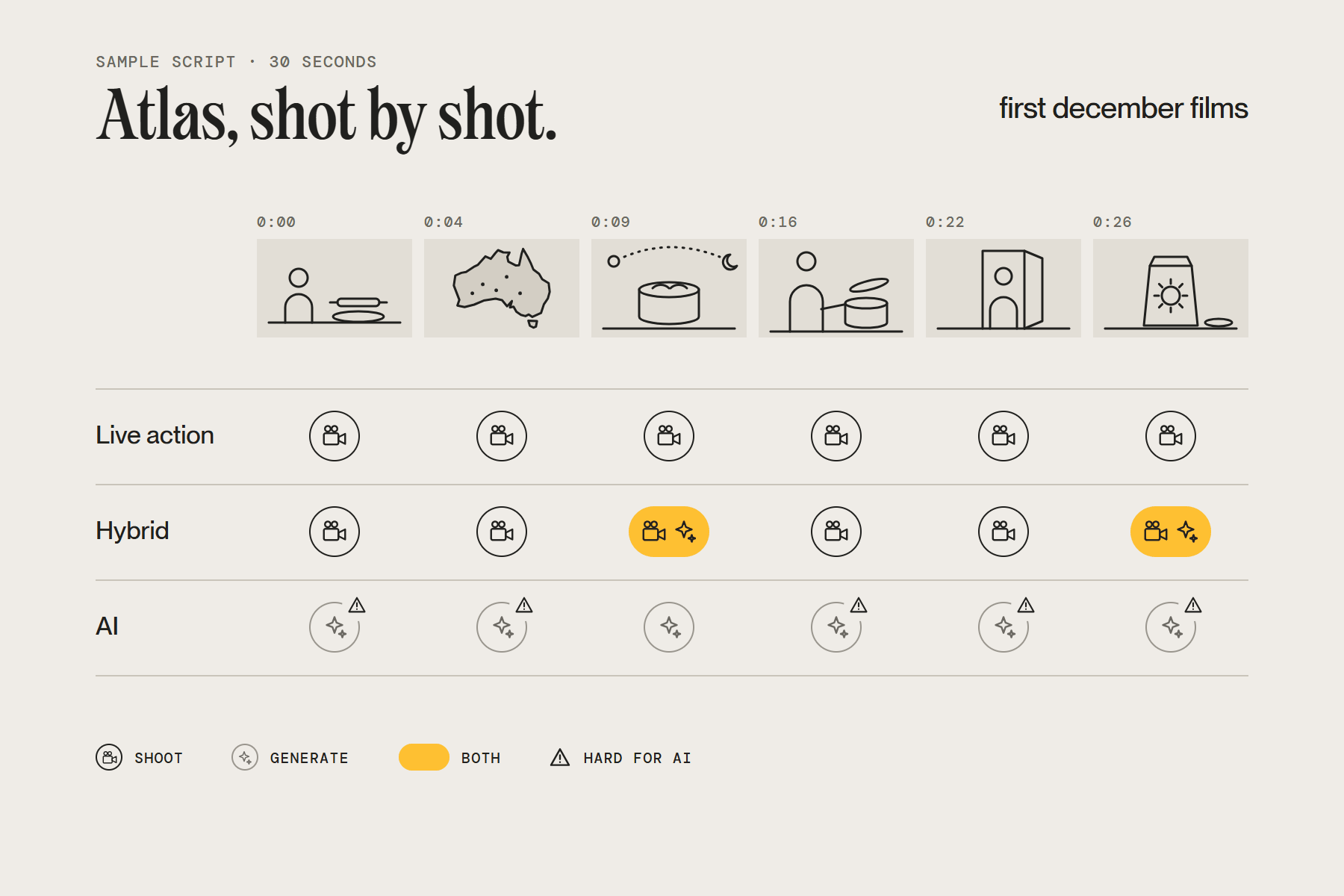
Here is the decision made on a real page. In our guide to writing an ad film script we wrote Atlas, a 30-second sample film for a fictional atta brand, Suraj Atta. Meera, eight, rolls a roti that comes out shaped like Australia. Over the following weeks her father, Dev, keeps every country she makes in a steel dabba. At seventeen she finds the dabba. He is caught in the doorway. Pack shot.
In our guide to the ad film script breakdown we read it as a producer would: one kitchen, two day parts, three principals, a child artiste on a five-hour day, a food styling job for six country-shaped rotis, and a complexity band of standard, the band where most national TVCs in India sit.
As live action, Atlas is exactly what it was written to be. Made as a broadcast national TVC, a standard-band script sits in the ₹25 to 60 lakh tier of our cost guide.
As hybrid, the honest answer is that most of Atlas should still be shot. The film is two faces and a dabba. AI earns its place in four spots: the animatic that lets the client see the film before the pre-production meeting, the passing weeks outside the kitchen window, the end-frame environment around a real packshot, and the language versions. Two things should stay real. The second Meera should be a second actor: ageing a real eight-year-old’s face to seventeen with AI alters a real child’s likeness, which needs her guardian’s written consent and turns that footage into synthetically generated information that platforms must label. And the rotis are the product’s result on screen. ASCI’s final guidelines prohibit exaggerated results, so the rotis should be real food from a real food stylist, as the breakdown already planned.
Hybrid does not halve this film’s budget. It moves a little money from the shoot day into post and buys the client a clearer picture before anyone books a crew.
As fully AI, Atlas is possible and much cheaper on the production side. It is also a different film. A father and daughter across nine years whose faces have to hold, rotis that have to look like food, and a label on a film whose entire point is that a real father kept real rotis. Unless the film stops pretending. An animated Atlas, plainly drawn, is a different film and could be a good one, and it sits outside the IT Rules’ labelling duty, which covers AI footage that could pass for real people or events.
Which rules now sit inside an AI ad budget in India?
Four sets of rules now apply to any AI or hybrid ad film made in India: platform labels under the IT Rules, ASCI’s new guidelines on AI in advertising, the courts’ orders on faces and voices, and the Copyright Office’s position on authorship. Each one is a line on the budget.
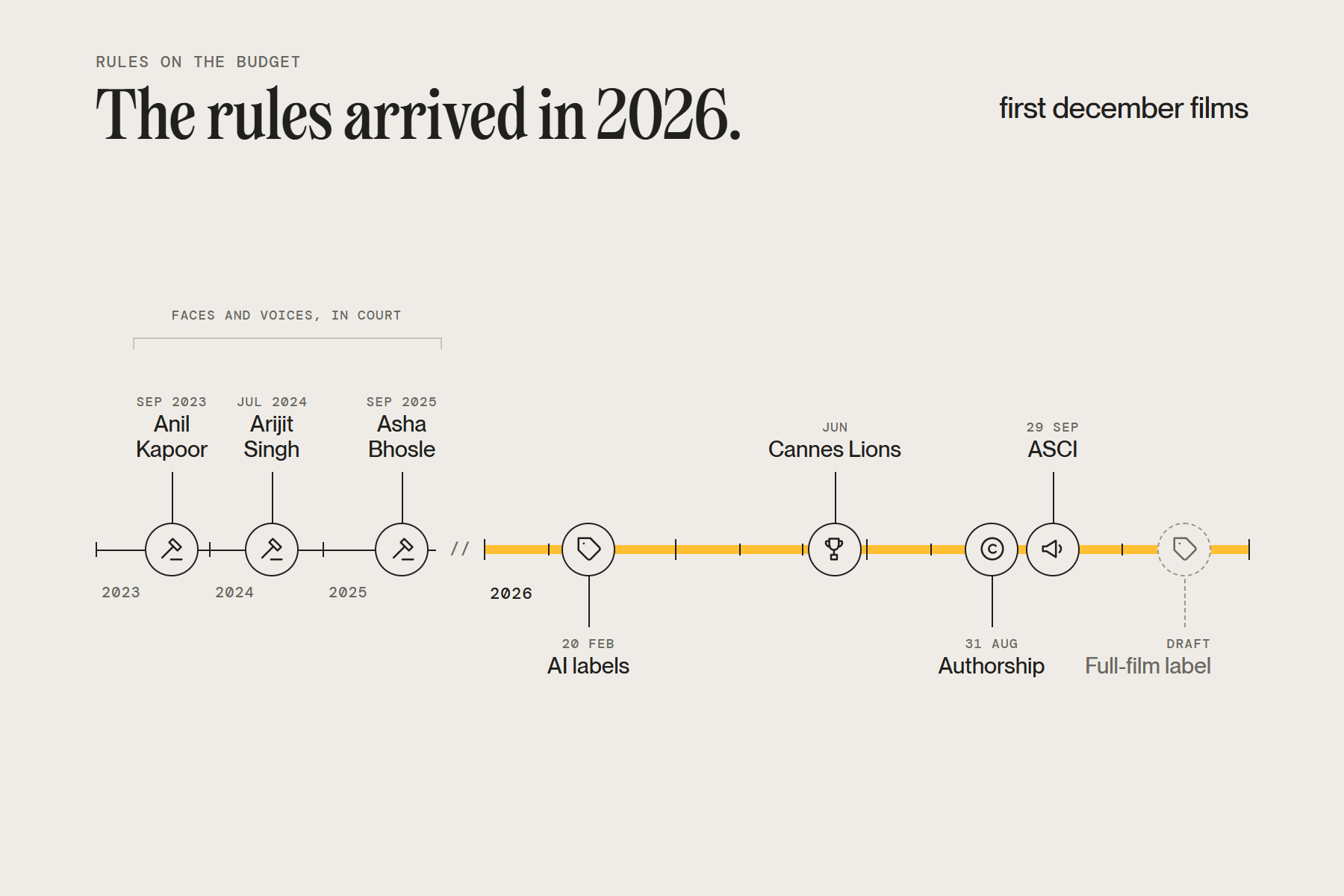
- Platform labels. The IT Amendment Rules, 2026, in force since 20 February 2026, cover "synthetically generated information": AI-made or AI-altered audio and video that looks real and could pass for a real person or event. Platforms must label it prominently and embed metadata, and the largest ones, with 50 lakh or more Indian users, must ask the uploader to declare it. The brand uploading the film is that uploader. A draft amendment that would keep the label on screen for the whole film closed for comments on 7 May 2026 and has not been notified.
- ASCI’s final guidelines. The Advertising Standards Council of India released its guidelines on labelling synthetically generated content in advertising on 29 September 2026; they take effect three months after publication. Banned even with a label: fabricated endorsements or testimonials, exaggerated results, non-existent locations shown as real, and anyone’s likeness without consent. Label required: synthetic influencers, a real person’s likeness or voice in personalised messages even with consent, fabricated events or settings that may change how consumers understand the product, and products that do not exist yet. No label needed: obvious fantasy, decorative backgrounds, routine edits. ASCI suggests wording such as "Video created using AI", says a label never cures a misleading ad, and reaches television through the Cable Television Networks Rules, which bar ads that break its code.
- Faces and voices. Indian courts keep stopping unauthorised AI use of a person’s identity: the Delhi High Court for Anil Kapoor in September 2023, and the Bombay High Court for Arijit Singh in July 2024 and for Asha Bhosle in September 2025, both over AI voice cloning. Budget for written, scoped consent and a fee for every real face or voice.
- Authorship. On 31 August 2026 India’s Registrar of Copyrights refused to register an AI system as an author, holding that the law recognises the human behind a work, not the tool. Keep a record of the human decisions, and settle who owns the finished film and the generated assets in the contract.
If the film is headed for awards, add one more. Cannes Lions requires every entry to say whether and how AI was used, added an AI craft subcategory to Film Craft for 2026, and can ban entrants who break its integrity rules for up to three years. Document the AI work from the first day, not the week of entry.
In budget terms, that means four lines on every AI or hybrid quote: a labelled master and a clean master, a consent and licence file for every real person and every tool, a record of the human decisions behind the generated material, and legal review time before air.
What are audiences and the industry telling brands?
The reaction to AI ads in India is split along the same line as the shot test: people forgive AI when it builds a world, and punish it when it replaces someone they expected to be real.
Cadbury Dairy Milk Silk shows how fast the mood turned. After embracing AI for its 2024 Valentine’s campaign, it released "AI Knows Nothing" in January 2026, a film by Ogilvy India and Good Morning Films that sets auto-generated declarations of love against the real thing. Its writer, Ogilvy’s Akshay Seth, told afaqs the point was that love should not be automated, not that technology is bad.
Critics have moved on to sameness. Prathap Suthan of Bang In The Middle told afaqs in June 2026 that once anyone can generate spectacle, production value stops signalling that a brand cares. Vibhor Yadav of tghtr, in the same piece, said efficiency is not effectiveness.
Audiences say the same thing in the comments. Hyundai India’s 30-year anniversary film, which its own description says was brought to life through AI, drew mostly owners pointing at their first car. The most-liked comment when we read them on 5 October 2026 said that making the whole ad through AI ruined the feel to connect.
The testing data is kinder, until the word AI appears. Kantar data cited by the Financial Express in September 2026 found GenAI-made animatics at par with traditional ones on several measures, including emotional response, in pre-testing. Researchers at NYU Stern and Emory found that ads made entirely with generative AI drew up to 19% more clicks than ads by human experts, and that telling people an ad was AI-made cut its click-through rate by 31.5%. Globally, a Harris Poll survey released at Cannes Lions in June 2026 found 73% of consumers would trust an ad less if they suspected AI had made it.
The industry now judges the blend as a craft of its own: Good Ads Matter, which folded AI into a visual effects category in 2025, gave it a category of its own in 2026, with a separate award for AI-integrated live action.
What comes next is contested. Mukherjee’s own thesis is that 90% of the world’s ad films will be made by AI rather than shot on camera by 2027. EY, cited by Reuters, projects AI could cut costs in Indian media and entertainment by 15% over the medium term. Both are forecasts. Ours is narrower. Ganesh said it to Social Samosa in April: "A camera can only do what a camera can do. But with AI, I can do things a camera never could." The brands that do well with AI will use it for exactly that, and keep the camera for everything the audience needs to be true.
When does this advice not apply?
Skip this if you are making performance creatives to test at volume. Variant ads for social testing are a different product, priced per creative or on retainer, and a production house is the wrong supplier for them.
Skip it if the film is built around a celebrity. Their fee, their calendar and their consent set the cost, and AI rarely makes that cheaper.
Skip it if your category makes claims about health, money or results. ASCI’s final guidelines prohibit fabricated testimonials and exaggerated results even with a label, and generated proof is the fastest route to both. Shoot the proof.
And skip it if you need the film on air this week but have not decided what it should be. AI is fast once the creative decisions are made. It is not faster at making them.
How do you brief an AI or hybrid film so the quotes compare?
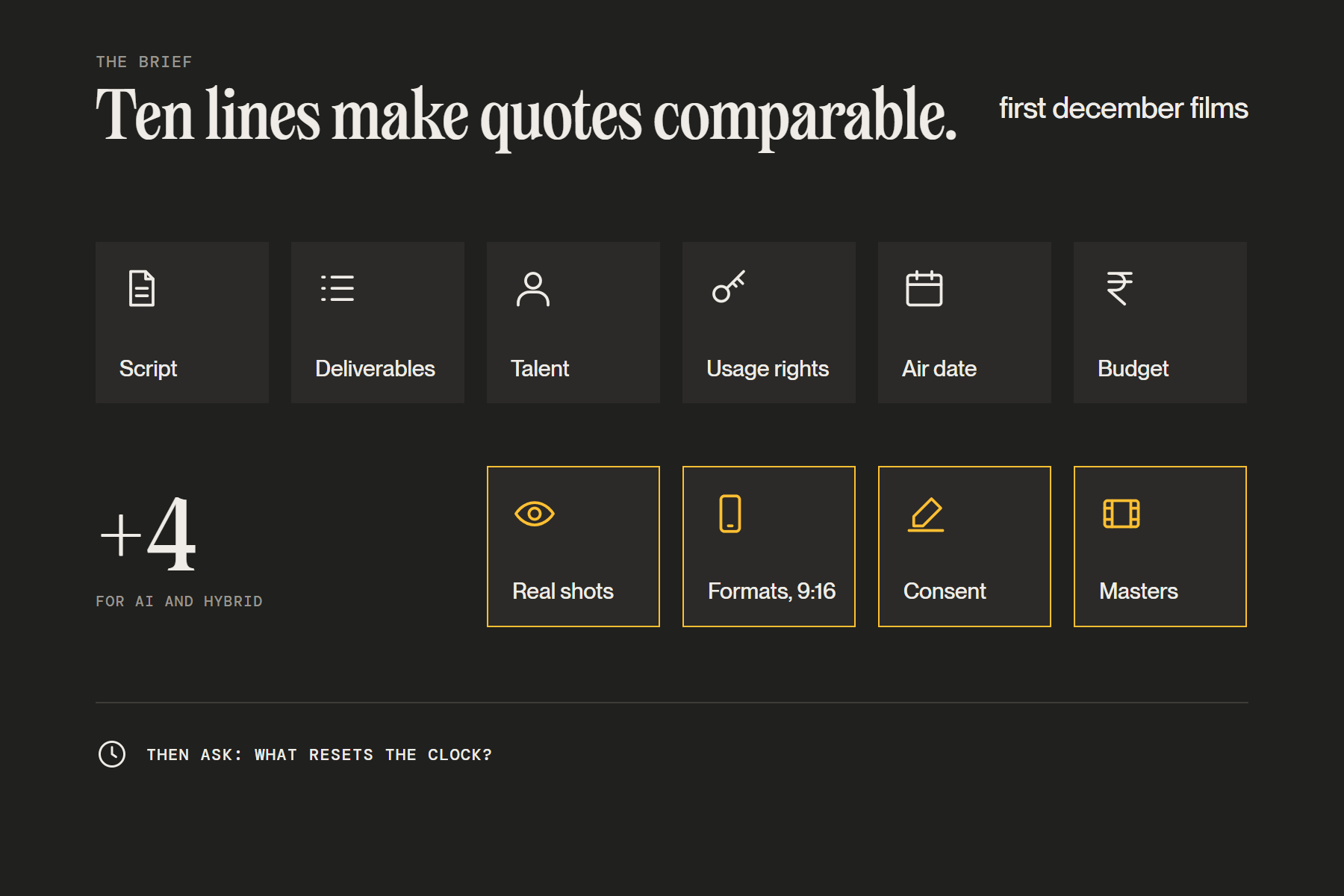
Our cost guide lists six things to send every production house: the script and runtime, every deliverable, the talent expectation, usage rights, the air date and your budget. For an AI or hybrid film, send those and four more.
- The shots that must be real. Faces, product, proof. Mark them on the script.
- Every format and language. Video models set the frame shape when each clip is generated (Google’s own model makes horizontal video unless 9:16 is asked for), so a vertical version is often a separate generation rather than a crop. Name 9:16 at the start.
- Every real person involved, and the consent you already hold for their face or voice.
- Masters, ownership and tools. Ask for a labelled and a clean master, say in writing who owns the finished film and the generated assets, and ask which models the film will be made on. The tools move fast: OpenAI removed Sora’s API on 24 September 2026, and of the main video models only Google offers IP indemnity, on its paid cloud platform.
Then ask each bidder two questions. At which stages are revisions included, and what resets the clock? The answers tell you more about the quote than the number does.
Get a producer’s read on your script
Every script already knows which route it wants. The faces, the product, the impossible shot and the number of versions are all on the page before anyone quotes.
Paste your script into our script analyser for a free producer’s read in about a minute, or send us the brief and a producer will tell you which shots to shoot, which to generate and which to blend.
First December Films is an advertising film production company in Mumbai. Our work has won more than 150 international creative awards, including Cannes Lions, D&AD and One Show Gold Pencils.
How much does an AI ad film cost in India?
Studio rate cards in India start a 30-second AI ad film at 21,000 to 75,000 rupees, with a median near 45,000, as of October 2026. AI films made to a brand’s television standard are reported in the trade press at roughly 4 to 12 lakh rupees, against about 25 lakh rupees for a broadcast live-action TVC.
Is an AI ad film cheaper than shooting a TVC?
Usually, but by less than the headlines say. Indian trade examples put a brand-grade AI film at roughly 13 to 25 percent of the shoot or CG film it replaced. The saving shrinks when the film depends on a celebrity, real locations or a full edit, grade and sound pass, because AI removes none of those.
When should a brand choose live action over AI?
Choose live action when a real face or performance carries the film, when the product has to look exactly as it is, and when the promise is that something really happened. Those are the shots where generated footage drifts, risks an exaggerated-results complaint under ASCI’s guidelines, or needs a label that undercuts the message.
What is a hybrid ad film?
A hybrid ad film shoots the people, the product and the proof on a real set, then generates the world around them: set extensions, backgrounds, crowds, period streets or impossible scale. Its cost is set by the shoot days it keeps, plus extra compositing in post to match the generated shots to the real light.
Do AI ads need a label in India?
Often, yes. Since 20 February 2026, India’s IT Rules require platforms to label realistic AI-made video and audio of people or events. ASCI’s final guidelines, released on 29 September 2026, require labels for uses such as synthetic influencers and fabricated settings, and ban fake testimonials and exaggerated results outright. Obvious fantasy and routine edits need no label.
How long does it take to make an AI ad film?
Indian examples range from four days, script to post, for AJIO’s 2025 campaign to 30 days for Emami’s DermiCool film, and months for a team building its first workflow. A live-action national TVC takes six to ten weeks from approved script to delivered master, with one to three shoot days.
Who owns an AI-generated ad film in India?
The contract decides it. On 31 August 2026 India’s Registrar of Copyrights refused to register an AI system as an author, holding that the law recognises the human behind a work, not the tool. Agree in writing who owns the finished film and the generated assets, and keep a record of the human creative decisions.