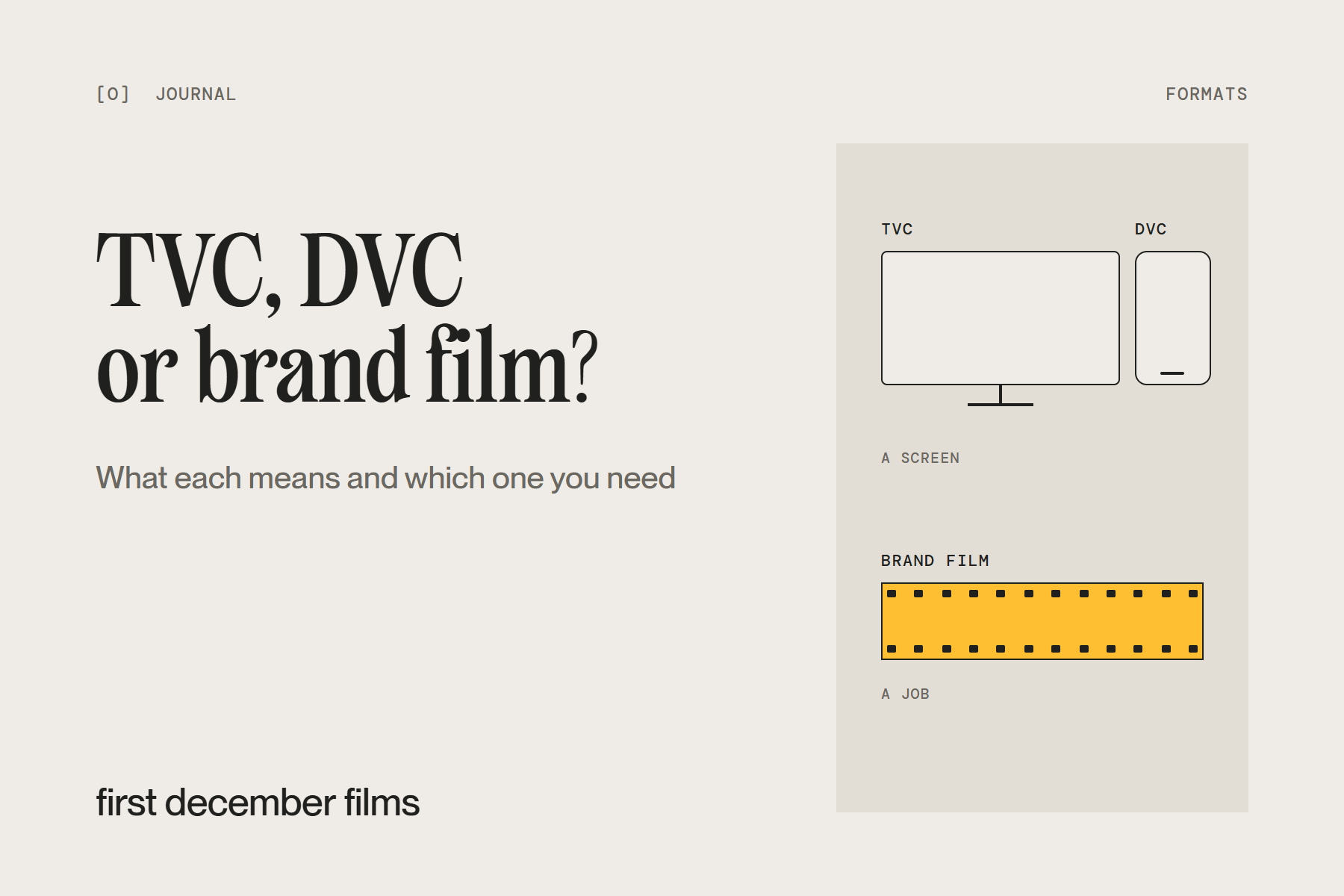
The short answer. A TVC, or television commercial, is an ad made for TV breaks, usually 10 to 30 seconds long. A DVC, or digital video commercial, is made for YouTube, Instagram and other platforms, from a 6-second bumper to a vertical Reel. A brand film is named for its job, not its screen: a longer story about what the brand stands for. Pick by where the media money goes and what the film has to do.
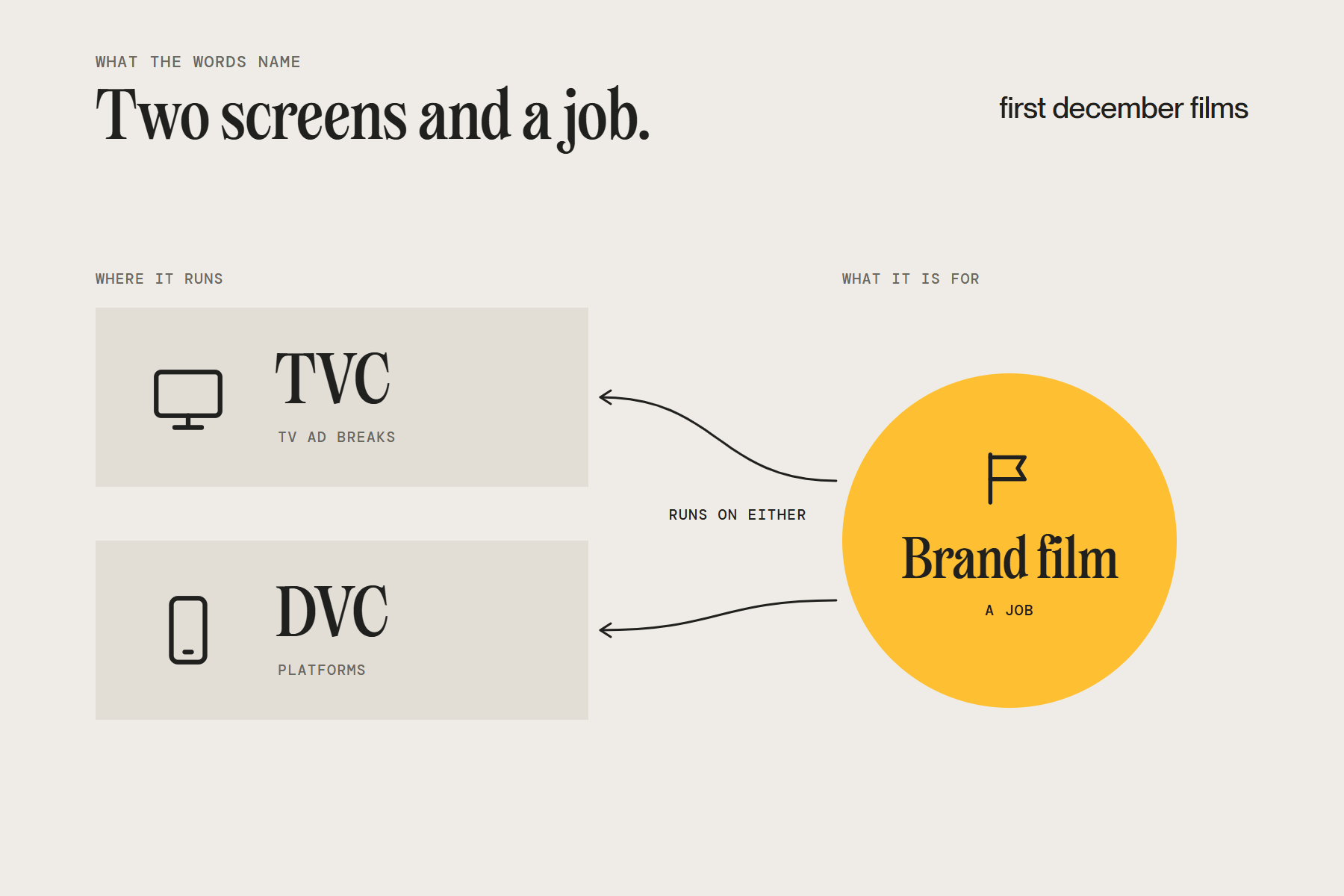
TVC vs DVC vs brand film sounds like a choice between three sizes of the same thing. It is not. Two of the words tell you where a film will run. The third tells you what it is for. That is why one film can be a brand film and a TVC at the same time, and why a brief that names the wrong one costs money.
We produce all three, for broadcast, for platforms and for brands’ own channels. So this is the producer’s version: what each term means in India in 2026, what actually changes on set, in the rules and in the budget, and how to decide. To test the most common assumption, that the difference is length, we also counted the 143 films on our own work pages. Length turns out to be the weakest clue.
Key takeaways
- TVC and DVC describe where a film runs. Brand film describes what it is for. A brand film can run as a TVC.
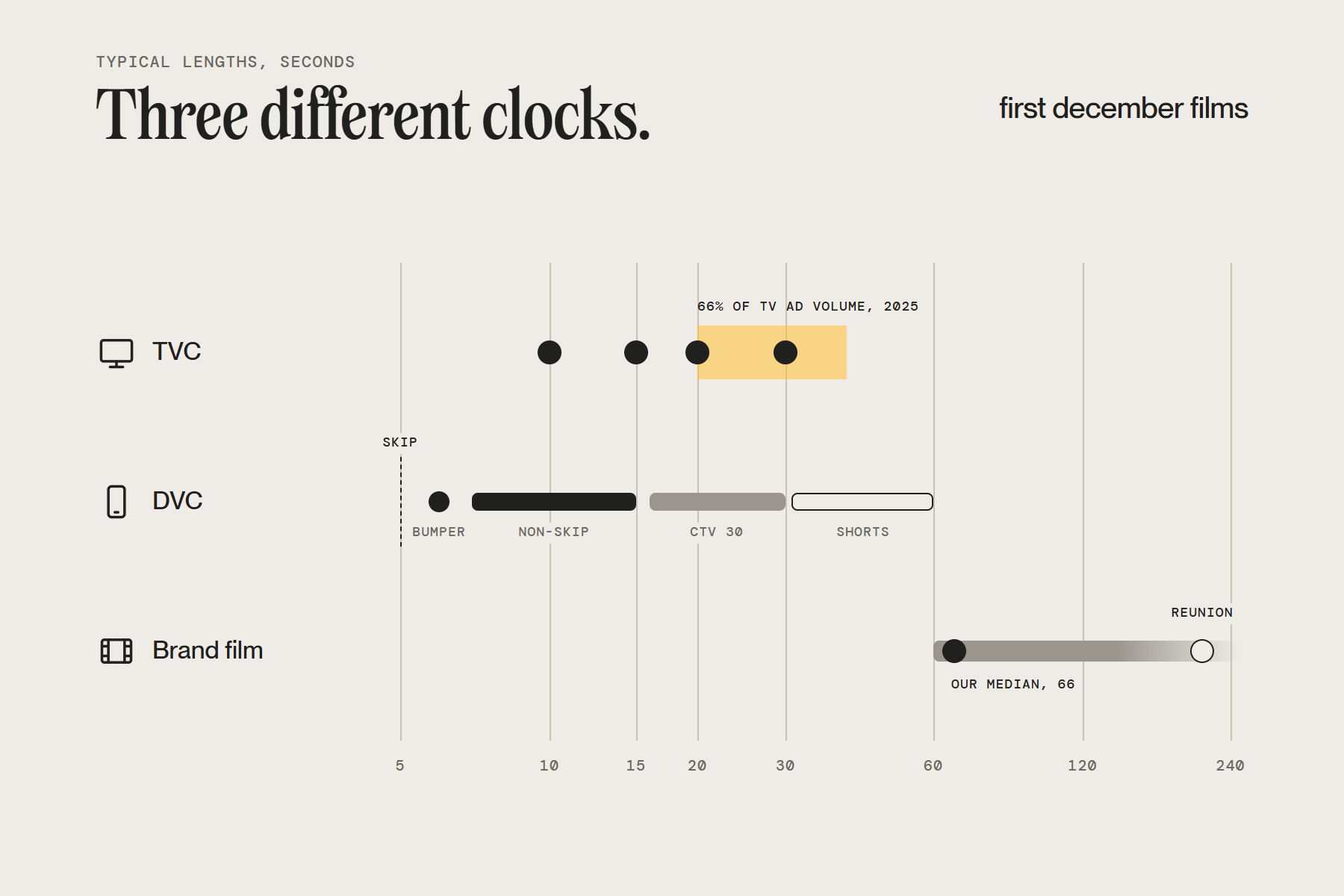
- Indian television sells airtime in 10-second units, so TVCs come as a 30, a 20, a 15 and a 10. In 2025, 66% of TV ad volume ran between 20 and 40 seconds (TAM AdEx data in FICCI-EY 2026).
- Running time does not separate a TVC from a DVC. On our own work pages, films we tag as TVCs have a median of 30 seconds and our digital films 28.5.
- Digital took 63% of Indian ad spend in 2025 and television 17% (FICCI-EY 2026), yet TV still delivers most of the reach for mass brands.
- The rules differ. TV ads must meet the Advertising Code in the Cable Television Networks Rules, which writes in the ASCI Code; digital ads answer to ASCI and each platform. The 12-minute hourly cap on TV advertising was removed on 21 August 2026.
- Most brands need one hero film written for its main screen, with every other version planned at the script rather than trimmed after the edit.
What is a TVC?
A TVC is a television commercial: an ad film made to run in the commercial breaks of TV channels, built to broadcast standard. TVC full form in advertising: television commercial. In India the word has stretched to mean almost any ad film, because when the acronym was coined television was the only screen a video ad could run on, as afaqs’ Ashwini Gangal pointed out in 2019.
Three things make a film a TVC, and none of them is the camera.
The airtime grid sets the length. As our guide to writing an ad film script puts it, Indian television sells airtime in ten-second units, so the broadcast family is usually a 30, a 20, a 15 and a 10. TAM AdEx data published in the FICCI-EY 2026 media report shows the result: in 2025, 66% of TV ad volume ran between 20 and 40 seconds, 28% under 20 and 7% over 40. Every extra 10 seconds is bought again on every airing. exchange4media reported in April 2026 that 10-second live spots on IPL television were priced at up to ₹18 lakh, and a 30 is three of those each time it airs.
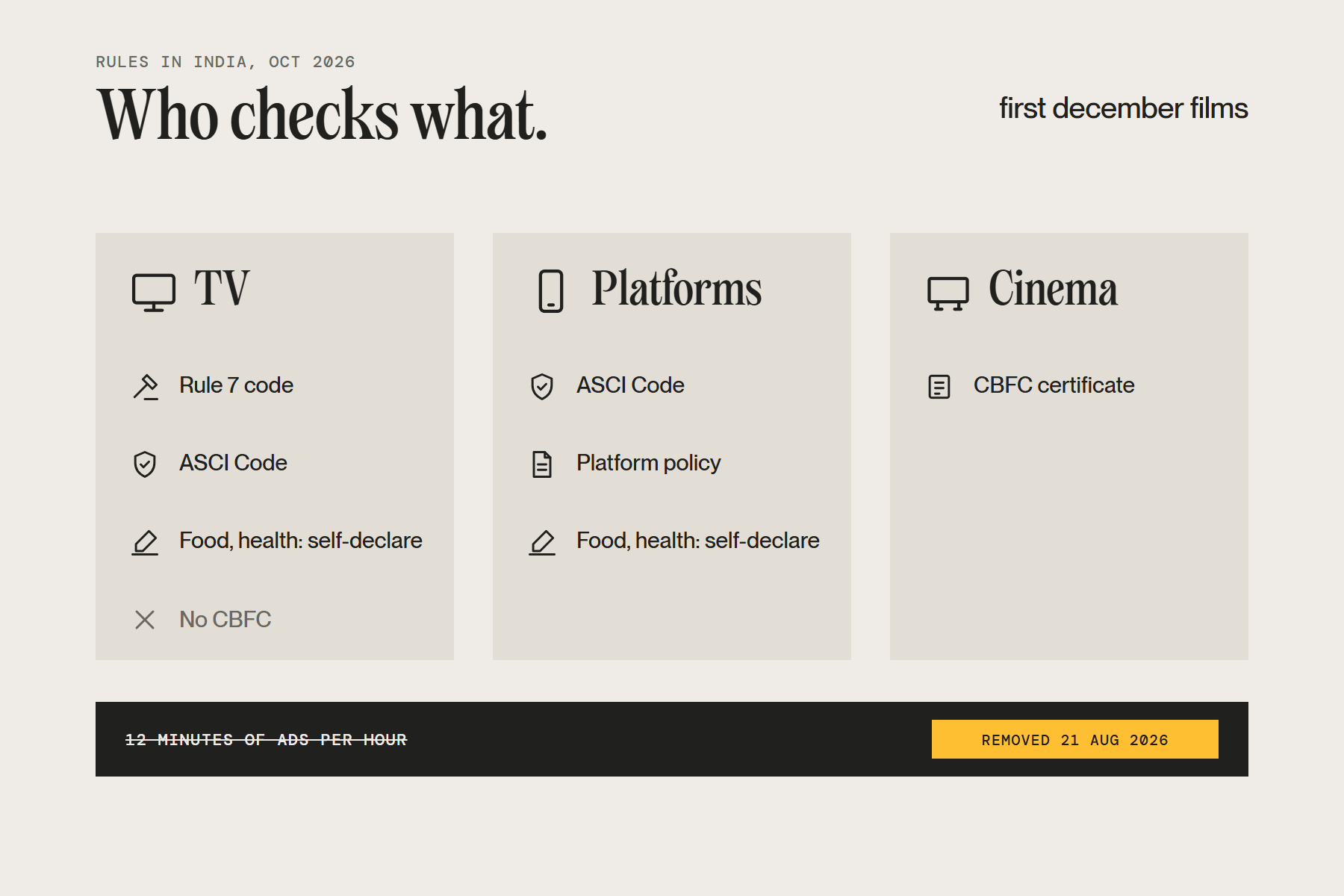
The rules are TV rules. Ads carried on cable and satellite television must meet the Advertising Code in Rule 7 of the Cable Television Networks Rules, 1994, and Rule 7(9) bars any ad that breaks the ASCI Code. TV ads are not pre-censored, and the CBFC does not certify them: its own FAQ says there is no CBFC certification for TV programmes. Two exceptions: surrogate brand-extension ads need a CBFC preview before telecast, and anything shown in a cinema needs a CBFC certificate like any other film. Food and health advertisers, on TV and online, also file an annual self-declaration, under an MIB advisory of July 2024 that narrowed the Supreme Court’s May 2024 order to those two sectors. And the old limit of 12 minutes of advertising per hour is gone: the government omitted it on 21 August 2026, less than three months after the Delhi High Court had upheld it, and TRAI repealed its matching regulation on 10 September while reserving the right to revisit ad limits.
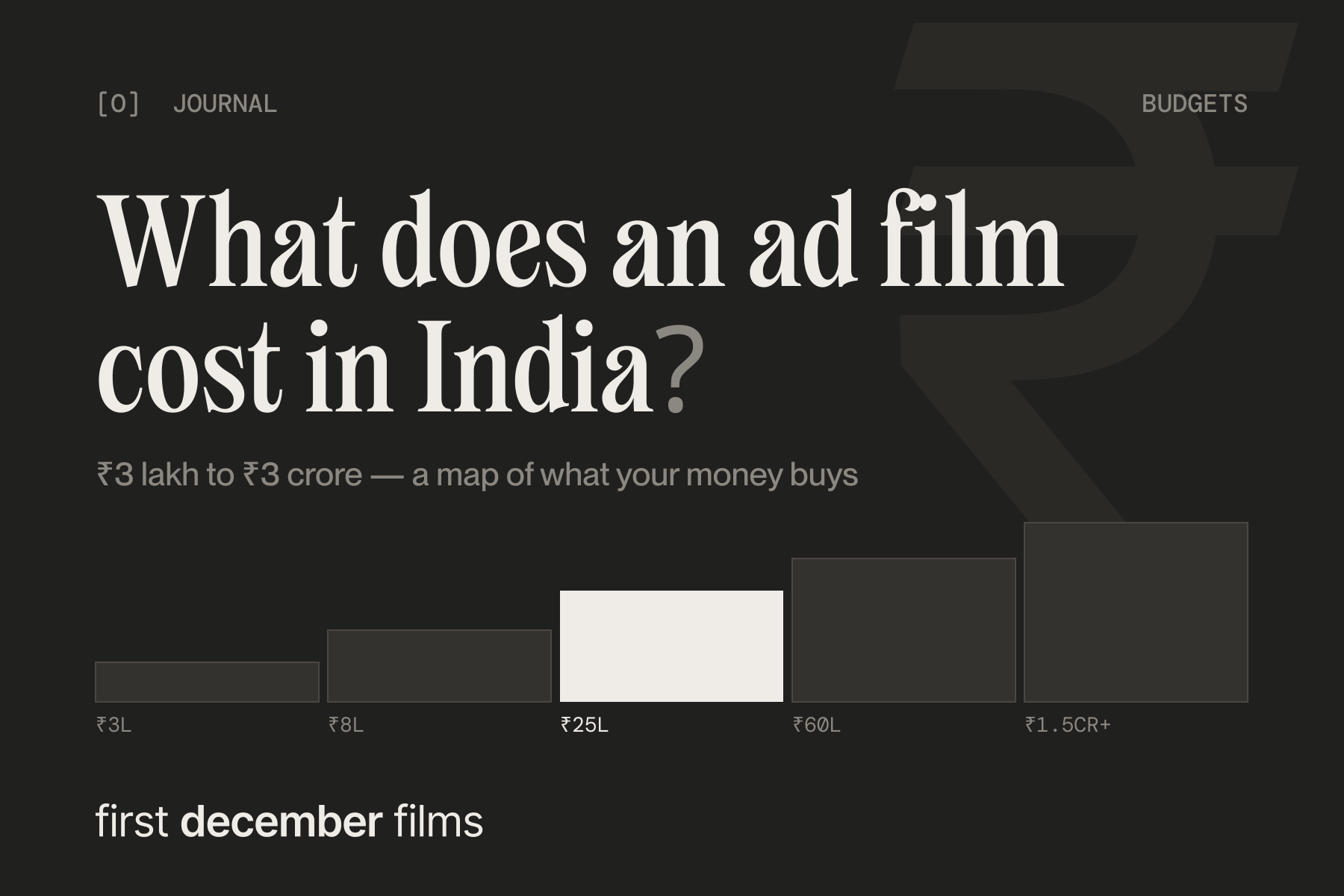
The production is broadcast standard. In our cost guide, a national TVC sits at ₹25 to 60 lakh: two to four shoot days, a crew of forty to eighty, specialist grade and sound. Our TVC process guide puts it at six to ten weeks from approved script to delivered master. Lower-budget regional TVCs are made in the tier below, ₹8 to 25 lakh.
A typical example from our own work: the Vivo S1 TVC, a 30-second television commercial directed by Atul Kattukaran and made for TV and digital. Or the seven Google Gemini films directed by Ronak Chugh in 2026, each between 20 and 27 seconds.
What is a DVC?
A DVC is a digital video commercial: an ad film made to run on digital platforms such as YouTube, Instagram, Facebook and streaming apps rather than in TV breaks. DVC full form in media: digital video commercial, though some Indian press releases expand it as digital video campaign. It is trade shorthand with no industry-body definition. The earliest use we found in Indian trade press is from October 2017, afaqs still put it in quote marks in 2019, and the term is also common in Pakistan.
Where a TVC is shaped by the airtime grid, a DVC is shaped by the placement, and every platform publishes its own grid. On YouTube, according to Google’s ad format specifications, a skippable ad can be skipped after 5 seconds and has no maximum length, a bumper runs 6 seconds, a standard non-skippable ad runs 7 to 15 seconds, and Shorts ads are recommended under 60. A 30-second non-skippable format runs only on connected TV and only as a horizontal video. On Instagram, Meta’s Reels specification is 9:16, with the top 14%, the bottom 35% and 6% on each side kept clear of text and logos.
So a DVC is really a set of films, one per placement, and each one plays by different attention rules. Google’s ABCD guidelines (Attention, Branding, Connection, Direction) are built for this: Google and Kantar’s model of more than 11,000 ads predicted a 30% lift in short-term sales likelihood for ads that follow them. Our own rule from the script guide is simpler: if the film makes no sense with the sound off, it will make no sense on a phone in a train.
DVCs answer to different rules too. The ASCI Code covers internet and digital media, so the content standards are the same as on TV, but the Cable TV Advertising Code does not apply, and each platform runs its own ad policy on top. If any footage is realistic and AI-generated, Indian platforms now label it, as our guide to AI ad film costs explains.
Do not treat DVC as a price tier. In our cost guide, a content film at ₹3 to 8 lakh makes good social content but not a TVC, and a serious digital film at ₹8 to 25 lakh is where most brands making their first film should start. But a digital film with a celebrity, a second location or real VFX costs what that script costs. Ali A. Rizvi, a Pakistani producer, put it plainly to Aurora in 2019: "It is the concept that dictates the production cost; labels don’t."
Two of ours show the range: Shiv Parameswaran’s 20-second Google #SearchSomethingNew, shot vertical at 1080 by 1920, and Atul Kattukaran’s 15-second YouTube Shorts launch film for India.
The most common DVC is still the wrong one: a TVC trimmed for a phone. Dinesh Menon, then CMO of SBI, told afaqs in 2019 that agencies still start from the 30-second TVC and ask how to adapt it for digital. Director Vinil Mathew said the same thing five years later to exchange4media: condensing TV commercials into short videos "often results in losing the essence of the ad. It confuses the audience."
What is a brand film?
A brand film is a film made to show what a brand stands for rather than to sell one product or offer. It is named for its job, not its screen or its length. Most brand films run longer than a commercial, from about a minute to several, the product often arrives late, and they run wherever the story can hold an audience: YouTube, connected TV, cinema, events, the brand’s own channels, and in a cut-down form, television.
India’s best-known example shows all of that at once. Google Search’s "Reunion", created by Ogilvy & Mather India, launched online in November 2013 at about three and a half minutes, and only a shortened version could air on TV because of its length. By 2016, seven of the ten most-watched ads on YouTube India that year ran over 90 seconds.
From our own work, all directed by Atul Kattukaran: Facebook Roar Together, an eight-minute brand film; Unacademy Believe at 2 minutes 26 seconds; and the 84-second Nike Make Every Yard Count, which won seven Cannes Lions.
Brands make them because brand building pays over time. Les Binet and Peter Field’s analysis of 996 campaigns in the IPA Databank found the most very large business effects when about 60% of the budget went to brand building and 40% to short-term activation, a pattern they later put at 62:38. The authors present it as an optimum in the data, not a law, and say the B2B balance sits nearer 46:54. A brand film is one way to spend the brand side, not the only one. Sudhir Sitapati, MD and CEO of Godrej Consumer Products, describes a different route to the same end in Manifest Media: "we make a big brand film and then run it on television for a year."
Two warnings. Long is not a virtue on its own: "some are just long for the sake of being long," Arun Iyer, then at Lowe Lintas, said of the 2014 wave of long-format ads. And view counts flatter. Rajiv Dhingra of WatConsult told Business Today in 2017 that the most-viewed ads were also the most promoted and "should not be seen as organic views". Neville Shah of FCB Kinnect has the test right: "If you have a narrative that requires time, it requires time."
There is no separate price tier for a brand film. The craft sets the cost. The tier in our cost guide that describes this kind of film is the campaign film, ₹60 lakh to ₹1.5 crore, "the film your brand is known by", but many brand films are made for less.
TVC vs DVC vs brand film: what is the difference?
The difference between a TVC, a DVC and a brand film is the question each word answers. TVC and DVC answer "where will it run?". Brand film answers "what is it for?". Everything else in this table follows from that.
| TVC | DVC | Brand film | |
|---|---|---|---|
| What the word names | A screen: TV ad breaks | A screen: digital platforms | A job: what the brand stands for |
| Where it runs | Broadcast and cable channels, and usually YouTube too | YouTube, Instagram, Facebook, streaming apps, connected TV | YouTube, connected TV, cinema, events, own channels; cut down for TV |
| Typical length | 10, 15, 20 or 30 seconds, bought in 10-second units | 6-second bumpers to 60-second Shorts; skippable ads have no limit | A minute to several; ours have a median of 66 seconds |
| Frame | 16:9 | 16:9, 9:16, 1:1 or 4:5, by placement | A 16:9 master, plus short and vertical cuts |
| Attention | The break is bought; the remote is not | Skippable after 5 seconds, often watched on mute | Has to hold people for every minute, and usually paid to be seen |
| Rules in India | Rule 7 Advertising Code, with the ASCI Code written in; no CBFC; food and health self-declaration | ASCI Code plus each platform’s ad policy; food and health self-declaration | The rules of wherever it runs; a CBFC certificate for cinema |
| Our production tier | National TVC ₹25 to 60 lakh; regional TVCs from ₹8 lakh | Content film ₹3 to 8 lakh, digital film ₹8 to 25 lakh, more if the script needs it | Set by the craft; our campaign film tier is ₹60 lakh to ₹1.5 crore |
| Timeline | Six to ten weeks, script to master | Three to four weeks for a fast, single-location film | Longer edit, grade and sound than a 30-second film of the same craft |
| Versions | A 30, 20, 15 and 10, often in several languages | One per placement: bumper, skippable, vertical, connected TV | A master plus short cuts for TV and paid media |
Production cost only, from our published cost guide and TVC process guide. Media is a separate, usually larger, budget. GST at 18% is extra.
Does length tell a TVC from a DVC?
No. On 9 October 2026 we counted every film on our work pages: 156 live entries, 143 distinct films once duplicate uploads and brand umbrella pages were removed, each with its running time checked against the video itself. 129 of them carry at least one format tag. Here is what the three tags in question show.
| Format tag on our site | Films | Median length | Shortest | Longest |
|---|---|---|---|---|
| Television commercials (TVCs) | 41 | 30 seconds | 15 seconds | 100 seconds |
| Digital films | 32 | 28.5 seconds | 6 seconds | 8 min 48 s |
| Brand films | 13 | 66 seconds | 15 seconds | 94 seconds |
| All 143 films | 143 | 35 seconds | 6 seconds | 8 min 48 s |
First December Films work pages, read 9 October 2026. Running time is for the cut shown on our site, often the director’s cut. Brand films exclude two showreels and two of our own films.
Films we made for television and films we made for platforms have almost the same median length: 30 seconds and 28.5. Nineteen of the 41 TVC-tagged films run longer than 35 seconds on our site, because the cut we show is often the director’s cut, not the broadcast edit. Swiggy XL, directed by Nitin Menon, is a 30-second film tagged digital only. Brand films do run longer, a median of 66 seconds, a little over twice a TVC, yet even that tag includes a 15 and two 30s.
The most common running times across all 143 films are 15 seconds (31 films), 20 seconds (14) and 30 seconds (13). The broadcast family’s lengths show up even in work made for platforms.
The lesson for a brief: name the screen and the job, then let the length follow. "Make us a 30-second DVC" tells a production house almost nothing it can budget.

Which one do you need?
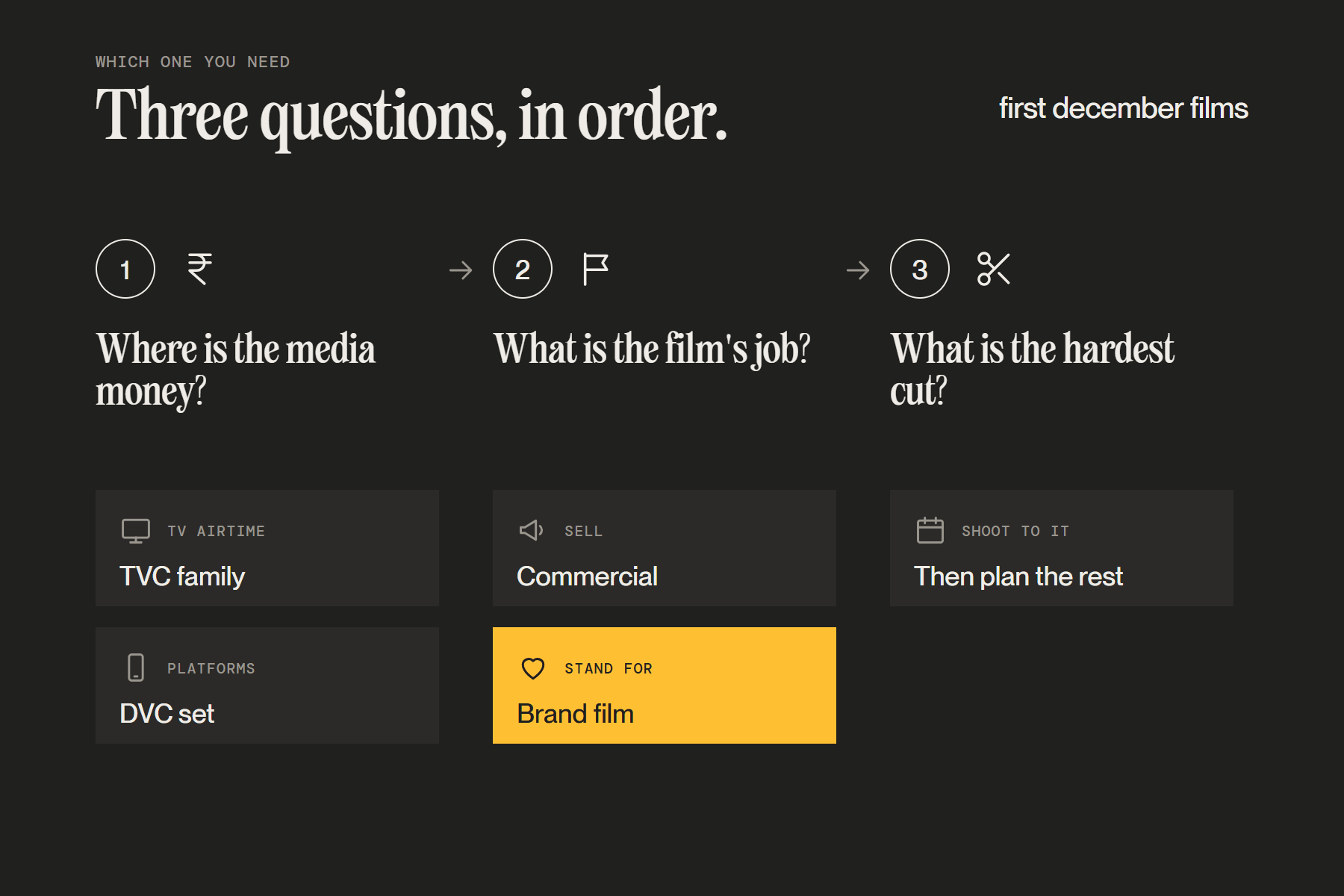
You need the film your media plan and your objective call for, and for most mass brands in India that means more than one. Three questions settle it.
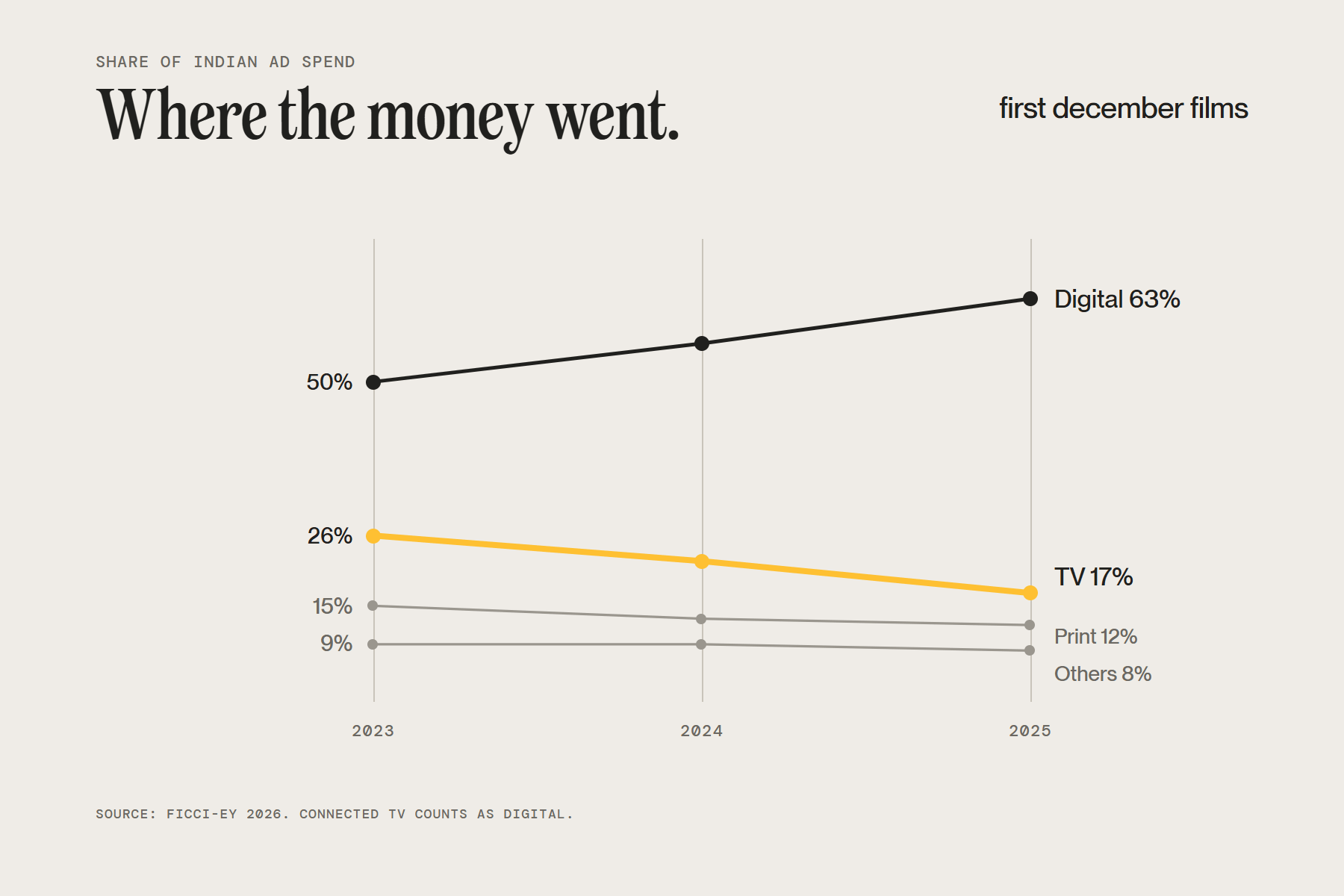
1. Where is the media money going? The production follows the plan, not the other way round. If TV airtime is bought, you need a TVC family. If the money is on platforms, you need DVCs built for each placement. Most budgets have moved: digital took 63% of Indian advertising in 2025 and linear television 17%, against 50% and 26% in 2023, according to FICCI-EY 2026. But spend is not reach. A single-source study by Worldpanel by Numerator with Sync Media, reported by indiantelevision.com in August 2026, found TV still the dominant reach driver for FMCG brands, with digital-only exposure reaching between under 1% and about 4% of households, and TV plus digital beating TV alone on penetration for nearly 75% of the brands studied.
2. What is the film’s job? Selling a launch, an offer or a feature is a commercial’s job, on TV or online. Changing what people think the brand stands for is a brand film’s job. If you need both, one brand film made to run on television can do both jobs, which is Sitapati’s model.
3. What is the hardest deliverable? Budget for the most demanding version, not the average one. If one cut must go on national television, the shoot must be broadcast standard, and everything else is made from it.
| If this is your situation | You need | Watch for |
|---|---|---|
| National TV airtime is booked | A TVC family, plus DVCs from the same shoot | Write the 30, then decide the 20, 15 and 10 at the script |
| The money is on YouTube, Instagram and connected TV | A DVC set, one film per placement | A trimmed TVC posing as a DVC; a broadcast budget you will never air |
| The brand needs to say what it stands for | A brand film, with short cuts for TV and paid media | Length for its own sake; no media plan to get it seen |
| It is your first film and the budget is modest | A serious digital film, ₹8 to 25 lakh in our tiers | A "TVC" quoted at content-film prices |
| You need fifty variants to test | A performance creative team, not a production house | Paying film rates for test creatives |
Our recommendation, built on the tiers in our cost guide.
Our position: write the hero film for the screen that carries most of the money, and plan every other version before the shoot. Ganesh Pareek, our partner and executive producer, described the target in MediaBrief in March 2026 as "not one film, but a system of master + cutdowns + socials + BTS + variants, often multi-language."
Not everyone agrees, and the disagreement is useful. Sitapati’s view is the opposite: "Six films or edits don’t cut for me. I want brand managers to run the ad for a year." And directors warn about what the system costs when it is under-funded. Shirsha Guha Thakurta of Oink Films told Open in March 2025 that brands now want "one ad-film plus six other deliverables" inside an 8-to-12-hour shooting shift, and that it hurts the quality. Both are right about something. One strong film, run long, beats six weak ones. Six versions are fine when each is written and budgeted, and damaging when they are squeezed out of the master’s shoot day.
Can one shoot give you a TVC, DVCs and a brand film?
Yes, if the versions are planned at the script and paid for in the schedule. The TV family and the DVC set usually come from one shoot. A real brand film usually needs scenes the commercial does not have.
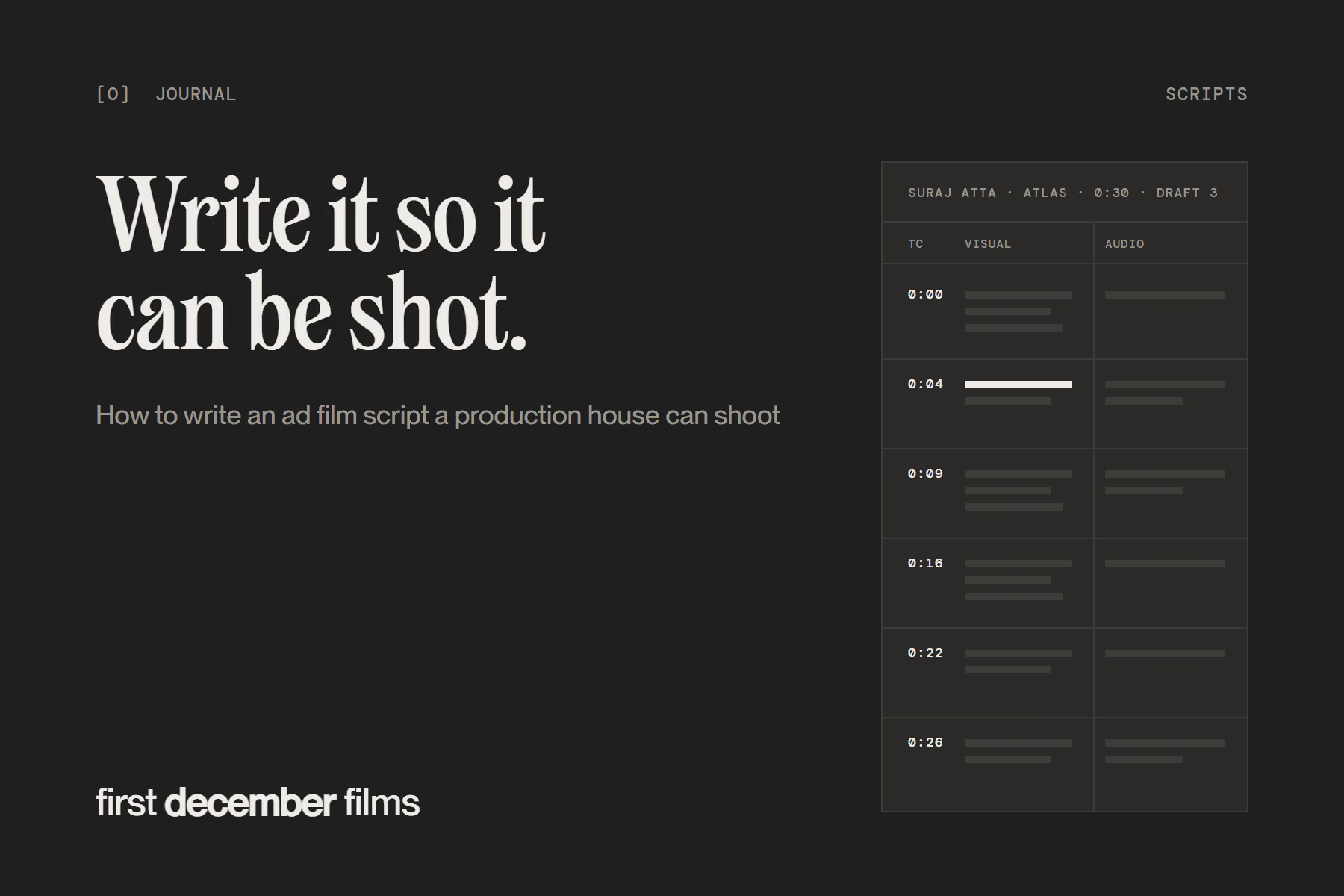
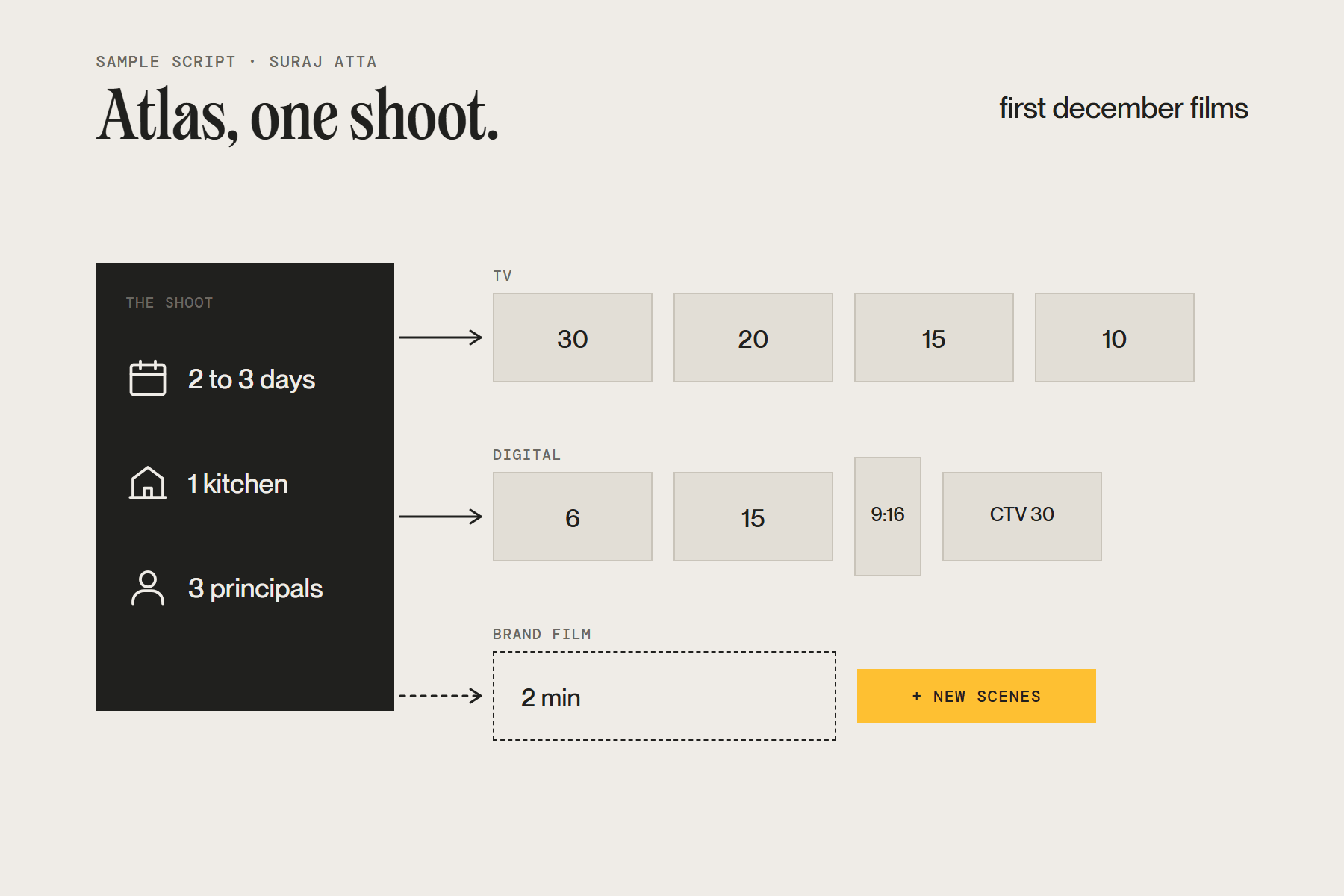
Take Atlas, the sample script from our script writing guide: a 30-second national TVC for a fictional atta brand, Suraj Atta. Meera, eight, rolls a roti shaped like Australia; her father keeps every country she makes in a steel dabba; at seventeen she finds it. Our script breakdown rates it standard: one kitchen, two day parts, three principals, two to three shoot days.
- The TV family. The 30 is the master. The 20, the 15 and the 10 are decided before the shoot by choosing which beats survive, so the camera covers them properly.
- The DVC set. The 6-second bumper is the Australia roti and Meera’s face, as the script guide already says. The vertical version is framed on set, with the packshot and super kept inside Instagram’s safe zone. The 15 runs as YouTube’s non-skippable ad, and the horizontal 30 also qualifies for YouTube’s connected TV format.
- The brand film. A two-minute Atlas needs the years between eight and seventeen: more countries in the dabba, more day parts, perhaps the school bag by the door. Those are new scenes, not a longer edit. In breakdown terms, more day parts and more set-ups are how a two-day shoot becomes three.
List every deliverable before the quote. Our cost guide counts it out: "A 30-second hero film is one edit. The 15, the 10, the 6, the vertical cut, the six-language dub and the CTV master are ten more." The same brief should name usage rights by media, territory and term, because talent and music are cleared for the media you name. A film cleared for digital only usually cannot go on air without going back to the actors and the music owner.
Planned well, one set can carry more than one film. Ganesh described a shoot to exchange4media in November 2025 where "We shot three films on one set by just changing the wall colour."
How did TVC, DVC and brand film get here, and what changes next?
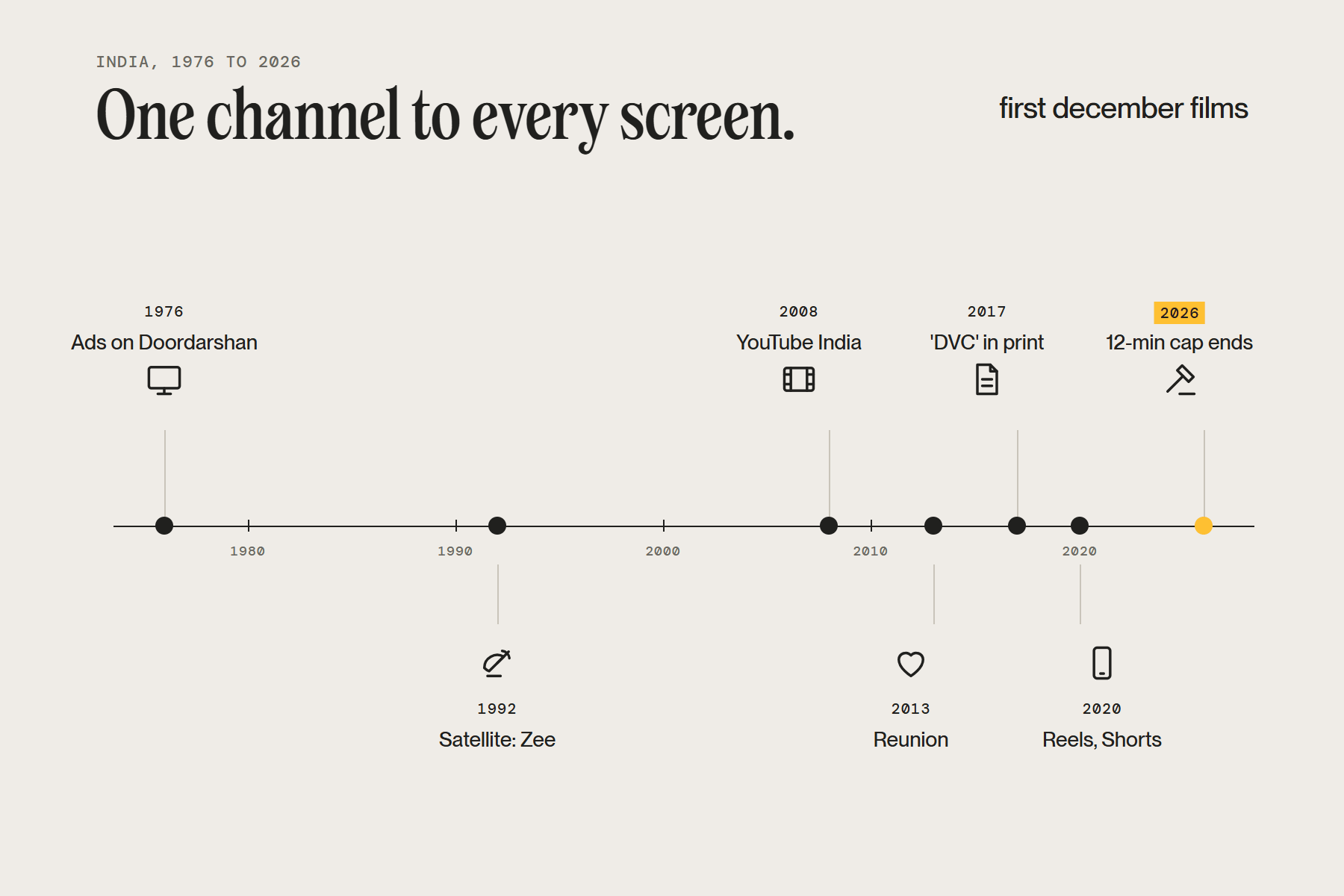
The past. Advertising began on Doordarshan in 1976, and for fifteen years a TV ad meant one broadcaster. Satellite television arrived in 1991 and 1992; when Zee TV launched on 2 October 1992, only six minutes of advertising were allowed in an hour, as its founder Subhash Chandra later recalled. YouTube launched an Indian site on 8 May 2008. Long-form brand films took off after "Reunion" in 2013 and dominated YouTube India’s most-watched list by 2016. After TikTok was blocked on 29 June 2020, Instagram began testing Reels in India on 8 July and YouTube put Shorts into beta in India in September, and vertical became a format brands had to brief.
The present. Digital is 63% of Indian ad spend (FICCI-EY 2026), and connected TV ad revenue, which FICCI-EY counts as digital, grew 42% in 2025 to ₹99 billion. YouTube reached over 75 million adults in India on connected TV in April 2025. A 30-second horizontal film on YouTube’s connected TV format is a TV-length ad on a TV screen that is booked and counted as digital.
What comes next. These are forecasts, and whose they are matters. The dentsu-e4m Digital Advertising Report 2026 forecasts television at 15% of Indian ad spend by 2027. FICCI-EY forecasts connected TV ad revenue at ₹164 billion by 2028. With the 12-minute cap removed, broadcasters can sell more minutes an hour, and TRAI has said it may revisit limits. Our forecast: TVC and DVC will matter less as separate words, because the same film will be bought for the same TV screen through both routes. Brand film will keep its meaning, because a job does not change with the screen.
When this advice does not apply
- Performance creatives at volume. Dozens of variants for social testing are a different product, priced per creative or on retainer. A production house is the wrong supplier.
- Corporate films, explainers and testimonials. They have their own formats and budgets, and none of these three labels fits them.
- Influencer content. Creator-made posts follow ASCI’s influencer guidelines and the creator’s own production. Brief them separately.
- A regional TVC on a tight budget. Our ₹8 to 25 lakh tier makes lower-budget regional TVCs. Broadcast delivery is a technical spec, and a smaller shoot can meet it.
If you have a script, paste it into our free Script Analyzer for a complexity band before you price anything. Then send us the brief with every deliverable on it: the TV family, each digital placement, any brand film, the languages and the usage rights. For AI or hybrid versions, see our AI ad films page.
First December Films is an advertising film production company in Mumbai. Our work has won more than 150 international creative awards, including Cannes Lions, D&AD and One Show Gold Pencils.
What is the full form of TVC?
TVC stands for television commercial, an ad film made to run in the commercial breaks of TV channels. In India the term is often used loosely for any ad film, but strictly it means a film made to broadcast standard for television, usually 10, 15, 20 or 30 seconds long, because Indian TV sells airtime in 10-second units.
What does DVC mean in advertising?
DVC stands for digital video commercial, an ad film made for YouTube, Instagram, Facebook and streaming apps rather than TV breaks. Some Indian press releases expand it as digital video campaign. The platform decides its shape: a 6-second bumper, a skippable ad, a vertical Reel or a 30-second spot on connected TV.
What is a brand film?
A brand film is a film made to show what a brand stands for rather than to sell one offer. It is defined by its job, not its screen or its length, though most run longer than a commercial, from about a minute to several. A brand film can run on YouTube, on connected TV, in cinemas or, cut down, on television.
Is a TVC more expensive than a DVC?
Not by definition. Cost is set by the script: shoot days, cast, locations and post. In our published tiers a serious digital film costs 8 to 25 lakh rupees and a national TVC 25 to 60 lakh rupees, because broadcast work usually needs more shoot days and a bigger crew. A digital film with a celebrity or real VFX can cost more than a simple TVC.
Can a TVC run on YouTube or Instagram?
Yes, and most do. A horizontal 30-second TVC fits YouTube’s non-skippable format on connected TV. What usually fails is a TVC trimmed for a phone: vertical frames, skippable placements and sound-off viewing need versions planned at the script. Check that the talent and music rights cover digital use before the film goes online.
Do TV ads need CBFC approval in India?
No. The CBFC does not certify TV programmes or TV ads. Ads on cable and satellite TV must follow the Advertising Code in Rule 7 of the Cable Television Networks Rules, 1994, which includes the ASCI Code. Ads shown in cinemas need a CBFC certificate, and surrogate brand-extension ads need a CBFC preview before telecast.
How long should a brand film be?
As long as the story needs and no longer. The brand films on our own work pages have a median running time of 66 seconds, and Google’s Reunion ran about three and a half minutes. Plan short versions for TV and paid placements as well, because most people will meet the film through its cutdowns.