
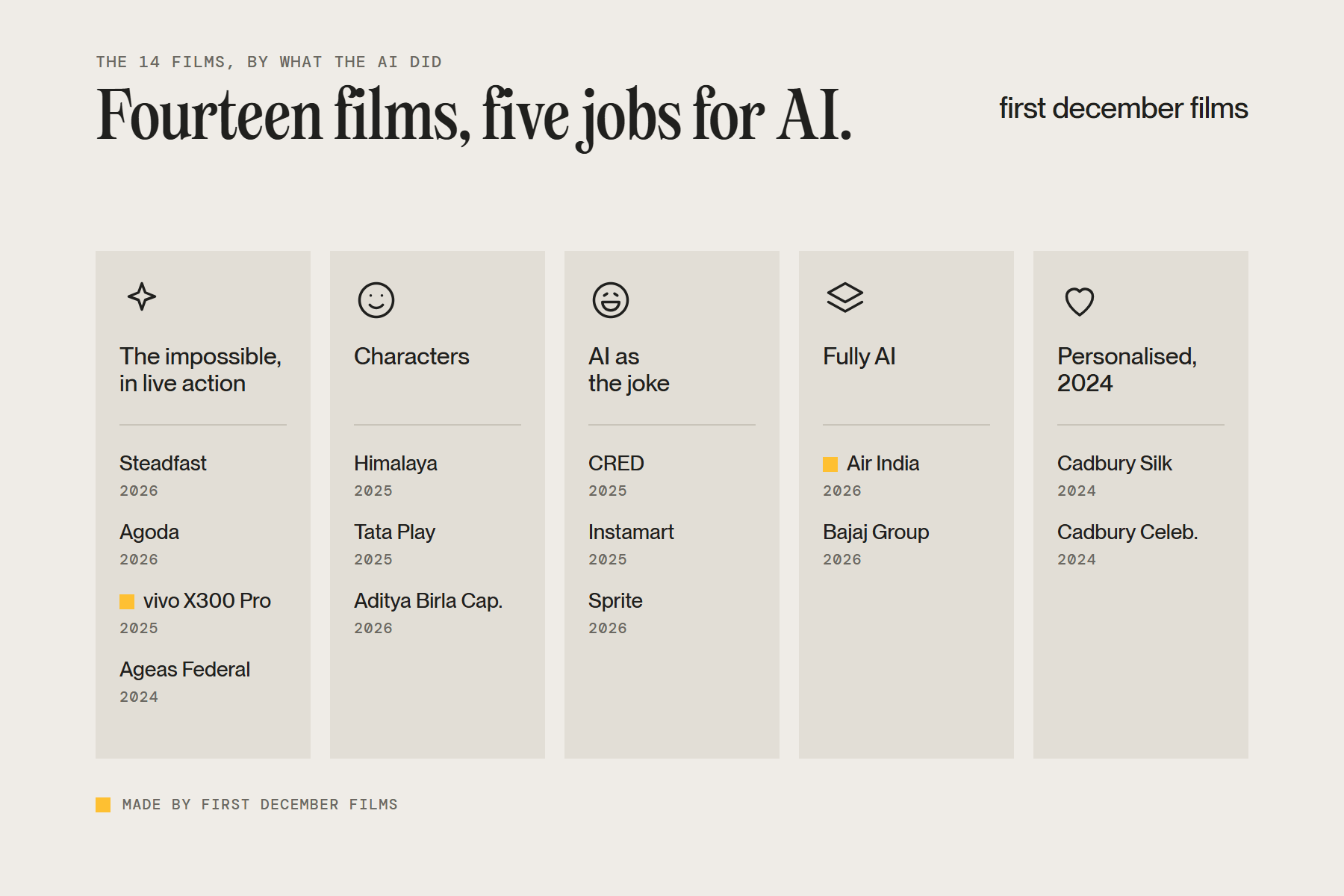
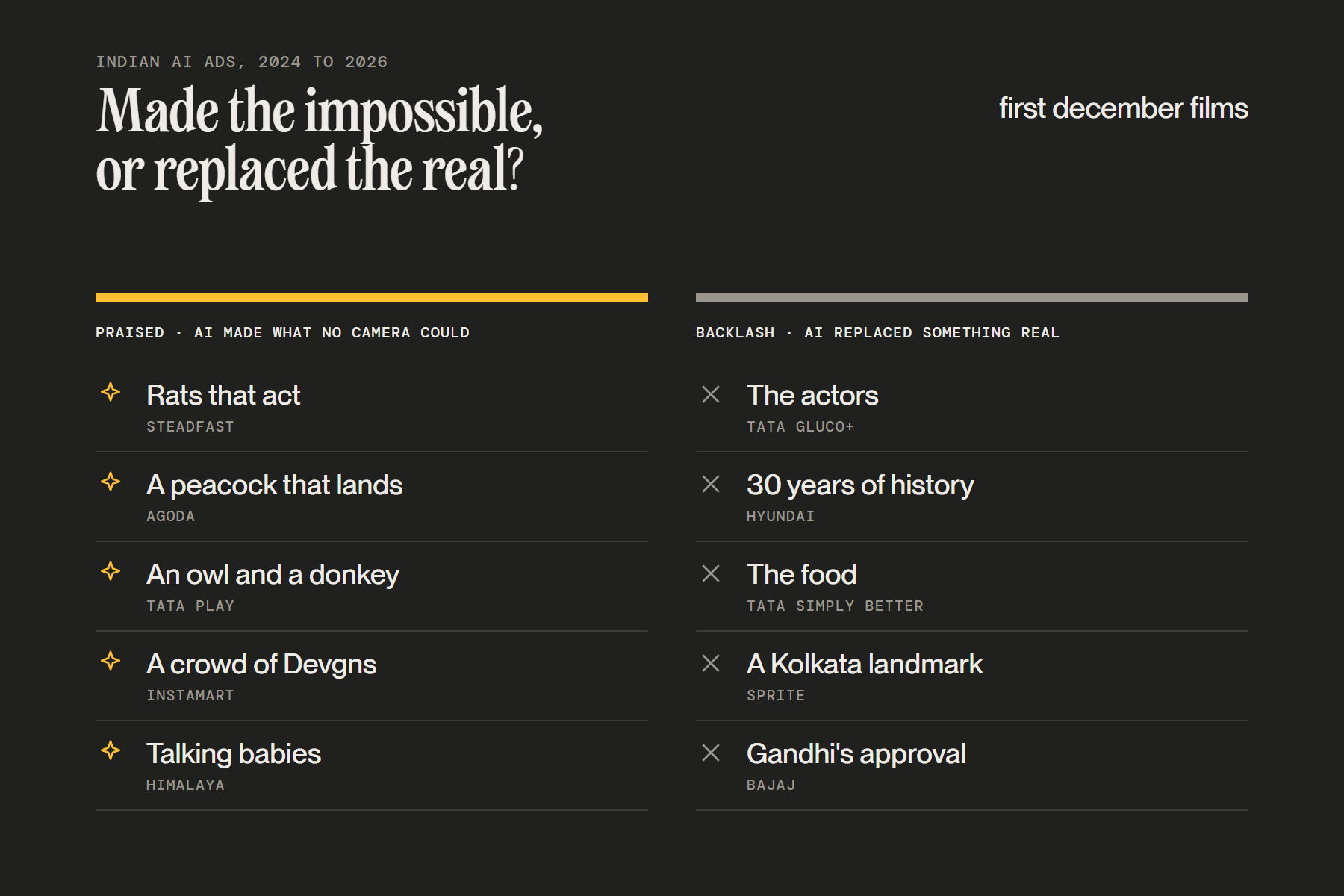
The short answer. The best AI ads in India from 2024 to 2026 used AI for something a camera could not do, inside a story people built: Steadfast’s photoreal rats, Agoda’s peacock, Tata Play’s owl and donkey, Air India’s 102-second portrait of a country. The films that drew backlash asked AI to stand in for something the audience knew was real.
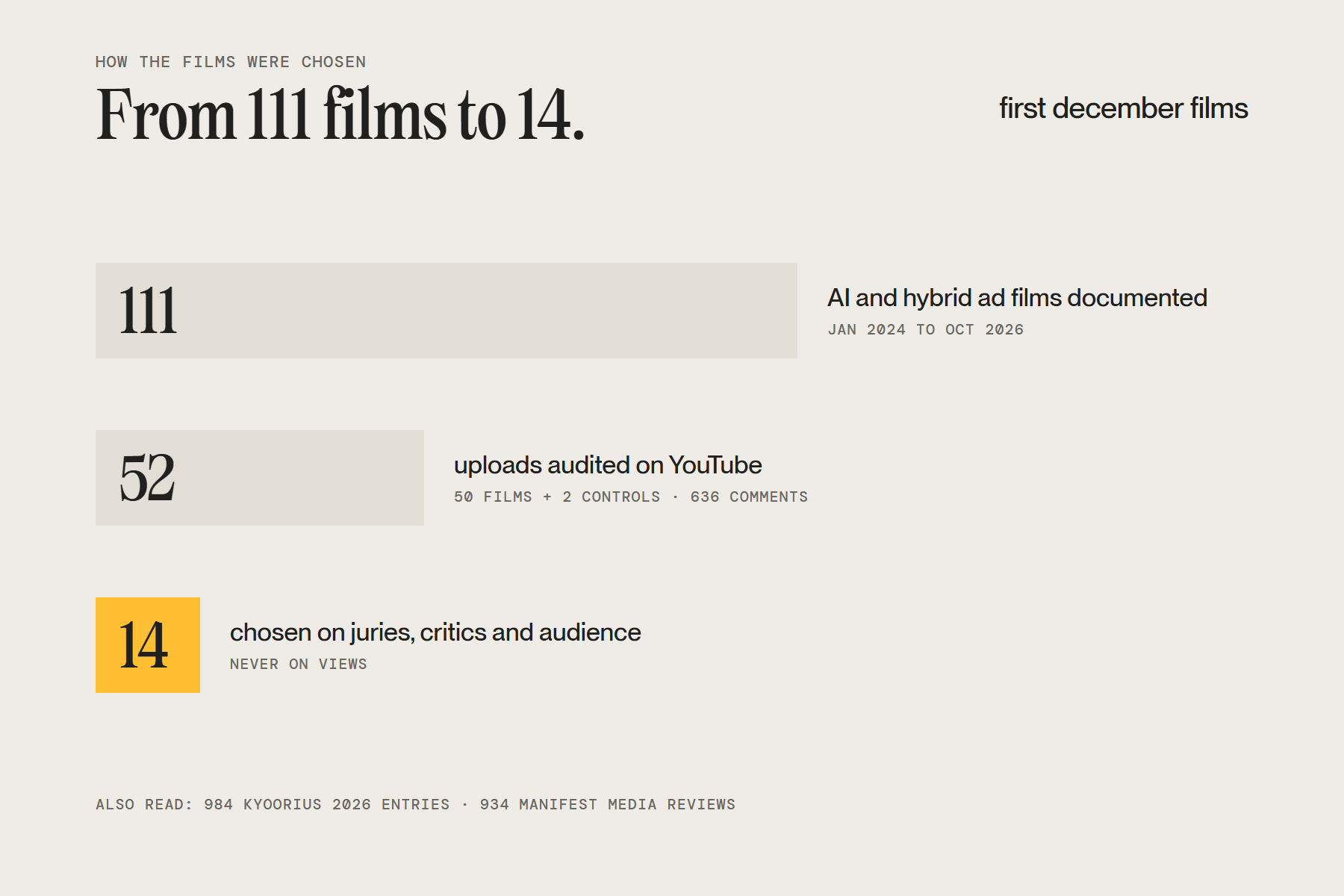
We are an ad film production house in Mumbai, and two of the 14 films below are ours: Air India’s There is an Air About India and the vivo X300 Pro launch film. We have marked them, judged them on the same five tests as everyone else’s, and said what each one gave up. The other twelve were chosen from 111 Indian AI and hybrid ad films we documented from January 2024 to October 2026, using award juries, named critics and an audit of 636 YouTube comments, never view counts.
Published 12 October 2026. Every award, quote and figure was checked against its source that week.
Key takeaways
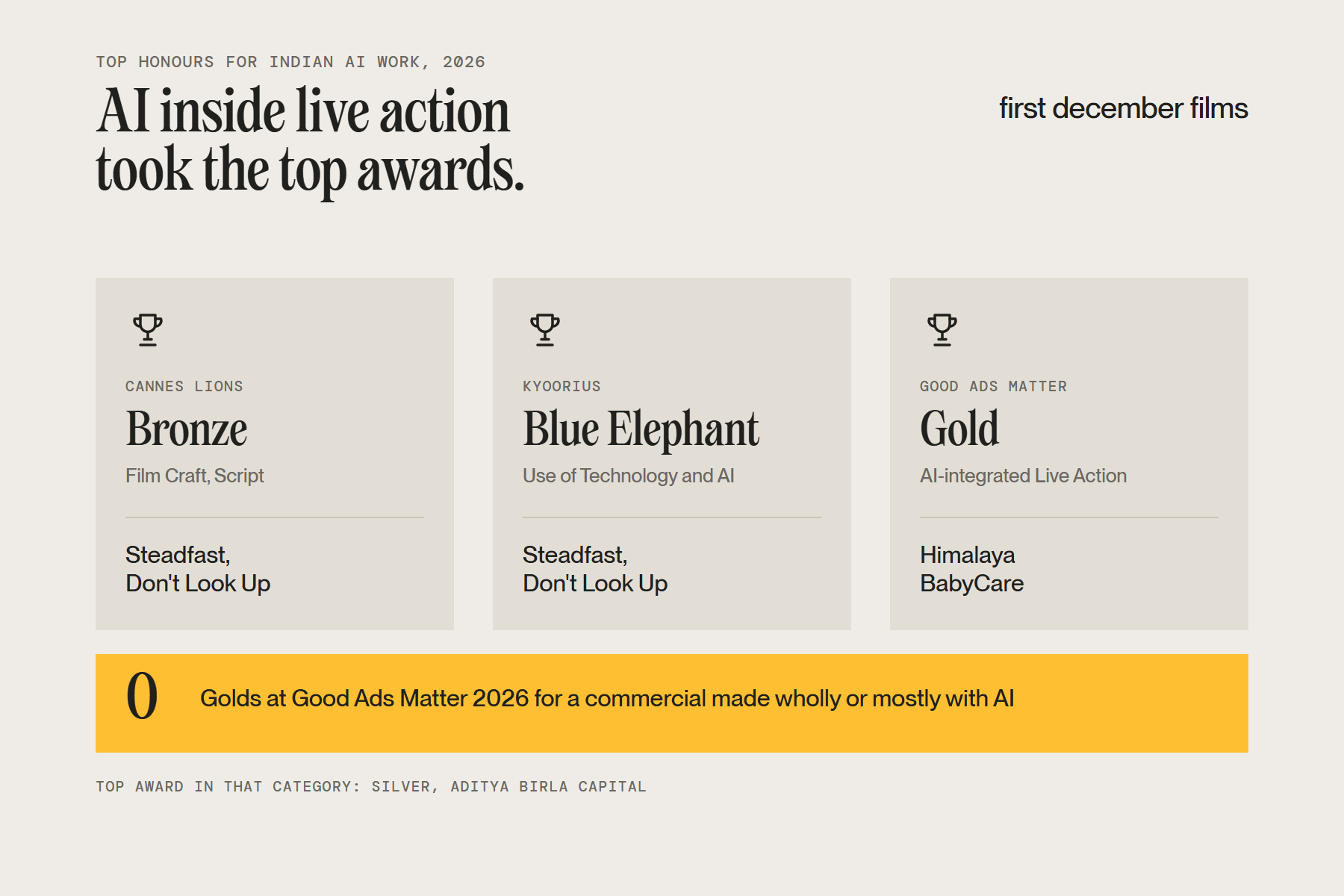
- The juries agree with the audience. The top honours for Indian AI ad films in 2026, a Cannes Lion, a Kyoorius Blue Elephant and a Good Ads Matter Gold, all went to films that put AI inside live action. Good Ads Matter’s category for films made wholly or mostly with AI gave no Gold.
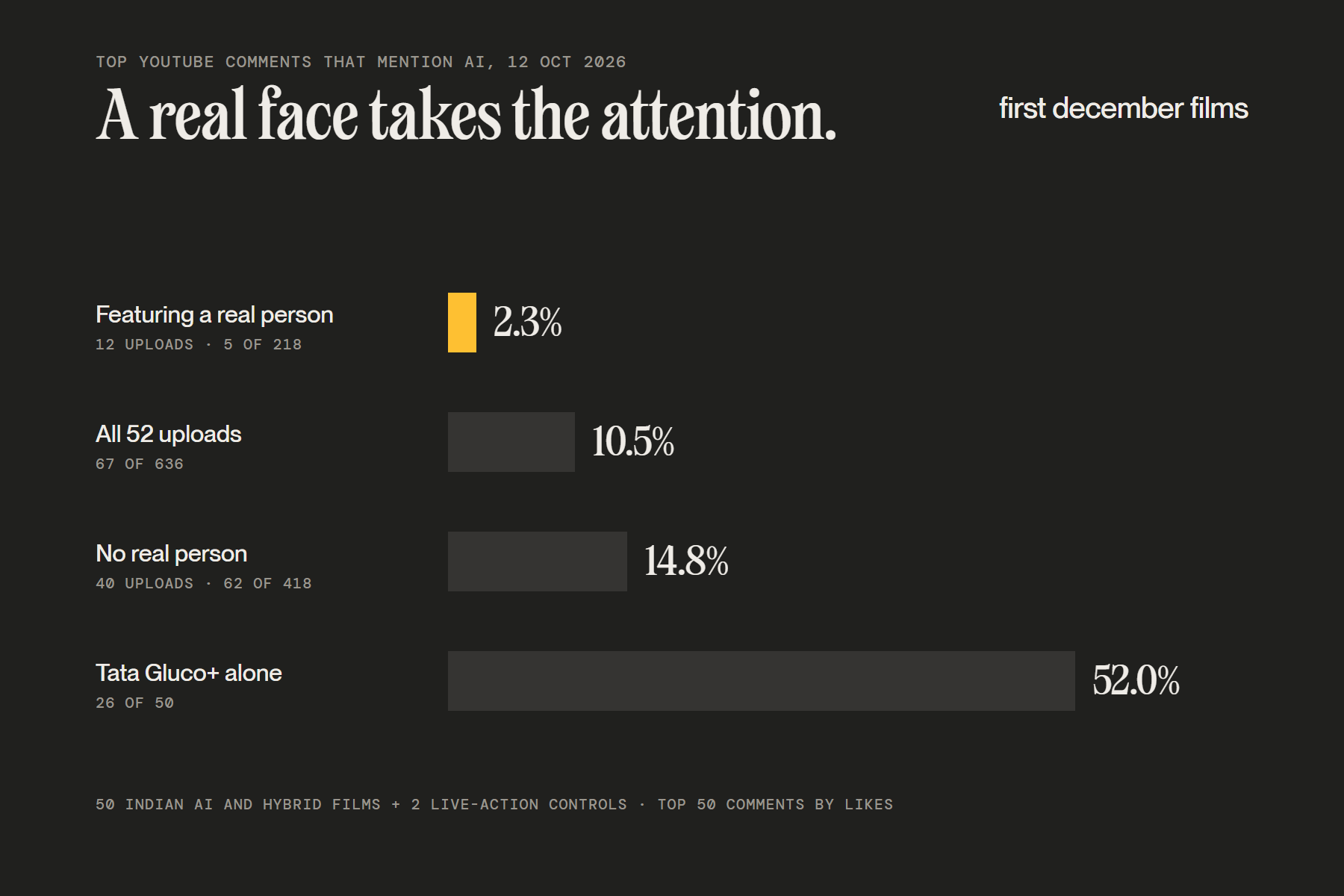
- In our audit of 52 YouTube uploads (50 Indian AI and hybrid films and two live-action controls), 14.8% of the top comments on films without a real person mentioned the AI, against 2.3% on films featuring a real person, such as a cricketer, an actor or a founder.
- AI won praise when it was the joke or the impossible thing: Ajay Devgn multiplied for Swiggy Instamart, a talking owl for Tata Play. It lost when it replaced the real thing: Hyundai’s own history, Tata Simply Better’s food, a Kolkata landmark in Sprite’s film.
- One film carries most of the anger. Tata Gluco+'s 2025 film holds 26 of the 67 comments that mention AI across all 52 films.
- No one can tell you which was India’s first AI ad, because every claim is a category first. The earliest fully AI-generated brand film we found in this period is Air India’s Holi film of 24 March 2024.
- A label did not change how often viewers talked about the AI. They spot it themselves and check: "I watched it on TV and ran to YouTube to confirm."
Which are the best AI ads made in India so far?
These are the 14 films that hold up best on the evidence, grouped by what the AI was asked to do. That grouping matters more than any ranking: it is the clearest predictor of how each film was received.
| Film | Year | What the AI did | Strongest evidence |
|---|---|---|---|
| Steadfast, Don’t Look Up | 2026 | Photoreal rats and an attic, composited into live action | Cannes Lions Bronze (Script); Kyoorius Blue Elephant, Use of Technology and AI |
| Agoda India, What A Save | 2026 | A peacock and a dolphin in place of dummy props | Good Ads Matter Silver; Kyoorius First List |
| vivo X300 Pro launch film (ours) | 2025 | AI integrated into a live-action phone launch | Good Ads Matter 2026 Bronze, AI-integrated Live Action Film |
| Ageas Federal Life, Cradle to Crease | 2024 | Sachin Tendulkar shown at ages before his debut | Manifest Media: it conveys the message "within a minute" |
| Himalaya BabyCare, India Tiny Talks Summit | 2025 | Talking babies, in eight languages | Good Ads Matter Gold for a Himalaya babies entry |
| Tata Play, Samajhdar Bano | 2025 | An owl and a donkey who explain the offer | Manifest Media: "makes complex ideas feel simple" |
| Aditya Birla Capital, Change the Default Settings | 2026 | A visual metaphor: old "codes" rewritten | Good Ads Matter Silver, Best AI Commercial (no Gold given) |
| CRED, AI films with Gautam Gambhir and the Deols | 2025 | An AI star the real star rejects | Good Ads Matter Bronze, Writing for AI; top YouTube comment: "ironic is genius" |
| Swiggy Instamart, Ajay Devgn’s split | 2025 | Endless Ajay Devgns | Manifest Media: "bold, quirky, and memorable" |
| Sprite, city films with Sharvari Wagh | 2026 | City-by-city versions of one idea | PRmoment’s top rating; one reported location error |
| Air India, There is an Air About India (ours) | 2026 | A fully AI 102-second film, about 100 shots | 7.5 million views in three weeks; 0 of its top 50 comments mention AI |
| Bajaj Group, Kathni Karni Ek Si | 2026 | Gandhi and Jamnalal Bajaj, in a 10-minute film by Rajkumar Hirani | Praised for its storytelling; questioned on Gandhi’s "approval" |
| Cadbury Dairy Milk Silk, The Story of Us | 2024 | 500,000+ personalised animated love stories | Reach of 199 million users (Social Samosa case study) |
| Cadbury Celebrations, #CreatingMemoriesNeverClicked | 2024 | Sibling photos that were never taken | Kyoorius 2025 Baby Blue Elephants, Creative Use of AI |
14 films, January 2024 to October 2026. "Ours" marks films made by First December Films.
How did we choose them?
We started with every Indian brand ad film we could confirm was made fully or partly with generative AI between 1 January 2024 and 12 October 2026: 111 films: 19 from 2024, 55 from 2025, 36 from 2026 and one awards entry we could not date. A film counted when a brand release, a trade report, an awards entry or the brand’s own upload said AI made or substantially altered it.
Then we weighed four kinds of evidence, in this order:
- Independent juries. The AI categories at the Good Ads Matter Awards (2025 and 2026), every one of the 984 entries in the Kyoorius Creative Awards 2026 gallery, the Kyoorius 2025 winners list, and Cannes Lions 2026.
- Named critics and publication verdicts. Manifest Media’s campaign reviews (934 read, 60 of them mentioning AI), exchange4media’s weekly Hit or Miss column, afaqs, Storyboard18, PRmoment and The AIDEM.
- The audience. We pulled the most-liked YouTube comments on 50 of the films, plus two live-action Cadbury Silk films as controls, and classified 636 of them by hand.
- Craft, as the makers describe it. Awards entries and studio statements say what the AI actually did.
We did not use views. Views on a brand’s YouTube upload largely reflect media spend: Shriram Life Insurance’s AI film has 17.8 million views and no comments at all.
We left out films whose AI work no source describes, so we could not judge it. Hindustan Times’ Truth won the only Gold for Best Use of AI (Commercial) at Good Ads Matter 2025, and Nilkamal’s Kursi won a Silver for AI visuals in 2026, but we found no description of either film’s AI. Our own two films are judged with the same evidence types as the rest, from our AI ad films page and the brands’ uploads.
Which films used AI to do what a camera could not?
The most decorated AI work in India is not AI-generated film. It is live action with one impossible element built by AI and placed in the frame.
Steadfast, Don’t Look Up (TBWA\Lintas, Ducktape Studios, 2026)
People in India still hold a currency note up to the light to check it. Steadfast sells counting machines that detect fakes, and TBWA\Lintas Mumbai turned the upward glance into a dark comedy that spirals out of control, played partly by rats in an attic. According to the agency’s Kyoorius entry, the rats and the attic were "developed through generative AI and refined through multiple iterations", then composited into live action.
What it got right. The AI serves the script. The film won a Bronze Lion for Script at Cannes Lions 2026, India’s only metal that night, and it is the only Blue Elephant in Film Craft, Use of Technology and AI, at Kyoorius 2026. No review we found even mentions the AI. That is the compliment.
What it got wrong. We found little evidence of public reach. The agency’s YouTube upload had 259 views on 12 October 2026, and no brand result has been published.
Agoda India, What A Save (22feet and SUPRVLLN, 2026)
A hotel discount, sold as rescues so absurd that a peacock and a dolphin get involved. The method is the lesson. The Kyoorius entry says all three films "were first shot as live-action footage with dummy props, so that the AI models have enough context for lighting". The props were then replaced with generated animals, and in a third film a young actor was aged into an old woman by AI character replacement.
What it got right. Shooting first meant the generated animals inherited real light, which is the same reason we shoot plates before we extend them. Good Ads Matter gave it a Silver in AI-integrated Live Action Film in 2026, and Kyoorius put it on the First List.
What it got wrong. The AI is spectacle for a discount, and the joke is louder than the offer. Comments on the upload are turned off, so the 29.4 million views tell you about media spend, not about what viewers thought.
vivo X300 Pro launch film (our work, 2025)
A 55-second launch for a phone built around a telephoto camera, made "for those who love to go the distance for the perfect shot", in vivo’s words. It was directed by Atul Kattukaran and released on vivo India’s channel on 3 December 2025. We list it as a hybrid film: live action with AI integrated, not an AI-generated film. We have not published which shots were generated, and we will not do it here.
What it got right. The jury at the Good Ads Matter Awards 2026 gave it a Bronze in AI-integrated Live Action Film, a Bronze shared with Old Monk Studio. Of the 43 YouTube comments we classified, none mentions AI; the most-liked asks where to find the full song.
What it got wrong. Reach. The upload had 36,275 views ten months after release, so its audience is a small, self-selected one. And because the work is credited to two studios, the award says less about any one team than a sole credit would.
Ageas Federal Life, Cradle to Crease (VML, 2024)
Sachin Tendulkar’s message for an insurer is "plan early", and the film shows him at ages before his international debut at 16, made with AI de-ageing.
What it got right. It uses AI for the one thing the brief needed that no camera could give: the real Tendulkar, younger. Manifest Media’s review praised it for "swiftly conveying the message within a minute", and singled out its use of AI as the best part of the film.
What it got wrong. The language around it. VML’s own announcement called Ageas "the first brand in India’s BFSI sector to use DeepFake technology positively". Banking, financial services and insurance is the one category where the word deepfake works against you, and the film did not need it.
Which films built characters with AI?
Characters are AI’s natural territory in advertising: nobody expects an owl to be real. The risk is the opposite one. When the characters are the whole idea, the film is judged on charm, and charm wears thin.
Himalaya BabyCare, India Tiny Talks Summit (82.5 Communications, 2025)
A mock press conference where a panel of babies, the "spokesbabies", answers reporters’ questions and picks Himalaya. afaqs reported that the campaign "uses AI-generated talking babies" and runs in eight languages.
What it got right. It hands a brand claim to the most believable witnesses a baby brand has. At Good Ads Matter 2026 the Gold in AI-integrated Live Action Film went to an entry titled "Himalaya - Made No. 1 By Babies", whose title matches this film’s premise, although the winners list does not name the film.
What it got wrong. Manifest Media’s verdict: "the execution relies more on cuteness than craft, making the concept clever in thought but not as memorable in impact."
Tata Play, Samajhdar Bano, Tata Play Lagao (Ogilvy, 2025)
A wise owl and a witty donkey argue about the smart way to watch TV, in four films across Hindi, Marathi and Tamil.
What it got right. Manifest Media wrote that the campaign "makes complex ideas feel simple and leaves a lasting impression." The characters are plainly invented, so nobody is fooled and nothing real is replaced. None of the ten YouTube comments we classified mentions AI.
What it got wrong. Talking animals are one of advertising’s oldest devices. AI changed how they were made, not how new they feel to watch.
Aditya Birla Capital, Change the Default Settings (FCB Kinnect script, Studio Blo, 2026)
A Women’s Day film about the systems around women, from workplaces to financial planning, that were never built with them in mind, told through a visual metaphor in which outdated codes are interrupted and rewritten.
What it got right. It won the highest award given for an AI commercial at Good Ads Matter 2026, a Silver, because no Gold was awarded in that category. The metaphor is something a camera could only approximate.
What it got wrong. The recognition rests on one show and the maker’s own account; we found no independent review. On YouTube it has 10.1 million views and 52 likes.
Which films made AI the joke?
The single most-liked positive comment about AI in our whole audit is this one, on CRED’s film with Gautam Gambhir: "Using AI in an ad but making it ironic is genius." Audiences forgive AI when the film admits it.
CRED, AI films with Gautam Gambhir, Farah Khan and the Deols (Moonshot, 2025)
In the Gambhir film an AI version of the cricket coach appears with an ice-cream cone, and the real Gambhir rejects it. Farah Khan’s face melts into chocolate in the next. The Deols turn into chickens and then gold coins in the third.
What it got right. The AI is the punchline, and the fans played along. The Daily Guardian reported that Gambhir demanded on X, in capitals, that the file be deleted, and that fans "quickly made memes". Good Ads Matter 2026 gave the Deols film a Bronze for Writing for AI Advertisement.
What it got wrong. afaqs called the Gambhir film "nothing short of grotesque" and said of the Farah Khan film that "the actual message almost disappears in the absurdity." The same afaqs piece added: "Fewer can explain that CRED is, in fact, a platform to pay credit card bills."
Swiggy Instamart, Ajay Devgn’s split (2025)
Ajay Devgn’s famous split between two moving cars, multiplied into infinite Devgns to sell speed. The film names its own trick: "Well, because AI. Ajay Infinite."
What it got right. The impossible is the point, so nobody feels cheated. Manifest Media called it "bold, quirky, and memorable."
What it got wrong. We cannot tell you what the audience thought: comments on the upload are turned off.
Sprite, city films with Sharvari Wagh (2026)
One summer idea, made in versions for Kolkata, Patna, Mumbai and Delhi, with exaggerated AI "solutions" to the heat before the real Sharvari Wagh arrives with a Sprite.
What it got right. PRmoment gave it the top rating in its column, praising "their cleverness in using AI to mock AI itself." Storyboard18 reported the industry view that AI makes hyper-local versions like these affordable at scale.
What it got wrong. The promise of a hyper-local film is that it knows your city. Storyboard18 reported a widely discussed observation that the Kolkata frame "reportedly featured Sydney’s Harbour Bridge instead of the Howrah Bridge", and added that in hyper-local storytelling "such mistakes are not minor."
Which films were billed as made entirely with AI?
Two films in our list were billed as made entirely with AI, and both are about India itself. That is the hardest brief there is for AI, because the audience knows the subject better than any model does.
Air India, There is an Air About India (our work, McCann, 2026)
India seen through a young cricketer’s eyes, from his father’s shoulders to a billion people cheering, made for Air India’s campaign with Vaibhav Sooryavanshi. It runs 102 seconds: about a hundred shots, kept from more than 600 generations. Every shot had to pass a realism gate of twelve checks, from hands, eyes and weight to background people, texture, light and morphing, and one wrong behaviour sent it back however good it looked. Every new shot was tested against six words: rooted, Indian, observed, layered, imperfect, human. The edit began while generation was still running, so the next prompt was written for the cut, not for a pretty clip. The labelled master reads "Some content is computer-generated." All of this is published on our AI ad films page.
What it got right. The comments are about the cricketer, not the technology. The film passed 7.5 million views on Air India’s channel within three weeks. Of the 50 most-liked YouTube comments, none mentions AI; the most-liked, with 76 likes, is about Sooryavanshi’s place in the national team. That matters because the ad film and feature director Ram Madhvani said in December 2025 that he could not yet use AI "as Indian as I’d like to." The six-word test exists for that problem.
What it got wrong. It was not cheap in effort: one generation in six made the cut. Two of the 75 comments we retrieved do mention AI, both with no likes, and one says the film "feels less genuine with all this ai generated video music and visuals". And no one outside the production has yet written about it as an AI film, so the credit for how it was made rests on our own account.
Bajaj Group, Kathni Karni Ek Si (Wondrlab, directed by Rajkumar Hirani, 2026)
A ten-minute centenary film in which Mahatma Gandhi and Jamnalal Bajaj are recreated with AI, and members of the Bajaj family appear, with actors’ performances transferred onto their faces by AI. Hirani told Storyboard18 that the Gandhi was built from archival stills, and called it "For the first time, actually seeing an actual, real-looking Gandhi".
What it got right. A director of feature films held a ten-minute brand film together. Hirani has said in general terms, to Variety India in February 2026, that "making a full AI film requires considerable effort." Manifest Media wrote that it "never feels stretched, largely because of the strength of its storytelling and emotional pacing." Bajaj disclosed the AI.
What it got wrong. It put words of approval in the mouth of a man who cannot consent. Anu Jain asked in The AIDEM whether Gandhi’s "approval" of Bajaj is "a fake endorsement" and wrote that the film "canonizes rather than interrogates." The Advertising Standards Council of India (ASCI), the industry’s self-regulator, released guidelines on 29 September 2026 that ban fabricated endorsements even when they carry a label, taking effect three months after publication. They were not in force when the film ran.
Which 2024 AI campaigns still hold up?
India’s best AI work of 2024 was not film generation at all. It was personalisation: AI used to make one idea personal to hundreds of thousands of people, wrapped in a conventionally shot film.
Cadbury Dairy Milk Silk, The Story of Us (Ogilvy, 2024)
For Valentine’s Day 2024, couples answered questions through a QR code and received an AI-generated animated film of their own love story, curated by Zoya Akhtar, who also appears in the launch film.
What it got right. Scale. Ogilvy’s chief creative officers called it "the first time customized AI video generation at scale is being attempted", and a Social Samosa case study reported more than 500,000 personalised stories and a reach of 199 million users.
What it got wrong. The machine did not always deliver. Six of the 32 top comments on the launch film say the personalised video never arrived: "I have not received the video yet??" Two years later the same brand and agency made AI Knows Nothing, a live-action film arguing that love should not be automated, and it won more at Kyoorius and Good Ads Matter 2026 than any AI-made film.
Cadbury Celebrations, #CreatingMemoriesNeverClicked (Ogilvy, 2024)
For Raksha Bandhan, the festival of siblings, a microsite used AI to recreate sibling photographs that were never taken, and the film dramatised one of them.
What it got right. The AI fills a real gap in real families’ albums. It won Baby Blue Elephants at Kyoorius 2025 in two Creative Use of AI categories and in Technology, AI/ML.
What it got wrong. Manifest Media tested it and found the tool refused two siblings of the same gender, with an error message saying the genders did not match, at a time when, the reviewer noted, the festival is increasingly celebrated between two brothers or two sisters.
Where did India’s AI ads go wrong?
The failures follow one pattern. Each asked AI to stand in for something the audience knew was real: actors, a brand’s own past, food.
| Film | What the AI replaced | What happened |
|---|---|---|
| Tata Gluco+, Piyo Goodness. Karo Greatness (VML, RAIDS), May 2025 | Every frame, including the actors | Aired on IPL; 26 of its 50 most-liked YouTube comments mention AI, 22 of them negatively |
| Hyundai India, From Dreams to Legacy, June 2026 | Thirty years of the brand’s own history | The most-liked comment: "Making Whole Add through AI is actually ruined the feel to connect." |
| Tata Simply Better, #GoHexaneFree, June 2026 | Food that will not enter the oil | Prathap Suthan, on food brands built on purity: AI "undermines everything the brand has spent years saying" |
| Emami DermiCool Warriors, May 2025 | A fantasy world of heat-rash monsters, in 30 days | exchange4media’s Hit or Miss: "It’s a miss" |
The cautionary films. YouTube figures from our audit of 12 October 2026.
Tata Gluco+ is the clearest case. It was billed as a 100% AI film, it ran during the IPL, India’s cricket league, and viewers went looking for it to check: "I watched it on TV and ran to YouTube to confirm", reads one comment with 87 likes. The most-liked, with 99: "Wth is this AI ad , i feel bad for actors and animator’s". The anger is about who was replaced, not about how the film looked.
Hyundai’s 30-year film and Tata Simply Better’s food film drew a sharper critique from inside the industry. Prathap Suthan of Bang In The Middle told afaqs in June 2026: "When a multinational conglomerate and a man with a corner shop and a laptop can produce the same scale of visual spectacle on the same software on the same afternoon, production value stops meaning anything at all." Vibhor Yadav of tghtr put it in one line: "When everyone has access to the same tools, the risk isn’t disruption. It’s sameness."
Rishabh Nagar’s review of the advertising year in the Free Press Journal put the pattern in two sentences: "All the flop ad campaigns hinged on the ‘made by AI’ narrative. All the hit ones were spiced up by social commentary."
DermiCool is the mixed case. Using AI for a monster world is the right instinct, and the film reached 22.7 million views. But exchange4media’s weekly reviewers called it a miss, Manifest Media said it "leans heavily on the AI-generated visuals", and one commenter caught the craft failure: "The main character changes completely in each shot".
What did 636 YouTube comments say about India’s AI ads?
On 12 October 2026 we pulled the top-level YouTube comments on 52 uploads, 50 Indian AI and hybrid ad films and two live-action Cadbury Silk films as controls, took the 50 most-liked on each (or all, where there were fewer), and classified 636 comments by hand: negative about AI, positive about AI, neutral mention of AI, about the story or people, or other. Here is what the counts show.
| Films | Videos | Top comments classified | Mention AI | Negative about AI |
|---|---|---|---|---|
| Featuring a real person (such as a cricketer, actor or founder) | 12 | 218 | 5 (2.3%) | 2 |
| No real person | 40 | 418 | 62 (14.8%) | 43 |
| Our five AI and hybrid films | 5 | 198 | 1 (0.5%) | 0 |
| AI films with human or realistic stories | 36 | 283 | 48 (17.0%) | 37 |
| The same, without Tata Gluco+ | 35 | 233 | 22 (9.4%) | 15 |
| All 52 uploads | 52 | 636 | 67 (10.5%) | 45 |
YouTube audit, 12 October 2026. A comment counts as a mention when it refers to AI or generated imagery; each was read and labelled by one reader.
Five things stand out.
- A real face takes the attention. On films built around a person viewers know, almost nobody talks about the AI. The one AI mention on our five films is "Why does this song feel ai generated", with no likes.
- The backlash is concentrated. Tata Gluco+ alone holds 26 of the 67 AI mentions and 22 of the 45 negative ones. Without it, the share of AI mentions on AI films with human stories falls from 17.0% to 9.4%.
- Most AI ads have no conversation to measure. Five of the 52 uploads have comments turned off, 15 have none posted, and only 16 have ten or more. Fibe’s AI film has 24.5 million views and no comments.
- Disclosure did not change the rate. Uploads that disclosed AI drew AI mentions in 10.1% of top comments; uploads that did not, 10.8%. Viewers notice on their own.
- Praise for AI is rare. Only 3 of the 636 comments are positive about AI, and the most-liked of them praises CRED for making AI the joke.
Reddit is harsher than YouTube. In 15 India-related Reddit threads about AI ads, 63 of 138 posts and replies we coded were negative about the AI and 5 were positive; the reasons given most often were cost-cutting, visible errors and lifeless faces.
Comment sections are small and self-selected, and views on brand uploads are mostly paid. Treat these as signals, not as measures of sales.
The research that does exist points the same way. Researchers at NYU Stern and Emory found that ads made with generative AI raised click-through rates by up to 19%, and that telling people an ad was AI-made cut its click-through rate by 31.5%. A Harris Poll released at Cannes Lions in June 2026 found 73% of consumers less likely to trust an ad they suspected was made with AI. Kantar reported that in India, GenAI ads in its pre-tests perform at par with traditionally produced ones. Researchers at TUM, Columbia and Harvard, working with ad platform data, found AI-made images beat human-made ones on clicks only if they do not look like AI. The common thread is that audiences reward the work and punish the shortcut.
What have India’s award juries rewarded?
India’s juries rewarded AI used for one job inside a film people shot, and gave no top award to a brand film made wholly with AI.
- Cannes Lions 2026. Steadfast’s Don’t Look Up won a Bronze in Film Craft, Script, the only Indian Lion of 2026 we found for a film made with generative AI.
- Kyoorius 2026. Of the 11 entries on the First List or above in Film Craft, Use of Technology and AI, only Steadfast won, with a Blue Elephant. Kyoorius’s rules for 2026 accept AI only where "a human creator is responsible for the final outcome", and say that is not the case when an entry "consists entirely of generative AI material". Our reading: human authorship, such as a script, keeps an AI-produced film eligible, while a film that is generation and nothing else cannot compete.
- Good Ads Matter 2026. This is the show that does judge them. Its Best AI Commercial category is for work "wholly or majorly generated by AI tools", and it gave no Gold; Aditya Birla Capital’s Silver was the top award. The only Gold for a brand’s AI ad film went to AI-integrated Live Action Film (Himalaya). Good Ads Matter ran AI inside a visual effects category in 2025 and gave it a category of its own in 2026.
- The counter-example. Cadbury Silk’s AI Knows Nothing, a live-action film by Ogilvy and Good Morning Films arguing that love should not be left to AI, won Golds in Writing and in GenZ Culture at Good Ads Matter 2026 and Blue Elephants at Kyoorius 2026. The best-awarded AI-themed film in India this year was not made with AI.
The mood abroad was similar. The Film Grand Prix at Cannes Lions 2026 went to a conventionally made campaign for Anthropic’s Claude that mocked the idea of ads inside AI chatbots, and the jury president, Pelle Sjoenell, called it "an AI making fun of AI".
How do the 14 films score on five tests?
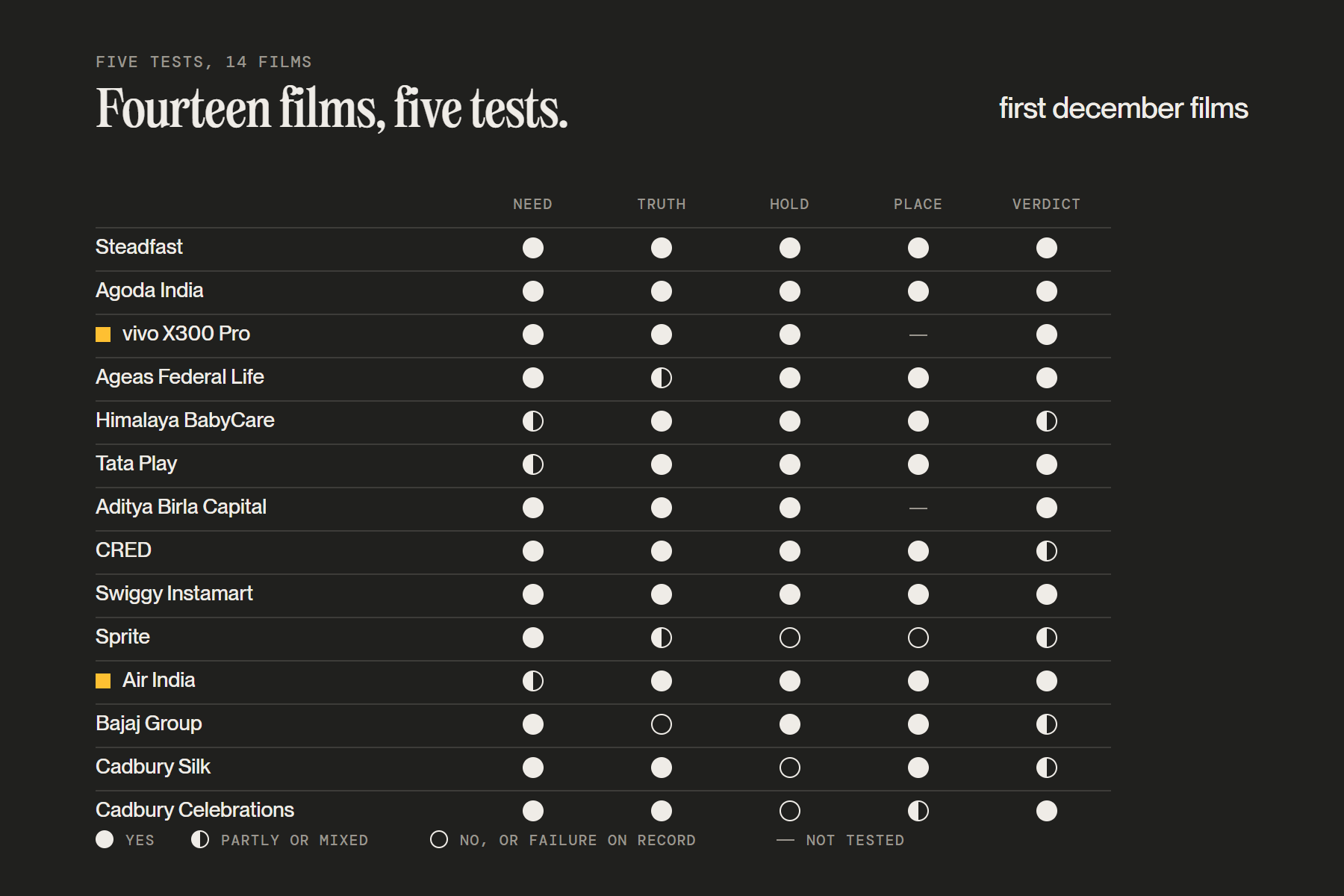
We ran every film through five questions. They come from our own pipeline, where every AI shot passes a realism gate before it is kept, and from what the audit above shows audiences notice.
- Need. Did the AI make something a camera could not make, or could not afford?
- Truth. Does the film avoid asking AI to stand in for something the audience knows is real: a person, a product result, a place, a piece of history?
- Hold. Do faces, products and places stay consistent from shot to shot, with no failure on record?
- Place. Does it feel true to where it is set?
- Outside verdict. What did juries, critics and comments say?
| Film | Need | Truth | Hold | Place | Outside verdict |
|---|---|---|---|---|---|
| Steadfast, Don’t Look Up | Yes | Yes | No issue on record | Yes | Cannes Bronze, Kyoorius Blue Elephant |
| Agoda India, What A Save | Yes | Yes | No issue on record | Yes | GAM Silver |
| vivo X300 Pro (ours) | Yes | Yes | No issue on record | Not tested | GAM Bronze; 0 AI comments |
| Ageas Federal Life, Cradle to Crease | Yes | Partly: a real star, de-aged with his part in it | No issue on record | Yes | Positive review |
| Himalaya BabyCare, Tiny Talks | Partly | Yes | No issue on record | Yes, eight languages | GAM Gold (title match); "cuteness than craft" |
| Tata Play, Samajhdar Bano | Partly | Yes | No issue on record | Yes, three languages | Positive review |
| Aditya Birla Capital | Yes | Yes | No issue on record | Not tested | GAM Silver |
| CRED with Gambhir and the Deols | Yes | Yes, the AI is the joke | No issue on record | Yes | GAM Bronze; "grotesque" (afaqs) |
| Swiggy Instamart, Ajay Devgn | Yes | Yes, the AI is the joke | No issue on record | Yes | Positive review |
| Sprite city films | Yes, for scale | Mixed | Issue on record: wrong bridge | No, in Kolkata | Top PRmoment rating |
| Air India (ours) | Partly: scale | Yes | No issue on record | Yes, tested on every shot | 0 AI comments in top 50 |
| Bajaj, Kathni Karni Ek Si | Yes | No: Gandhi’s "approval" | No issue on record | Yes | Praised; ethics questioned |
| Cadbury Silk, The Story of Us | Yes, for scale | Yes | Delivery failures on record | Yes | Large reach; complaints of no video |
| Cadbury Celebrations | Yes | Yes | Tool failure on record | Partly | Kyoorius Baby Blue Elephants |
The five-test scorecard. "No issue on record" means no critic or comment we found reported a failure, not that none exists.
Which was India’s first AI ad?
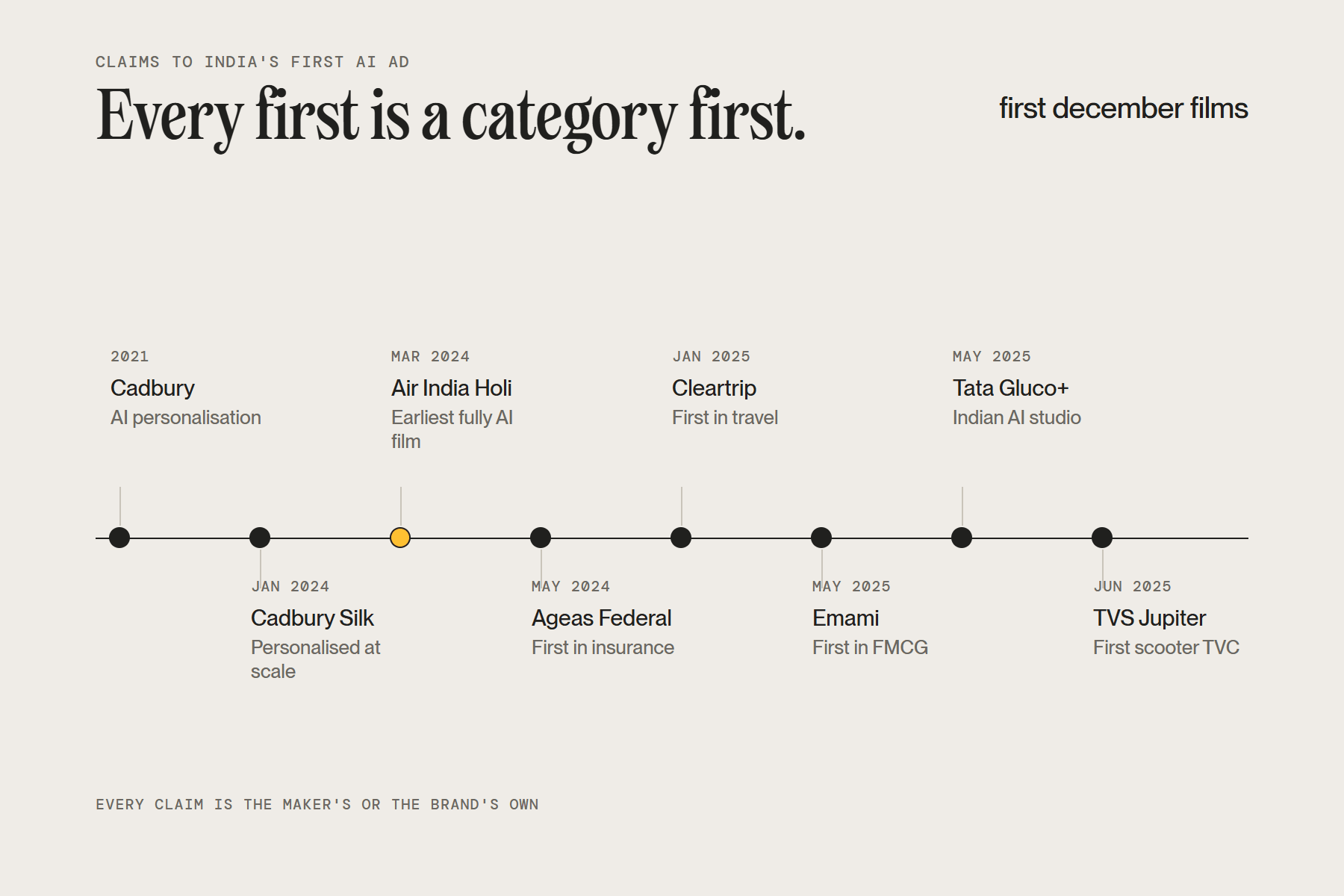
There is no single answer, because every "first" in Indian advertising is a first within something: a category, a format, a method. Here are the main claims in order.
| Date | Film | The claim, in its makers’ or brand’s words | What it actually was |
|---|---|---|---|
| Diwali 2021 | Cadbury, Shah Rukh Khan "My Ad" | "the first big, mainstream campaign in India that used AI", per Cheil India’s Sudhir Das, paraphrased by Social Samosa | AI personalisation of a filmed star’s voice and face |
| 28 January 2024 | Cadbury Silk, The Story of Us | "the first time customized AI video generation at scale is being attempted" | Personalised animated films at scale |
| 24 March 2024 | Air India, Colours of Travel | No claim; uploaded as "Air India’s AI generated Holi Film" | The earliest fully AI-generated brand film we found in this period, 27 seconds |
| May 2024 | Ageas Federal Life | "the first brand in India’s BFSI sector to use DeepFake technology positively" | A sector first |
| 14 January 2025 | Cleartrip | "the first AI film in the travel and tourism category for India" | A category first |
| May 2025 | Emami DermiCool | exchange4media, 10 May 2025: "India’s first fully AI-generated FMCG ad" | A category first |
| 20 May 2025 | Tata Gluco+ | "first AI film developed for an Indian Brand, by an Indian AI Studio" | A qualified first |
| 4 June 2025 | TVS Jupiter 110 | "the first-ever fully AI-generated television commercial for a scooter brand in India" | A category first |
Competing "firsts", each quoted from its maker, its brand or the trade press. The Air India Holi film of March 2024 is not the 2026 film we made.
The settled version: Cadbury’s 2021 campaign is the earliest mainstream Indian ad using AI that the trade press cites, and Air India’s Holi film of March 2024 is the earliest fully AI-generated brand film we could confirm from 2024 onwards. Every later "first" is true only inside its category.
How do India’s AI ads compare with Coca-Cola, Toys"R"Us and the rest?
The arc abroad looks like India’s: AI firsts, then backlash, then a turn towards AI inside live action.
| Film | What AI did | What happened |
|---|---|---|
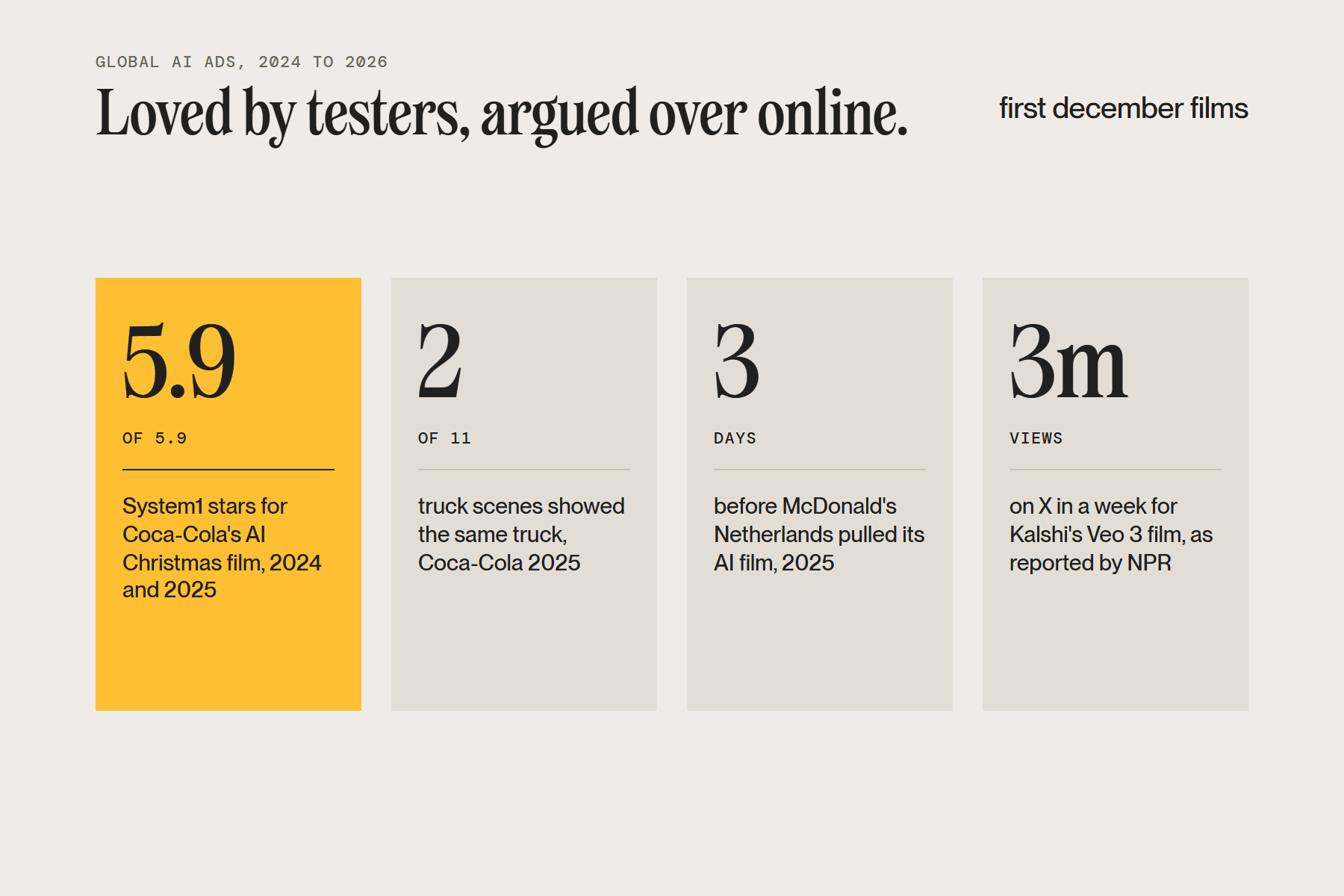
| Coca-Cola, Holidays Are Coming, 2024 and 2025 (US and UK) | Remade a famous Christmas film with AI | Scored System1’s maximum 5.9 stars both years, while the industry criticised it; in 2025 only two of 11 truck scenes showed the same truck |
| Toys"R"Us, 2024 (US) | A brand origin film made almost entirely with OpenAI’s Sora | Harsh criticism online, including complaints about hands and character consistency |
| McDonald’s Netherlands, December 2025 | An AI Christmas film | Pulled after three days after viewers called it "creepy" and "poorly edited" |
| Kalshi, NBA Finals, 2025 (US) | A chaotic, meme-style film made with Google’s Veo 3 | Praised for matching a chaotic brief; NPR reported 3 million views on X in a week |
| Under Armour with Anthony Joshua, 2024 | An "AI-powered" film | A row over reused footage shot by another director |
| LG Uplus, 2024 (South Korea) | A 30-second film made with no filming at all | Its makers put the cost at about 60% of a 3D-animated film; no public reaction on record |
| The RealReal, The Last Real Man, 2026 (US) | An AI world around one real handbag | Cannes Lions Silver and Bronze, as reported by a tool vendor |
Global AI ads, 2024 to 2026.
Jeff Bowerman, an executive creative director at Dept, wrote in Creative Review that Coca-Cola’s 2025 film would have been "a far more sympathetic and no less impressive solution" with "real people in front of the camera with an AI-generated truck and backdrops". That is the hybrid route India’s juries rewarded.
Two differences matter for an Indian brief. Coca-Cola could remake a film audiences already loved and still earn System1’s top score from test viewers; Indian brands rarely have a film that famous, so their AI work has to earn attention from scratch. And India’s best AI work so far is live action with an AI element, the same thing Simon Dolsten, an AI director in New York, argued for when he wrote in LBB: "You shoot the performance live, because nothing synthetic yet matches the micro-expressions that make a face read as human."
What do the best AI ads have in common?
Put the 14 films and the cautionary four side by side and four things separate them.
- The AI does a job the camera cannot. A rat that acts, a peacock that lands, a younger Tendulkar, a thousand Devgns. When the AI could have been a camera, viewers ask why it was not.
- Something real carries the film. A performance, a known face, a live-action plate the AI inherits its light from. On the films with a real person at the centre, 2.3% of top comments mentioned AI.
- Nothing real is faked. Not a person’s approval, not food, not a brand’s own past, not a city. ASCI’s guidelines of 29 September 2026, which take effect three months after publication, ban fabricated testimonials, exaggerated results and non-existent locations shown as real, even with a label. Our guide to whether AI ads are legal in India covers what those guidelines and the IT Rules 2026 ask.
- Someone checked every shot. The Kolkata bridge, the changing face in DermiCool, the trucks in Coca-Cola’s film: each is a failure a person reviewing shots would have caught. On Air India we kept about one generation in six.
Ganesh Pareek, a partner and creative director at First December Films, said it plainly to Social Samosa in April 2026: "A camera can only do what a camera can do. But with AI, I can do things a camera never could." The best films on this list kept the camera for everything the audience needed to be true. Piyush Pandey, who led Ogilvy’s creative work in India for decades, set the bar in January 2024, speaking of an animator’s invisible work: "That is the true use of technology when you never comment on it."
When does this list not apply?
Skip it if you are making performance creatives for social testing. Variant ads at volume are judged by click-through and cost per result, not by juries or comment sections, and different rules apply.
Skip it if your brand already owns a film people love. Coca-Cola’s result suggests a familiar idea can survive an AI remake with viewers, even when the industry objects. Most brands do not have that asset.
Read it with care if your category is health, money or results. The cautionary films show what happens when AI replaces something real, and in those categories ASCI’s guidelines make that a compliance problem as well as a creative one.
And remember that 14 films picked by evidence are not a law. Comment sections are small, view counts are bought, and awards reflect what was entered. These are the best signals available in October 2026.
How much does an AI ad film like these cost?
That depends on whether the film is fully AI, hybrid or live action, and on how many films it is. Our guide to AI ad film cost in India sets out what each route costs, where the money goes, and how to decide at the brief and then shot by shot.
Get a producer’s read on your AI idea
Every film on this list was decided before anyone generated a frame: what the AI would do, what had to stay real, and who would check each shot.
If one scene in your script feels impossible to promise, bring it to us as a one-scene feasibility test before full production. You can paste your script into our script analyser for a free producer’s read, or send us the brief and a producer will tell you which shots to shoot, which to generate and which to blend.
First December Films is an advertising film production company in Mumbai. Our work has won more than 150 international creative awards, including Cannes Lions, D&AD and One Show Gold Pencils.
Frequently asked questions
What are the best AI ads made in India?
On the evidence of awards, critics and audiences, the strongest include Steadfast’s Don’t Look Up, Agoda India’s What A Save, Tata Play’s owl and donkey films, Himalaya BabyCare’s talking babies and CRED’s AI films with Gautam Gambhir. Each used AI for something a camera could not do, inside a story people built.
Which was the first AI ad in India?
There is no single first. Cadbury’s 2021 Shah Rukh Khan campaign is the earliest mainstream Indian ad using AI that the trade press cites, through personalisation. The earliest fully AI-generated brand film we could confirm from 2024 onwards is Air India’s Holi film of 24 March 2024. Later firsts, such as Emami’s and TVS’s, are firsts within a category.
Why do some AI ads get backlash in India?
In our audit of 636 YouTube comments, anger focused on films where AI replaced something real, such as the actors or a brand’s own history. Tata Gluco+’s 2025 film alone drew 26 of the 67 comments that mention AI. Films where AI was the joke, or made something plainly impossible, drew far fewer complaints.
Do AI ads win awards in India?
Yes, mostly when AI sits inside live action. In 2026 Steadfast’s Don’t Look Up won a Cannes Lions Bronze and a Kyoorius Blue Elephant, and the only Good Ads Matter Gold for a brand’s AI film went to an AI-integrated live-action film. The Good Ads Matter category for films made wholly or mostly with AI gave no Gold.
Did First December Films make Air India’s AI ad?
Yes. First December Films made the AI film for Air India’s There is an Air About India campaign with Vaibhav Sooryavanshi, released in September 2026 with the agency McCann. It runs 102 seconds, about a hundred shots chosen from more than 600 generations, and passed 7.5 million views on Air India’s channel within three weeks.
Should a brand label an AI ad in India?
Platforms label realistic AI content under India’s IT Rules 2026, and ASCI’s guidelines of 29 September 2026 require a label where AI could change what a buyer believes. In our audit, disclosure on the upload did not change how often viewers mentioned AI, at 10.1 percent with a disclosure and 10.8 percent without.
How do you make an AI ad that audiences accept?
Give the AI a job a camera cannot do, keep something real at the centre, such as a performance or a known face, never fake a person, a result or a place, and have a person check every shot before it is kept. On films built around a real person, only 2.3 percent of top comments mentioned AI.