
The short answer. AI previs means using image and video models to plan a film before anyone shoots or generates it: mood boards, storyboards, animatics and previs, made in hours instead of days. Use it to settle look, story order and timing, and get every frame signed off as a still. Do not use it to promise a performance, a lens or a camera move that the shoot cannot repeat.
Pre-production is where a commercial is cheapest to change. Our TVC process guide puts it plainly: the pre-production meeting (the PPM) exists "to move every argument off the shoot day, where an argument costs a full crew day". AI has made the pictures that settle those arguments very fast and very convincing. That speed is useful, and it is also where most of the new mistakes start. We make live-action, hybrid and fully AI films for brands in India and abroad, and our AI page lists pitch films and animatics for agencies as a format we make. So we went looking for what the rest of the market says. We read the 43 pages that rank in Google for AI storyboards, AI previs and AI animatics in the US, the UK and India, captured 14 answers from ChatGPT, Gemini and Google’s AI Overviews, collected what 50 named practitioners in 14 countries have said on the record, and checked the terms of 16 AI storyboard and previs tools against what an agency should want before it uploads a client’s unreleased script. This guide is the result.
Published 23 October 2026. Tool terms and prices were checked on their own pages on 21 October 2026; currency conversions use European Central Bank rates of 21 October 2026. This is a producer’s guide, not legal advice.
Key takeaways
- AI previs is the use of generative image and video models to make the planning pictures of a film (mood boards, storyboards, animatics, previs) before the shoot or the final generation. It changes how fast those pictures arrive and how finished they look, not what each one is for.
- Make each picture only as finished as the decision it has to settle. AI suits decisions about look, story order and timing. It cannot give you a measured camera position, a real lens or a performance you can repeat; Runway’s own guide says numbers pulled off a generated frame "describe a camera that never existed".
- AI animatics have reached ad research. Kantar says 15% of the unfinished ads it tested in India in 2025 were generative AI animatic films, 80% of them in the last six months. But a research animatic is a promise: the finished film has to stay close to what was tested.
- Most AI storyboard tools are not built for a client’s secrets. Of 16 tools we checked on 21 October 2026, 7 say in their own terms that they may train on what you upload, Midjourney makes your images public by default, and none offers an IP indemnity on a self-serve plan.
- The cost of pre-production pictures has fallen sharply, but the cost of a wrong decision has not. A UK studio publishes research animatics at £4,000 to £15,000 per route (about $5,400 to $20,100), against the $60,000 to $80,000 an Ipsos executive says he heard for an animatic in the old arms race.
- Sign off stills before anything moves. A change to a character, costume or location is cheap on a still and expensive in motion, on a set or in a generation.
What is AI previs?
Previs (previsualisation) is a planning version of a film made before production, so the director, crew and client can see shots and sequences before paying to make them. The Previsualization Society, launched in 2009 and inspired by a joint committee of the American Society of Cinematographers, the Art Directors Guild and the Visual Effects Society, described it as "a collaborative process that generates preliminary versions of shots or sequences, predominantly using 3D animation tools and a virtual environment" (Post Magazine, 2009).
AI previs is the same job done with generative models. Instead of building a 3D scene or drawing frames by hand, a director, art director or producer generates the frames from text and reference images, keeps characters and products consistent across shots, and animates the stills into a timed cut with a scratch voice and music. The output can look nearly finished, which is the whole appeal and most of the risk.
In advertising the word previs covers several jobs that are worth keeping apart, because AI is good at some and useless at others:
- Pitchvis shows the potential of an idea before it is funded or approved, to win buy-in. Epic Games describes it as previs that "usually occurs before a project is even greenlit" (Unreal Engine).
- Techvis works out the exact technical requirements of a shot: cameras, cranes, rigs, distances. It needs real measurements.
- Postvis drops placeholder effects into shot footage so the edit can proceed.
In India the same planning pictures sit inside the agency’s approval chain for a TVC (a television commercial) or a DVC (a digital video commercial): the agency’s board for the client, the director’s treatment, the PPM deck and the shooting board. In the US and the UK the pitch versions are often called rip-o-matics or photomatics. The jobs are the same everywhere.
Mood board, storyboard, animatic, previs: what is the difference?
A storyboard is a sequence of still frames showing what each shot contains. An animatic is a storyboard set to time, usually with a scratch voiceover, music and simple camera moves, so the client can feel the pace of a 30-second film. Previs adds space and movement: where the camera is, how it moves, how the action is blocked. A mood board sets the look before any of them: colour, light, texture, casting type, wardrobe.
Each one exists to settle a different decision, and each needs a different level of finish. This is the ladder we use to decide what to make, and where AI helps or misleads.
| Pre-shoot picture | What it settles | Who signs it off | Where AI helps | Where AI misleads |
|---|---|---|---|---|
| Mood board and look development | Colour, light, texture, casting type, wardrobe, the world of the film | Director, agency creative director, brand | Fast options in a consistent look; tests a look before anyone builds it | Pulls the look toward what the model does well, and borrows from reference images you may not have rights to |
| Agency storyboard | Whether the idea and its order make sense to the client | Brand marketing team | Clear frames in hours; lets the agency show instead of explain | Polish hides a thin idea; the client approves the rendering, not the story |
| Director’s treatment and shooting board | How the director will shoot it, shot by shot | Agency, brand, then the crew | Exact frames for the PPM; casting and location stand-ins | Implies lenses, light and performances the DP and actors have not agreed |
| Production animatic | Pace, timing, voiceover and music in a 15 to 60 second cut | Agency and brand, before the shoot or generation | Timed cuts with motion and scratch audio in a day or two | Clients fall for a generated performance or move that cannot be repeated |
| Research animatic | Whether consumers respond to the idea in a pretest | Brand insight team and research agency | Photoreal versions of several routes cheaply | Tests a film you may not be able to make; lip sync and timing errors drag scores |
| Pitchvis and AI test film | Whether a difficult or new idea is possible, and how it will feel | Brand, investors, or the agency’s pitch team | Proof of concept of one hard scene before the budget is committed | A demo is not a production plan; one good shot is not thirty |
| Techvis | Camera positions, distances, rigs, set builds | Director, DP, production designer, VFX supervisor | Very little today | Has no measurable space; numbers from a generated frame are invented |

Make each picture only as finished as the decision it has to settle. A mood board that looks like a final frame will be judged as a final frame. A research animatic that looks better than the film you can afford is a problem you have bought in advance.
What changes when AI makes the pictures?
Three things change, and all three are visible in what practitioners have said in the last two years.
Speed. When Mazda’s agency in South Africa, Boundless, had two days and no budget for a video animatic, it made one with AI. "Our usual process would take at least 10 days, involving illustration, animation, VO, and music", the agency’s chief creative officer, Roanna Williams, told System1, which tested the animatic with consumers before the final film (System1, 20 February 2026). Jian Yi Lay, a group creative director at VaynerMedia in Asia-Pacific, says work that "involved many steps like booking resources, crafting visuals, scouting photo libraries, animatics and recording VO guides, can now be done within hours" (LBB, 21 April 2026).
Finish. Pitches now arrive looking like films. "Clients have always wanted to ‘see the film before you make it’ and we’ve never been closer to wowing them before recording anything", said Henry Scriven, a creative director at Eight&Four in London (The Drum, 3 November 2025). Pablo Díaz, an editor at SOMOS5 in Madrid, says AI "has turned the visual treatment into something closer to a prototype of the film" (LBB, 28 September 2026). In India, Nisha Singhania, co-founder of Infectious, told Campaign India that agencies have "moved from static decks to immersive, AI-assisted storytelling" (Campaign India, 18 June 2025).
Who makes them. The pictures that a storyboard artist or an animatic house once made are now often made inside the agency. Mick Sutter, chief creative officer of the US agency WHITE64, told Digiday that AI is "already replacing or augmenting many of the intermediary tools we used to rely on like comps, storyboards, rip-o-matics, animatics" (Digiday, 13 March 2026). Agency art directors on Reddit describe being asked for "photo realistic storyboards for research" and finished-looking animatics they make themselves (r/advertising, 14 January 2026).
What does not change is the purpose of each picture. A board still exists to agree the story; a shooting board still exists to brief the crew. The danger is that finish arrives before agreement.
Where does AI help before the shoot, and where does it stop?
Look development and mood boards
This is where AI is strongest and safest. A look can be explored in a dozen directions in an afternoon, shared with the client, and narrowed before anyone builds a set or trains a model. The founders of Rhino & Oxpecker Productions told Campaign Middle East they see value "from mood boards, visual references, storyboards and animatics in pre-production" (Campaign Middle East, 15 October 2026). Studio Blo’s co-founder Dipankar Mukherjee says the Mumbai studio still commissions illustrators for "original artworks and characters" before it trains models on them (Social Samosa, 3 June 2026). That order matters: a look that starts from your own art is a look you own.
Storyboards and shooting boards
AI can now hold a face, a product and a location steady across a sequence, which was the main failure two years ago. "The look of that character can vary widely from one rendering to the next", Derek Powell of the US production company Tool said in 2024 (LBB, 27 February 2024). Runway’s Gen-4, released on 31 March 2025, was built to "generate consistent characters, locations and objects across scenes" (Runway), and 11 of the 16 tools we checked now have a character or product consistency feature.
What a board cannot carry is the craft that turns it into a film. Paul Mansfield, senior creative director at PLAYE in Australia, used a detailed storyboard to anchor an AI film for Fortescue and warns: "You have to give it guardrails. If you give it too much room, it guesses" (Campaign Brief, 24 July 2026).
Animatics for approvals
A timed animatic with motion and scratch audio is the single most useful AI pre-production picture for a brand team, because it answers the question every approver is really asking: how does this feel at 30 seconds? Mazda South Africa’s head of marketing, Deolinda Da Costa, said the AI animatic "reduced ambiguity, accelerated internal multi-stakeholder approvals, and built early momentum behind the idea" (System1, 20 February 2026). Eight of the 16 tools in our audit make a timed animatic you can export.
Animatics for research
This is the newest use, and the one with the most money riding on it. It gets its own section below.
Pitchvis and AI test films
When a shot has never been made, the honest answer is to make it once before promising thirty. Lester Platt of STLL Studios in Texas says his team made "a two-minute proof of concept using AI tools like Higgsfield in about a day" to pitch a feature to investors, and adds that because visuals are easy now, "what really makes a pitch stand out is still the strength of the concept" (LBB, 6 May 2026). In Indonesia, LiQuid’s AI unit ran "visual tests, integration trials, compositing checks and lighting simulations" before the shoot of a hybrid Biznet commercial (Campaign Brief Asia, 25 February 2026).
Techvis: where AI stops
AI previs does not give you space. Runway, which sells the tools, is blunt about it: AI previs "does not produce measurable space, so any shot with something physical to plan, meaning a rig, a performer or a set build, still needs a traditional previs or techvis pass" (Runway, 28 August 2026). Autodesk researchers presenting at CHI 2026 found that image and video models "lack spatial grounding: precise placement of objects and camera, blocking, and continuity are difficult to control" (arXiv, 3 February 2026). If a shot depends on a crane height, a motion-control move or a stunt, plan it in 3D with real measurements.

Do AI animatics test as well as finished ads?
Animatics have been a standard stimulus in ad pretesting since about the 1980s, by the account of Ipsos’s Pedr Howard. That stimulus is turning into AI video quickly. Prasanna Kumar, Kantar’s executive vice president for India, writes that 15% of all unfinished ads Kantar tested in India in 2025 were generative AI animatic films, and that 80% of those appeared in just the last six months. He calls it "a clear workflow shift, not experimentation" (Kantar).
Three findings from three different datasets are worth holding together, without mixing them:
- India, unfinished films. In India, Kantar says, generative AI ads "perform at par with traditionally produced ads, including on emotional response metrics", while globally they "tend to score slightly lower". The weak spots it lists are under-expressed emotional cues, lip sync and timing mismatches, and faces that look more realistic than the scene around them.
- Global, finished ads. Across Kantar’s LINK database, ads created with generative AI averaged the 54th percentile on overall impact against the 65th for ads made without it (Kantar, 26 March 2026).
- US, matched pairs. Ipsos and Syracuse University rebuilt 10 human-made 30-second ads with AI, using Gemini to write a brief from each ad and Sora 2 to generate it, then tested all 20 with 3,000 US consumers. The human-made ads were 14% stronger on short-term effectiveness and 17% stronger on long-term effectiveness (Ipsos, May 2026).

The more important warning comes from inside the research industry. Pedr Howard, head of creative excellence at Ipsos in the US, wrote that animatics "often score higher than fully produced, finished films", that he "heard $60,000-80,000 or more per ad" for animatics at the height of the arms race, and that the whole method "is reliant on the finished ad being as close to the animatic as possible" (The Drum, 9 July 2025).
That is the rule we would give any brand. Test the film you can actually make. If the research animatic is photoreal AI, decide before testing whether the final film will be AI, hybrid or shot, and make the animatic in that grammar. A research animatic that wins with a generated performance you will later recast is a test of a different film.
How should you run AI pre-production on a commercial?
The order matters more than the tools. This is the order we recommend, built from our own published AI pipeline and live-action process and from what the practitioners above learned the hard way.
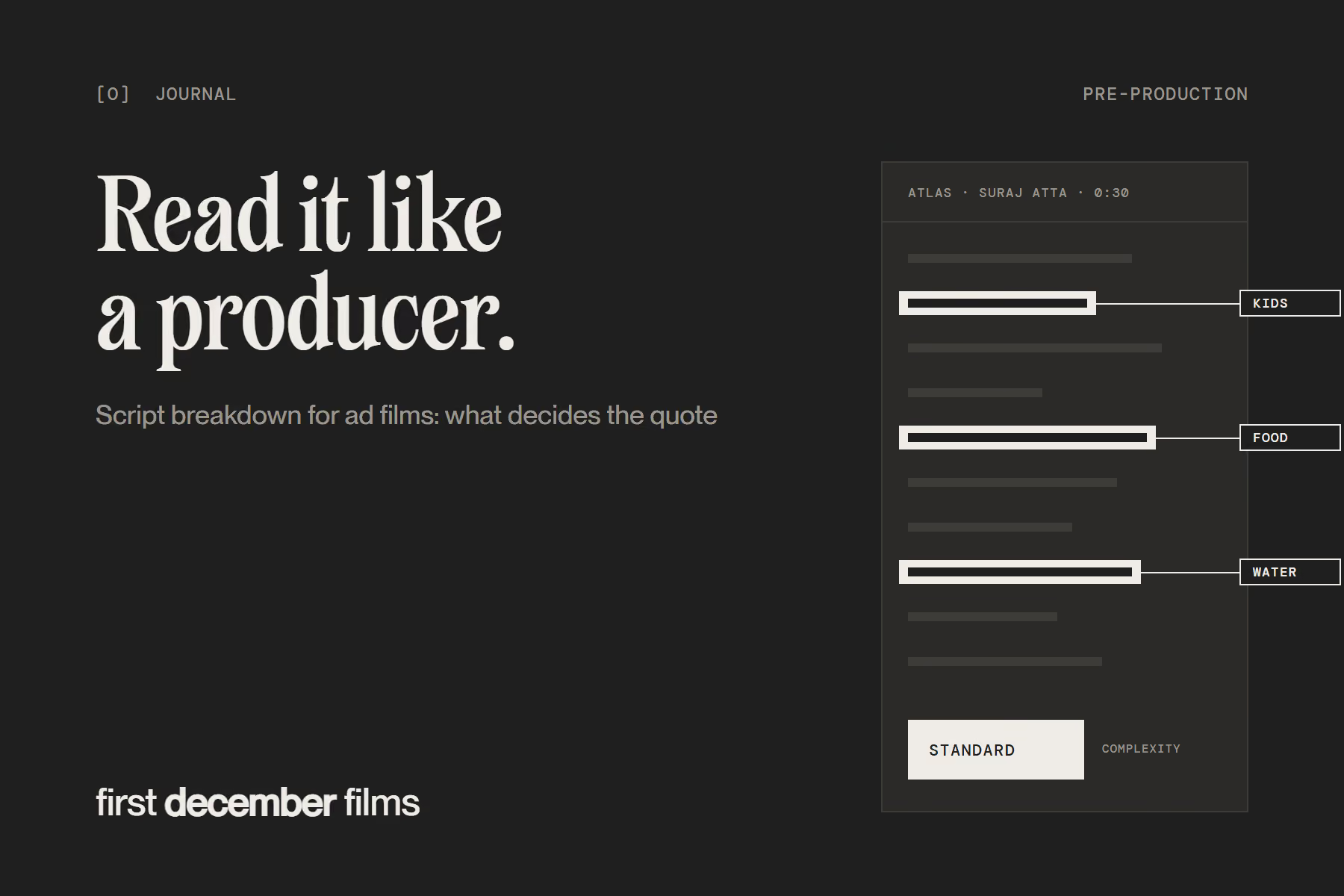
- Break the script down before generating anything. On our AI films the first stage is a script breakdown: "A production map of scenes, characters, locations and risk areas. No generating yet." The same map tells you which shots belong to a camera and which to a model. Our script breakdown guide shows how a producer reads a script before quoting.
- Agree the look as a bible, not a vibe. Approve characters, costume, locations and rules of the world as reference stills. On AI films we call this the asset bible.
- Board it as stills and sign the stills. Every frame approved as a still before it moves. We call this image lock, and our pillar post on how AI commercials are made describes it as the storyboard, shot for real. Kingsley Harden, a VFX supervisor at Jogger Studios in the US, gives the same advice from the other side: "always get your initial reference frames approved before moving into video" (LBB, 29 April 2026).
- Cut a timed animatic with scratch audio. This is where pace, voiceover length and supers (on-screen text) get fixed.
- Decide shot by shot: camera, model or both. Real people, products and places usually belong to a camera. On hybrid films we shoot the plates first, then extend them with AI, "so the AI inherits real light instead of inventing it".
- Lock in a PPM. Bring the person with final approval. Every change after this point costs a crew day on a set or a regeneration in an AI film.
- Test the riskiest shot before committing the budget. If one scene feels too specific, too risky or too hard to keep believable, we turn it into a paid look-development and feasibility test before full production. On Razorpay’s 32 founder films for IPL 2026 (the Indian Premier League cricket season), set-up and "a paid test film" came first, then about one film a day.
Our partner Ganesh Pareek put the stakes simply when India’s advertising regulator, ASCI, proposed AI labelling rules: "the imageboard approval stage becomes the most critical legal and creative gate in the entire process" (BestMediaInfo, 18 May 2026). Approval of stills is where taste, consent and compliance can all be checked while a change is still cheap.

What goes wrong with AI boards and animatics?
The client falls in love with a frame nobody can repeat
Harden describes a partner who "fell in love with the performance of a generated character, except for a few minor details". When he fixed the details and regenerated, the new output "created a completely different performance". A generated performance is a lucky draw, and a shoot or a second generation will not draw the same card. A filmmaker on r/aifilmmaking put it as "falling in love with an AI shot that’s impossible to recreate practically" (Reddit, September 2026).
The previs overrules the cinematographer
"The artists generating it are not trained directors of photography," Harden says, "and when you hold too tightly to AI-generated camera work and lighting, you risk sidelining the director of photography on set." A board should brief the DP, not replace the conversation.
Polish hides a weak idea
A live-action storyboard artist on r/Storyboarding describes following an agency’s AI boards until the agency and client realised the commercial "had absolutely no substance, and they had just been "wow"d by the highly rendered pictures" (Reddit, June 2025). Ryan Knowles, a creative director at Electric Theatre Collective in London, warns that polished images made by agencies, clients and directors "risk shortcutting the creative development" (VFX Voice, autumn 2025).
Everyone freezes the plan
Dissara Udomdej, chief executive of Yell in Bangkok, said in 2024 that once everything is clear from the start, clients "want to stick to the original plan like it’s a maths problem", which leaves directors no room for a better idea on the day (LBB, 27 February 2024). A board is a plan, not a contract for every frame.
The research animatic oversells the film
See the section above: test what you can make, in the grammar you will make it.
The board borrows faces it has no right to
An animatic that uses a recognisable actor’s or celebrity’s face, or a look-alike, before anyone has signed anything is a consent problem even if it never airs, because research audiences and pitch rooms are audiences too. Our guide to AI actors in ads covers consent, pay and the rules by market.
Which AI storyboard tools are safe for a client’s script?
An agency storyboard often contains the most confidential material a brand has: an unreleased product, a launch date, a celebrity in talks. The Association of Independent Commercial Producers’ Post Council in the US advises producers to "use a closed loop system that doesn’t train on your or agency’s confidential information (e.g., scripts, storyboards, etc.)" (AICP, August 2025).
So we checked. On 21 October 2026 we read the pricing pages, terms, privacy policies and help pages of 16 tools that rank for AI storyboards or that productions use for frames and test shots, and scored each on five things an agency should want before uploading a client’s script: commercial use, no training on your inputs, private by default, ownership of the output and an IP indemnity. A 2 means the tool says it clearly on its own pages for its cheapest paid commercial plan; a 1 means only on enterprise plans, behind a setting, or unclear; a 0 means not stated, or the opposite.
| Tool | Commercial use | No training | Private | You own it | Indemnity | Score /10 | From USD/mo | Animatic |
|---|---|---|---|---|---|---|---|---|
| Boords | 2 | 2 | 2 | 2 | 0 | 8 | 39 | Yes |
| Adobe Firefly (with Boards) | 2 | 2 | 1 | 2 | 1 | 8 | 9.99 | Yes |
| Krock.io | 2 | 2 | 2 | 1 | 0 | 7 | 10 | Yes |
| Canva | 2 | 1 | 1 | 2 | 1 | 7 | 1.40 | Partly |
| Storyboarder.ai | 2 | 2 | 1 | 1 | 0 | 6 | 53 | Yes |
| Higgsfield | 2 | 1 | 1 | 1 | 1 | 6 | 9 | Partly |
| Runway | 2 | 1 | 1 | 2 | 0 | 6 | 15 | Partly |
| OpenAI ChatGPT | 1 | 1 | 1 | 2 | 1 | 6 | 4.22 | No |
| LTX Studio | 2 | 1 | 0 | 2 | 0 | 5 | 35 | Yes |
| Midjourney | 2 | 0 | 1 | 2 | 0 | 5 | 60 | No |
| Intangible | 1 | 1 | 1 | 2 | 0 | 5 | 35 | Yes |
| Kling AI | 2 | 0 | 0 | 2 | 0 | 4 | 8.80 | Partly |
| Katalist | 1 | 0 | 0 | 2 | 0 | 3 | 19 | Yes |
| StoryboardHero | 2 | 0 | 0 | 1 | 0 | 3 | 19 | Partly |
| Google Flow | 1 | 1 | 0 | 1 | 0 | 3 | 4.99 | Partly |
| Previs Pro | 0 | 0 | 0 | 0 | 0 | 0 | 10 | Yes |
Source: each tool’s own pages, read 21 October 2026. From USD/mo is the cheapest plan that allows commercial use; Animatic means it exports a timed animatic; Canva and ChatGPT were listed in rupees and are converted at 94.47 rupees to the dollar; Storyboarder.ai’s price is an offer ending 31 October 2026; Midjourney requires the Pro plan for companies with more than $1 million in annual revenue.

What the audit found:
- Seven of 16 say they may train on your uploads or outputs by default: LTX Studio, Higgsfield, Runway, Google Flow, ChatGPT’s consumer plans, Kling and Canva. Only three of those let you switch it off yourself. Runway’s standard terms say "Inputs and Outputs may be used by the Company to train and improve its AI models" (Runway terms); its enterprise terms say the opposite (Runway Enterprise).
- Four say clearly that they do not train on your inputs: Boords, Storyboarder.ai, Krock.io and Adobe Firefly. Boords’ security page says it "does not train, retrain, or fine-tune any AI or machine learning models using customer data" (Boords).
- Midjourney is public by default. Its terms say "By default, Your Content is publicly viewable and remixable", and private Stealth Mode needs the Pro or Mega plan (Midjourney terms).
- Nobody indemnifies a self-serve buyer. Four tools offer IP indemnity, and all four only under enterprise contracts: Adobe, OpenAI, Canva and Higgsfield. At least 12 of the 16 make you indemnify them instead.
- Google Flow uses human review. Its privacy notice says a sample of data is reviewed by people and tells users not to submit confidential information (Google Flow).
The practical rule for agencies: keep a client’s unreleased script, product and talent off any tool that trains on inputs or shows work publicly, use an enterprise plan or a no-training tool for live jobs, and put the tool’s name in the job’s paperwork. The median cheapest commercial plan in our audit costs $12.50 a month (about ₹1,180). Data mistakes cost more than that.
Who owns an AI storyboard?
Ownership matters less for a board that dies in a deck than for a frame that ends up in the film, but it is worth knowing where you stand in each market.
- United States. The US Copyright Office concluded in January 2025 that "prompts alone do not provide sufficient human control to make users of an AI system the authors of the output", while human "selection, coordination, or arrangement" of AI material can be protected (US Copyright Office, Part 2 report). The Supreme Court declined to hear Thaler v. Perlmutter on 2 March 2026, leaving the human-authorship rule in place (Supreme Court docket 25-449).
- United Kingdom. Section 9(3) of the Copyright, Designs and Patents Act treats the author of a computer-generated work as "the person by whom the arrangements necessary for the creation of the work are undertaken" (legislation.gov.uk).
- India. The Copyright Act gives a computer-generated work to "the person who causes the work to be created", section 2(d)(vi) (Copyright Office, India). The government’s Department for Promotion of Industry and Internal Trade (DPIIT) published the first part of a working paper on generative AI and copyright in December 2025 (European Commission IP Helpdesk).
- European Union. The AI Act’s disclosure rules in Article 50 apply to content shown to people, and for evidently artistic or fictional work the duty is limited to disclosing that AI was used (Article 50). We found nothing in the Act or in the European Commission’s guidance that addresses internal storyboards or research stimuli. If a photoreal AI animatic will be shown to consumers in research, ask your lawyer.
Tool terms add a layer on top of the law. Midjourney, for example, says a company with more than $1 million a year in revenue must be on its Pro or Mega plan to own what it makes. The AICP’s model bid language for AI work tells agencies that deliverables "may not be copyrightable, in whole or in part" (AICP). The safest boards are the ones built from art you commissioned and decisions a human made, which is also what makes a film protectable later.
What do previs, storyboards and animatics cost, with and without AI?
Published prices for pre-production pictures are rare. These are the ones we could verify on official pages, converted at the rates of 21 October 2026.
| Item | Published figure | About in USD | About in INR | Source and date |
|---|---|---|---|---|
| Storyboard artist, UK film, union minimum | £483 a day, £2,415 a week (films over £30 million) | $647 a day | ₹61,000 a day | Bectu art department rate card 2025 to 2026 |
| Story artist, US animation, union minimum | $2,622 a week (fully qualified grade, from August 2026) | $2,622 a week | ₹2.48 lakh a week | The Animation Guild wage rates 2024 to 2027 |
| Traditional previs, UK | about £1,300 a day (2017) | $1,742 a day | ₹1.65 lakh a day | Post Magazine, 2017 |
| Animatic for ad research, US, at the peak | "$60,000-80,000 or more per ad" (what an Ipsos executive heard) | $60,000 to $80,000 | ₹57 lakh to ₹76 lakh | The Drum, 2025 |
| AI boardomatic research test, UK studio | £4,000 to £8,000 per route | $5,400 to $10,700 | ₹5.1 lakh to ₹10.1 lakh | Myth Labs pricing |
| Photoreal AI research animatic, UK studio | £10,000 to £15,000 per route | $13,400 to $20,100 | ₹12.7 lakh to ₹19 lakh | Myth Labs pricing |
| AI storyboard tool, cheapest commercial plan | median of 16 tools | $12.50 a month | ₹1,180 a month | Our audit, 21 October 2026 |
| Time for a video animatic | 10 days the usual way; 2 days with AI (Mazda South Africa) | System1, 2026 |
A lakh is 100,000 rupees. Union minimums are floors, not market rates. We found no published storyboard or previs rate card for India; Indian prices are quoted job by job.
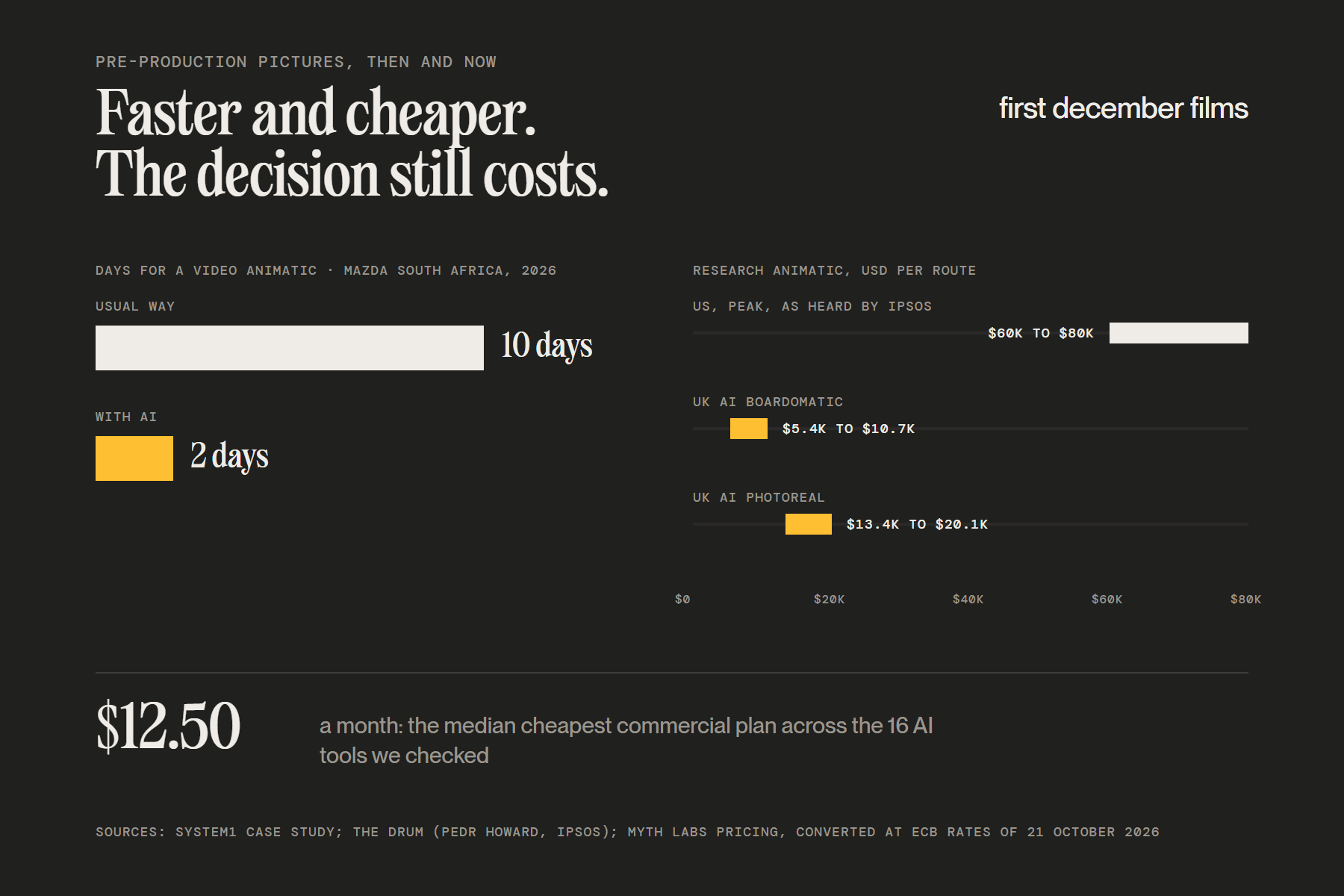
Two things the table does not show. First, AI moves cost rather than removing it: illustrator days become director, art director and producer hours spent choosing, fixing and approving frames. On our Air India film, about a hundred shots made the cut from more than 600 generations, and every one of those choices was a person’s decision. Second, the cheapest picture is the one that settles the decision first time. A research animatic that tests the wrong film is the most expensive line in the budget.
What happens to storyboard artists?
This is the part of AI pre-production that people argue about most, and they are arguing about real jobs.
When Martin Scorsese said in June 2026 that testing an AI storyboard tool on a scene "was creatively freeing" (The Guardian, 3 June 2026), the reaction was immediate. The Art Directors Guild, which bargains for storyboard artists in the US, said generative AI produces this kind of work "by ingesting large swaths of copyrighted work, likely scraped from the internet without consent, credit, compensation, or transparency" (Deadline, 10 June 2026). In Indonesia, Lina Meilina, a former storyboard artist for TV commercials, told The Guardian that she has "seen colleagues lose jobs because companies are using Midjourney", and that those who kept them had their wages cut (The Guardian, 31 May 2025).
The data is thinner than the anger. A January 2024 survey of entertainment executives for The Animation Guild and others found 15% expected storyboard, illustration and animation jobs to be at risk of consolidation, replacement or elimination by 2026 (CVL Economics). In storyboard forums we found six first-hand accounts from advertising board artists of thinner commercial work since 2024, alongside artists who are still busy and say some brands "want NOTHING to do with AI, sometimes for legal reasons" (Reddit, June 2025).
Our view: pay for the drawing where the drawing is the decision. A storyboard artist who can stage an action sequence, a director who draws, and an illustrator who creates an original character give a film things a model cannot: intent, authorship and a look nobody else has. AI is useful for the volume around them: variations, versions, stand-ins and timing. Nik Kleverov, founder of the AI studio Native Foreign, says his clients are often surprised that boards are still needed at all: "Yes, we still have to storyboard" (The Drum, 23 June 2026).
When should you not use AI before the shoot?
Skip AI frames if the film turns on a real performance: an actor’s timing, a child’s reaction, a dancer’s movement. Board it simply and cast it properly; a generated performance will set an expectation no person can meet.
Skip AI previs for anything physical. Stunts, vehicles, rigs, motion control, crane moves and set builds need measured techvis, not pictures of camera moves.
Skip photoreal research animatics if you have not decided how the final film will be made. Test in the grammar you will shoot or generate.
Skip AI tools entirely for unreleased products, launch dates and talent in negotiation unless the tool’s terms say it does not train on or publish your inputs, and you are on the right plan.
Skip the polish when the idea is not settled. Rough boards invite better notes. A finished-looking frame invites approval of the wrong thing.
How did we get here, and what changes next?
Storyboards started at Disney in the early 1930s, credited to the storyman Webb Smith, who pinned sketches in order on boards so artists could see a story rather than read it (D23). Animatics became a staple of ad research from about the 1980s, by Pedr Howard’s account. Chris Edwards, from the previs team on Star Wars Episode III at George Lucas’s Skywalker Ranch, founded The Third Floor in Los Angeles in October 2004 (Visual Effects Society), and the Previsualization Society launched in 2009.
The AI era is barely two years old. LTX Studio launched in February 2024 promising a script and storyboard from an idea. Runway’s Frames came in November 2024 and Gen-4, with consistent characters, in March 2025. OpenAI’s image generation in ChatGPT arrived in March 2025, Adobe Firefly Boards in public beta in April 2025, Google’s Flow with Veo 3 and generated audio in May 2025, and Midjourney’s first video model in June 2025. Kling 3.0 added storyboard control and 15-second clips in February 2026. OpenAI closed the Sora app on 26 April 2026 and its API on 24 September 2026 (OpenAI). Scorsese’s storyboard test in June 2026 made the argument mainstream.

What comes next, and these are forecasts, labelled by whose they are:
- Pedr Howard (Ipsos): animatics "will soon be consigned to history", replaced by AI versions anyone can make for research "in hours".
- Kingsley Harden (Jogger Studios): when previs looks finished, someone will ask why the film needs shooting at all, "and I think it will mostly fail at first".
- US ad buyers (IAB, July 2026): generative AI will be used in 43% of their ad assets by 2027, up from a third in 2026 (IAB).
- Ours: by the end of 2027, the stills sign-off before motion will be a standard line in production contracts, in the way the PPM is now, because it is where creative approval, consent for faces and AI disclosure can all be checked before anything is expensive.
Bring us the shot everyone says cannot be done
If your brief has one scene that feels too specific, too risky or too hard to keep believable, bring it to us as a paid look-development and feasibility test before you commit the campaign. Agencies can brief us for pitch films and animatics on short timelines, under NDA by default. See the Air India film for how we work, read how we judge the companies we compete with in how to choose an AI video production company, paste your script into our free script analyser for a producer’s read, or send us the brief.
First December Films is an advertising film production company in Mumbai. Our work has won more than 150 international creative awards, including Cannes Lions, D&AD and One Show Gold Pencils.
Frequently asked questions
What is AI previs?
AI previs is the use of generative image and video models to plan a film before it is shot or generated. Directors, agencies and producers use it to make mood boards, storyboards, animatics and pitch films in hours. It settles look, story order and timing well, but it cannot give measured camera positions or real lens data.
What is the difference between a storyboard, an animatic and previs?
A storyboard is a sequence of still frames showing what each shot contains. An animatic sets those frames to time with scratch voiceover and music, so you can feel the pace. Previs adds space and movement: where the camera sits, how it moves and how the action is blocked, usually built in 3D.
Can AI replace a storyboard artist?
For quick variations, stand-in frames and pitch boards, agencies already use AI instead. For action, staging and original characters, a skilled artist still gives a film intent and authorship that a model cannot. Union bodies such as the Art Directors Guild object to AI built on artists’ work used without consent.
How much does an AI animatic cost?
Published prices are rare. One UK studio, Myth Labs, lists AI research animatics at 4,000 to 15,000 pounds per route, about 5,400 to 20,100 dollars in October 2026. An Ipsos executive wrote that he heard of 60,000 to 80,000 dollars or more per animatic at the peak. The AI tools we checked cost a median of 12.50 dollars a month.
Can you use an AI animatic for ad pretesting?
Yes, and brands already do. Kantar says 15% of the unfinished ads it tested in India in 2025 were AI animatic films. Test the film you can actually make: if the final ad will be shot or recast, a photoreal AI animatic can score a version you will never air.
Who owns an AI-generated storyboard?
It depends on the market and the tool. In the US, prompts alone do not make you the author, though human selection and arrangement can be protected. The UK and India give computer-generated works to the person who arranged or caused them. Tool terms add limits, such as Midjourney’s rule for large companies.
Is it safe to put a client’s script into an AI storyboard tool?
Only if the tool’s terms say it will not train on or publish your inputs, on the plan you use. Of 16 tools we checked on 21 October 2026, seven may train on uploads by default, Midjourney is public by default, and none indemnifies a self-serve buyer. Use enterprise or no-training plans.