
The short answer. The biggest advertising trends for 2027 are slower but still healthy ad growth, platforms making basic video ads for free, hybrid AI and live action becoming the default for films that carry a brand, series and versions replacing the single hero film, flat TV beside fast CTV, and AI labels going live in most major markets at once.
Most advertising trend lists for 2027 are written by media agencies, ad tech vendors and survey firms. They tell you where the money goes. Few tell you what changes when the money arrives at a shoot: how many films a brief now asks for, which shots are generated and which are filmed, what has to be signed before anything moves, and when a cricket film has to be in production to air on time.
We make TV commercials, brand films, and AI and hybrid films in Mumbai for brands in India and abroad, so this guide reads the 2027 forecasts from the production floor. We graded every trend as well evidenced, contested or hype, named whose forecast it is and when it was published, and added what each one changes on set. Two pieces are our own: a re-cut of the 242 AI commercial campaigns we tracked for our State of AI Commercials report, and a 2027 production calendar that works back from each big moment to the date a script has to be approved.
Forecasts and sources checked on 17 November 2026. Rupee conversions use the European Central Bank reference rate of 16 November 2026 (1 US dollar = 93.93 rupees); 1 crore is 10 million and 1 lakh is 100,000.
Key takeaways
- Global advertising will still grow in 2027, but more slowly than in 2026: WARC forecasts 8.4% to $1.46 trillion, Madison and Wall 5.9%, dentsu 5.5%. India looks different: WPP Media expects a return to double-digit growth from 2027, a year that carries the last IPL season of the current rights cycle and the Men’s Cricket World Cup.
- The cheapest video ad of 2027 will be made by the platform itself. Google Ads, Meta, Amazon and TikTok all generate video ads inside their own tools at no extra cost, and nearly 10 million advertisers used Meta’s generative AI ad tools in the third quarter of 2026.
- Fully AI commercials will not replace the shoot for films that carry a brand in 2027. In blind tests AI-made ads still trail human-made ones, and award juries in 2026 rewarded direction, craft and humour. Hybrid films, shot first and extended with AI, are where premium work is heading.
- AI is buying speed more than savings. Speed to market has overtaken cost as the main reason UK advertisers use AI in production, and seven in ten agencies told D&AD they have not changed what they charge. Claims that AI cuts production cost by 50% to 95% come only from vendors.
- Briefs are turning into systems: a hero film plus cut-downs, vertical versions, creator-fronted spots and regional-language edits. Plan the versions before the shoot, not after it.
- In India, linear TV advertising is flat at about ₹32,855 crore ($3.5 billion) while connected TV grows 33%, and celebrity-led TV ad volumes fell 17% in the first nine months of 2026.
- 2027 is the first year AI label rules run in most major markets at once: the EU, China, New York, Pennsylvania and California, and India’s ad self-regulator from late December 2026. The approval trail you keep during production is now your compliance record.
What are the biggest advertising trends for 2027?
The biggest advertising trends for 2027, graded by how strong the evidence is, are below. "Well evidenced" means measured data from a primary source; "contested" means credible sources disagree; "hype" means the claim rests on vendor marketing or a single forecaster’s thesis.
| Trend for 2027 | Verdict | The evidence | What changes on set |
|---|---|---|---|
| Ad growth slows after a record 2026 | Well evidenced (direction); size contested | WARC +8.4%, Madison and Wall +5.9%, dentsu +5.5% for 2027 | Fewer budget shocks; money follows platforms |
| Platforms make basic video ads for free | Well evidenced | Veo in Google Ads globally; nearly 10 million advertisers on Meta’s GenAI tools in Q3 2026; Amazon’s free video generator in nine marketplaces | The bottom of the market stops paying for production |
| Hybrid AI and live action for brand films | Well evidenced for use; contested for share | 40% of Cannes Lions 2026 entries declared AI; AI-made ads trail human-made ones in Kantar and Ipsos tests | Shoot real plates and people, extend with AI |
| AI buys speed, not cheaper films | Speed well evidenced; big savings are hype | UK advertisers rank speed to market (36%) above cost savings; 70% of agencies have not changed prices | Earlier image lock, more versions, same core budget |
| Series, versions and creators over one hero film | Well evidenced for spend; contested for brand building | Meta partnership ads above a $15 billion run rate; 83% of marketers call short-form popular, 40% doubt it builds brands | Plan every deliverable before the shoot |
| India: TV flat, CTV and cricket up | Well evidenced | Linear TV flat at ₹32,855 crore; CTV +33% to ₹8,000 crore; IPL 2027 is the last season of the current rights | Cricket windows decide the shoot calendar |
| Fewer celebrity TV ads in India | Well evidenced for TV | Celebrity-led TV ad volumes down 17% in January to September 2026 | Shorter celebrity days, more digital cut-downs |
| AI labels and consent rules everywhere at once | Well evidenced | EU Article 50 since 2 August 2026; California from 1 January 2027; ASCI from late December 2026 | Lock and document approvals before generation |
| Trust and craft decide whether AI ads work | Contested | 49% of Americans view AI-made ads negatively; 65% of Indians say polished AI ads would improve their view of a brand | Quality bar rises; label strategy is creative |
| AI tool churn is a production risk | Well evidenced | OpenAI discontinued the Sora app and API (March 2026) | Keep pipelines tool-agnostic |
| Fully AI films replace most shoots by 2027 | Hype for brand work | One studio founder’s thesis of 90%; blind tests and awards point the other way | Keep the shoot for faces, products and places |
| AI cuts production cost by 50% to 95% | Hype | Vendor claims only; no independent cost study | Budget for direction and approvals, not prompts |

How much will advertising grow in 2027?
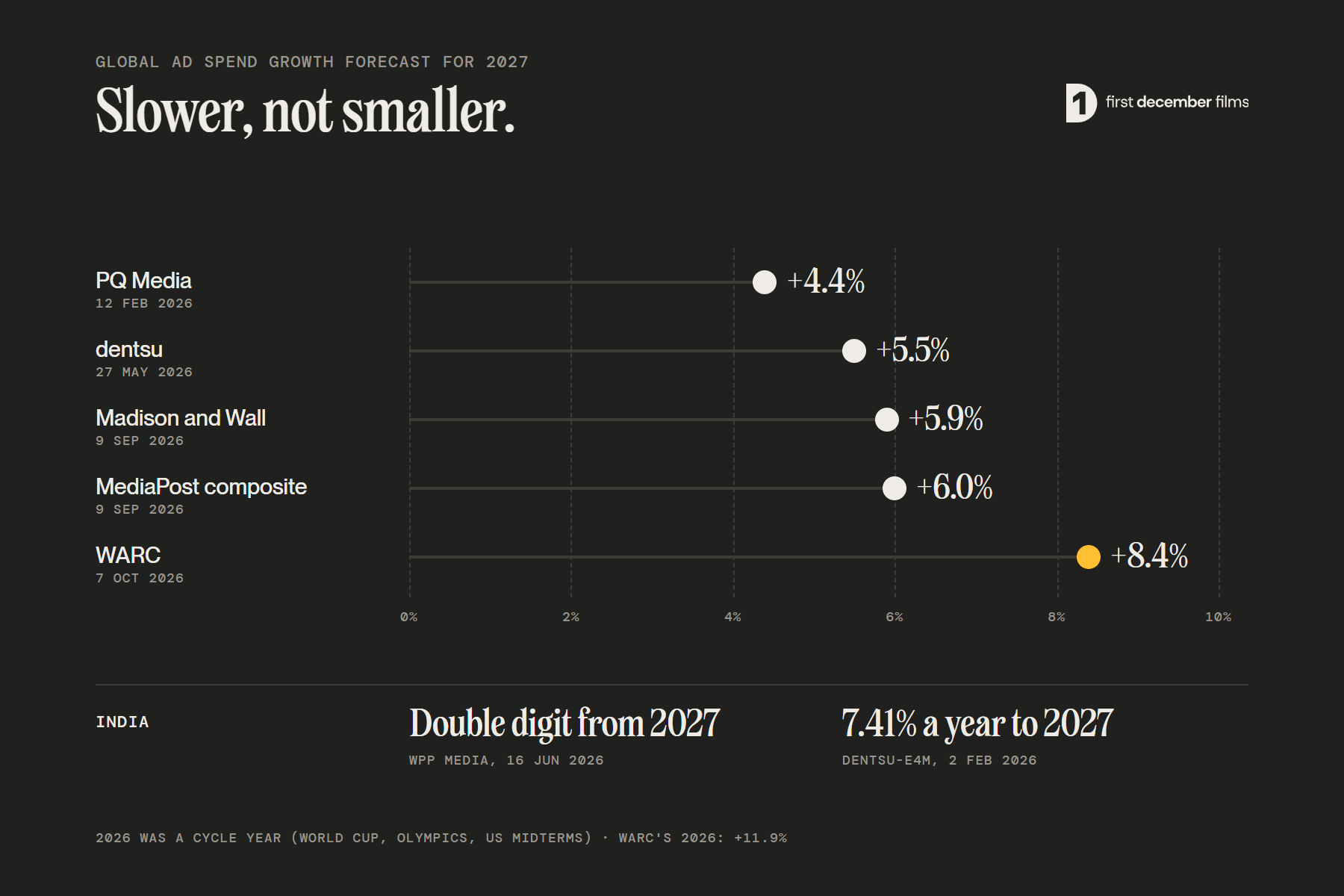
Global advertising will grow by roughly 4.4% to 8.4% in 2027, depending on whose forecast you read, after an exceptionally strong 2026. Every forecaster that has published a 2027 number expects a slowdown, and they disagree only on how much. Television is where the forecasts agree most: WARC expects global TV ad spend to shrink 1.8% in 2027, and EMARKETER expects US traditional TV ad spending to fall 15.0%.
| Forecaster | 2027 forecast | Published | Notes |
|---|---|---|---|
| WARC | +8.4%, to $1.46 trillion | 7 October 2026 | 2026 forecast +11.9% to $1.34 trillion |
| Madison and Wall | +5.9% worldwide, +4.1% US | 9 September 2026 | Includes US political spend in 2026 |
| MediaPost composite | +6.0% worldwide, +4.4% US | 9 September 2026 | Average of the published forecasts |
| dentsu | +5.5% | 27 May 2026 | 2026 forecast +5.0% |
| PQ Media | +4.4% | 12 February 2026 | The lowest published 2027 figure, and the oldest |
| EMARKETER (US only) | +9.4% US media ad spend | 13 November 2026 | Expects CTV spend to "normalize" in 2027 |
| WPP Media (India) | "a return to stable, double-digit growth starting in 2027" | 16 June 2026 | India 2026: $22.5 billion, +8.8% |
| dentsu and exchange4media (India) | ₹1,40,001 crore by 2027 (about $14.9 billion), 7.41% CAGR | 2 February 2026 | Digital near 70% of all ad spend by 2027 |
WARC Global Ad Spend Outlook Q3 2026; MediaPost on Madison and Wall and on PQ Media; dentsu Global Ad Spend Forecasts May 2026; EMARKETER; WPP Media This Year Next Year India midyear 2026; dentsu-e4m Digital Advertising Report 2026 via BW Marketing World. WPP Media’s and dentsu’s December global forecasts were not yet published on 17 November 2026.
Why does every forecaster expect 2027 to slow?
2026 was a cycle year: a men’s football World Cup, the Winter Olympics and the US midterms all pulled money into advertising, and 2027 has none of them. WARC still expects 2027 to add more than $100 billion, but the growth is concentrated. Alphabet, Amazon and Meta take 59.7% of global ad spend outside China in 2026 by WARC’s count, and dentsu expects 75% of ad spend to be bought by algorithm by 2028.
For a production house, concentration matters more than the headline rate. When most of the money runs through three platforms’ auctions, the creative those auctions reward (many versions, tested fast, refreshed often) gets commissioned more than the single 60-second film.
Why do the India forecasts disagree?
India’s forecasters measure different things. Pitch Madison’s 2026 report puts total adex at ₹1,74,605 crore (about $18.6 billion) on an expanded definition that includes quick commerce and small businesses. WPP Media puts 2026 at $22.5 billion and expects double-digit growth from 2027. The dentsu and exchange4media report projects ₹1,40,001 crore by 2027 at a 7.41% compound annual rate. Before comparing an Indian figure with anything, check which definition it uses; most of the gap between them is definition, not disagreement about the market.
What they agree on is direction. Digital takes 60% to 70% of Indian ad spend, linear TV is flat or shrinking, and commerce media (ads on Amazon, Flipkart, Blinkit and other retail and quick-commerce apps) grows fastest. Unlike the global market, India’s 2027 is not an off year: it carries the final IPL season of the 2023 to 2027 rights and the ICC Men’s Cricket World Cup in October and November.
1. Will platforms make video ads for free in 2027?
Yes. In 2027 the cheapest video ad will be generated by the ad platform itself, from a few product images, at no extra cost. This is the best-evidenced production trend of the year, because the platforms report it themselves.
- Google brought its Veo video model into Google Ads globally in March 2026: an advertiser uploads up to three still images and gets videos of up to 10 seconds for YouTube (Search Engine Land, 27 March 2026).
- Meta said nearly 10 million advertisers used at least one of its generative AI creative tools in the third quarter of 2026, and adoption of video generation grew 25% in a quarter (Meta earnings call, 21 October 2026, via PPC Land).
- Amazon offers a video generator for Sponsored Brands at no additional cost in nine marketplaces, including India and the UK.
- TikTok made its Symphony Creative Studio generally available in June 2026 and labels its outputs as AI-generated.
Forrester predicts that in 2027 enterprises will bring up to 60% of templated content production in-house, from social posts to simple video (Forrester, 28 October 2026).
What this changes: the bottom tier of video advertising, the 6 to 15 second product spot for a performance campaign, stops being a production job for most brands. That work moves inside the platform. Production budgets concentrate on what a platform cannot generate from a product photo: real people, real places, a performance, a celebrity, a story with an idea, and the finishing that makes a film look like one brand rather than one template.
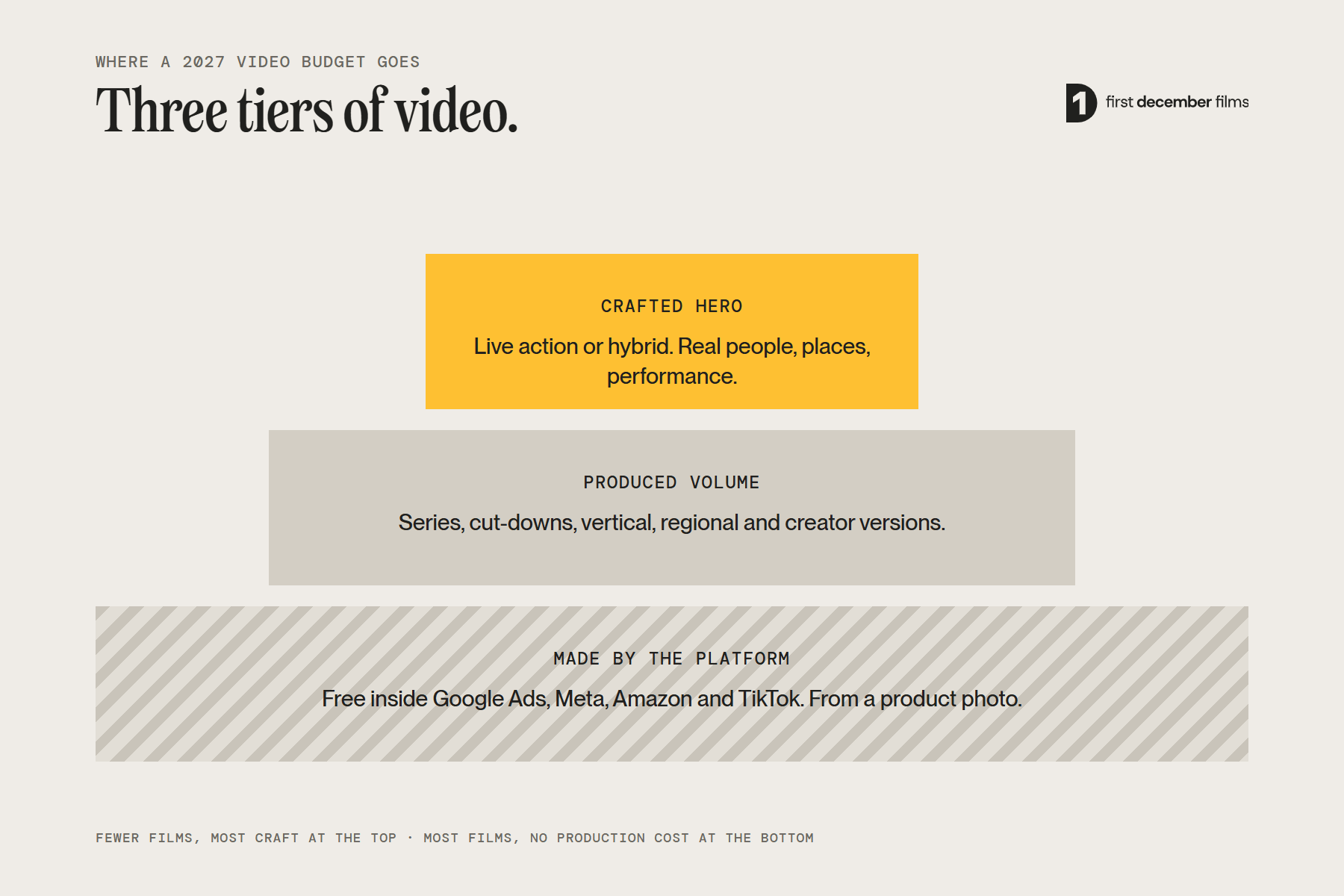
Our reading. Brands should stop asking whether AI will replace their production house and start sorting their deliverables into those three tiers. The first tier is free and fast. The third tier is where a production budget earns its keep. The middle tier, produced volume, is where most of the 2027 argument about cost will happen.
2. Is hybrid, not fully AI, the default for films that carry the brand?
For films that carry the brand in 2027, the default is hybrid: real plates, people and locations shot first, then extended with AI. Fully generated commercials will keep growing in volume, mostly for built worlds and fast, short-lived formats, but the evidence does not support them replacing the shoot for brand films.
The case for hybrid comes from three directions.
Audiences. In Kantar’s LINK testing, ads made with generative AI scored a 54% average percentile against 65% for ads made without it (Kantar, 26 March 2026). Ipsos and Syracuse University found human-made ads 14% stronger in short-term impact and 17% stronger in long-term impact, while only 25% of viewers could confidently tell an AI ad was AI (Ipsos, 18 May 2026). The gap is real but small, and Kantar found it narrows when viewers do not notice the AI, which argues for using AI inside a filmed piece rather than instead of one.
Awards. 40% of Cannes Lions 2026 entries declared AI use, up from 20% in 2025 and 11% in 2024 (Campaign, 25 June 2026). Yet the Film Grand Prix went to Mother London’s Super Bowl films for Claude, which mocked ads inside AI, and the Film Craft Grand Prix went to Isle of Any’s Coinbase film primarily for its direction (Cannes Lions, June 2026). When System1 tested the Cannes Film winners on ordinary viewers, craft, humour and storytelling did best (LBB Online, 30 June 2026). AI is assumed; craft is what gets judged.
Our own count. We re-cut the 242 AI commercial campaigns in our State of AI Commercials dataset, leaving out our own eight. Announced AI campaigns rose from about 3 a month in 2024 to about 12 a month in the second half of 2025, then fell to about 8 a month in the first half of 2026 and about 6 a month from July to 20 October 2026. Fully generated films made up 34% of the 2024 campaigns, 52% of 2025 and 46% of 2026 so far.
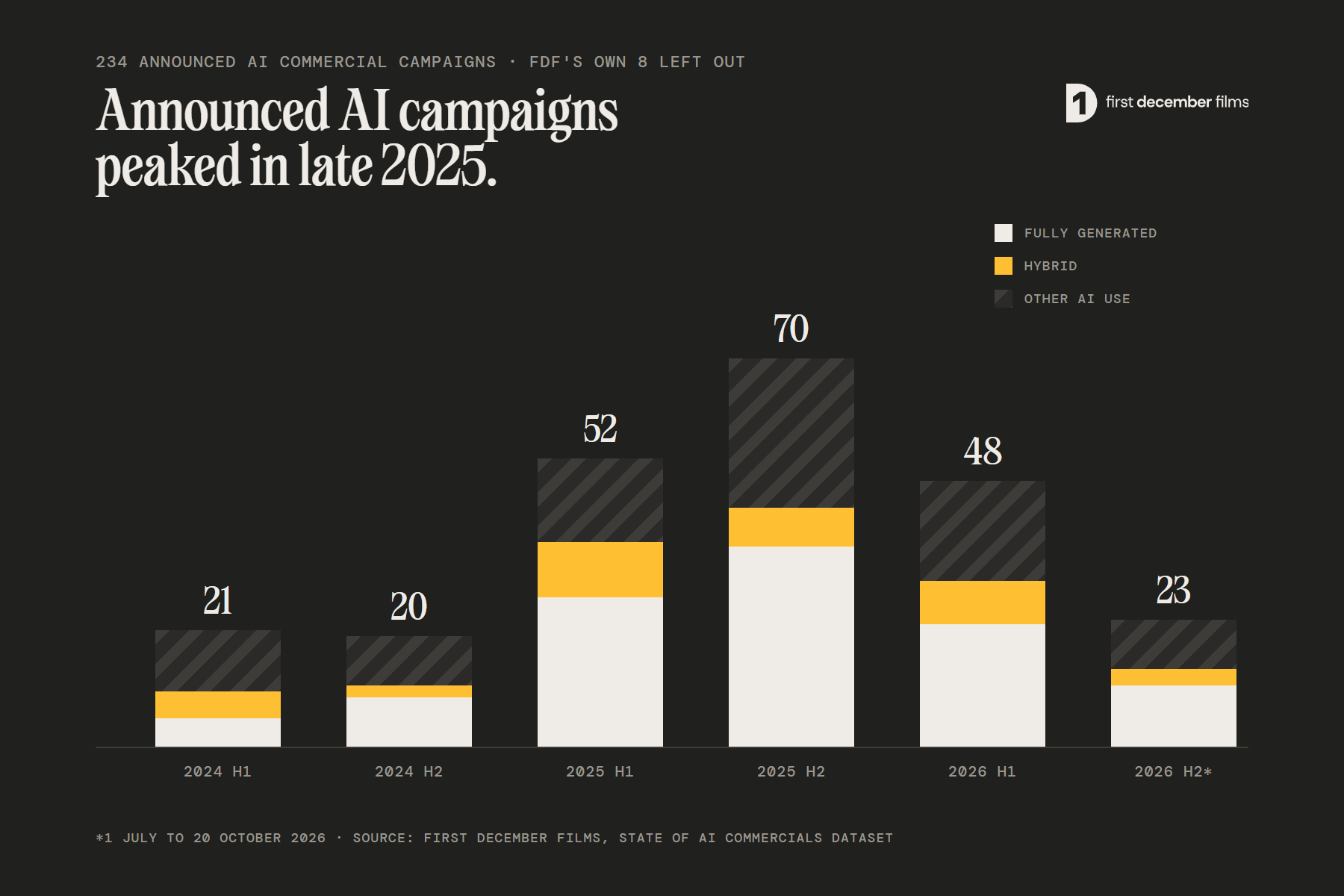
We read that fall carefully. It does not mean brands stopped using AI; it more likely means fewer of them announce AI as news, because it is becoming a normal part of production rather than a press angle. That is the same direction the awards point: AI as a tool inside the film, not the headline.
How we work this way: on our AI films we "shoot the plates first, then extend them with AI (set extensions, generated backgrounds, metaphor shots), so the AI inherits real light instead of inventing it." Malaysia Airlines’ Cricket at 30,000 Feet, with Rohit Sharma, Hardik Pandya and Trent Boult, was made that way and reached 141 million views on the airline’s YouTube channel by September 2026. Our vivo X300 Pro launch film won a Bronze for AI-Integrated Live Action Film at the Good Ads Matter Awards 2026, shared with Old Monk Studio.
When fully AI is the right answer. Built worlds that could not be filmed, high-volume series and fast topical work. Our 32 fully AI founder films for Razorpay aired during IPL 2026: five days of set-up and a paid test film, then about one film a day across the IPL window. The idea decides the method; neither method is the cheaper version of the other.
3. Does AI make ad films cheaper in 2027?
Not in the way vendors claim. In 2027 AI mainly makes ad production faster and more flexible; large, reliable cost savings on brand films are not supported by any independent evidence we could find.
- Speed beats savings. In Extreme Reach’s UK survey, 83% of advertisers were using or piloting AI in production, and speed to market (36%) had overtaken cost savings as the top reason; reducing production costs came third at 32% (Advanced Television, 9 September 2026).
- Prices have not moved. In D&AD’s AI and Creativity Report 2026, seven in ten agencies said they had not changed what they charge (D&AD, 18 August 2026).
- Forecasts run ahead. In IAB’s 2025 survey, US video buyers projected generative AI in 40% of video ad creative by 2026; the 2026 survey found 33%. The same buyers now forecast 43% for 2027 (IAB, 14 July 2026). Treat it as a forecast that has overshot once.
The "50% to 95% cheaper" figures that circulate in 2027 trend lists come from AI vendors and agencies selling AI services. We found no independent production cost study behind them.
Where the time goes instead is approvals. On our AI pipeline every frame is approved as a still before it moves (we call it image lock), and after image lock a 15 to 30 second film takes about a day of generation. What resets the clock is a character or location changed after that point, or notes with no priority. Our working rule is "Speed = clarity × early lock × parallel generation", and none of the three is a tool feature.
For what AI, live action and hybrid films actually cost in India, see our AI ad film cost guide and our live-action production cost guide.
4. Why are series, versions and creators replacing the single hero film?
Because the media plan has changed shape. In 2027 most video money runs through feeds and auctions that reward many versions, refreshed often, and fronted by people the audience already follows.
- WARC’s Marketer’s Toolkit 2027 found 83% of marketers say short-form video is a popular format, while 40% question whether it builds brands the way TV, films and events do; WARC advises building "connected content series" (WARC via MediaNews4U, 10 November 2026).
- Meta’s partnership ads, which run creators’ posts as ads, grew more than 97% year on year to an annual revenue run rate above $15 billion (Meta earnings call, 21 October 2026).
- US creator ad spending was on track to reach $44 billion in 2026, up from $37 billion in 2025 (IAB and PwC, via Marketing Dive, 20 April 2026). In India, influencer marketing is projected to reach ₹4,500 crore to ₹5,000 crore (about $480 million to $530 million) by 2027 (Kofluence, via IBTimes India, 14 May 2026).
- Kantar’s warning is the counterweight: only 6% of creator content works for both the platform and the brand (Kantar, 3 November 2026).
What changes on set: a 2027 brief should list its deliverables before the shoot, because versions cost least when they are planned into the coverage. A vertical 9:16 film is not a crop of a 16:9 frame; on our AI pipeline it is a separate generation, and on a live-action shoot it is a separate framing. Regional-language versions need lip-sync planning or a performance shot for each language. And a creator-fronted spot needs the creator’s own voice, which a script written for a TV presenter rarely allows.
For the difference between a TVC, a digital film and a brand film, see TVC vs DVC vs brand film.
5. What happens to TV advertising in India in 2027?
Linear TV advertising in India is flat while connected TV and cricket carry the growth. Pitch Madison’s 2026 report forecast linear TV ad spend flat at ₹32,855 crore (about $3.5 billion) and connected TV up 33%, from ₹6,000 crore to ₹8,000 crore (about $850 million) (exchange4media, 24 February 2026). TAM AdEx counted TV ad volumes down 6% in January to September 2026, after a 10% fall a year earlier (exchange4media, 29 October 2026).
India’s connected TV audience is now about 207 million viewers in 62 to 65 million homes, three times its 2022 size, according to a WPP Media and The Trade Desk report by Ormax (exchange4media, 19 August 2026). The government removed the 12-minute hourly cap on TV ads on 21 August 2026, but Elara Capital’s Karan Taurani estimated it could lift industry ad revenue "by a mere" 1% to 3%, because it adds inventory where demand is already soft.
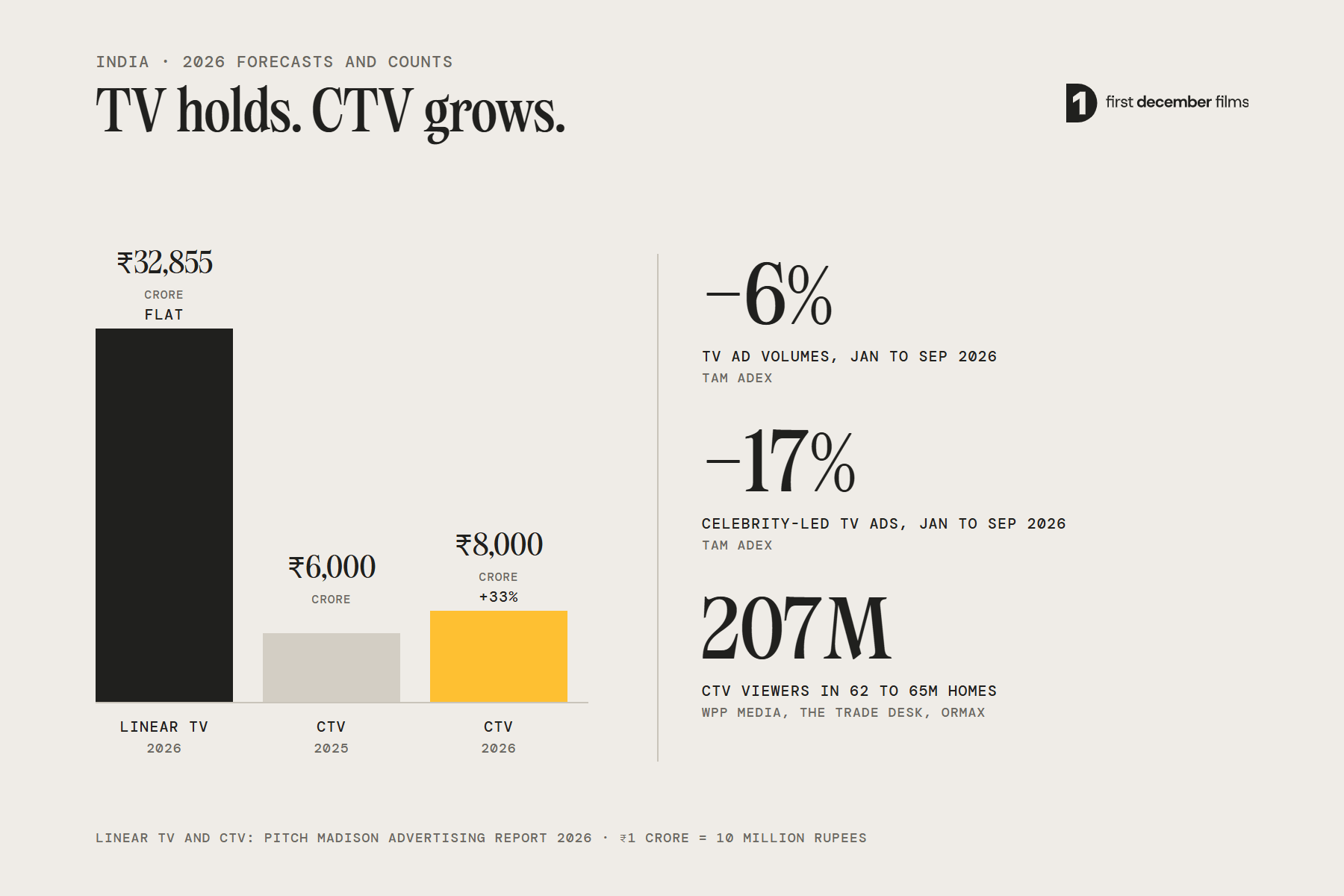
Is TV advertising dead in India? No. The TVC is still the anchor format for cricket, for festive launches and for any brand that needs national reach in a week. What is ending is the TV-only film. The same master now has to play on a 55-inch connected TV, where viewers see craft at full size, and on a phone in a feed.
What does the 2027 cricket calendar mean for advertisers?
2027 is India’s heaviest cricket year for advertisers since 2023. IPL 2027 is the last season of the 2023 to 2027 media rights, with the tender for 2028 to 2032 expected early in 2027 (exchange4media, 28 September 2026). The BCCI has not announced dates; its secretary aimed to start around 10 March and finish by mid May (Wisden, 18 June 2026). The ICC Men’s Cricket World Cup runs from 2 October to 21 November 2027 in South Africa, Zimbabwe and Namibia, with India against Pakistan in Johannesburg on 10 October, which puts the year’s second big cricket window on top of the festive season (ICC, October 2026).
For media buyers, IPL 2026 TV rates on JioStar started at ₹18 lakh per 10 seconds (about $19,200) and reached ₹50 lakh (about $53,200) for the final (BestMediaInfo, 12 February 2026). On digital, IPL 2026 connected TV reach grew 22% and regional-language watch time grew 33% (JioStar data via MediaNews4U, 6 October 2026). For producers, that means more films versioned into Hindi, Tamil, Telugu and Kannada, and more films designed for the big screen at home.
What happens to celebrity ads?
Celebrity-led TV ad volumes in India fell 17% in January to September 2026, while celebrities still appeared in more than a quarter of TV ads (TAM AdEx via exchange4media, 22 October 2026). Kroll’s 2025 valuation put the combined brand value of India’s top 25 celebrities at $2.0 billion, down 3.7%, with digital endorsements making up about 60% to 75% of brand associations for several leading names (Kroll, 5 August 2026).
The production reading: celebrity films are not disappearing, they are being shot shorter and cut more ways. Expect a 2027 celebrity day to deliver a TV film, several digital cut-downs and social content in the same schedule, which makes the shot list and the usage contract matter more than the number of set-ups.
6. What do AI labels and consent rules change on set in 2027?
2027 is the first year AI labelling rules apply in most major advertising markets at the same time, which turns the approval trail kept during production into the compliance record. The EU’s Article 50 transparency duties have applied since 2 August 2026; China has required labels on AI content since 1 September 2025; New York’s synthetic performer law has applied since 9 June 2026, Pennsylvania’s AI ad law from 21 December 2026, and California’s synthetic performer law, signed on 16 September 2026, from 1 January 2027, the default start date for new California laws. In India, ASCI’s guidelines on labelling AI content in ads take effect three months after their September 2026 publication, in the second half of December 2026. In the US, the SAG-AFTRA Commercials Contracts, with their digital replica and synthetic performer terms, run until 31 March 2028.
Ganesh Pareek, our executive producer, put the production consequence plainly when ASCI’s draft came out: every key element of an AI film has to be "locked and documented before motion generation begins", and "that locked approval is now your compliance paper trail" (BestMediaInfo, 18 May 2026). His view of the rules: "ASCI is not slowing AI advertising down. It is forcing the industry to grow up."
What changes on set: written consent for every real face and voice before generation, a log of what was generated, a labelled master and a clean master for each market, and a decision made at the script stage about which shots will need a label where. The full rules, market by market, are in our guide to whether you have to label AI ads; for faces and voices, see AI actors in ads.
7. Will craft or AI win with audiences in 2027?
Neither wins outright; quality and context decide. The evidence on how audiences treat AI ads is genuinely split, and it splits by market.
- In the US, Gallup found 49% of Americans view businesses’ use of AI to create ads negatively and 19% positively, and 62% said AI-created people or voices in ads are unacceptable even with disclosure (Gallup, 19 August 2026). A Harris Poll for the 4As found 73% less likely to trust an ad they suspect is AI-made (Marketing Brew, 24 June 2026).
- At Super Bowl LX, the ads that featured AI messaging averaged 2.1 stars in System1’s testing against 2.7 for all Big Game ads (System1, 9 February 2026).
- In India, a DoubleVerify study found 65% of consumers said polished, professional AI-generated ads would improve their perception of a brand, against 13% negative (Passionate in Marketing, 6 August 2026).
Our reading: the backlash in the US and UK has landed hardest on fully generated films that replaced something audiences loved, Christmas ads above all (see our analysis of AI Christmas ads). Indian audiences are more open to polished AI work, which is a reason to hold a higher bar, not a lower one. Ganesh’s line on AI is the one we brief to: it "multiplies options; without a strong point of view, it multiplies noise" (MediaBrief, 2 March 2026).
8. How risky is it to build a film on one AI tool?
Riskier than most 2027 trend lists admit. The leading AI video models change every few months, and a model can disappear: OpenAI announced on 24 March 2026 that it would discontinue Sora in the consumer app and API (Engadget, 24 March 2026). A campaign built around one tool’s look, with assets that only that tool can extend, can lose its pipeline mid-flight.
What changes on set: keep the creative decisions in assets a production owns (the approved stills, the asset bible, the edit) rather than inside one tool’s project files, and ask any AI studio which models it would switch to if its main one went away. Our guide to how AI commercials are made walks through that pipeline stage by stage.
Which 2027 trends are hype?
Five claims repeat across 2027 trend lists without the evidence to carry them.
- "90% of ad films will be made by AI by 2027." This is the thesis of Studio Blo’s Dipankar Mukherjee, and Social Samosa labelled it as his view (3 June 2026). Blind tests, award results and the shape of 2027 briefs point the other way for brand films.
- "AI cuts production cost by 50% to 95%." Vendor claims only; seven in ten agencies have not changed their prices.
- Microdramas as a major ad budget line in 2027. The audience is real (about 100 million Indians watch microdramas every month, per ShareChat and Moj with Kantar), but brand ad spend on them is not yet measured.
- Live commerce in India. Market-size estimates from paid research firms differ by more than two times, and we found no primary data.
- Consumers handing their shopping to AI agents in 2027. In WARC’s survey, 69% of marketers expect customers to use AI agents for product research within three years, but only 8% expect consumers to fully delegate purchases.
Where production people disagree about 2027
People who make ads for a living disagree about 2027 more sharply than the forecasters do. Their published positions fall into three camps.
The AI-first camp. Dipankar Mukherjee, co-founder of the Mumbai AI studio Studio Blo, has the boldest forecast on record: "It’s my thesis, though, that by 2027, 90% of all ad films in the world will be made by AI, and not shot on camera" (Social Samosa, 3 June 2026). The AI director Nick Tasker answers the quality objection head on: "Right now, many of my peers still think AI ads are slop. To that, I say 98% of commercials have always been slop" (LBB Online, 11 August 2026). In Mumbai, White Rivers Media’s Archit Agarwal says "AI is clearing executional bottlenecks, so more production now happens inside the agency itself" (exchange4media, 14 August 2026).
The sceptics. Kate Taylor, who runs the UK production house Rogue, uses AI in post but not to make the picture: "We aren’t using it in moving image creation, because that’s not what it’s good at" (shots, 27 February 2026). Sarah Thomas of STOM Productions in Mumbai sees AI "more as a powerful pre-production assistant than a replacement for production" (exchange4media, 14 August 2026). Prathap Suthan of Bang in the Middle predicts the market "will flood with AI-generated work. Competent, yet mediocre" (Social Samosa, 5 January 2026).
The hybrid majority. Most of the production heads we read sit between the two. Saatchi & Saatchi’s chief production officer Jess Ringshall: "AI fills the gaps for speed and volume, but when brands want meaning, fame and long-term equity, they still back high-end craft" (shots, 27 February 2026). Patricia Lino of PSP Production in Lisbon: "AI does not make the production decision. It expands the field before experienced producers make it" (LBB Online, 4 November 2026). Neil Duncan of Publicis Production in Sydney: "AI can increase output. It cannot solve fragmentation" (LBB Online, 17 September 2026). In the Gulf and Asia, electriclime°'s Michael Ahmadzadeh, who chaired ADFEST’s 2026 Film Craft jury, put it as "AI can create but you need humans to create emotions" (ADFEST, 19 March 2026). The Sweetshop’s Morgan Whitlock has turned work down on these grounds: "I’ve had conversations with clients where we’ve declined to create a project entirely synthetically, because we didn’t think it was right from a craft perspective" (shots, 27 February 2026).
The budget pressure under the argument is real, whichever camp is right. Aalap Desai of the Mumbai agency tgthr told exchange4media that his per-project cost had come down "from Rs 1 crore to Rs 25 lakh" (about $106,000 to $27,000), and Infectious Advertising’s Nisha Singhania described the brief that follows: "do ten things instead of one" (exchange4media, 22 October 2025). On Reddit, where we read 455 comments about AI across 34 threads from production and advertising forums up to October 2026, the commonest worry was pressure to be cheaper and faster (93 comments), ahead of quality (70) and jobs (40); AI labels came up 4 times. One producer on starting a company in India: "The bottom end of the market is being decimated" (r/Filmmakers, 14 June 2026).
Where we stand. We are in the hybrid camp, with a production house’s caveat: we make fully AI films too, and the idea decides which. Ganesh holds both halves of it. "A camera can only do what a camera can do. But with AI, I can do things a camera never could," he told Social Samosa (21 April 2026); and he wants AI used "for compression" of logistics, iterations and prep, "never as a substitute for taste or judgment" (MediaBrief, 2 March 2026). Mukherjee’s 90% may describe the number of ad films; it will not describe the films that carry a brand in 2027.
The 2027 production calendar: when to start each film
The date that matters for a 2027 campaign is not the air date but the date the script has to be approved. Our TVC timeline runs six to ten weeks from an approved script to the master, with one to three shoot days, so the table below works back six to ten weeks from each moment. Big casts, celebrities, international locations and heavy post push you to the earlier date.
| 2027 moment | Date | Market | Approve the script between |
|---|---|---|---|
| Chinese New Year | 6 February | China, Singapore, Malaysia | 28 November and 26 December 2026 |
| Ramadan begins (expected) | 8 February | Gulf, South and Southeast Asia | 30 November and 28 December 2026 |
| Super Bowl LXI | 14 February | US | 6 December 2026 and 3 January 2027 |
| Eid al-Fitr (expected) | 9 or 10 March | Gulf, India | 29 December 2026 and 26 January 2027 |
| IPL 2027 (window from about 10 March, dates not announced) | about 10 March | India | 30 December 2026 and 27 January 2027 |
| FIFA Women’s World Cup, Brazil | 24 June to 25 July | Global | 15 April and 13 May |
| Independence Day | 15 August | India | 6 June and 4 July |
| Ganesh Chaturthi, start of the festive season | 4 September | India | 26 June and 24 July |
| Men’s Rugby World Cup, Australia | 1 October to 13 November | UK, Australia, Europe | 23 July and 20 August |
| ICC Men’s Cricket World Cup | 2 October to 21 November | India, cricket markets | 24 July and 21 August |
| Diwali | 29 October | India, diaspora | 20 August and 17 September |
| UK Christmas ad launches | early to mid November | UK | 30 August and 27 September |
dates from the ICC, FIFA, World Rugby, India’s Department of Personnel and Training holiday lists for 2027, Variety and Fox (Super Bowl LXI), Khaleej Times and Gulf News (expected Ramadan and Eid dates); IPL window from BCCI comments reported by Wisden, 18 June 2026. Windows are our analysis from our published TVC timeline. Festive films usually air weeks before the festival itself, so count back from the first air date, not the festival.

Two clusters decide most Indian production years, and 2027 is no exception. Scripts for IPL, Eid and Gulf Ramadan work need approval between late December and late January. Scripts for the Cricket World Cup and the festive season need approval between late June and mid September. A brand with both should brief both in December.
How do these trends differ in the US, UK, Gulf and India?
The same trends land differently by market, and a film that travels has to meet the strictest version of each.
| Market | 2027 spend outlook | AI rules in 2027 | Big 2027 moments | Production note |
|---|---|---|---|---|
| United States | +4.1% (Madison and Wall) to +9.4% (EMARKETER) | New York, Pennsylvania and California label laws; SAG-AFTRA AI terms to March 2028 | Super Bowl LXI, 14 February; LA28 sponsor work begins | Strongest audience scepticism of AI ads |
| United Kingdom | Part of the global slowdown | No blanket AI label law; disclose where omission misleads | Rugby World Cup; Christmas | Christmas is where AI backlash has been loudest |
| European Union | Part of the global slowdown | Article 50 labels for realistic AI content | FIFA Women’s World Cup sponsors | Deployer duty often falls on the agency or studio |
| Gulf (UAE, Saudi Arabia) | No 2027 forecast found | Platform and local media rules | Ramadan from about 8 February; Eid | Ramadan shoots fall in December and January |
| India | Double digit (WPP Media) or 7.41% CAGR (dentsu-e4m) | ASCI labels from late December 2026; IT Rules on platforms; DPDP consent duties from 13 May 2027 | IPL 2027; Cricket World Cup; Diwali, 29 October | Regional versions and CTV masters |
forecasts as above; rules from our AI label guide; DPDP Rules via Bar and Bench; calendar as above.
How did advertising get here, and what comes after 2027?
Three years explain 2027. In 2024, AI commercials were a stunt: Coca-Cola’s AI remake of Holidays Are Coming in November 2024 drew a backlash that made AI the industry’s argument of the year. In 2025, AI moved into the pipeline: announced AI campaigns in our dataset nearly tripled, from 41 to 122, and Cannes Lions made AI disclosure mandatory at entry. In 2026, the platforms took the cheap end of video in-house, AI label laws for ads came into force in the EU and New York, and award juries rewarded craft over novelty.
2027 is the year those changes meet a normal budget cycle. What comes after is already dated: the SAG-AFTRA contracts expire on 31 March 2028, the next IPL rights cycle starts in 2028, and the LA28 Olympics run from 14 to 30 July 2028. Those are forecasts of the calendar, not of the market; nobody has published a credible 2028 production forecast yet.

What should brands brief differently for 2027?
- Sort deliverables into three tiers before you brief: what the platform can generate, what needs produced volume, and what has to be the crafted hero. Spend the production budget on the third.
- List every version in the brief. Aspect ratios, durations, languages and creator cuts cost least when they are planned into the shoot.
- Decide the method by the idea. Real faces, products and places favour live action or hybrid; built worlds and volume favour fully AI. Ask for both options if you are unsure.
- Lock approvals early and keep them. The approved stills, scripts and consent forms are your compliance record in 2027.
- Plan cricket and festive work together. Approve IPL scripts by late January and World Cup and festive scripts by mid August.
- Ask for a labelled and a clean master for every market the film will run in.
- Keep your pipeline tool-agnostic. Own the assets; do not own a dependency on one model.
When this does not apply
- Performance-only brands that buy only short product spots on one platform may get most of what they need from the platform’s own tools; this guide is for films that carry a brand.
- Regulated categories (health, medicine, financial returns, politics) carry rules this guide does not cover; generated proof for such claims is off the table whatever the trend.
- Forecasts change. WPP Media and dentsu publish their December 2026 forecasts after this guide, and Kantar’s 2027 trends are not out yet. We will update the figures in January 2027.
Planning a 2027 film?
The cheapest place to make a 2027 decision is the script. Paste yours into our free script analyser for a producer’s read of its complexity, see how we make AI and hybrid films, or read how a TVC is made in India. Or send us the brief, and a producer will tell you which shots to film, which to generate, and when you need to start.
Sources
- Forecasts: WARC Global Ad Spend Outlook Q3 2026, 7 October 2026; WARC Q3 channels via MediaNews4U, 8 October 2026; WARC TV forecast via PPC Land, 11 October 2026; MediaPost on Madison and Wall and the composite, 9 September 2026; MediaPost on PQ Media, 12 February 2026; dentsu Global Ad Spend Forecasts, 27 May 2026; EMARKETER on 2027 US ad spending, 13 November 2026; EMARKETER US TV Ad Spending 2027, 4 November 2026; Forrester Predictions 2027, 28 October 2026; WARC Marketer’s Toolkit 2027 via MediaNews4U, 10 November 2026.
- India: WPP Media This Year Next Year India midyear 2026, 16 June 2026; dentsu-e4m report via BW Marketing World, 2 February 2026; Pitch Madison Advertising Report 2026 via exchange4media (total adex; TV and CTV), 24 February 2026; TAM AdEx via exchange4media (TV volumes, 29 October 2026; celebrity ads, 22 October 2026); India’s CTV audience, 19 August 2026; TV ad cap removal, 10 September 2026, and Elara Capital’s estimate, 17 August 2026; Kroll Celebrity Brand Valuation, 5 August 2026; Kofluence via IBTimes India, 14 May 2026; ShareChat and Moj microdrama report, 27 August 2026.
- Cricket and calendar: ICC Men’s Cricket World Cup 2027 schedule; Wisden on IPL 2027, 18 June 2026; IPL media rights, 28 September 2026; IPL 2026 ad rates, 12 February 2026; IPL 2026 viewing, 6 October 2026; Super Bowl LXI and Variety on its ad sales; FIFA Women’s World Cup 2027 dates; Men’s Rugby World Cup 2027; India’s 2027 holiday list; Ramadan and Eid 2027; Chinese New Year 2027.
- AI in production: Veo in Google Ads, 27 March 2026; Meta Q3 2026, 21 October 2026; Amazon Ads Video Generator; TikTok Symphony; OpenAI on Sora via Engadget, 24 March 2026; IAB Digital Video Ad Spend and Strategy 2026, 14 July 2026, and 2025; D&AD AI and Creativity Report 2026; Extreme Reach via Advanced Television, 9 September 2026; IAB and PwC via Marketing Dive, 20 April 2026; Kantar Forward, 3 November 2026.
- Audiences and awards: Kantar on GenAI ads, 26 March 2026; Ipsos, 18 May 2026; Gallup, 19 August 2026; Harris Poll via Marketing Brew, 24 June 2026; DoubleVerify India study, 6 August 2026; System1 on Super Bowl LX, 9 February 2026; Cannes Lions 2026 winners and craft winners; Campaign on AI entries, 25 June 2026; System1 on Cannes winners via LBB Online, 30 June 2026.
- Rules: EU AI Act Article 50; Regulation (EU) 2026/1744; California SB 1050; China’s labelling measures; CAP on AI disclosure; ASCI guidelines; SAG-AFTRA 2025 Commercials Contracts summary; DPDP Rules via Bar and Bench.
- Practitioners: Dipankar Mukherjee, Social Samosa; Kate Taylor, Morgan Whitlock and Jess Ringshall, shots; Sarah Thomas and Archit Agarwal, exchange4media; Aalap Desai and Nisha Singhania, exchange4media; Prathap Suthan, Social Samosa; Nick Tasker, Patricia Lino and Neil Duncan, LBB Online; Michael Ahmadzadeh, ADFEST; Ganesh Pareek in MediaBrief, BestMediaInfo and Social Samosa.
- First December Films: The State of AI Commercials dataset (242 campaigns, 1 January 2024 to 20 October 2026; re-cut for this guide on 17 November 2026 without our own eight); AI ad films; Malaysia Airlines; TVC production process.
First December Films is an advertising film production company in Mumbai. Our work has won more than 150 international creative awards, including Cannes Lions, D&AD and One Show Gold Pencils.
Frequently asked questions
What are the biggest advertising trends for 2027?
Slower but still healthy ad growth, platforms generating basic video ads for free, hybrid AI and live action for films that carry a brand, series and versions in place of a single hero film, flat TV beside fast connected TV, and AI label rules applying in most major markets at once. In India, 2027 is also a heavy cricket year.
Will AI replace ad film production in 2027?
Not for films that carry a brand. In blind tests by Kantar and Ipsos, AI-made ads still trail human-made ones, and 2026 award juries rewarded direction and craft. AI will take over the cheapest product spots and speed up everything else, while real people, products and places are still filmed and then extended with AI.
How much will advertising spend grow in 2027?
Forecasts published by November 2026 put global growth at 4.4% (PQ Media) to 8.4% (WARC, to 1.46 trillion US dollars), slower than 2026, which had a men’s football World Cup, the Winter Olympics and the US midterms. In India, WPP Media expects a return to double-digit growth from 2027.
What are the advertising trends in India for 2027?
Digital moves towards 70% of ad spend, linear TV stays flat while connected TV grows about a third a year, celebrity-led TV ads fall, and commerce media grows fastest. 2027 also carries the last IPL season of the current rights cycle and the ICC Men’s Cricket World Cup from 2 October to 21 November.
Is TV advertising dead in India?
No. Linear TV ad spend is flat at about 32,855 crore rupees for 2026 by Pitch Madison’s forecast, and the TV commercial is still the anchor for cricket and festive launches. What is ending is the TV-only film: the same master now has to work on a connected TV and on a phone.
When should a brand start making an IPL 2027 ad?
Approve the script between late December 2026 and late January 2027. The IPL is expected to start around 10 March 2027, though the BCCI has not announced dates, and a TV commercial takes six to ten weeks from an approved script to the master. Celebrity films and heavy post production need the earlier date.
Do AI ads need a label in 2027?
In many markets, yes, depending on what the AI does. The EU, China, New York, Pennsylvania and California have label rules in force by 1 January 2027, and India’s ad self-regulator ASCI applies its AI labelling guidelines from late December 2026. The UK has no blanket rule and asks for disclosure only where leaving it out would mislead.