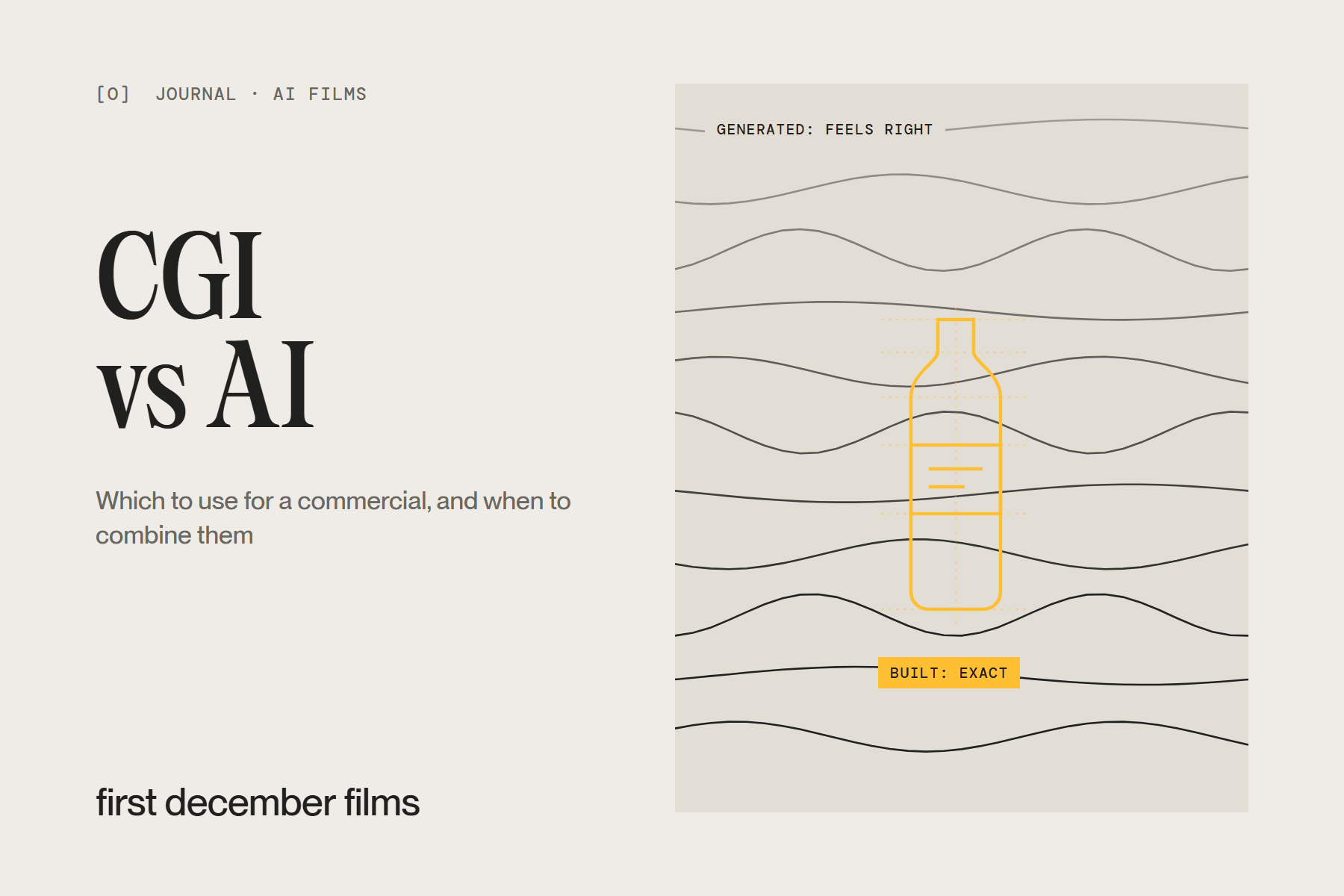
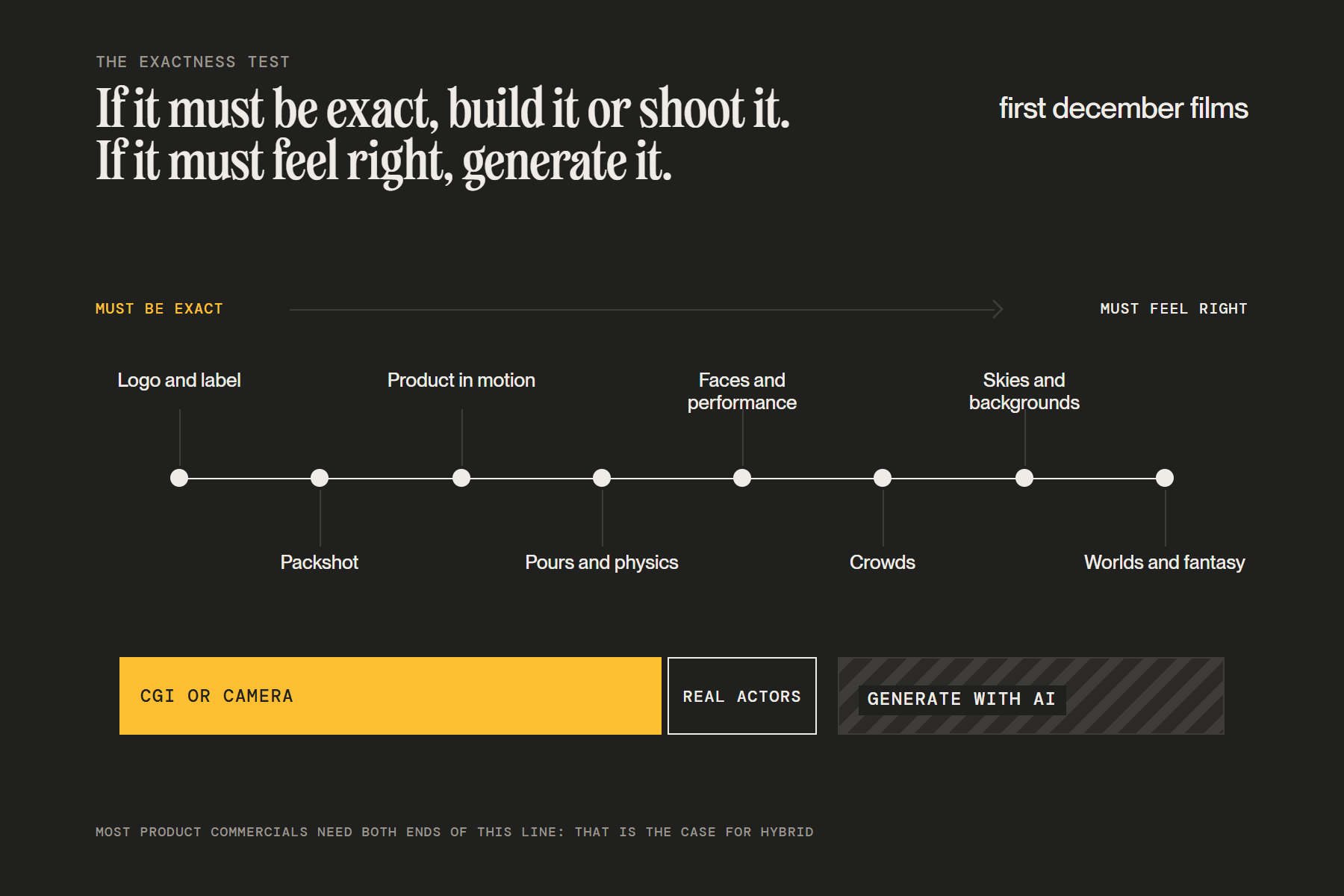
The short answer. Use CGI for anything the viewer, the client or the legal team will check frame by frame: the pack, the logo, the label, a product in motion, physics that must be exact. Use generative AI for worlds, moods and impossible scale, where a shot only has to feel right. For most product commercials, combine them: shoot or build the product exactly, and let AI make the world around it.
That is the test behind how we make films, and why our AI ad films page sells fully AI and hybrid films as equals and says "The idea decides". The CGI vs AI question used to be a technical one for post-production. In 2026 it is a budget, schedule and legal decision that a marketer has to sign off before the treatment is written. We make live-action, hybrid and fully AI films, so we have no reason to sell you one method. For this guide we compared the official per-second prices of today’s AI video models with ten published CGI price cards from seven countries, re-cut our own dataset of 242 AI commercial campaigns to see who combines methods, and read 21 recent campaigns in which the makers said what was CGI and what was AI.
Published 29 October 2026 by Atul Kattukaran, Partner and Director. Prices and model availability were checked on 29 October 2026; AI video changes monthly, so we will update this post as it moves.
Key takeaways
- CGI (computer-generated imagery) is built: an artist models, lights and renders every object, so the same product looks identical in every frame and every revision. Generative AI video is predicted: a model invents each frame from a prompt or an image, so it is fast and cheap per take but never exactly repeatable.
- The deciding question is exactness. Coca-Cola’s head of generative AI, Pratik Thakar, put it plainly in 2024: generative AI "doesn’t do justice when we want to show something very realistic", but it is "the perfect tool" for the "hyper-realistic and fantastical".
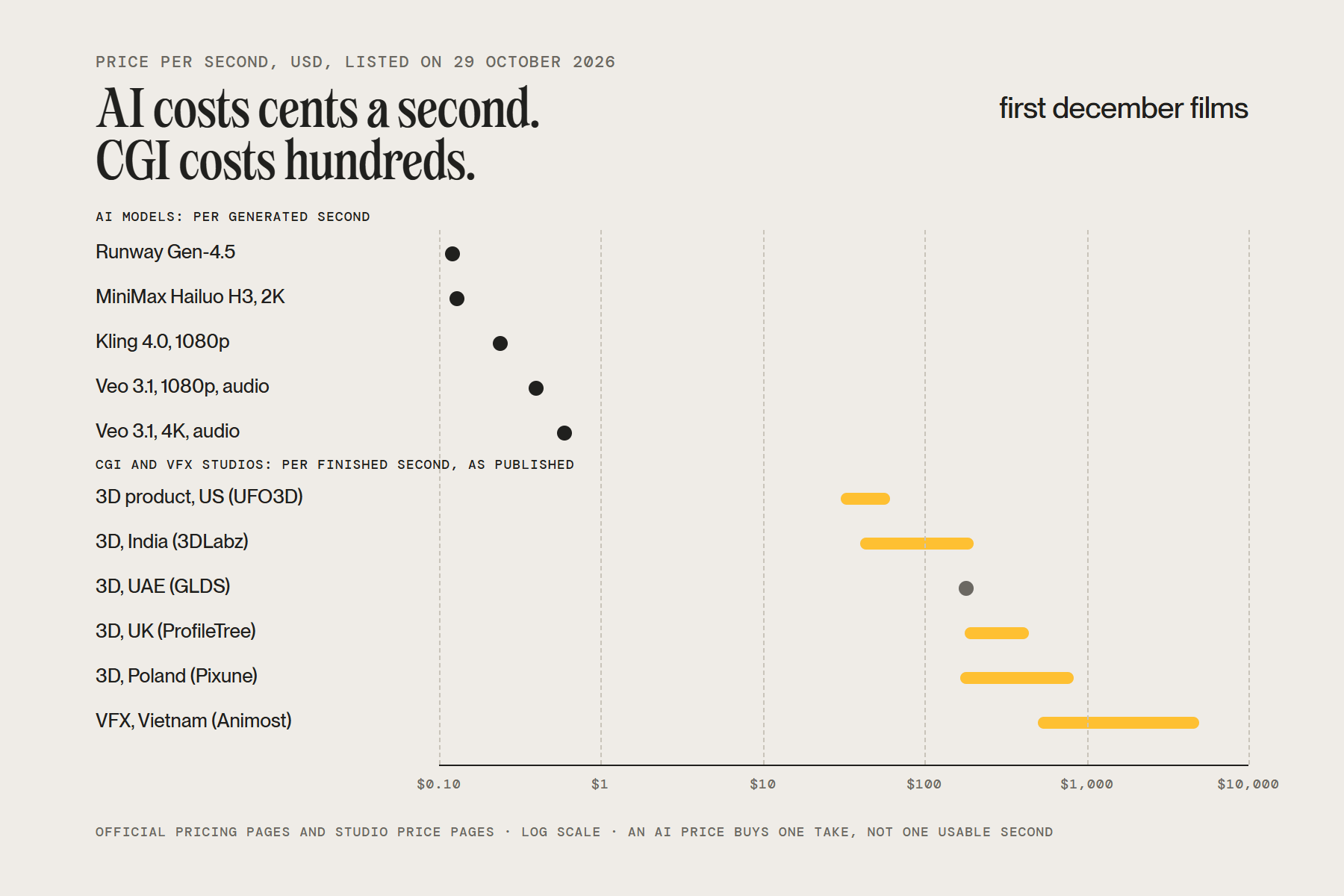
- AI generation is cheap at list price: $0.12 to $0.60 a second for the leading models on 29 October 2026, against $30 to $833 a second on the published 3D animation price cards we found. But makers report 6 to 27 generations for every shot they keep, and the generation fee is the smallest part of the bill.
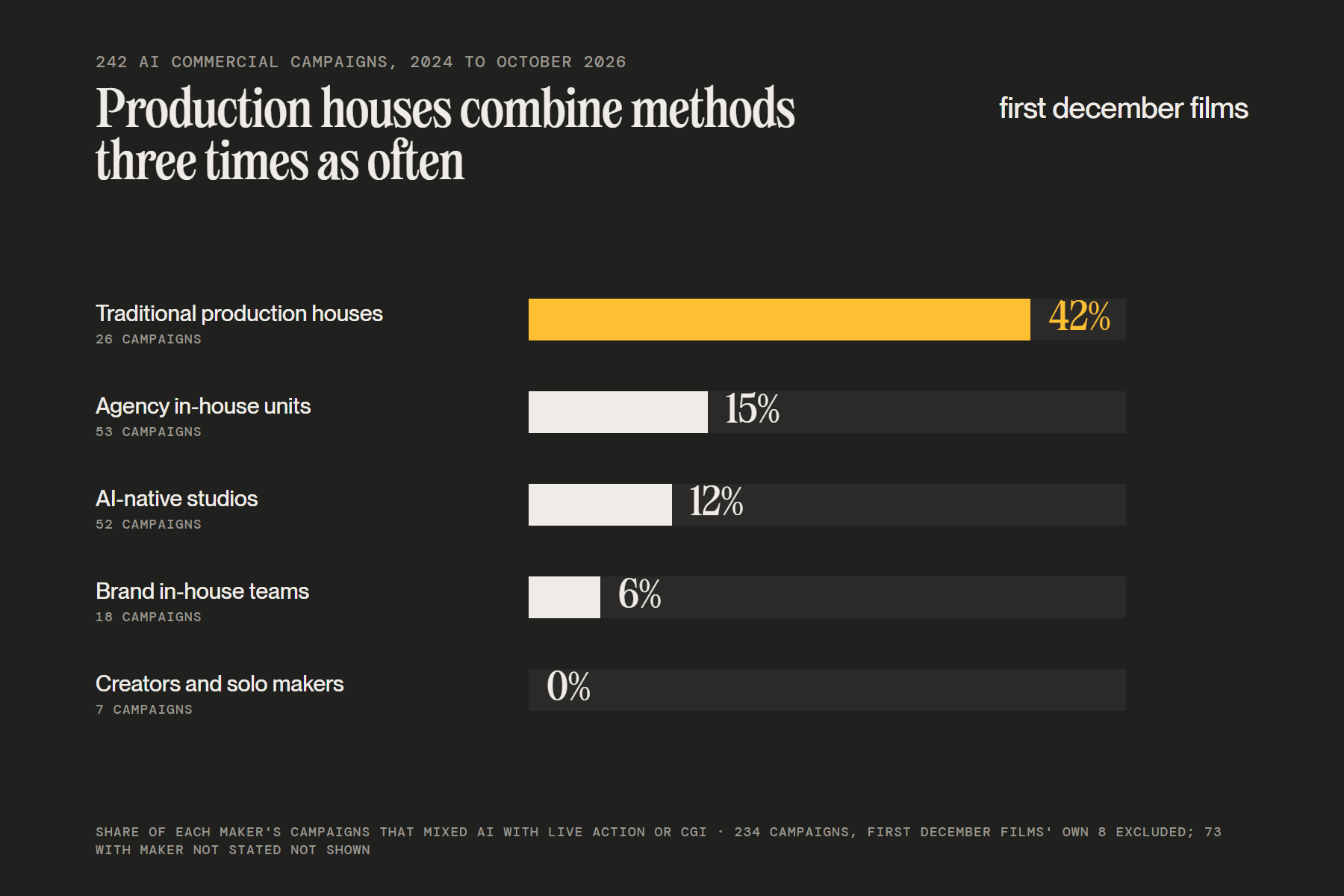
- Hybrid is how production houses actually work. In our dataset of 242 AI commercial campaigns (our own eight left out), traditional production houses combined AI with live action or CGI in 42% of their campaigns, against 12% for AI-native studios.
- The legal gap is real. Purely AI-generated footage cannot be registered for copyright in the US, vendors’ indemnities cover only some models on some plans, and India’s ASCI labelling guideline takes effect on 29 December 2026. A CGI asset you commissioned is simply yours.
- Our rule of thumb: if it must be exactly right, build it or shoot it. If it only has to feel right, generate it. If it is both, combine them, and decide which is which before anything is made.
What is the difference between CGI and AI?
CGI is imagery built by artists in 3D software. A modeller makes the product or character as a digital object, a lighter places virtual lights, an animator moves it, and a renderer calculates every pixel from those decisions. Tools include Maya, Houdini, Cinema 4D, Blender and Unreal Engine. Because every element is defined, the result is deterministic: render the same scene twice and you get the same frame.
Generative AI video is footage predicted by a model. You give a model such as Google’s Veo, Runway, Kling or MiniMax’s Hailuo a text prompt, a reference image or a start and end frame, and it generates a clip of a few seconds that matches the description statistically. Nothing inside it is modelled. Run the same prompt twice and you get two different clips.
VFX (visual effects) is the umbrella. It covers any imagery added or changed after filming: CGI, compositing, clean-up, set extensions and, since 2024, generated shots. A commercial can be live action with VFX, fully CGI, fully AI, or any mix.
So, is there AI in CGI? Increasingly, yes, inside the tools. VFX artists on r/vfx describe AI doing rotoscoping, depth maps, clean-up and matchmove assistance, while the hero work stays hand-built (r/vfx thread, May 2026). The FICCI-EY 2026 report on Indian media, as reported by AnimationXpress in March 2026, says AI in roto, paint, clean-up and quality control "delivered up to 40 per cent time savings". AI inside a CGI pipeline is a faster pencil. A fully generated shot is a different method.
CGI vs AI vs hybrid: the decision matrix
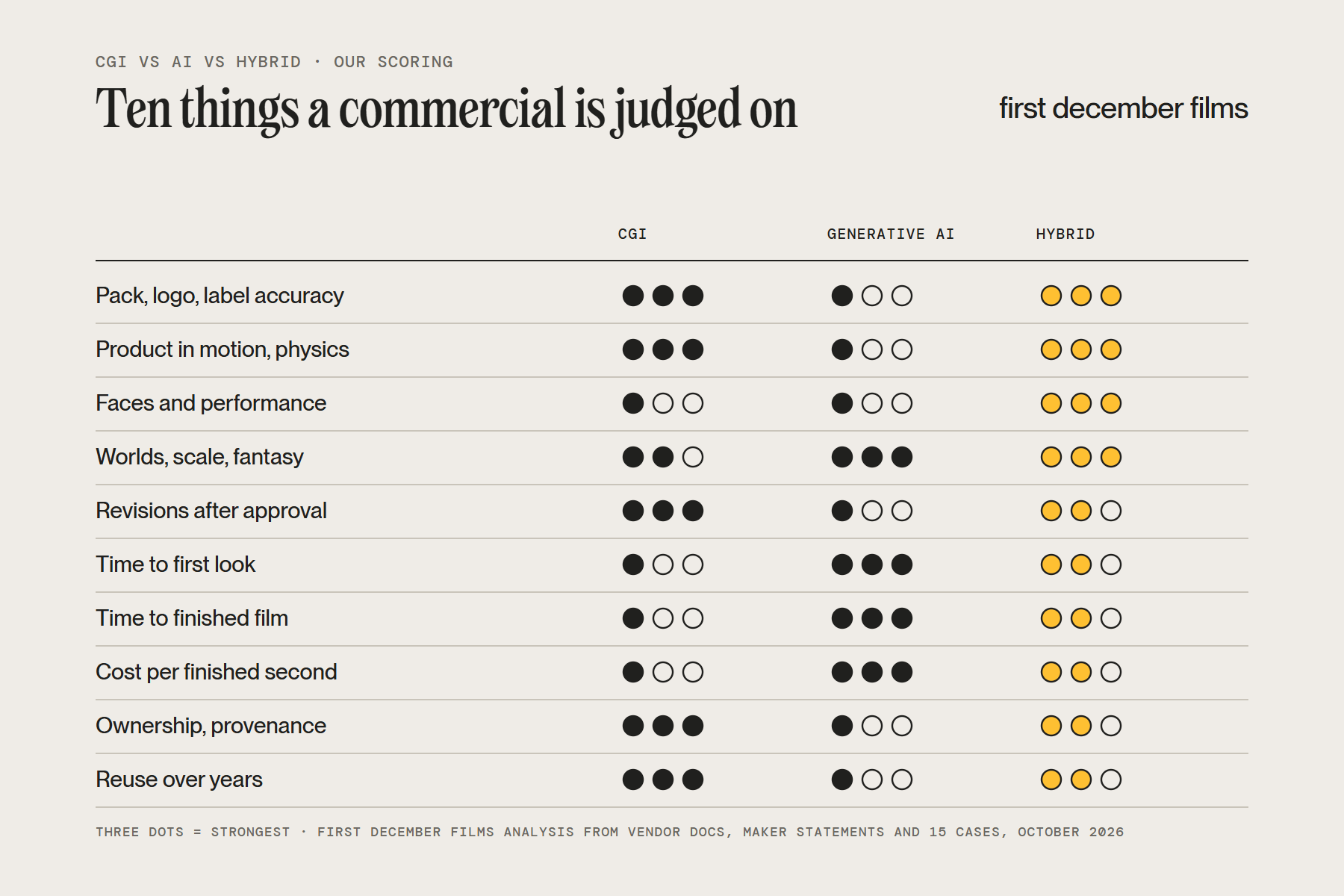
We scored the three methods on the ten things a commercial is judged on. The scores are our analysis, built from the vendor documentation, maker statements and cases in this guide; each row is argued in a section below.
| Criterion | CGI | Generative AI | Hybrid (shoot or CGI the hero, AI the world) |
|---|---|---|---|
| Pack, logo and label accuracy | Exact, every frame | Drifts; text and logos need fixing in post | Exact on the hero, AI kept away from the pack |
| Product in motion and physics | Exact and repeatable (simulated liquids, cloth, crashes) | Plausible, but cause and effect can break | Exact where it matters |
| Faces and performance | Expensive and uncanny unless very high budget | Faces drift between shots; performance hard to direct | Real actors on camera, AI around them |
| Worlds, scale, fantasy | Possible, slow and costly | Strongest point | Strongest point |
| Revisions after approval | Change a parameter, re-render the same shot | Each fix is a new generation; may change the shot | Deterministic on the hero, flexible elsewhere |
| Time to first look | Weeks | Hours | Days |
| Time to finished film | Weeks to months (a UK studio quotes 8 to 16 weeks a finished minute) | 2 days to a month reported | Weeks, with less build time |
| Cost per finished second | High, mostly artist time | Low generation cost, high iteration and finishing time | Middle |
| Ownership and legal provenance | Yours under a normal commission | Unclear copyright; indemnity varies by vendor and plan | Clear on the built or shot parts |
| Reuse over years | Asset library reusable for every campaign | Regenerate each time; consistency not guaranteed | Hero assets reusable |
When should a commercial use CGI?
Use CGI when a frame will be checked. Four kinds of shot fall here.
The packshot and anything with your logo or label on it. A product shot is a legal and brand document as much as a picture: the pack, the claim on it, the colour of the logo, the shape of the bottle. Generative models are not built to reproduce a specific object exactly, and no vendor we checked documents how accurately its model renders text or logos. Coca-Cola’s own AI holiday films show the problem. For the 2024 version, "traditional post-production tools were used to smooth out the kinks, including nailing the iconic Coca-Cola script on the side of the delivery trucks", Silverside AI told Marketing Brew (21 November 2024). In 2025, Dino Burbidge, founder of the UK consultancy Dinova, counted the trucks: "Only two of the 11 truck scenes feature the same truck, specifically the same wheel layout" (The Drum, 4 November 2025). A CGI truck has the same wheels in every shot because it is the same file.
A product in motion. Dustin Callif, president of Tool of North America, the Los Angeles production company, wrote in May 2025: "If you want to feature dynamic product shots (car moving and showing consistency between scenes), traditional is still the way to go" (Tool). Tool’s own Land Rover Defender experiment shot the car and the people live and generated only the dream worlds around them (LBB Online, 17 December 2024).
Physics that must be right. A pour, a splash, cloth on a body, a phone dropping on a floor. CGI simulates these from rules you can tune. Runway’s own research page for Gen-4.5 lists its model’s known limitations, among them causal reasoning, object permanence, and actions that "disproportionately succeed" (Runway). Those are exactly the errors a food, beverage or automotive client will send back.
A mascot or character you will use for years. A CGI character is an asset: you can pose it in next year’s campaign, a print ad and a 3D billboard. Svedka learned the cost of losing that. For its Super Bowl LX return in February 2026, the vodka brand’s team "no longer had the CGI files" for its 2005 Fembot, and a spokesperson told LBB Online that "AI was necessary to rebuild her" (5 February 2026). Whatever you choose, own and archive your assets.
There is one more case for CGI that has nothing to do with accuracy: the stunt that only works because it looks real. The fake out-of-home films of 2023, Jacquemus’s bags driving through Paris and Maybelline’s mascara wand on a London Tube train, were CGI by Ian Padgham’s studio Origiful. He described the craft to PAPER (7 April 2023): "you have to make any 3D elements (like the bags) and integrate them into the footage while matching the lighting, shadows, reflections and physical space as closely as possible." Maybelline’s vice president of marketing, Fernando Febres, told Glossy that a traditional billboard "probably wouldn’t have gotten the eyeballs that we did" (11 August 2023).
When should a commercial use generative AI?
Use AI when the shot only has to feel right, when it would be impossible or absurdly expensive to film, or when you need many versions fast.
Worlds, skies and impossible scale. Rob Wrubel, founder of Silverside AI, said his team "mostly thought about how we could create the ‘impossible’ that would be too complicated to do in a regular production", such as epic aerial and crane shots (Futureweek, 20 February 2025). Toyota South Africa’s Starlet campaign did exactly that in 2025: the car and cast were shot over two days in Johannesburg, and AI generated the fantasy worlds around them (Bizcommunity, 9 September 2025).
Films where no product needs to appear. Volvo’s 2025 "Come Back Stronger" film in Saudi Arabia, by Lion Creative, was fully generated and showed no car at all. "We were reluctant to include a car because we feared the message would be distracting", said Lion’s chief creative officer, Osama Saddiq (Design Compass, 11 March 2025). Take the product out and the main weakness of AI goes with it.
Replacing a CG-heavy animated film. This is where AI has taken the most work from CGI so far, especially in India and Korea. Emami’s DermiCool campaign, made fully with AI in 2025, cost just 15 to 20% of what "a similar CG-heavy film would have", said Kaushik Vedula, the brand’s assistant vice president of marketing (Storyboard18, 1 July 2025). In South Korea, the agency HS Ad said LG Uplus’s fully AI ad cost about 60% of an ad made with 100% 3D animation (KED Global, 27 May 2024). Both figures are the makers’ own claims, not audits, but they point the same way.
Volume. A campaign of 30 short films in one look is where AI changes the economics. Our own Razorpay series for IPL 2026 took "five days of set-up and a paid test film, then about one film a day: 32 founder films for the IPL window, delivered in batches over five weeks", as we published on our AI ad films page. The same 32 films in full CGI would have needed a character pipeline and weeks of rendering for each batch.
AI is weakest exactly where CGI is strongest. Harikrishnan Pillai, chief executive of the Indian agency TheSmallBigIdea, summed it up: "AI is cost-effective if you’re not using celebrities or physical locations." It is not always cheaper, he added, and "rarely precise" (Storyboard18, 1 July 2025).
When should you combine CGI, AI and live action?
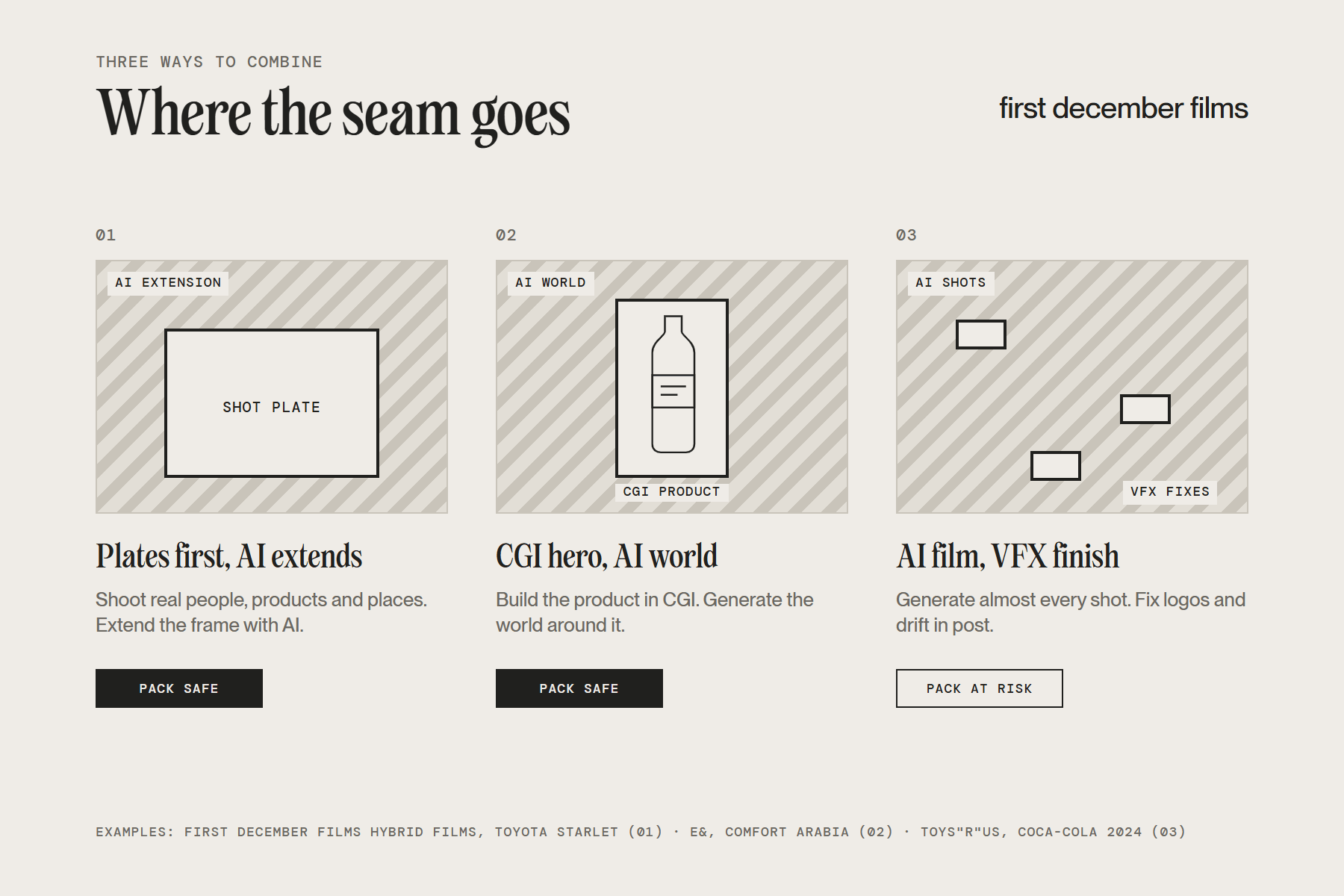
Most of the time, for a product commercial. The question is not whether to combine but where the seam goes. We see three patterns that work.
| Pattern | What is built or shot | What is generated | Example (as the makers described it) |
|---|---|---|---|
| Plates first, AI extends | Real people, products and locations, on camera | Set extensions, backgrounds, metaphor shots | Our hybrid films: "we shoot the plates first, then extend them with AI ... so the AI inherits real light instead of inventing it" (FDF); Toyota Starlet, South Africa, 2025 |
| CGI hero, AI world | The product as a CGI model | Environments, textures, skies | e& (Etisalat UAE), 2024: AI skies and "AI textures were applied to 3D elements" (Campaign Middle East); Comfort Arabia, 2025, AI "with high-end CGI and immersive 3D animation" (Campaign Middle East) |
| AI film, VFX finish | Corrections, logos, clean-up in post | Almost every shot | Toys"R"Us, 2024: "almost entirely created with Sora, with some corrective VFX" (PR Newswire); Coca-Cola 2024, script on the trucks fixed in post |
The first two patterns put the seam in the right place: the exact things are made exactly, and AI makes what can vary. The third pattern accepts that the film is mostly generated and spends post-production fixing what drifted. It works for short-lived, fantastical films; it is the riskiest for a brand that lives on its pack.
The best-known example of combining at the top end is from cinema, not advertising. Rob Bredow, chief creative officer of Industrial Light & Magic, told a TED audience in 2025 that generative AI alone struggled with "the details and the controls" when de-ageing Harrison Ford, so ILM blended it with a full CGI version of the actor (Decrypt, 15 May 2025).
Who actually combines methods? What 242 AI campaigns show
We re-cut the dataset behind our State of AI Commercials 2026 report: 242 AI commercial campaigns from ten regions, released between 2024 and 20 October 2026, each confirmed by the maker, the brand or trade press quoting them. We left our own eight campaigns out of this count. Of the 234 that remained, traditional production houses made 26 campaigns, and 11 of them (42%) were hybrid, mixing AI with live action or CGI. AI-native studios made 52, and 6 (12%) were hybrid; 33 of their 52 (63%) were fully generated. Agency in-house units were hybrid in 15% of campaigns and brand in-house teams in 6%. Only 26 of all 242 maker descriptions mention CGI, VFX, 3D or compositing at all.
The pattern is what you would expect. Teams that already own cameras, crews and VFX pipelines use AI as one more department. Teams built around AI tend to generate the whole film. Neither is wrong, but it tells you what you will be offered: ask an AI-native studio and a production house the same brief, and you will likely get two different methods.
Is CGI cheaper than AI?
No. At list price, generating a second of AI video costs a small fraction of a second of CGI. But the comparison most websites make, a CGI production budget against an AI tool subscription, is wrong, and it is repeated in Google’s AI Overview for this question. Here are the real numbers, read from the official pages on 29 October 2026.
| Method | Published price | About USD per second | Source and date |
|---|---|---|---|
| Google Veo 3.1 with audio, 1080p | $0.40 a second (40 Runway credits at $0.01) | 0.40 | Runway API pricing; Google Vertex AI lists $0.40 per unit, read 29 Oct 2026 |
| Google Veo 3.1 with audio, 4K (Vertex AI) | $0.60 per unit | 0.60 | Google Cloud, 29 Oct 2026 |
| Runway Gen-4.5 | 12 credits a second | 0.12 | Runway, 29 Oct 2026 |
| Kling 4.0, 1080p (official API) | list price per second | 0.24 | Kling, 29 Oct 2026 |
| MiniMax Hailuo (H3), 2K | per-second list price | 0.13 | MiniMax, 29 Oct 2026 |
| 3D product animation, US (UFO3D, San Francisco) | $30 to $60 a second | 30 to 60 | studio price page, read 29 Oct 2026 |
| 3D animation, India (3DLabz) | $40 to $200 a second | 40 to 200 | studio price page, read 29 Oct 2026 |
| 3D animation, UK (ProfileTree) | £8,000 to £20,000+ a finished minute | 177 to 444+ | studio guide, 30 August 2026 |
| 3D explainer, UAE (GLDS, Dubai) | from AED 40,000 for 60 seconds | 182+ | studio page, April 2026 |
| 3D animation, Poland (Pixune) | $10,000 to $50,000+ a minute | 167 to 833+ | studio guide, 6 September 2026 |
| VFX for commercials, Vietnam (Animost) | $500 to $5,000 a second | 500 to 5,000 | studio guide, 30 August 2025 |
Currency conversions use the Reserve Bank of India’s reference rates for 29 October 2026 (95.37 rupees, 0.75 pounds and 3.67 dirhams to the dollar). In Indian terms, a 30-second 3D product film at 3DLabz’s published rate is about 1.1 to 5.7 lakh rupees (one lakh is 100,000), and a Pune agency, IRPR, starts 3D product animation at "₹5 lakh+" a project (about $5,200). The CGI rows are studios’ published marketing prices, not audited rates.
Why the AI price per second misleads
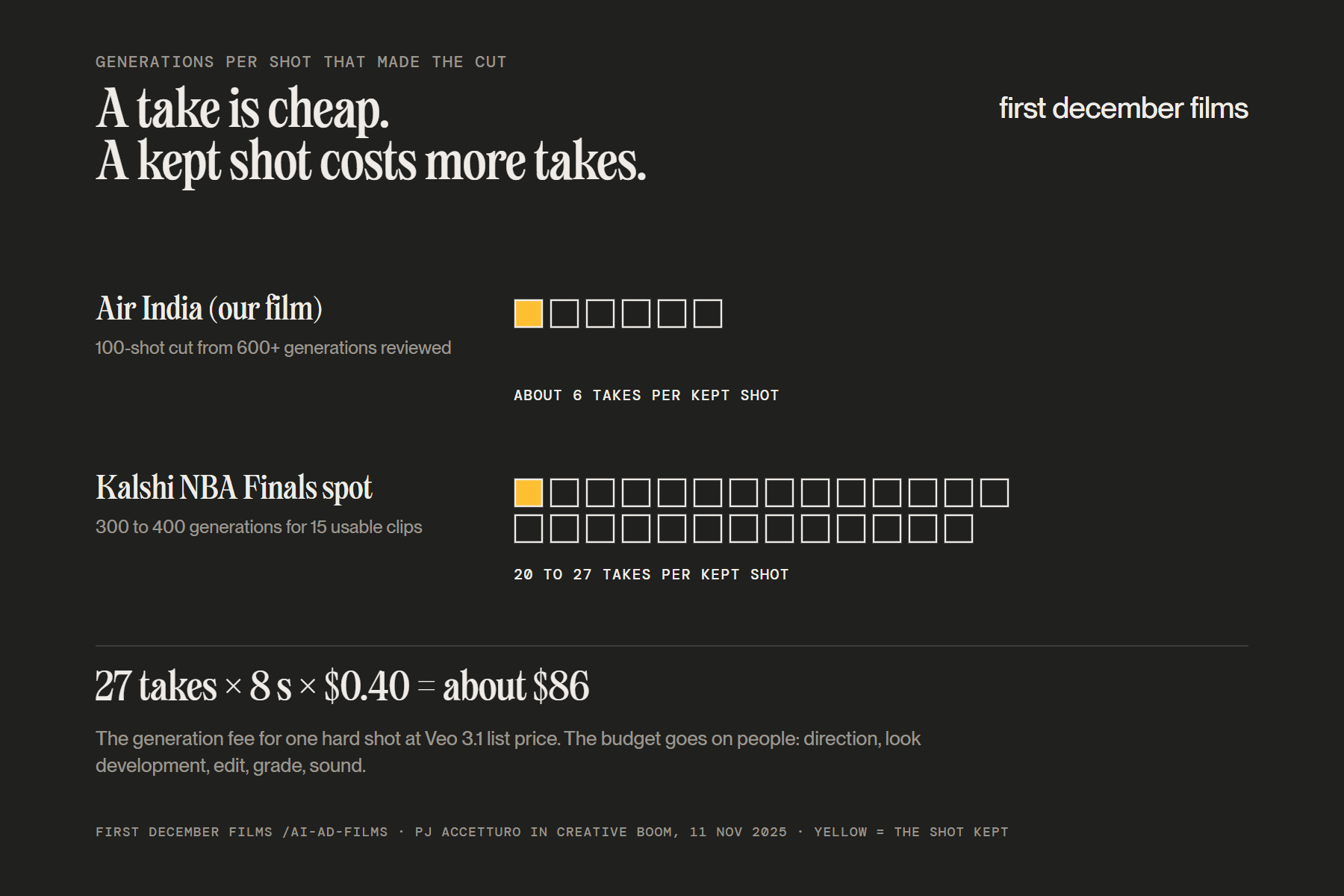
A generation price buys one take, not one usable second. Makers who published their numbers show how many takes it costs to keep one shot. The director of Kalshi’s 2025 NBA Finals spot, PJ Accetturo, said it took about 300 to 400 generations "to get 15 usable clips" (Creative Boom, 11 November 2025), or 20 to 27 takes per kept clip; Kalshi told NPR the prompting cost "under $2,000". For our Air India film, the shots in the 100-shot cut "were chosen from 600+ generations reviewed" (FDF), about six per shot, because every frame was approved as a still before anything moved. For Coca-Cola’s 2025 holiday film, the team "refined more than 70,000 generated video clips to assemble the final advertisement", Dataconomy reported (4 November 2025).
The generation fee is the smallest line in the budget. At $0.40 a second, even 27 eight-second takes of one shot cost about $86. The money in an AI film, as in a CGI film, goes on people: direction, look development, iteration, editing, grading, sound and approvals. That is why the reported savings, 40% to 85% of a CGI or traditional budget in the Emami, LG Uplus and Reliance Digital cases above and below, are large but not a hundred-to-one.
Cheap revisions are a myth for both. Gemini told us that AI revisions are "cheap and instant"; Perplexity and ChatGPT said the opposite. In practice, a CGI change to a material or camera move is a re-render of the same shot. An AI change is a new generation that may change everything else in the shot too. Our own AI page lists what resets the clock: "a character changed after image lock, a location changed after motion has started, or notes with no priority". If you expect many client notes late in the process, that favours CGI or a hybrid.
How long does each take?
The 1993 Coca-Cola polar bears, an early CGI landmark animated by Rhythm & Hues, took "some 12 weeks to produce from beginning to end", according to Coca-Cola’s history page. Today a UK studio guide quotes 8 to 16 weeks for a finished minute of 3D animation (ProfileTree, August 2026). On the AI side, Kalshi’s spot took two days, Coca-Cola’s 2025 film "less than a month" against "months and months" for traditional animation, in the words of Secret Level’s Jason Zada (The Hollywood Reporter, 6 November 2025), and on our own pipeline "a 15 to 30 second film takes about a day of generation" once the image lock is signed off.
Two cautions. First, the AI clock starts after the creative is locked; a brief that is still moving is slow in any method. Second, generation can be undone by time. Moonshot, the Indian AI studio, told Indian Television about its first fully AI film for Tata Consumer Products in June 2026: "Weeks of rendering were scrapped."
What about faces and performance?
This is where we would push back hardest on a fully generated film with people in it. Callif of Tool: "The biggest area where traditional production is and will remain king is human performance." Sandeep Goyal of Rediffusion, which made Tata Power’s AI Christmas film in India in 2024, said "Getting the right skin tone and eye colours were some of the challenges we faced" (Storyboard18, 20 December 2024). Even Coca-Cola’s AI lead said in 2025 that the year before "it was difficult to get those expressions from animals so we had to use human faces" (The Hollywood Reporter).
CGI people are not the easy answer either: a photoreal digital human is among the most expensive things in VFX. For a commercial, the practical answer is to cast real people and shoot them, then use CGI or AI around them. When a real person’s likeness is generated, you need their written consent. Our guide to AI actors in ads covers consent, pay and the laws in the US, UK, EU and India.
Who owns a CGI ad and who owns an AI ad?
A commissioned CGI film is ordinary intellectual property. The software makers do not claim your output; Blender’s licence says "What you create with Blender is your sole property" (Blender). Your contract with the studio decides who owns the files, and third-party models or textures come with their own licences, so ask for the list.
AI output is less settled, and it differs by market.
| Market | Can AI footage be protected? | Must an AI ad be labelled? | Source |
|---|---|---|---|
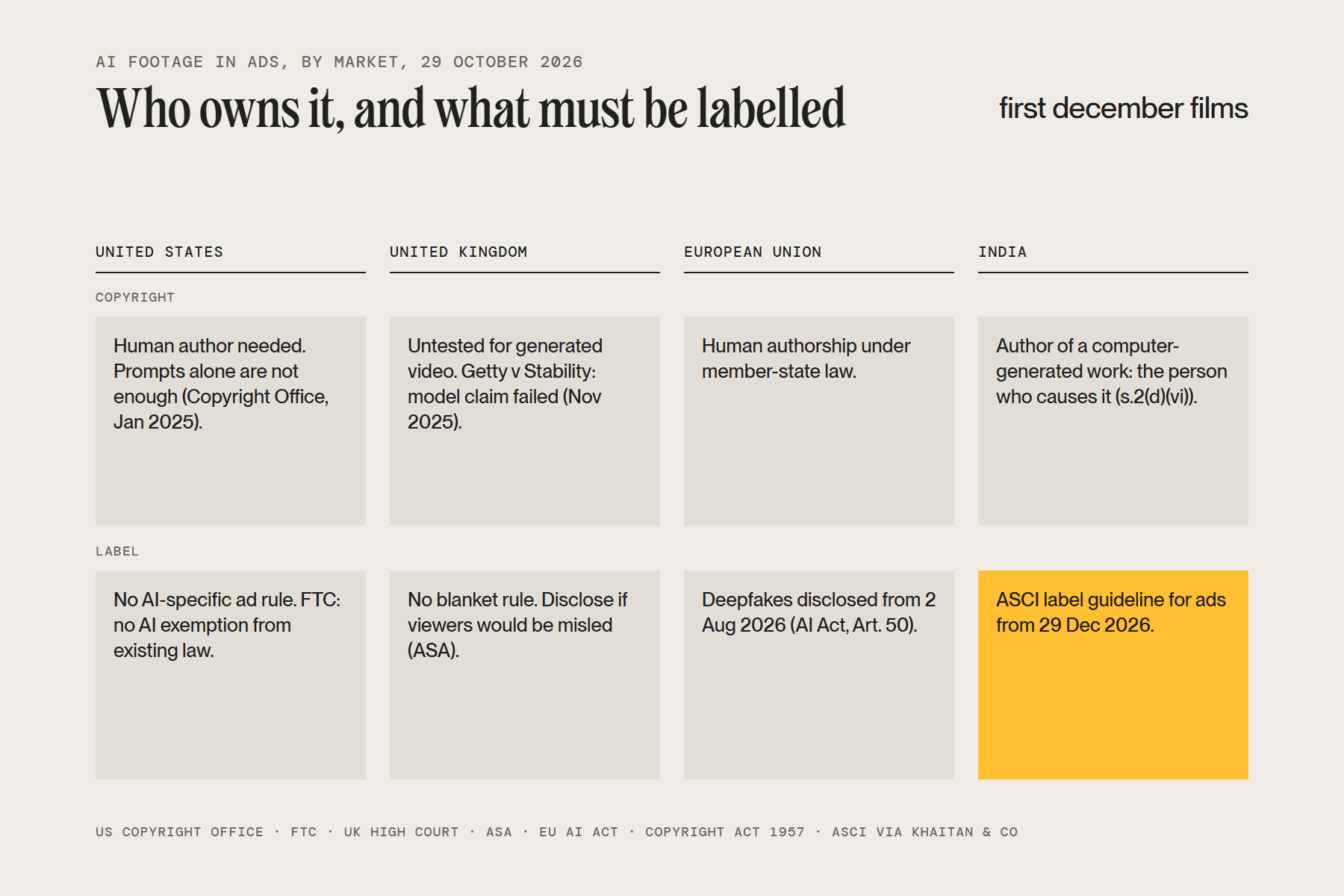
| United States | Not purely generated material. The Copyright Office (January 2025): "prompts do not alone provide sufficient control"; human selection, arrangement and edits can be protected. The courts require a human author (Thaler v. Perlmutter; Supreme Court declined the appeal on 2 March 2026) | No AI-specific ad rule. The FTC: "there is no AI exemption from the laws on the books" (25 September 2024) | US Copyright Office; Supreme Court docket 25-449; FTC |
| United Kingdom | Undecided for generated video. In Getty Images v Stability AI (High Court, 4 November 2025), the copyright claim against the model failed because it "does not store or reproduce any Copyright Works" | No blanket rule. The ASA (29 May 2025): disclose if the audience is "likely to be misled" without it | Getty v Stability judgment; ASA |
| European Union | Human authorship needed under member-state law | AI Act Article 50: deepfakes must be disclosed from 2 August 2026; for "evidently artistic, creative, satirical, fictional" work, in a way that "does not hamper the display or enjoyment of the work" | Article 50 |
| India | The Copyright Act names "the person who causes the work to be created" as author of a computer-generated work, a route the US does not have | IT Rules amendment, in force 20 February 2026: platforms must label synthetic content. ASCI’s guideline for ads takes effect 29 December 2026 with prohibited, label-required and no-label categories | Copyright Act 1957, s.2(d)(vi); Khaitan & Co on ASCI |
Two practical points for a brand. Ask which model and which plan your producer used. Google’s indemnity for Veo covers only "generally available versions" on its enterprise cloud (Google Cloud); Adobe’s covers Firefly video for customers whose agreement links its indemnity page; Runway’s terms leave commercial use to you, with no indemnity and outputs usable "to train and improve its AI models" (Runway terms). Ask for a generation log. If you ever need to show what was generated, from what and by whom, a log is your paper trail. Lawsuits are still open: Disney and Universal sued Midjourney on 11 June 2025 ("Piracy is piracy", says the complaint), and we found no ruling as of 29 October 2026. For the Indian rules in detail, see are AI ads legal in India.
Can AI deliver a broadcast commercial?
Yes, with limits you should know before you approve a schedule. Google’s Veo 3.1 generates clips of "4, 6, or 8 seconds" at up to 4K on Vertex AI (Google Cloud), so a 30-second spot is many generations cut together, not one. Models change fast: OpenAI removed Sora 2 from its API on 24 September 2026 (OpenAI), and Google shut down the Veo previews in its Gemini API on 22 October 2026 (Google), although Veo 3.1 remains on Vertex AI. A film that depends on one model’s look should keep its source files and settings.
Our own generation standard today is 1080p, with 16:9, 4:3 and 1:1 from one generation and "9:16 is a separate one", as our AI ad films page states. CGI renders at whatever resolution and aspect ratio you specify, which matters for cinema, large outdoor screens and long-life assets.
CGI vs AI in real commercials, 2023 to 2026
Built, shot or combined
| Brand, year, market | Method | What was built or shot | What was generated | What the makers said |
|---|---|---|---|---|
| Jacquemus, 2023, France | CGI | 3D bags tracked into street footage | Nothing | "I modeled it in 3D and used it in this footage" (Ian Padgham, PAPER) |
| Maybelline, 2023, UK and US | CGI | 3D mascara and lashes on a London Tube train | Nothing | Brand: traditional out-of-home would not have got the same reach (Glossy) |
| Coca-Cola x Marvel "The Heroes", 2024 | CGI | Marvel characters animated into a live comic shop (Electric Theatre Collective) | Nothing stated | Won Outstanding VFX in a Commercial at the 2025 VES Awards (VFX Voice) |
| Under Armour, 2024, global | Hybrid | A 3D model of Anthony Joshua, 3D CGI, 2D VFX, 35mm film | AI video, photo, voiceover | Built "from nothing but existing assets" with "no athlete access" (Wes Walker, TechCrunch) |
| e&, 2024, UAE | Hybrid | Live action and 3D elements | Skies, textures, scene development | "More than 5,000 AI-generated images were reviewed" (Campaign Middle East) |
| Toyota Starlet, 2025, South Africa | Hybrid | Car and cast, two days in Johannesburg | Fantasy worlds | AI "helped us to enhance the commercial" (Peet Engelbrecht, Bizcommunity) |
| Comfort Arabia, 2025, UAE | Hybrid | High-end CGI and 3D animation | AI generation | Region’s "first AI-generated TVC aired across more than 10 channels" (Insia Ali, Campaign Middle East) |
| Reliance Digital, 2026, India | Hybrid | Live performances | Environments, set extensions, lighting | "AI helped us enhance the cinematic world around those performances, not replace them" (Masumeh Makhija, Indian Television) |
Mostly or fully generated
| Brand, year, market | Method | What was built or shot | What was generated | What the makers said |
|---|---|---|---|---|
| Toys"R"Us, 2024, US | AI with VFX finish | Corrective VFX | Almost every shot (Sora) | "almost entirely created with Sora" (PR Newswire) |
| LG Uplus, 2024, South Korea | AI | Nothing stated | The whole film | About 60% of the cost of a 100% 3D ad (KED Global) |
| Coca-Cola, 2024 and 2025, global | AI with post fixes | Script on the trucks fixed in post (2024) | Trucks, people (2024), animals (2025) | Only 2 of 11 truck scenes show the same truck (Burbidge, The Drum) |
| Volvo, 2025, Saudi Arabia | AI | Nothing | The whole film, no car shown | "reluctant to include a car" (Osama Saddiq, Design Compass) |
| Emami DermiCool, 2025, India | AI | Nothing | The whole film | 15 to 20% of the cost of "a similar CG-heavy film" (Storyboard18) |
| Kalshi, 2025, US | AI | Nothing | The whole spot | Two days; prompting "under $2,000" (NPR) |
| Svedka, 2026, US | AI rebuild of a CGI mascot | Performance captured | The Fembot and her world | "AI was necessary to rebuild her" (LBB Online) |
A TVC, short for television commercial, is the common Indian and Middle Eastern term for what the US calls a TV spot or commercial. A practical note for anyone comparing these: the cost and time claims above are the makers’ own, made at launch.
How did we get here, and what changes next?
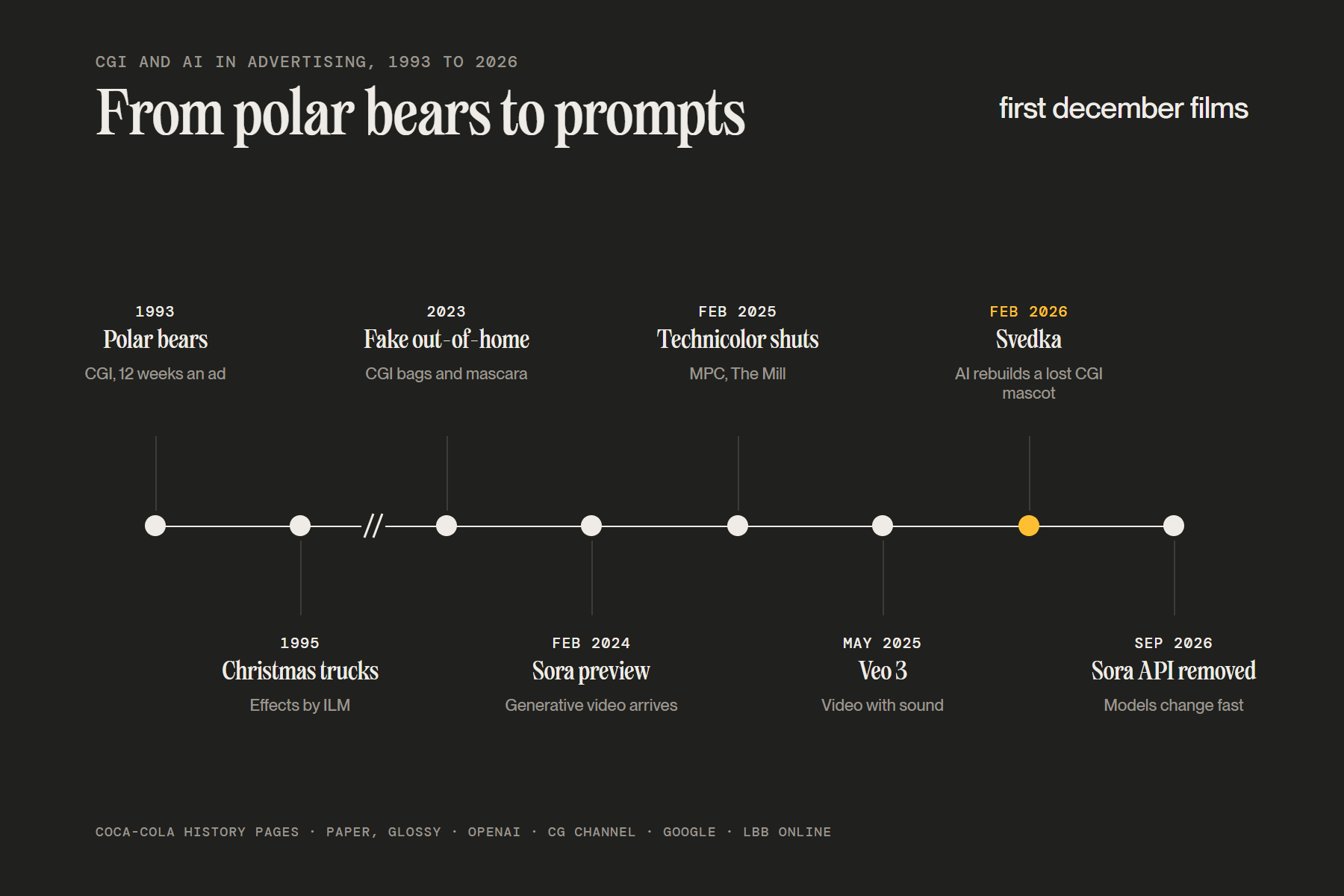
CGI entered advertising as the method for impossible shots. Coca-Cola’s polar bears (1993) and its Christmas trucks (1995, created by W.B. Doner with "special effects by the world-famous Industrial Light and Magic", per Coca-Cola’s history page) were made with the tools of their day. Thakar drew the line from there to now. For impossible shots, he said, "We have to do CGI" in the past, "and now it’s gen AI" (Digiday, 20 November 2024).
The generative era moved fast. OpenAI previewed Sora in February 2024, Google launched Veo 3 with sound on 20 May 2025, and Netflix’s Ted Sarandos said in July 2025 that a building-collapse sequence in El Eternauta "was completed ten times faster than it could have been completed with traditional VFX tools and workflows" (Futurism). The traditional VFX business took a hit in the same months: Technicolor Group, owner of MPC and The Mill, began shutting down operations in February 2025 (CG Channel), and the FICCI-EY report, as reported by AnimationXpress, says the shutdown displaced "up to 2,000" VFX and animation professionals in Bengaluru.
What changes next is a matter of forecast, and practitioners disagree. PJ Accetturo said in November 2025: "I do not see a world in which a year from now, million-dollar shoots exist." Callif of Tool expects human performance to remain with live action. Framestore, the London VFX house, named a creative director for AI in May 2026 and describes its bet as AI "with the granular control necessary to respond to client feedback" (Framestore). Our view: control is the whole game. The method that gives a brand control over the frames it cares about will win those frames, and today that is still CGI or a camera for the product, and AI for the world.
How to decide on a brief: five questions
Before a treatment is written, ask five questions of every shot that is not straightforward live action.
- Will anyone check this frame? If the pack, logo, label, claim or product shape is on screen, build it in CGI or shoot it. Do not generate it.
- Does it need to move exactly? Pours, crashes, cloth, a car through a corner: CGI simulation or a camera. A drifting sky, crowd or skyline: AI.
- Is there a real face carrying the story? Cast and shoot the person. Use AI or CGI around them, and get written consent for any generated likeness.
- Will you use this asset again? A mascot, a hero product or a world you will return to for years is worth building once as CGI.
- How many versions, and how fast? Thirty variants in a month favour AI. One flagship film with heavy late notes favours CGI or a shoot.
If the answers still leave one shot in doubt, test it before you commit. We turn the one scene that feels too risky into a paid look-development and feasibility test before full production.
When this advice does not apply
- Pure animation styles. If the film is deliberately stylised (2D, clay, cel-shaded), the choice is about style and pipeline, and the exactness test matters less.
- Very short-life social content. A 6-second social cutdown seen for a week can tolerate drift that a national TV commercial cannot.
- When the idea is the method. Our Nike film "Make Every Yard Count" (2014) was a single bowling action assembled as stop-motion from 2,25,000 photographs (225,000) of 1,440 young cricketers, with no CGI character and no generative AI (FDF). Sometimes the strongest answer to CGI vs AI is neither.
- Regulated claims. Health, medical and financial-return claims should not rest on generated proof. We do not make generated proof for these claims at all.
Planning a commercial with effects?
The CGI vs AI decision is made shot by shot, and it is cheapest when it is made at the script. Paste your script into our free script analyser for a producer’s read of its complexity, or bring us the shot everyone says can’t be done as a paid feasibility test. To see how an AI film is made stage by stage, read our AI commercial production guide; for budgets, our AI ad film cost guide compares AI, live action and hybrid in rupees. Or send us the brief and a producer will tell you which shots to build, which to shoot and which to generate.
First December Films is an advertising film production company in Mumbai. Our work has won more than 150 international creative awards, including Cannes Lions, D&AD and One Show Gold Pencils.
Frequently asked questions
What is the difference between CGI and AI?
CGI is built by artists in 3D software: every object is modelled, lit and rendered, so the same frame comes out identical every time. Generative AI video is predicted by a model from a prompt or image, so it is fast and cheap per take but never exactly repeatable. VFX is the umbrella term that covers both.
Is CGI cheaper than AI for a commercial?
No. On 29 October 2026 the leading AI video models listed at 0.12 to 0.60 US dollars a second, against roughly 30 to 833 dollars a second on published CGI price cards. But makers report 6 to 27 generations for every shot they keep, and most of either budget goes on people, not software.
Is there AI in CGI?
Increasingly, inside the tools. VFX teams use AI for rotoscoping, clean-up, depth maps and matchmove assistance, and India’s FICCI-EY 2026 report credits it with up to 40 per cent time savings on such tasks. A fully generated shot is a different method from a CGI shot made faster with AI.
Will AI replace CGI in advertising?
For fantastical, CG-heavy animated films it already is: brands such as Emami and LG Uplus reported AI films costing 15 to 60 per cent of a comparable 3D film. For packshots, logos, products in motion and assets reused for years, CGI or a camera still gives the control a brand needs.
Can AI make a packshot or show my logo accurately?
Not reliably. Generative models drift between shots, and Coca-Cola’s 2024 AI film needed traditional post-production to fix the brand script on its trucks. We build or shoot the product and keep AI to the world around it.
Who owns an AI-generated commercial?
In the US, purely AI-generated footage cannot be registered for copyright, though human selection and editing can be protected. India’s Copyright Act names the person who causes a computer-generated work to be created as its author. A commissioned CGI film is owned under your contract with the studio.
Do AI ads need a label?
It depends on the market. The EU AI Act requires deepfakes to be disclosed from 2 August 2026, the UK has no blanket rule, and the US has no AI-specific ad rule. In India, ASCI’s labelling guideline for synthetic content in ads takes effect on 29 December 2026.