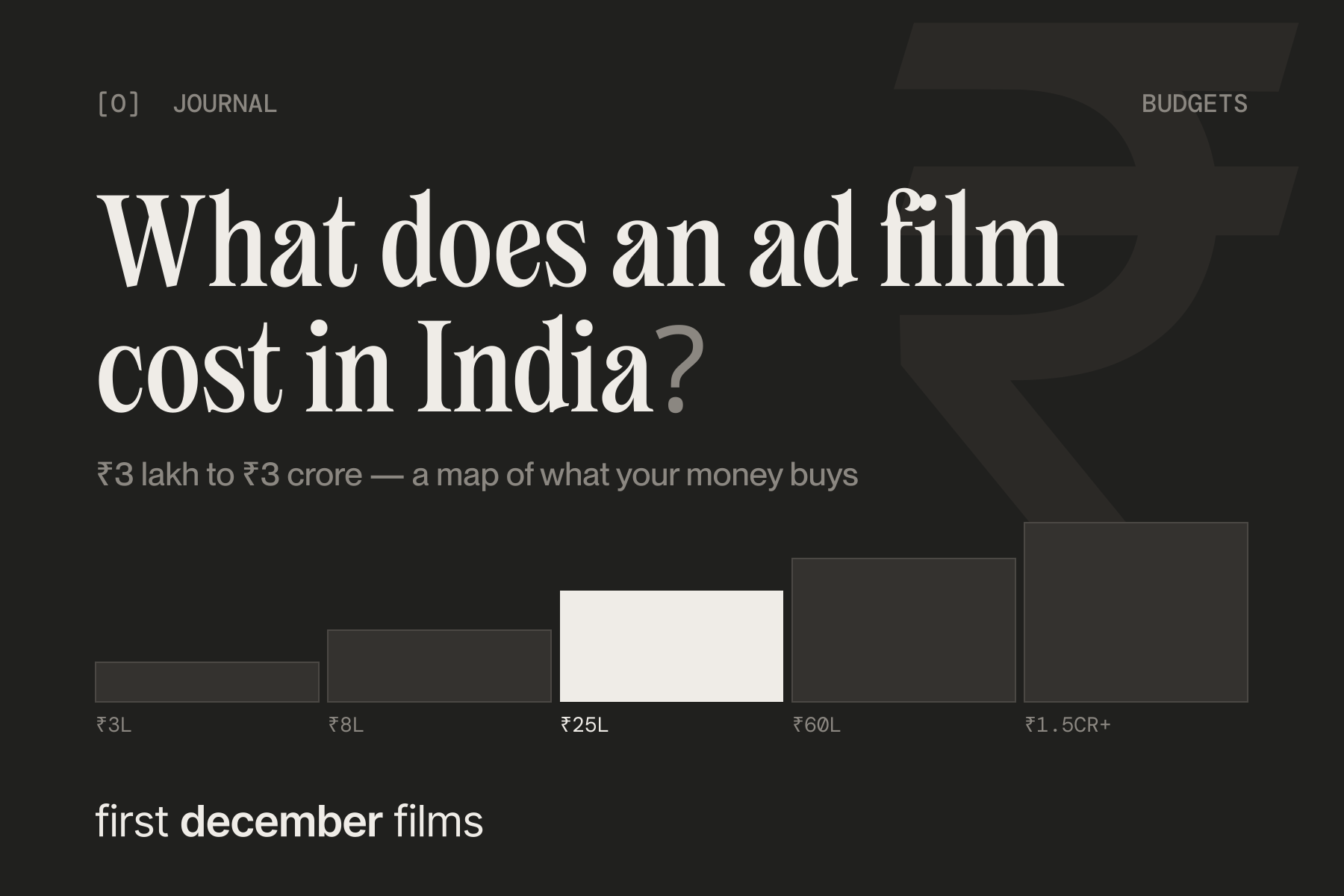
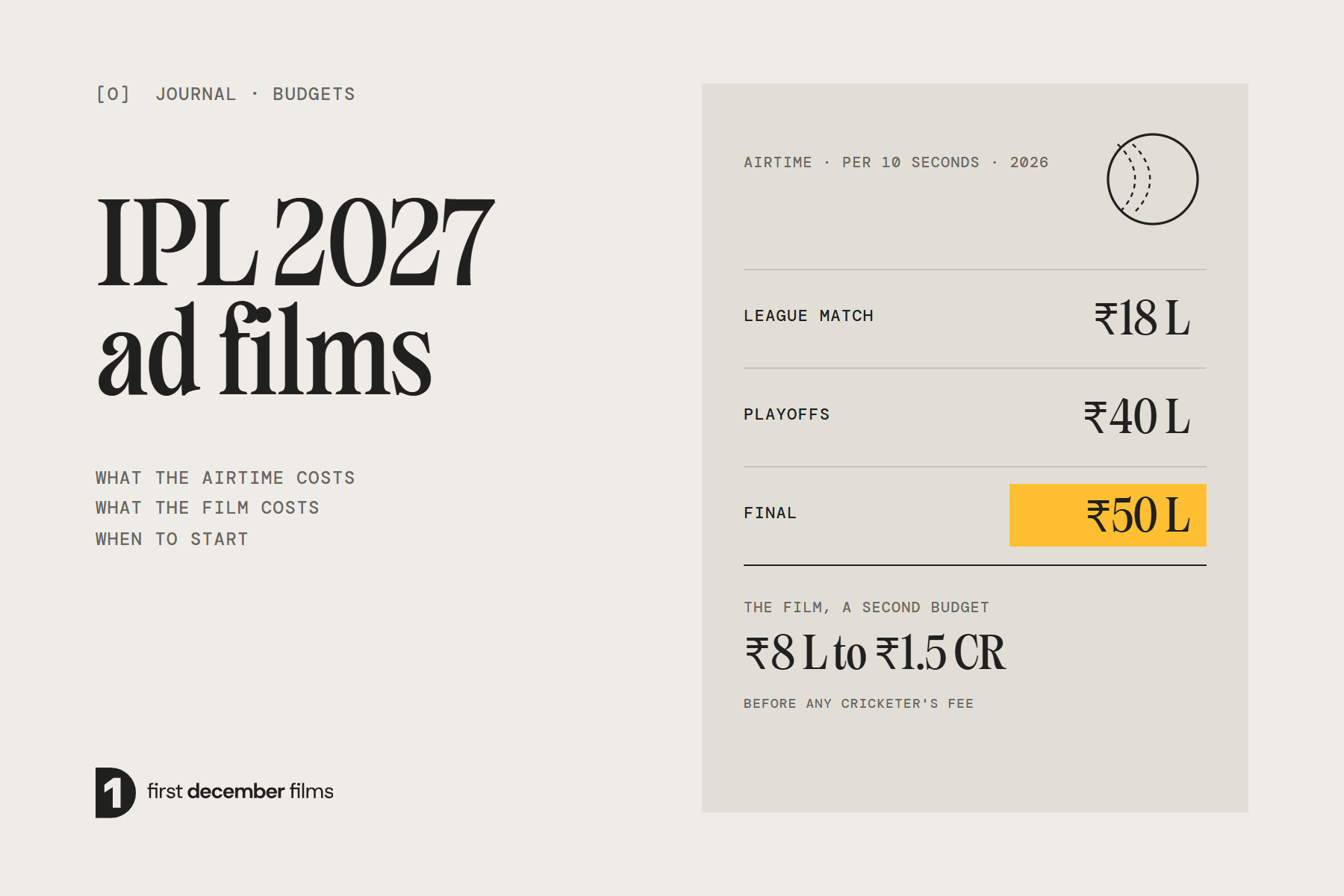
The short answer. In IPL 2026 a 10-second TV spot on JioStar’s rate card cost ₹18 lakh (about $19,100) in a league match and ₹50 lakh (about $53,100) in the final, and connected TV started at ₹600 per thousand views. The film is a separate budget: roughly ₹8 lakh to ₹1.5 crore to make, before any cricketer’s fee. For a March 2027 start, approve the script by mid-January.
IPL ad cost is usually answered with one number, the price of ten seconds of airtime. That is half the bill. The other half is the film that fills those ten seconds, and nobody who ranks for the question prices it. We make IPL and cricket films for brands, from an in-flight cricket film with Rohit Sharma and Hardik Pandya for Malaysia Airlines to more than 30 fully AI founder films for Razorpay that aired during IPL 2026, so this guide prices both halves, the way a producer has to when a brand asks whether it can afford the season.
It also adds two things we could not find anywhere else: a catalogue of 63 IPL 2026 campaigns that shows how brands actually turned up (how many films, how long, how many cricketers, how late), and a production calendar for IPL 2027 worked back from the first match.
Rates below are the 2026 rate cards as reported by the trade press; JioStar does not publish them, and the 2027 card is not out. Currency conversions use the Reserve Bank of India reference rate of 16 November 2026 (1 US dollar = ₹94.12). One lakh is 100,000 rupees; one crore is 10 million.
Key takeaways
- IPL 2026 TV airtime on JioStar’s card: ₹18 lakh per 10 seconds for a league match (SD and HD together), ₹21.6 lakh for Grade A matches, ₹40 lakh for playoffs and ₹50 lakh for the final. That is ₹1.8 lakh a second in the league and ₹5 lakh a second in the final.
- Connected TV rose 25% to a base of ₹600 per thousand impressions, with premium CTV breaks at ₹21.35 lakh per 10 seconds. Rate cards are indicative; most deals are bundled across TV and digital and negotiated.
- The film is a separate budget. On our own published tiers, a serious digital film costs ₹8 to 25 lakh, a national TVC ₹25 to 60 lakh and a campaign film ₹60 lakh to ₹1.5 crore. A top cricketer’s day can cost more than all of it.
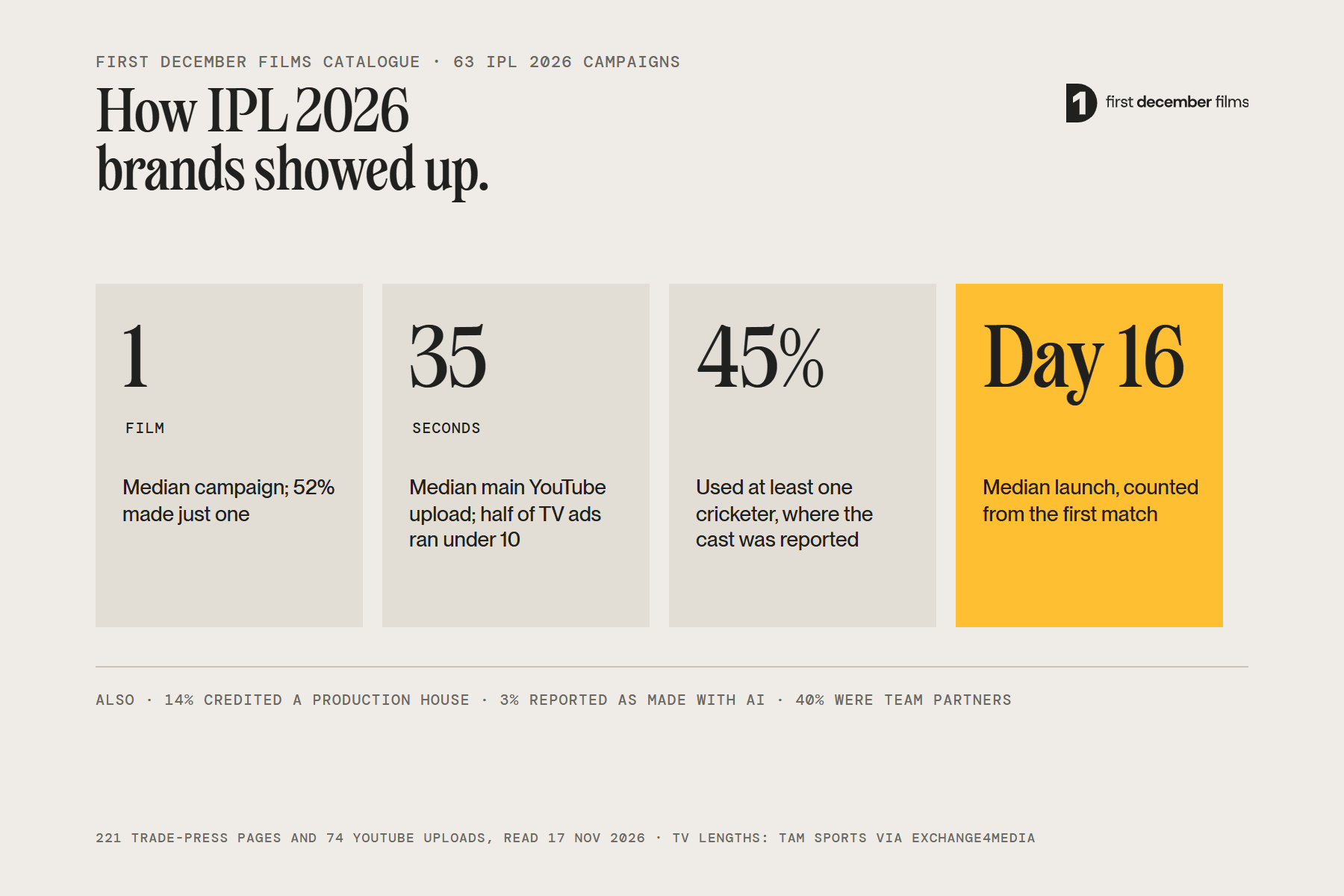
- In our catalogue of 63 IPL 2026 campaigns, the median campaign made one film, its main YouTube upload ran 35 seconds, and it launched 16 days after the first match. On TV, TAM Sports counted half of all IPL ad insertions at under 10 seconds.
- IPL 2027 is the last season of the ₹48,390 crore 2023 to 2027 media rights. The BCCI has not announced dates; plan for a start as early as 10 March.
- Four rules change what a 2027 IPL ad can be: the ban on real-money gaming ads (which reaches anyone involved in making one), ASCI’s AI labelling rules from 1 January 2027, the IPL’s ban on unlicensed use of its marks, and ASCI’s due-diligence duty on celebrities.
- Per 10 seconds, a Super Bowl spot in February 2027 costs 50 to 56 times the IPL final and 140 to 157 times an IPL league match.
How much does an IPL ad cost?
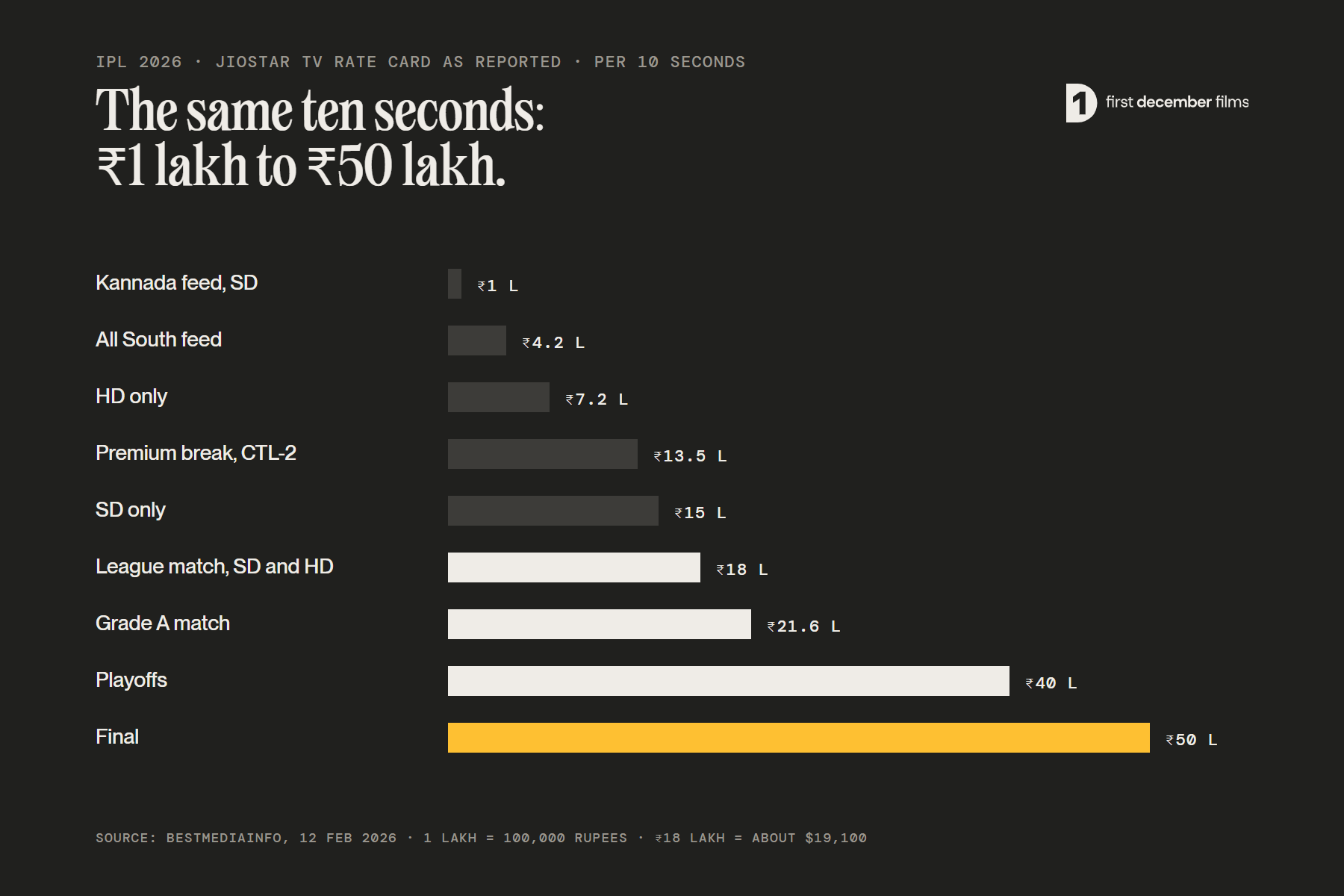
An IPL ad cost ₹18 lakh (about $19,100) per 10 seconds on JioStar’s linear TV in a league match of the 2026 season, rising to ₹50 lakh (about $53,100) per 10 seconds in the final, according to the rate card reported by BestMediaInfo on 12 February 2026. Connected TV is sold separately, from ₹600 per thousand impressions for a 10-second ad.
The base TV rate did not move from 2025. What moved was everything around it: the HD-only feed rose 20%, the premium CTL-2 break rose 25%, regional feeds rose 10% to 67%, and connected TV rose 25%.
| IPL 2026 inventory (JioStar rate card, as reported) | Price per 10 seconds | In US dollars |
|---|---|---|
| TV live, league match, SD and HD | ₹18 lakh | about $19,100 |
| TV live, SD only | ₹15 lakh | about $15,900 |
| TV live, HD only | ₹7.2 lakh (up 20%) | about $7,650 |
| TV live, Grade A match | ₹21.6 lakh | about $22,950 |
| TV live, playoffs | ₹40 lakh | about $42,500 |
| TV live, final | ₹50 lakh | about $53,100 |
| TV premium break, CTL-2 | ₹13.5 lakh (up 25%) | about $14,350 |
| TV regional feed, All South | ₹4.2 lakh | about $4,460 |
| TV regional feed, Kannada SD | ₹1 lakh (up 67%) | about $1,060 |
| Connected TV, base | ₹600 per 1,000 impressions (up from ₹480) | about $6.40 CPM |
| Connected TV, premium break CTL-2 | ₹21.35 lakh | about $22,700 |
| Digital sponsorship, associate tier | ₹14 crore per season | about $1.49 million |
| Premium partnerships | ₹100 to 260 crore per season | about $10.6 to 27.6 million |
Sources: BestMediaInfo, 12 February 2026 (TV) and 10 February 2026 (CTV); exchange4media, 1 April 2026 (packages).
Why the rate card is not the price
The card is the opening position. Vinay Hegde, CEO Investments (Media) at Madison World, told exchange4media on 1 April 2026: "Rate cards have increasingly become reference points, with most deals bundled across TV and digital to deliver unified reach and optimise ROI." Big advertisers buy packages that mix TV spots, CTV, mobile and sponsorship features; on JioHotstar, handheld packages ran ₹25 to 100 crore and CTV packages ₹60 to 150 crore in 2026, and features such as the DRS or toss segments were open only to brands spending ₹30 to 35 crore or more (exchange4media, 1 April 2026).
That is also why reports disagree. BusinessLine’s headline on 27 March 2026 said IPL 2026 ad rates went up 25 to 30%; BestMediaInfo and exchange4media both reported the base TV rate flat at ₹18 lakh. Both can be true: the base held, while premium breaks, HD, regional feeds and CTV went up. Treat any single "IPL ad cost" figure as a list price for one slice of inventory, not what your plan will cost.
One more correction worth making: Google’s AI Overview for "ipl ad cost", read on 17 November 2026, gave base rates of "₹18,000,000", which is ₹1.8 crore and ten times the real figure. The rate is ₹18,00,000 in Indian notation: ₹18 lakh.
Can a small brand afford IPL?
A small brand can be in the IPL without buying the league feed. In 2026, JioStar sold regional TV feeds from ₹1 lakh per 10 seconds, and on connected TV and mobile it sells by the thousand impressions, so the entry ticket is set by the budget, not the match. For IPL 2025, JioHotstar offered small and medium businesses packages from ₹15 lakh, built on 10-second clips (Outlook Business, 9 March 2025); we found no 2026 equivalent published.
Regional is not a consolation prize. JioStar’s sports CEO Ishan Chatterjee said at a FICCI event that under 10% of IPL 2026 watch time was in English and about 90% in Indian languages (exchange4media, 29 September 2026), and JioStar reported that the regional share of digital watch time grew 33% during the season. Anup Govindan, JioStar’s Head of Sales for sports, put the opportunity as "building around those nuances rather than viewing regional consumption purely through the lens of scale" (Deccan Chronicle, 7 October 2026). For a brand strong in two states, two language feeds can do more than the national one.
What will IPL 2027 ad rates be?
Nobody outside JioStar knows yet. The 2026 card reached the trade press about six weeks before the season (BestMediaInfo, 10 February 2026, for a 28 March start), so expect the 2027 card in late January or early February.
Three forces pull in different directions. In favour of holding: IPL 2027 is the last season of JioStar’s ₹48,390.32 crore rights for 2023 to 2027 (BCCI, 15 June 2022), the 2028 to 2032 tender is expected early in 2027 (exchange4media, 28 September 2026), and ad volume per channel per match rose 4% in 2026 even with fewer advertisers (TAM Sports, via Indian Television, 12 June 2026). Against: real-money gaming, which supplied up to 30% of IPL ad revenue at its peak, is banned (exchange4media, 24 February 2026); TAM counted about 65 TV advertisers in 2026 against more than 110 in 2025; and Media Partners Asia forecast in March 2026 that the next rights cycle will stay flat at $5.4 billion, with the value per match falling about 13%.
Mayank Shah, Vice President at Parle Products, said before the T20 World Cup that "A decline of around 10-15% is considered quite possible, if not inevitable" for cricket rates (BestMediaInfo, 19 December 2025). That was a forecast for a different tournament, and the IPL base held. Our planning assumption for clients: budget at the 2026 card, expect the premium and CTV lines to move more than the base, and keep 10% of the media plan unallocated until the card is out.
What does an IPL ad film cost to make?
An IPL ad film costs what any ad film costs: the airtime does not change the price of a shoot day. On the tiers we publish in our ad film production cost guide, a serious digital film costs ₹8 to 25 lakh, a national TVC ₹25 to 60 lakh, a campaign film ₹60 lakh to ₹1.5 crore, and celebrity-led production starts near ₹75 lakh before the endorsement fee. What the IPL changes is how many versions you need and whose time you are buying.
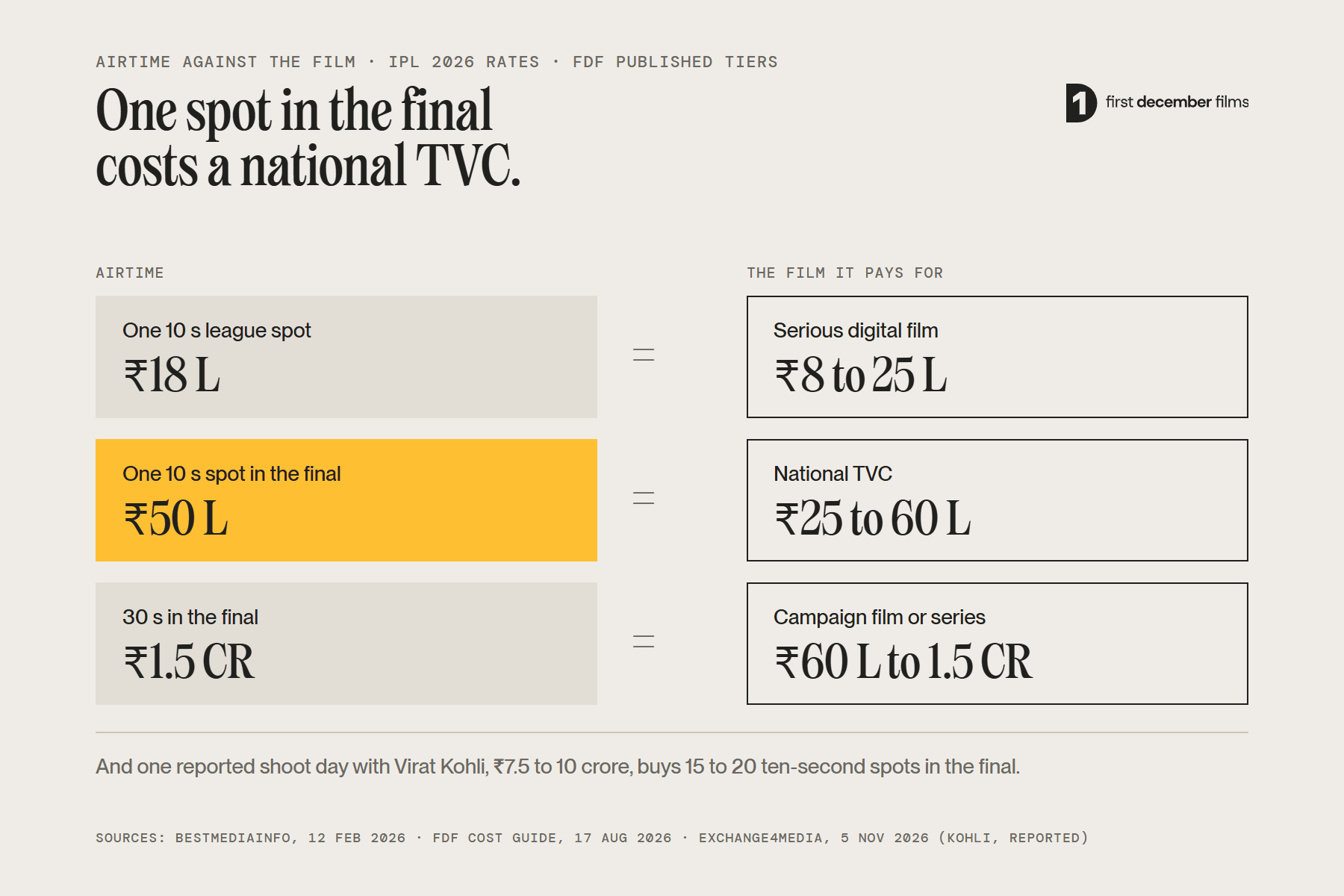
The comparison most brands never make is between the two budgets. One 10-second spot in the 2026 final, at ₹50 lakh, costs the same as a national TVC in the middle of our range. A single 10-second league spot, at ₹18 lakh, would pay for a serious digital film. Media is almost always the larger budget, and a film that is cheap to make but wrong for the slot wastes the expensive one.
| What you are buying | Typical cost | In US dollars | What it equals in IPL 2026 airtime |
|---|---|---|---|
| Serious digital film (our tier 2) | ₹8 to 25 lakh | about $8,500 to 26,600 | one league TV spot of 10 seconds |
| National TVC (our tier 3) | ₹25 to 60 lakh | about $26,600 to 63,800 | one 10-second spot in the final |
| Campaign film or series (our tier 4) | ₹60 lakh to ₹1.5 crore | about $63,800 to 159,400 | 30 seconds in the final |
| Celebrity-led production, before the fee | from about ₹75 lakh | from about $79,700 | 15 seconds in the final |
| One shoot day with Virat Kohli (reported) | ₹7.5 to 10 crore | about $0.8 to 1.06 million | 15 to 20 ten-second spots in the final |
Sources: First December Films’ cost guide (17 August 2026); exchange4media, 5 November 2026, citing industry reports for the Kohli day rate; rate card as above.
What does a cricketer add to the cost?
A cricketer adds a fee, a schedule and a set of rules. The fee is the visible part. Kroll’s celebrity brand valuation report (5 August 2026) put Virat Kohli’s brand value at $158.4 million, MS Dhoni’s at $115.3 million, Rohit Sharma’s at $62.0 million and Jasprit Bumrah’s at $44.6 million, and exchange4media reported on 5 November 2026 that Kohli’s commercial shoots run ₹7.5 to 10 crore a day. For creator-style IPL work, Monika Chettri of Social Beat said "Top players today can command ₹50 lakh to ₹1 crore per post" (exchange4media, 28 April 2026).
The less visible costs are licences. Using a franchise’s logo, jersey or name means a separate deal with the team: industry sources quoted by exchange4media (28 April 2026) said such deals trigger revenue sharing, with teams taking 20 to 40%, and that bundling several players into one campaign can carry a 30 to 40% premium. A plain cricketer in a plain shirt is cheaper than the same cricketer in a franchise jersey.
Then there is time, which no fee buys more of. The BCCI said in January 2025 that India players "are not permitted to engage in personal shoots or endorsements during series or tour", so shoot days have to sit between national duty and the IPL itself. On our Malaysia Airlines film, "Rohit Sharma and Hardik Pandya were in the middle of an IPL season, so the film had to be built around a very short window with the players", and everything that did not need them was planned and shot so that their time went only on the beats that carried the film. That is the real cricketer cost: a production built backwards from a few hours.
How many films does an IPL campaign need?
Fewer than most plans assume, and more versions than most budgets allow. In our catalogue of IPL 2026 campaigns, 17 of the 33 campaigns that reported a film count (52%) made a single film; 11 (33%) made three or more. Birla Opus made three films in four languages with ten cricketers (Campaign India, 24 April 2026). OpenAI’s "Everyday Superheroes", produced by Early Man Film and directed by Abhinav Pratiman, ran seven films in nine languages (Indian Television, 14 April 2026).
The season is long, and that punishes one film. Anadi Sah, National Creative Director at tgthr, put it plainly: "IPL runs for over a month, and unless a brand has the budget and planning to create multiple variations, a single ad quickly becomes white noise and gets ignored." (exchange4media, 6 May 2026). The cheapest way to get variety is to plan it into one shoot: several scripts on the same set, the same cast, the same days. That is how campaign films bring the per-film cost down, and it is why we price multi-film work as a campaign rather than film by film.
How does an IPL ad compare with the Super Bowl?
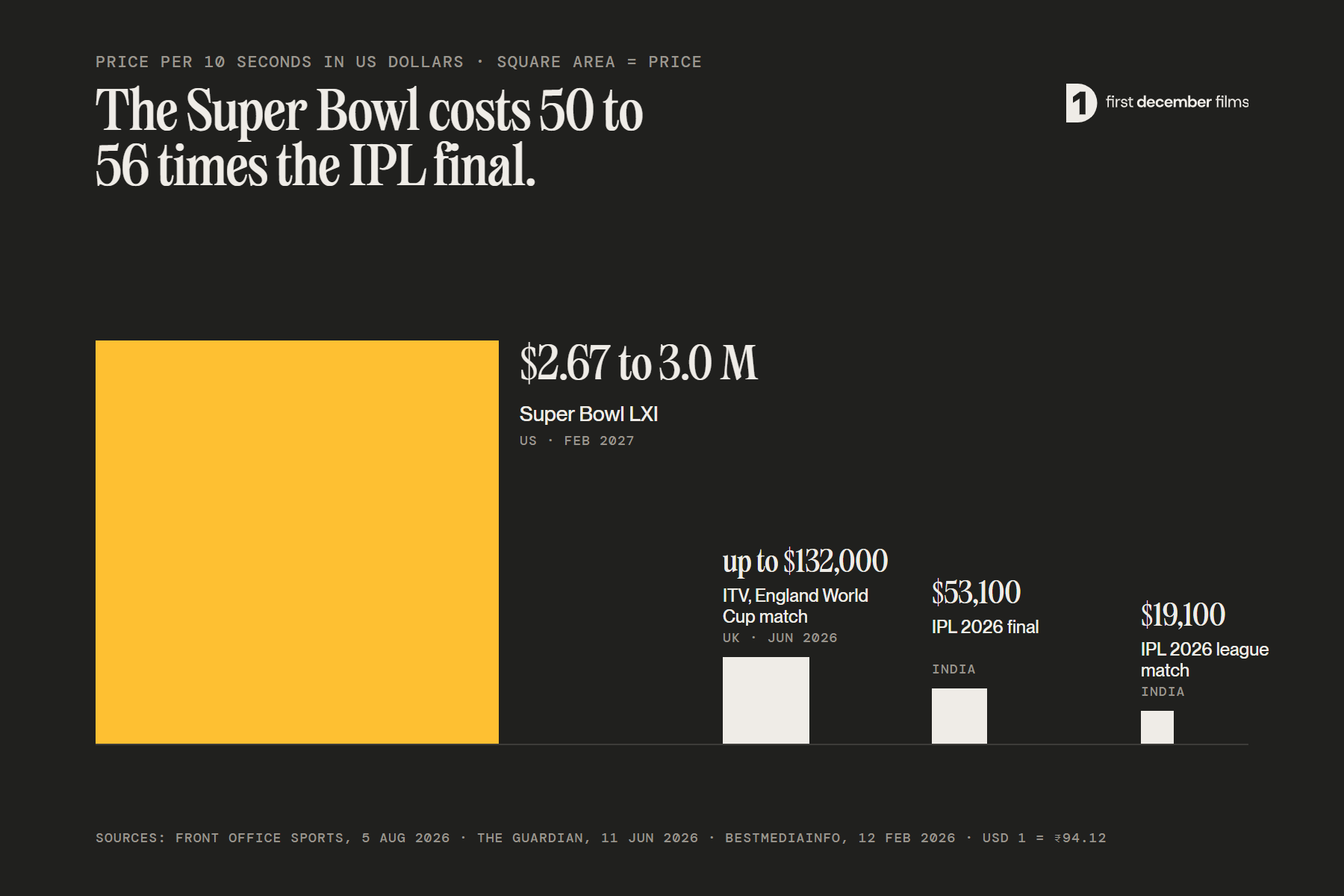
Per 10 seconds, a Super Bowl spot costs 50 to 56 times the IPL final and 140 to 157 times an IPL league match. Disney sold out Super Bowl LXI, which airs on 14 February 2027, with many 30-second units reported at $8 million to $9 million (Front Office Sports, 5 August 2026). The IPL 2026 final, at ₹50 lakh per 10 seconds, works out at about $159,000 for 30 seconds.
| Property | Price as reported | Per 30 seconds, in US dollars | Per 10 seconds, in US dollars |
|---|---|---|---|
| Super Bowl LXI, United States, February 2027 | $8 to 9 million per 30 seconds | $8 to 9 million | $2.67 to 3.0 million |
| FIFA World Cup 2026, England match on ITV, United Kingdom | up to £300,000 per 30 seconds | about $396,000 | about $132,000 |
| IPL 2026 final, India | ₹50 lakh per 10 seconds | about $159,000 | about $53,100 |
| ICC Men’s T20 World Cup 2026, India v Pakistan | ₹20 to 25 lakh per 10 seconds | about $64,000 to 80,000 | about $21,300 to 26,600 |
| IPL 2026 league match, India | ₹18 lakh per 10 seconds | about $57,400 | about $19,100 |
Sources: Front Office Sports and TheDesk, 5 August 2026; The Guardian, 11 June 2026 (ITV, citing media industry sources); BestMediaInfo, 12 February 2026; exchange4media, 11 March 2026. IPL is sold in 10-second units; the 30-second figure is arithmetic for comparison. Rates for the Big Bash, SA20, ILT20 and The Hundred are not public.
The IPL’s case is volume, not unit price: 74 matches over about nine weeks against one Super Bowl night, and a claimed reach of more than 1.2 billion people across TV and digital (JioStar, 15 June 2026; the broadcaster’s own figure, not an audited one). Ashish Pathak, Executive Creative Director at Edelman, called the IPL "India’s version of the Super Bowl, a stage where the most iconic advertising could be created, but brands aren’t leveraging it that way" (exchange4media, 6 May 2026).
The difference for the film is the reverse of the difference in price. A Super Bowl brand writes one 30 or 60-second film for one night and spends months on it. An IPL brand needs a film that survives being seen dozens of times over nine weeks, usually in 10 seconds. For a global brand coming to India for the IPL, as Malaysia Airlines and OpenAI did in 2026, that is the part of the brief that does not travel.
What did IPL 2026 ads actually look like?
IPL 2026 ads were mostly single films, launched after the season began, with a 30 to 35-second master and a much shorter cut on TV. That is what we found when we catalogued 63 IPL 2026 campaigns from 221 trade-press pages and 74 official YouTube uploads, between 20 February and 10 June 2026, checked on 17 November 2026.
| What we measured in 63 IPL 2026 campaigns | Result |
|---|---|
| Campaigns with at least one cricketer (where the cast was reported) | 18 of 40 (45%) |
| Campaigns with three or more cricketers | 13 of 40 (32%) |
| Campaigns led by a non-cricketer star instead | 13 of 40 (32%) |
| Most-featured cricketer | Ruturaj Gaikwad, 3 campaigns; ten players in 2 each |
| Single-film campaigns (where a count was reported) | 17 of 33 (52%) |
| Main YouTube upload length, median | 35 seconds (middle half 20 to 61 seconds) |
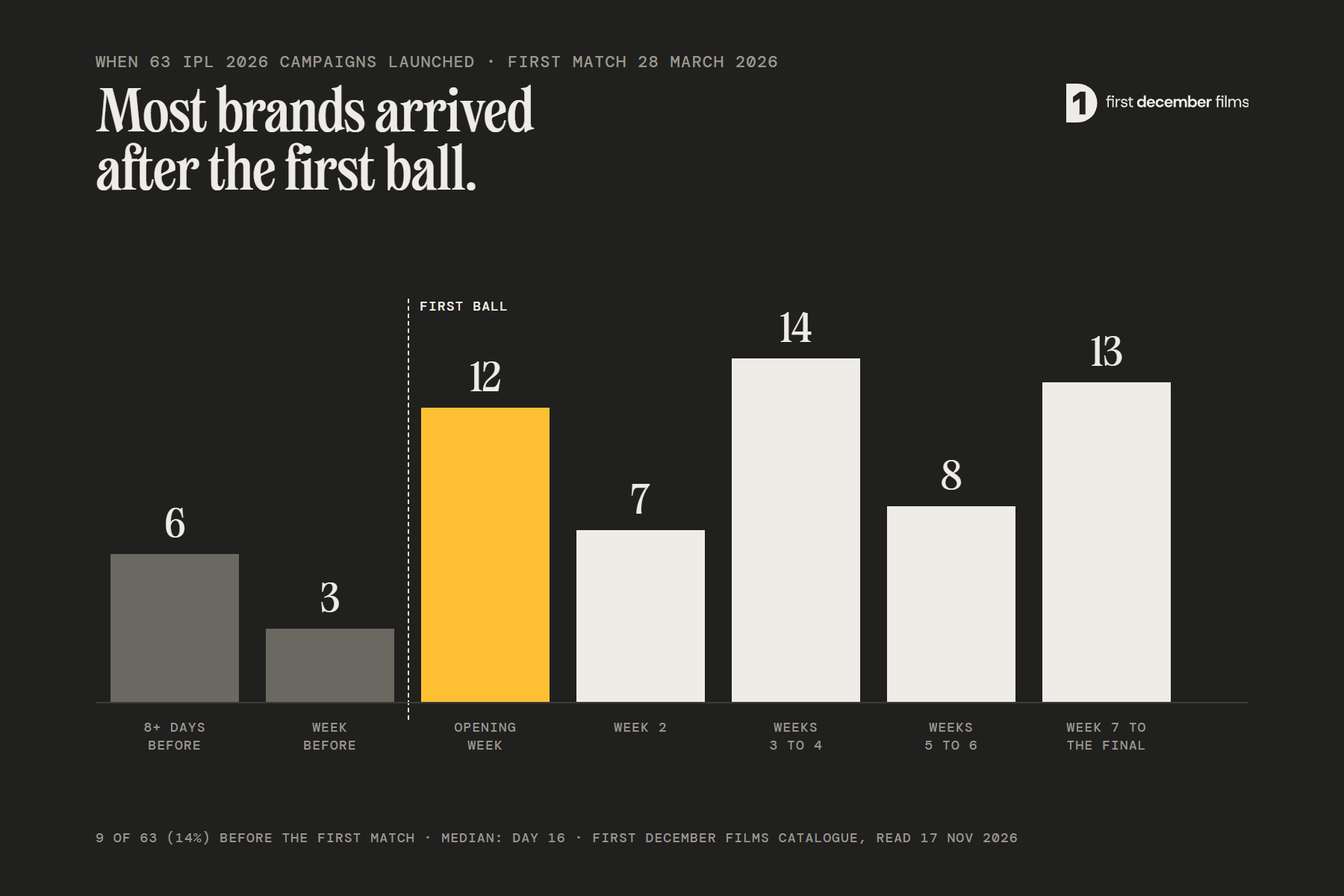
| Launched before the first match | 9 of 63 (14%) |
| Median launch | 16 days after the first match |
| Launched in week 7 or later | 13 of 63 (21%) |
| Production house credited anywhere in coverage | 9 of 63 (14%) |
| Reported as made with AI | 2 of 63 (3%), one of them our Razorpay series |
| Team partner campaigns | 25 of 63 (40%) |
Source: First December Films catalogue of IPL 2026 campaigns (first match 28 March 2026, final 31 May 2026). The catalogue covers campaigns the trade press wrote about, so heavy TV spenders without a campaign story are under-counted; YouTube views include paid promotion.
Three things in that table matter for 2027.
The film on YouTube is not the film on TV. The median main upload ran 35 seconds, but TAM Sports found that half of all IPL 2026 TV insertions ran under 10 seconds and 41% ran 11 to 20 seconds (exchange4media, 18 June 2026). Most brands make a long film and cut it down. Ashish Khazanchi, Managing Partner at Enormous Brands, said "a lot of advertisers are relying on cutdowns rather than designing ideas from the ground up for a 20-second narrative", and that if 20 seconds is the new normal, "storytelling has to be built for that constraint from the start, not adapted later" (exchange4media, 6 May 2026). Write the 10-second version first, then the long one.
Most brands arrive late, and that is not always a mistake. Only 14% of campaigns launched before the first ball; the median arrived on day 16, and a fifth arrived in the last three weeks. Our Malaysia Airlines film launched on 7 May 2026, day 40 of the season, and reached 141 million views on the airline’s YouTube channel by September 2026. The season is long enough to enter in the middle with a film built for that moment. What a late film cannot do is borrow the opening-week attention.
Makers are invisible. Only 18 of 63 campaigns (29%) had any agency, director or production house credited in the coverage we read. For brands, that means the trade press is a poor way to find who made the films you admired; ask the brand or check the credits on the director’s own reel.
Cricketers are not the default either. TAM Sports found celebrity ads made up 61% of IPL 2026 ad volume, but film stars carried more than 75% of that celebrity volume, and Rohit Sharma led the sports names with 22.1% (Indian Television, 17 June 2026). In our catalogue, almost a third of the campaigns with a known cast used a non-cricketer star.
When should you start an IPL 2027 ad film?
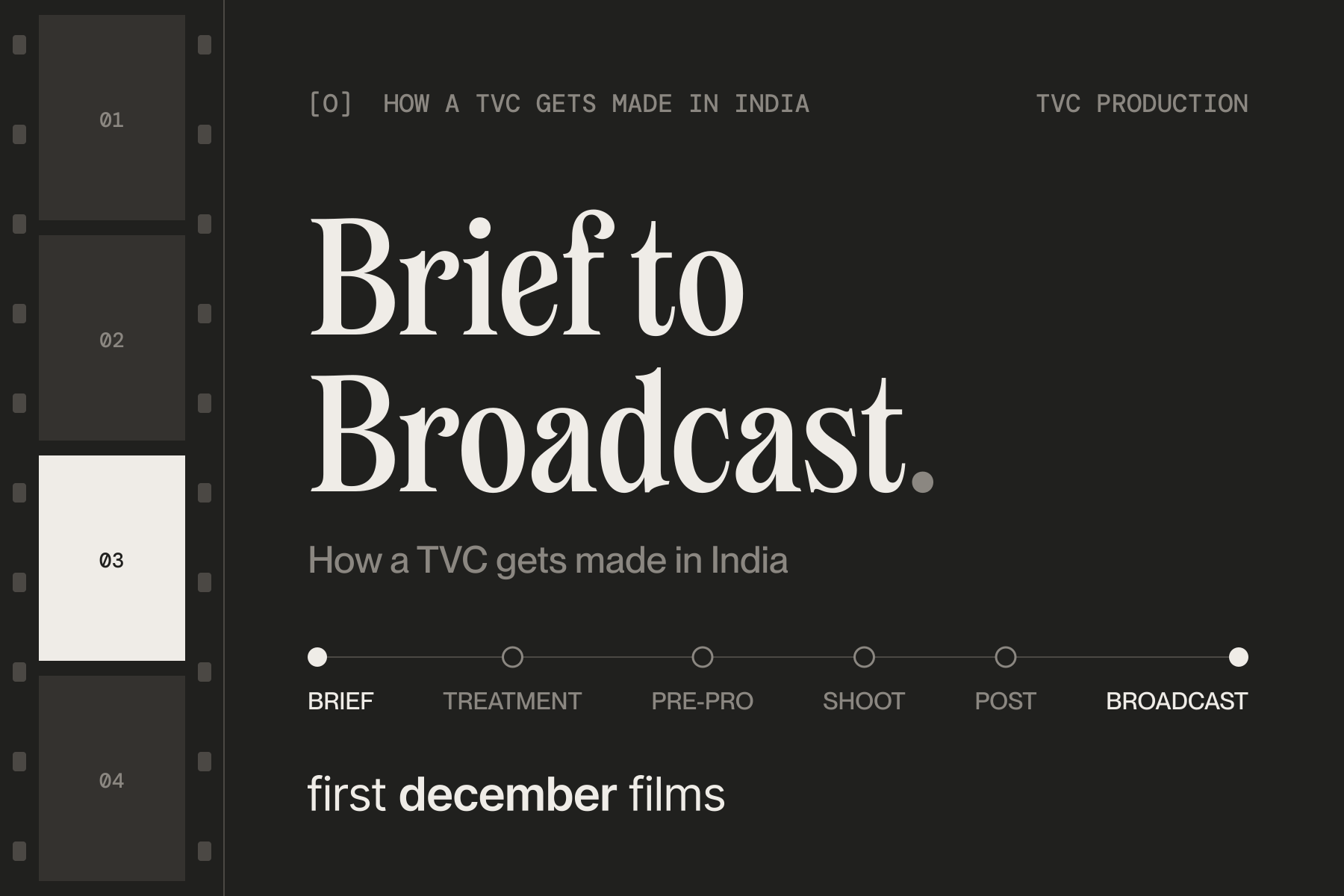
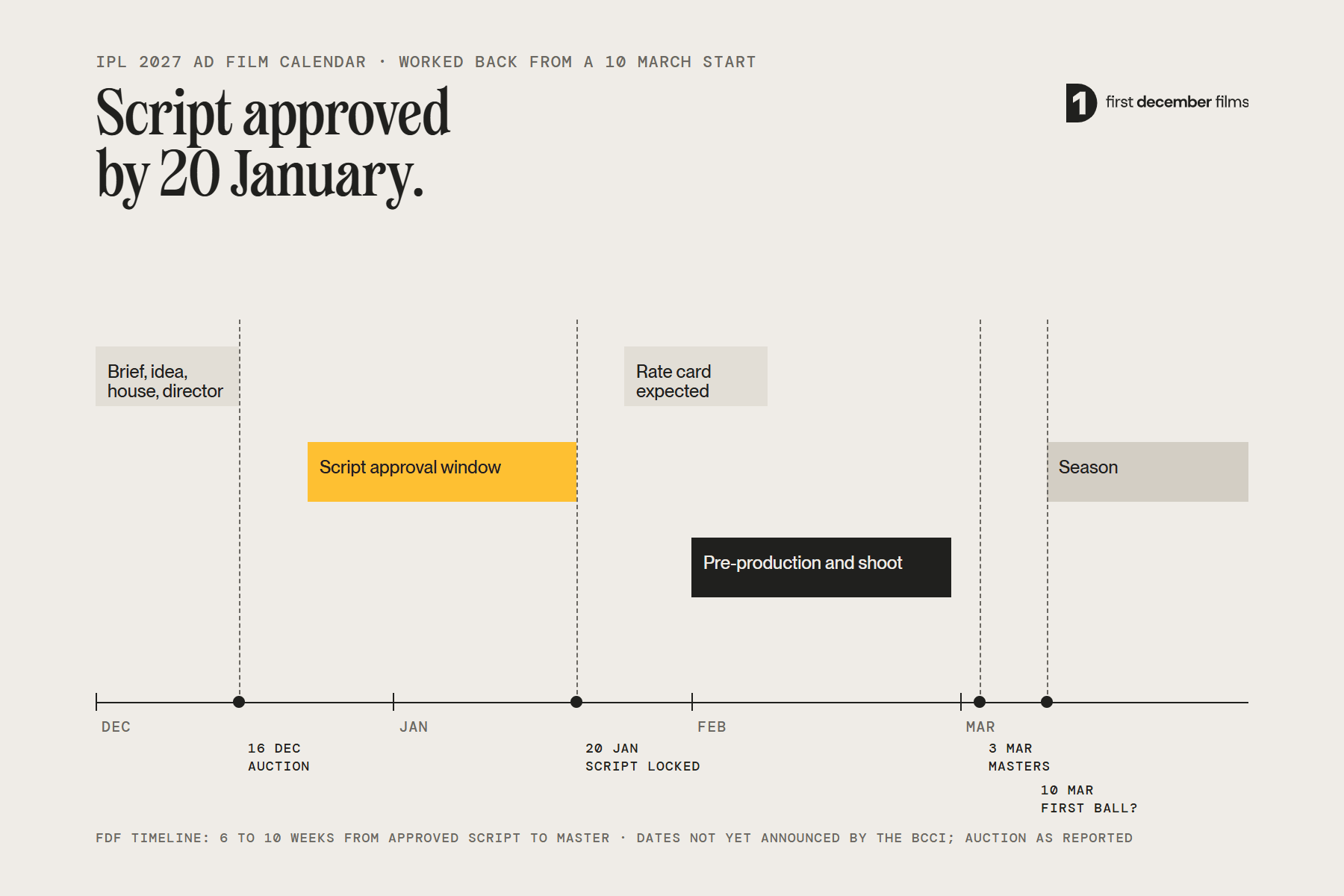
Start with an approved script by mid-January 2027 if you want the film on air for the first match. That works back from our own timeline of six to ten weeks from approved script to master, with one to three shoot days, which we set out in our TVC production process guide, and from the earliest start date the BCCI has floated.
The dates are not fixed. The BCCI secretary Devajit Saikia said in June 2026 that the board aimed to start "by 10th of March and conclude it by 15th of May" (ESPNcricinfo, 18 June 2026); a later report said he indicated a start around the end of March (CricTracker, October 2026). The original window was 14 March to 30 May. Plan for 10 March: if the season starts later, you gain two weeks, and if you planned for late March and it starts on the 10th, you lose the opening.
| Date (2026 to 2027) | What happens | What it means for the film |
|---|---|---|
| Now to mid-December 2026 | Brief, idea, choose the house and director | Decide film count, lengths and languages now; they set the budget |
| 16 December 2026 (reported) | IPL 2027 player auction in Goa | Squads settle; cast a player for a team-linked idea only after this |
| 23 December 2026 to 20 January 2027 | Script approval window (10 to 6 weeks before masters) | The approved script fixes the cost; changes after this are paid in days |
| Late January to early February 2027 | 2027 rate card expected (2026’s arrived about six weeks before the season) | Confirm lengths against the inventory you can afford |
| February 2027 | Pre-production and one to three shoot days, between players’ national duties | Shoot every version, language and vertical cut on the same days |
| By 3 March 2027 | Masters, cut-downs and language versions delivered | A week of buffer before a possible 10 March start |
| March to May 2027 | The season, about 74 matches | Hold a second wave for the playoffs and the final |
Sources: First December Films TVC timeline (31 August 2026); ESPNcricinfo, 18 June 2026; CricTracker and The Week, October 2026 (auction, no formal BCCI confirmation); BestMediaInfo, 10 February 2026 (rate card timing).
The AI engines we asked recommend starting four to eight months ahead. That is right only when you need something scarce: a top cricketer, a franchise licence or a sponsorship package. For a film with actors, a known director and a clear script, ten weeks is enough. Our JioStar film for the ICC Men’s T20 World Cup 2026, "History Repeat Karenge" with Rohit Sharma, directed by Atul Kattukaran, launched on 22 January 2026, sixteen days before the first ball, with a 47-second film and a 30-second broadcast cut.
What lead time cannot fix is a late question. Vishakha Khattri, AVP at McCann India, described the pattern: "Brands often come in just a month or even a week before the Indian Premier League and say, ‘We want to be on IPL’, without asking what they want to say" (exchange4media, 6 May 2026). The calendar starts with that answer, not with the booking.
How do cricket ads get made?
Cricket ads are built around the scarcest thing on the call sheet, the player’s time, and around the edit that has to fit a 10-second break. The craft is in planning, not in the shoot.
The players’ time is measured in hours. On our Malaysia Airlines film, "Cricket at 30,000 Feet", the cabin was a set, the players arrived with their own hair and make-up teams, and every shot that did not need Rohit Sharma, Hardik Pandya or Trent Boult was planned, blocked and shot without them. A locked shot list, a set that is ready before they arrive and a second camera already lit are what turn a short window into a finished film.
The second unit makes the season’s content. On the same film, "A second unit ran alongside the main one. A socials director, DOP and editor captured vertical and behind-the-scenes material from the same shoot", so the airline and Mumbai Indians had short-form content for weeks without a second day with the players. With the creator market around IPL players estimated at about ₹700 crore (exchange4media, 28 April 2026), that footage is worth planning for, not grabbing.
Versions are designed, not trimmed. A 30-second master, a 20, a 15, a 10 and a 6 each need their own idea of the ending; in a 10-second break the product has to arrive early. Manoj Shroff, Executive Producer at Equinox Films, said brands now "put out 6-seconders to have a presence and be visible, and afford it" (exchange4media, 17 December 2025). Language versions need a native writer at script stage, not subtitles at the end.
Moments are pre-made. Rajiv Dingra, founder and CEO of ReBid, described "pre-programmed creative libraries mapped to match events like wickets, sixes, powerplays and even player-specific moments" (exchange4media, 22 April 2026). A library like that is shot on the same days as the hero film, as a list of short end-frames and lines triggered by the match.
Ideas still decide. The production craft only pays off when the film has something to say. Ganesh Pareek, who wrote this guide, put the Indian brief in one line in March 2026: "we still want a 3 crore film on a 2 crore budget" (MediaBrief, 2 March 2026). The way to meet that brief is fewer, better decisions before the shoot.
Can you make an IPL ad with AI?
Yes, and it aired. Our fully AI founder films for Razorpay ran during IPL 2026, directed by Shivang Monga: 15-second films set in "one white world", made after five days of set-up and a paid test film, then about one film a day, delivered in batches over five weeks, as our AI ad films page sets out. In our catalogue, only 2 of 63 IPL 2026 campaigns were reported as made with AI, and one of the two was ours.
AI suits three IPL jobs: volume (a film a day for a season), speed (a topical film after a result), and worlds you cannot shoot. It suits a real cricketer less. From 1 January 2027, ASCI’s guidelines for labelling AI content in ads apply, so they cover the whole IPL 2027 season: a replicated likeness or voice of a real person needs consent and a label, and a deepfake or a fabricated endorsement is banned even with one (ASCI guidelines published 29 September 2026, as summarised by Fox Mandal). Lawyers quoted by exchange4media on 30 September 2026 added that consent to use a cricketer’s likeness is not consent to a new AI-generated statement in his name. For faces, we shoot the person and extend the world with AI, so the AI inherits real light; our guide to how AI commercials are made explains the pipeline, and our AI ad film cost guide prices it.
Viewers care less than marketers fear. On our Air India AI film with the cricketer Vaibhav Sooryavanshi, 3 of 94 YouTube comments mentioned AI at all, when we read them on 17 November 2026. Ganesh’s line on where AI belongs: "AI is an incredible assistant, never an author." (MediaNews4U, 1 October 2026).
What can a non-sponsor show in an IPL ad?
A non-sponsor can show cricket but not the IPL. The IPL governing council’s brand and content protection guidelines bar unlicensed use of the IPL name, marks, trophy and match footage, and anything confusingly similar (summarised by Indian Television in 2018 and by the IP firm Khurana & Khurana in July 2023; the current 2026 documents were not publicly readable when we checked). That leaves generic cricket, players in a personal capacity under their own contracts, and timing an ad around matches without claiming an association.
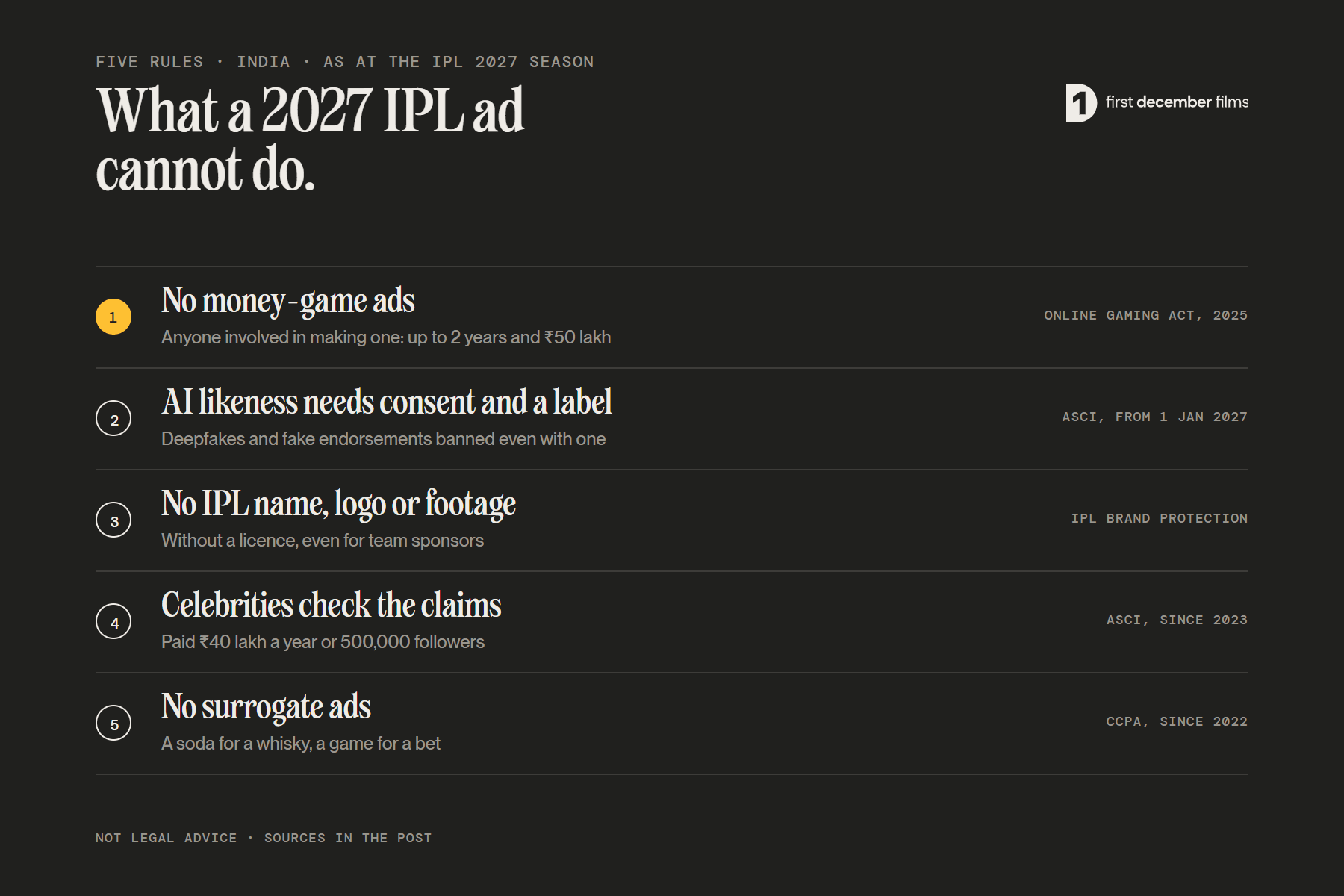
Five rules shape an IPL 2027 film, sponsor or not:
| Rule | What it says | Who it binds | In force |
|---|---|---|---|
| Online Gaming Act, 2025, section 6 | No one may make, or be involved in the making of, an ad that promotes an online money game; up to 2 years in prison and a ₹50 lakh fine | Brand, agency, production house, talent | Enacted 22 August 2025 |
| ASCI AI labelling guidelines | Label replicated likenesses and voices, synthetic people and invented settings; deepfakes and fake endorsements banned even with a label | Advertiser and its agencies | 1 January 2027 |
| IPL brand and content protection | No IPL name, marks, trophy or footage without a licence; franchise sponsors may not use the IPL marks | Every brand, including team sponsors | Each season |
| ASCI celebrity guidelines | Anyone paid ₹40 lakh a year for ads or with 500,000 followers must check the ad’s claims can be substantiated | Celebrity and advertiser | Since 2023 |
| CCPA misleading ads guidelines | Surrogate ads (a soda for a whisky brand) banned; fines up to ₹10 lakh, ₹50 lakh on repeat | Advertiser, agency, endorser | Since June 2022 |
Sources: Gazette of India, Act 32 of 2025; Fox Mandal and exchange4media on ASCI, 29 to 30 September 2026; ASCI, 9 August 2023; Government of India (Vikaspedia) on the CCPA guidelines. Not legal advice.
The gaming rule is the one producers underestimate. Section 6 does not stop at the advertiser; it reaches anyone "involved in the making" of the ad. Gaming has already left the season: it disappeared as a TV category in IPL 2026 (TAM Sports, via Indian Television, 12 June 2026), after Dream11 and Playgames 24x7 alone had more than 6% of IPL 2025 TV ad time (exchange4media, 29 April 2026). Free-to-play and e-sports brands are outside the ban; a "brand extension" that points to a paid-stake game is not.
One rule went the other way. The government deleted the 12-minute hourly cap on TV advertising on 21 August 2026 (G.S.R. 751(E)), and TRAI repealed its matching regulation on 10 September 2026. No report says JioStar will sell more IPL seconds in 2027, so treat "more inventory" as a possibility, not a plan. For AI labels across other markets, our guide to whether you have to label AI ads covers the EU, UK, US and China.
When is the IPL the wrong buy?
The IPL is the wrong buy when the brand cannot afford variety, needs measurable sales this quarter, or has nothing to say that is better heard during cricket. Ganapathy Viswanathan, a communications consultant, wrote that "IPL is no longer the starting point for most startups." (exchange4media, 6 April 2026), and Mihir Mehta of 0101.Today warned that "Rising viewership often signals reach, not necessarily attention, intent, or conversion." (exchange4media, 2 April 2026).
The other side has data too. Jaskaran Singh Kapany, CMO of MobiKwik, said "the blended CAC improves when you factor in stronger organic installs, better activation rates, and higher retention" (Inc42, 15 April 2026), and Sumanka Gandhi of Navi said the IPL lets the brand "compress what would typically take months of awareness-building into a few weeks" (Inc42, 15 April 2026).
Skip the IPL, or buy only a slice of it, if:
- your whole budget buys one film and a handful of league spots: the film will be lost by week three;
- your category is money gaming, betting or a surrogate for alcohol or tobacco: you cannot advertise it legally;
- your customers are concentrated in one region: buy that language feed or CTV by geography instead of the national feed;
- your brief is a launch date in April that will not move: a fixed date and a cricketer’s calendar rarely meet.
How did IPL advertising get here?
IPL airtime has gone from ₹2 lakh to ₹18 lakh per 10 seconds in nineteen seasons. When the league launched in 2008, Sony’s 10-second spots were marked at ₹2 lakh at the start and pushed to ₹5 to 10 lakh as the season caught on (Business Standard, 9 June 2008). The first media rights, to Sony and World Sport Group, were worth $1.03 billion over ten years (Business Standard, 16 April 2008).
The rights then compounded: ₹16,347.5 crore to Star India for 2018 to 2022, and ₹48,390.32 crore for 2023 to 2027, split between TV and digital (BCCI, 15 June 2022). Viacom18 and Star have since merged into JioStar, which now sells both screens, and connected TV is the fastest-growing of them: CTV consumption grew 22% in 2026 (JioStar, 15 June 2026).
Next is forecast, not fact. Media Partners Asia expects the 2028 to 2032 rights to stay flat at $5.4 billion (March 2026), BCCI has said there is no immediate plan to expand from 74 to 94 matches, and Tata’s title sponsorship runs to 2028 at ₹2,500 crore over five years (IPL, 20 January 2024). For a brand, the useful forecast is the creative one: shorter breaks, more languages, more films per campaign and more of them made with AI, all of which push cost from airtime into production planning.
Planning an IPL 2027 film?
The cheapest decisions in an IPL film are made before anyone books a break: how many films, how long, in which languages, with whom. Paste your script into our free script analyser for a producer’s read of its complexity, see our cricket films on the Malaysia Airlines and JioStar pages, or read our guides to choosing an ad film director and the difference between a TVC, a DVC and a brand film. For the wider year, see our advertising trends for 2027 and the best Indian ads of 2026. Or send us the brief and a producer will tell you what your IPL 2027 film will cost, how many versions it needs and the date the script has to be approved.
Sources
- Airtime: BestMediaInfo, IPL 2026 TV rates, 12 February 2026; BestMediaInfo, IPL 2026 CTV rates, 10 February 2026; exchange4media, IPL ad rates hold steady, 1 April 2026; The Hindu BusinessLine, 27 March 2026; Outlook Business, JioHotstar SME packages, 9 March 2025; BestMediaInfo, T20 World Cup pricing, 19 December 2025; exchange4media, T20 World Cup ad revenue, 11 March 2026.
- Season data: JioStar, IPL 2026 season release, 15 June 2026; Indian Television, TAM Sports ad volumes, 12 June 2026; Indian Television, celebrity endorsements, 17 June 2026; exchange4media, under-10-second ads, 18 June 2026; exchange4media, CTV gains and the e-gaming ban, 29 April 2026; exchange4media, regional languages 90% of watch time, 29 September 2026; exchange4media, gaming retreats, 24 February 2026.
- Rights and 2027: BCCI, 2023 to 2027 media rights, 15 June 2022; exchange4media, next IPL media rights, 28 September 2026; Advanced Television on Media Partners Asia, 24 March 2026; ESPNcricinfo, IPL 2027 window, 18 June 2026; CricTracker, IPL 2027 auction, October 2026; IPL, Tata title sponsorship, 20 January 2024; Business Standard, 2008 ad rates, 9 June 2008; Business Standard, 2008 rights, 16 April 2008.
- Rules: Gazette of India, Promotion and Regulation of Online Gaming Act, 2025; Fox Mandal on ASCI’s AI labelling guidelines, September 2026; exchange4media on ASCI’s AI rules, 30 September 2026; ASCI celebrity guidelines, 9 August 2023; Vikaspedia on the CCPA guidelines, 2022; Khurana & Khurana on IPL ambush marketing, 25 July 2023; exchange4media, TV ad cap scrapped, 22 August 2026; TRAI press release 117 of 2026, 10 September 2026; ANI on the BCCI shoot policy, 17 January 2025.
- Production and talent: Kroll celebrity brand valuation 2025, 5 August 2026; exchange4media on Virat Kohli’s commercial value, 5 November 2026; exchange4media, cricket’s creator economy, 28 April 2026; Campaign India, Birla Opus, 24 April 2026; Indian Television, OpenAI Everyday Superheroes, 14 April 2026; exchange4media, from 30 to 6 seconds, 17 December 2025.
- Voices: exchange4media, Are IPL 2026 ads on sticky wicket?, 6 May 2026; exchange4media, IPL 2026 signals a shift, 2 April 2026; Deccan Chronicle on JioStar’s regional push, 7 October 2026; exchange4media, the AI game of ads, 22 April 2026; exchange4media, startups move away from IPL, 6 April 2026; Inc42, IPL as a full-funnel bet for fintechs, 15 April 2026; MediaBrief, BRIEF26: Ganesh Pareek, 2 March 2026; MediaNews4U interview with Ganesh Pareek, 1 October 2026.
- Global: Front Office Sports, Super Bowl LXI sellout, 5 August 2026; The Guardian, ITV World Cup advertising, 11 June 2026; RBI reference rates via MSEI, 16 November 2026.
- Our own data: First December Films catalogue of 63 IPL 2026 campaigns (221 trade-press pages, 74 YouTube uploads, read 17 November 2026); Malaysia Airlines, Cricket at 30,000 Feet; JioStar, History Repeat Karenge; AI ad films.
First December Films is an advertising film production company in Mumbai. Our work has won more than 150 international creative awards, including Cannes Lions, D&AD and One Show Gold Pencils.
Frequently asked questions
How much does an IPL ad cost?
On JioStar’s IPL 2026 rate card, as reported by BestMediaInfo, a 10-second TV spot cost 18 lakh rupees (about 19,100 US dollars) in a league match, 40 lakh rupees in the playoffs and 50 lakh rupees in the final. Connected TV started at 600 rupees per thousand impressions. The 2027 card is expected in late January or early February 2027.
How much does an IPL ad cost per second?
About 1.8 lakh rupees a second in a 2026 league match on TV, because the 18 lakh rupee rate is for 10 seconds. In the final it was about 5 lakh rupees a second. Rate cards are list prices; most brands buy bundled TV and digital packages at negotiated rates.
How much does it cost to make an IPL ad film?
Making the film is a separate budget from the airtime. On First December Films’ published tiers, a serious digital film costs 8 to 25 lakh rupees, a national TVC 25 to 60 lakh rupees and a campaign film 60 lakh to 1.5 crore rupees, before any cricketer’s fee. A top cricketer’s shoot day has been reported at 7.5 to 10 crore rupees.
When should a brand start an IPL 2027 ad film?
Have the script approved by mid-January 2027 to be on air for the first match. A film takes six to ten weeks from approved script to master, and the BCCI has spoken of a start as early as 10 March 2027. Start earlier only if you need a top cricketer, a franchise licence or a sponsorship package.
Can a brand that is not an IPL sponsor advertise during IPL matches?
Yes. Any brand can buy airtime during IPL matches, but only licensees may use the IPL name, logo, trophy or match footage. A non-sponsor can show generic cricket and can use a player in a personal capacity under the player’s own contracts, as long as the ad claims no link to the league.
Is an IPL ad more expensive than a Super Bowl ad?
No. A 30-second Super Bowl spot in February 2027 was reported at 8 to 9 million US dollars, which per 10 seconds is 50 to 56 times the IPL 2026 final rate. The IPL is bought for volume instead: about 74 matches over nine weeks.
Can you make an IPL ad with AI?
Yes. First December Films made fully AI founder films for Razorpay that aired during IPL 2026. From 1 January 2027, India’s ASCI guidelines require a label on AI likenesses, voices and invented settings, and ban deepfakes and fake endorsements even with a label, so a real cricketer’s face needs consent and usually a real shoot.